

The best PostPlanify alternative for most buyers is PostEverywhere because it combines broad dashboard publishing with API, SDK, and MCP access at a low flat price. PostOnce ranks second and is the better alternative when you want posts from one connected social network to crosspost automatically to the others.
PostPlanify remains a capable social media management platform. It combines publishing, team workspaces, approvals, reporting, review management, and agency features. But its current entry plan starts at $99 per month, while white-label features sit on the $399-per-month Scale plan. That is more software—and more cost—than many creators, founders, and small teams need.
This guide compares 12 PostPlanify alternatives across workflow, account limits, team features, analytics, APIs, and current pricing. It includes lightweight creator tools, agency platforms, and enterprise suites so you can choose based on the work you actually need to remove.
If you are still comparing the broader category, use the best crossposting tools guide, the best social media scheduler guide, or the PostOnce comparison hub alongside this brand-specific shortlist.
Disclosure and research method: PostOnce publishes this guide and ranks itself second, behind PostEverywhere. We have direct product knowledge of PostOnce. Competitor capabilities and prices were checked against official pricing, product, and help pages on July 29, 2026. Competitor entries are documentation-based and are not presented as long-term hands-on reviews. Prices, limits, and social network APIs can change, so verify the plan you intend to buy.
The best PostPlanify alternatives at a glance
| Rank | Tool | Best for | Starting price | Main tradeoff |
|---|---|---|---|---|
| 1 | PostEverywhere | Flat-price dashboard publishing with API access | $29/mo | No white-label plan; 40-account ceiling |
| 2 | PostOnce | Automatic source-to-destination crossposting | $29/mo | Not a social inbox or listening suite |
| 3 | SocialPilot | Lower-cost agency scheduling | $20/mo | Advanced agency features require higher tiers |
| 4 | Metricool | Analytics and competitor reporting | Free; paid from $25/mo | X and some networks have plan restrictions |
| 5 | Planable | Content collaboration and approvals | Free for 50 posts; paid from $33/workspace | Inbox and analytics are separate add-ons |
| 6 | Nuelink | RSS feeds and evergreen automations | $18/mo | Entry plan is limited to one brand and user |
| 7 | Buffer | Simple scheduling and a useful free tier | Free; paid from $6/channel/mo | Per-channel pricing grows with your account count |
| 8 | SocialBee | Evergreen content categories | $29/mo | Approval workflows require a higher plan |
| 9 | Publer | Flexible low-cost scheduling | Free; paid from $5/mo | Limits and features vary by account selection |
| 10 | Postiz | Open-source and developer-friendly publishing | $29/mo | Smaller ecosystem than established suites |
| 11 | Agorapulse | Unified inbox and moderation | $99/user/mo | X inbox and reporting require an add-on |
| 12 | Hootsuite | Enterprise governance and listening | $99/user/mo | Expensive for creators and small teams |
The starting prices above are monthly list prices where available. Annual billing can reduce several of them. The fairest comparison is your total cost at the number of social accounts, users, brands, and workspaces you need—not the lowest number printed on a pricing page.
Why look for an alternative to PostPlanify?
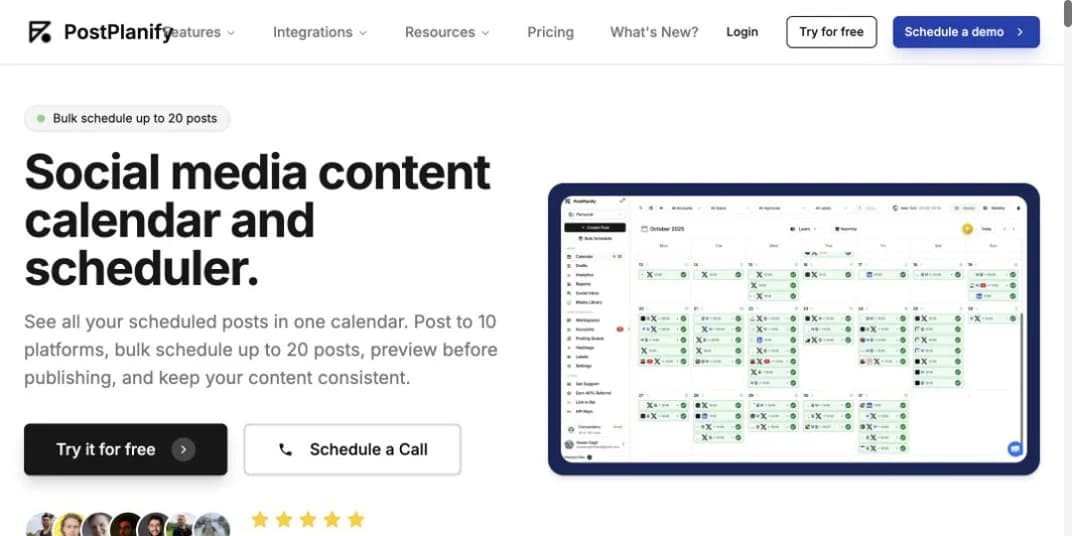
PostPlanify is designed primarily for agencies and teams. Its current plans reflect that positioning:
- Growth: $99 monthly, or $79 per month billed annually, for 15 social accounts, five workspaces, three users, and unlimited posts.
- Premium: $199 monthly, or $159 per month billed annually, for 30 accounts, 15 workspaces, six users, approvals, roles, and reports.
- Scale: $399 monthly, or $299 per month billed annually, for 100 accounts, 50 workspaces, 12 users, a white-label dashboard, and white-label PDF reports.
PostPlanify supports Instagram, Facebook, X, LinkedIn, TikTok, YouTube, Threads, Pinterest, Bluesky, and Google Business Profile. It offers a seven-day trial and a 14-day money-back guarantee, but no permanent free plan. Those are reasonable terms for a team that needs the whole agency workflow.
An alternative makes sense when one of these situations describes you:
- You want content to distribute automatically after publishing natively, rather than composing every destination in a dashboard.
- You need a lower entry price or a free plan for a small number of channels.
- You care more about analytics, approvals, evergreen recycling, or inbox management than PostPlanify's complete bundle.
- You need API or MCP access without moving to an expensive agency tier.
- You manage fewer than 15 accounts and do not want to pay for workspaces or users you will not use.
- You need enterprise listening and governance beyond PostPlanify's core publishing workflow.
PostPlanify is not a poor product because another tool fits one of these jobs better. The goal is to pay for the workflow that removes your bottleneck.
How we ranked these PostPlanify alternatives
Each product was evaluated against six practical criteria:
- Publishing workflow: Does it automate distribution, simplify scheduling, or still require repetitive work for every destination?
- Platform coverage: Does it support the social networks creators and teams use in 2026?
- Price at a realistic account count: How does the cost change when you add channels, brands, users, or workspaces?
- Specialist strength: Is it meaningfully better at automation, analytics, approvals, inbox work, evergreen queues, or governance?
- Team fit: Are collaboration, roles, approvals, and client separation included or gated?
- Exit risk: Are there important ceilings, add-ons, or missing features that could force another migration later?
The ranking favors tools with a clear reason to choose them. A long feature list did not automatically earn a higher position.
1. PostEverywhere — best value for dashboard publishing and APIs
PostEverywhere is the closest choice for buyers who want broad publishing from a central dashboard at a flat account allowance. You compose once, choose destinations, customize the post, and publish immediately or schedule it.
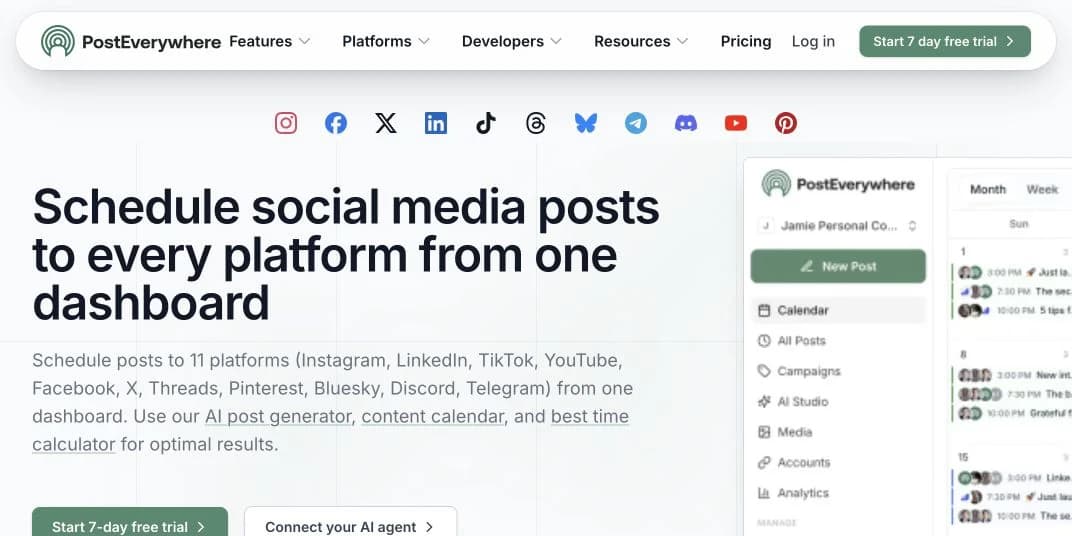
Its Starter plan is $29 per month for 10 social accounts. Growth is $39 for 25 accounts, and Pro is $79 for 40 accounts. All plans list unlimited posts and storage, along with API, SDK, and MCP access. The product also promotes AI captions, images, and video tools.
PostEverywhere lists 11 supported platforms, including Telegram and Discord. It does not list Google Business Profile, and its public pricing tops out at 40 accounts. The seven-day trial requires a card, and there is no permanent free plan.
Why choose PostEverywhere over PostPlanify
- Lower flat prices at 10, 25, and 40 connected accounts.
- API, SDK, and MCP access are included at every paid tier.
- Unlimited posts and storage make usage easier to predict.
- Telegram and Discord expand the publishing mix beyond standard social networks.
Where PostPlanify is stronger
PostPlanify scales to 100 accounts and includes deeper agency workspaces, approvals, roles, reports, Google Business Profile, and white-label options. PostEverywhere is a publishing-first dashboard and does not advertise a white-label tier.
Best for: Technical creators, startups, and small agencies that prefer dashboard scheduling and want developer access without enterprise pricing.
2. PostOnce — best for automatic crossposting
PostOnce is the best PostPlanify alternative when the main problem is repetitive distribution. Instead of requiring you to rebuild a post for every destination, PostOnce can monitor a connected source account and automatically publish that content to selected destinations through reusable workflows.
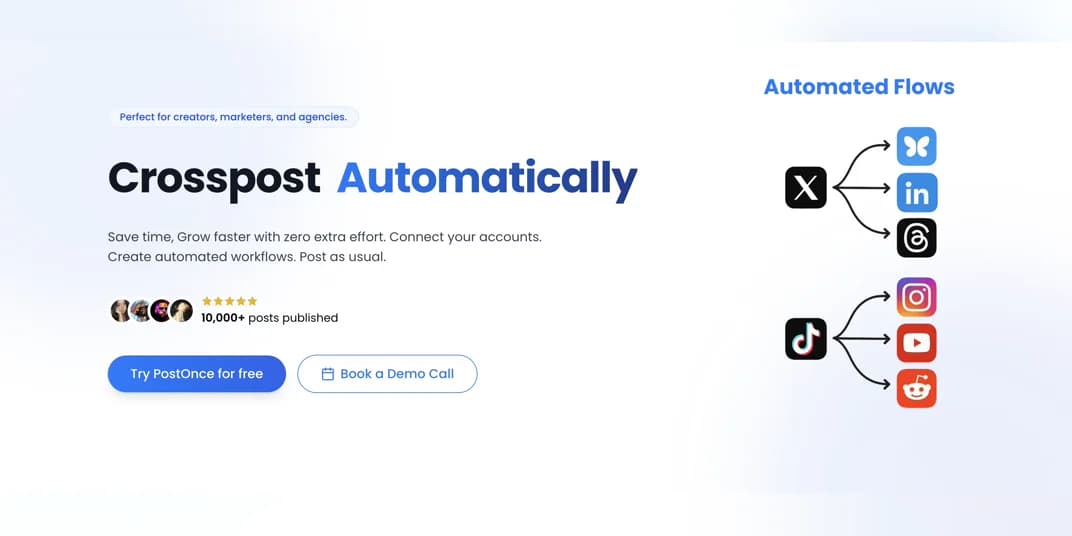
The Creator plan costs $29 per month, or $24 per month billed annually. It includes 15 social accounts, unlimited workflows, unlimited posts, scheduling, existing-content backfill, image repurposing, and developer API plus MCP access. PostOnce currently supports TikTok, Instagram, YouTube, Facebook, LinkedIn, X, Bluesky, Pinterest, and Threads; available source/destination pairs and post types vary.
That makes it particularly useful for creators and lean teams who already like publishing natively. You can keep the original composer, sounds, tags, and platform-specific workflow you know, then use PostOnce as the distribution layer behind it. Rules and filters provide more control than a blind copy-and-paste automation.
Why choose PostOnce over PostPlanify
- Source-triggered automatic crossposting reduces repeated uploads.
- The $29 Creator plan costs less than PostPlanify Growth at $99.
- API and MCP access are included on paid plans.
- Existing posts can be brought into a workflow instead of starting with an empty calendar.
- It handles video, image, and text distribution rather than focusing only on one content format.
Where PostPlanify is stronger
PostPlanify is the better fit when you need client workspaces, a unified agency dashboard, approval chains, review management, white-label reports, or a social inbox. PostOnce is intentionally focused on publishing, crossposting, repurposing, and scheduling—not full-service community management.
Best for: Creators, founders, and small teams whose bottleneck is posting the same content across multiple networks.
3. SocialPilot — best lower-cost agency scheduler
SocialPilot is a practical alternative for agencies that need calendars, bulk scheduling, client organization, inbox work, and reports without starting at PostPlanify's $99 entry price.

Essentials starts at $20 per month for five social accounts and one user. Standard costs $40 per month for 10 accounts and three users, adding bulk scheduling and inbox features. Premium is $100 per month for 20 accounts and six users, with approvals and white-label reporting. Annual billing lowers those effective monthly prices, and the trial lasts 14 days without requiring a card.
SocialPilot is closer to PostPlanify than PostOnce in workflow: both are dashboard-centered social media management products. Its advantage is a lower starting point and a smoother path for teams that want conventional scheduling before they need a complete agency operating layer.
Best for: Small agencies and marketing teams that need bulk publishing, approvals, and client reporting at a lower initial cost.
Watch for: Compare at your real account and user count. Premium reaches roughly the same monthly price as PostPlanify Growth while serving a different combination of limits and features.
4. Metricool — best for analytics and competitor reporting
Metricool is a strong PostPlanify alternative when measurement is more important than agency workspaces. Its plans combine scheduling with analytics, reporting, competitor tracking, and campaign data.
For a deeper look at this option, read the full Metricool alternatives comparison or the direct Metricool vs PostOnce guide.
The free plan covers one brand and 20 posts per month, although LinkedIn and X are excluded. Starter begins at $25 per month for five brands and includes unlimited publishing, reporting, and competitor analysis. X is treated as an add-on in current pricing, so include that cost if it is a core channel.
Metricool's brand-based structure can be attractive when each client or business needs a consolidated reporting view. It is less compelling when the main job is automatically moving a source post to multiple destinations; that remains a scheduling workflow.
Best for: Freelancers, analysts, and marketing teams that need publishing plus accessible performance reporting.
Watch for: Free-plan network exclusions and paid X access can make the headline price look lower than the configuration you actually need.
5. Planable — best for approvals and content collaboration
Planable is designed around content review. Posts appear in a visual workspace where teammates and clients can comment, edit, approve, and organize campaigns before publishing.

You can try the product for 50 posts. Basic costs $33 per workspace for four social pages, 60 posts, and unlimited users. Pro costs $49 per workspace for 10 pages and 150 posts. Planable lists nine publishing networks, while inbox and analytics functionality are sold as workspace add-ons.
Unlimited users are a meaningful difference for collaborative teams. A platform can look inexpensive per account but become costly when every reviewer needs a paid seat. Planable reverses that tradeoff: collaboration is central, while other management modules may add to the bill.
Best for: Brands and agencies where stakeholder review, visual feedback, and approvals are more important than automation.
Watch for: Price the required workspaces, pages, inbox, and analytics together. The base plan is not a complete replacement for every PostPlanify module.
6. Nuelink — best for RSS and evergreen automations
Nuelink combines scheduling with automation sources such as RSS feeds, websites, and content libraries. It is useful when your content should enter a social queue from several systems rather than from only a social source account.

Standard is currently listed at $18 per month, with a promotional annual equivalent of $12 per month. It includes 10 channels, one brand, one user, 10 automations, a 365-post queue, and API plus MCP access. Nuelink lists nine social networks on its current pricing page.
Nuelink and PostOnce overlap on automation, but their best starting points differ. Nuelink is appealing when blogs, stores, podcasts, or feeds are the source. PostOnce is more direct when an existing social post should trigger distribution to other social accounts.
Best for: Bloggers, ecommerce operators, and creators who want RSS-driven or evergreen queue automation.
Watch for: One brand, one user, and a finite entry-plan queue may require an upgrade as the operation grows.
7. Buffer — best simple scheduler and free plan
Buffer remains one of the easiest social schedulers to understand. Its clean calendar, composer, and queue suit people who want predictable manual scheduling without a large agency suite.
The Buffer alternatives guide covers more direct substitutes, while Buffer vs PostOnce focuses on the difference between calendar scheduling and automatic distribution.
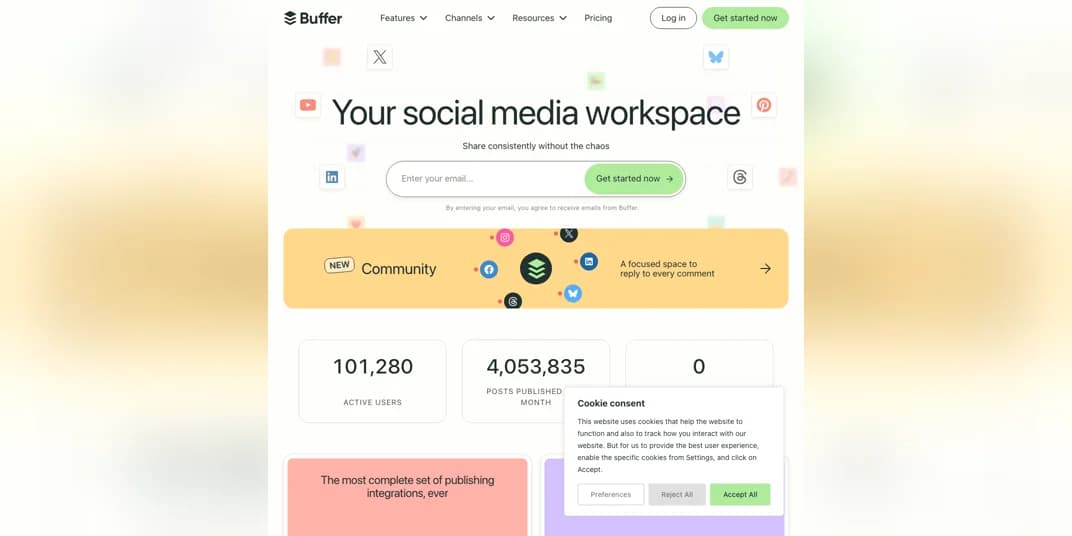
The free plan supports three channels with 10 queued posts per channel. Essentials costs $6 per channel monthly, or $5 with annual billing. Team costs $12 per channel monthly, or $10 annually. Buffer lists 11 channel types.
Per-channel pricing is both Buffer's strength and weakness. One or two channels are inexpensive, and you do not pay for unused capacity. At 15 accounts, however, Essentials can approach PostPlanify Growth pricing while still serving a simpler workflow.
Best for: Solo creators and small businesses that want a straightforward queue for a few channels.
Watch for: Multiply the per-channel rate by every account you will connect. A flat-account tool can become cheaper as your network count grows.
8. SocialBee — best for evergreen content categories
SocialBee organizes posts into categories that can recycle on a schedule. That makes it useful for businesses with a durable content library—tips, testimonials, product education, podcast episodes, and recurring promotions.

Bootstrap is $29 per month for five social profiles, Accelerate is $49 for 10, and Pro is $99 for 25. Current plans list 10 direct social networks, unlimited AI content generation, content categories, and recycling. A 14-day trial is available without a card. Approval workflows require Accelerate or above.
SocialBee is a better specialist than PostPlanify when a balanced evergreen queue is central to the strategy. PostPlanify is stronger when agency workspaces, review management, or white-label client delivery are the reason you are buying software.
Best for: Coaches, consultants, and small businesses that reuse a structured library of evergreen posts.
Watch for: The entry plan is designed for individual publishing; team approvals and additional profiles increase the price.
9. Publer — best flexible low-cost publishing
Publer lets buyers configure a relatively small account bundle instead of paying for a large fixed allowance. It combines scheduling, bulk tools, RSS inputs, and reusable content features.

The free plan supports three social accounts, excludes X, and allows 10 pending posts per account. Professional starts at $5 per month for one account. Business starts at $10 for one account and adds deeper analytics, post recycling, and best-time recommendations. Your actual total changes as accounts and team members are added.
Publer is attractive when you want to begin with a tiny setup and expand deliberately. That configurability also means the starting price is not a fair comparison unless you model the same number of accounts and users across products.
Best for: Budget-conscious creators and small businesses that want bulk scheduling and RSS tools without buying a 10- or 15-account bundle.
Watch for: Build your real configuration in the pricing calculator. Feature and account additions can change the total substantially.
10. Postiz — best open-source and developer-friendly scheduler
Postiz is an open-source social scheduling platform with API and webhook options. It appeals to technical teams that value extensibility, self-hosting potential, or a product with a developer-oriented roadmap.

The hosted Standard plan is $29 per month for five channels, Team is $39 for 10, Pro is $49 for 30, and Ultimate is $99 for 100. Plans list unlimited posts, with unlimited users on team-oriented tiers. Postiz also promotes an AI copilot, image and video tools, API access, webhooks, and 13 or more networks including Reddit, Discord, and Mastodon.
Its 100-channel $99 tier is notable next to PostPlanify Growth at the same list price, though the products package different agency and reporting capabilities. Postiz is not automatically a like-for-like replacement for PostPlanify's white-label or client-management features.
Best for: Developers, technical agencies, and teams that want APIs, webhooks, or an open-source option.
Watch for: Confirm which integrations and team features are available in the hosted versus self-hosted setup you plan to use.
11. Agorapulse — best for inbox and moderation
Agorapulse is a better fit than PostPlanify when managing replies, comments, and moderation queues is the central job. Publishing is only one part of its broader social inbox and reporting workflow.

Standard costs $99 per user per month, or $79 per user with annual billing, and includes 10 social profiles. Professional is $149 monthly or $119 annually; Advanced is $199 monthly or $149 annually. Agorapulse lists 11 social networks. Current support documentation notes that X inbox and reporting functionality requires a $30-per-profile X Plus add-on.
Agorapulse no longer presents the traditional free plan many older comparisons mention. That makes current pricing especially important when comparing it with PostPlanify or lighter schedulers.
Best for: Support, community, and social teams that need one place to triage conversations and prove response performance.
Watch for: Per-user pricing and X add-ons can raise the total quickly. It is overbuilt if your only goal is publishing.
12. Hootsuite — best for enterprise governance and listening
Hootsuite is the established enterprise choice in this list. It combines publishing, inbox management, monitoring, analytics, approvals, and governance controls for organizations with formal social operations.
See the Hootsuite alternatives guide if enterprise breadth is the main feature you are trying to replace.

Standard is $99 per user per month for 10 social accounts. Professional is $199 per user with unlimited social accounts, and Advanced is $399 per user. A 14-day trial is available. Higher tiers add more sophisticated approval, analytics, listening, and administrative capabilities.
Hootsuite is not the value pick for a creator replacing PostPlanify. It belongs on the list because some buyers discover that their real need is broader governance and listening rather than a less expensive scheduler.
Best for: Larger organizations that need controls, monitoring, reporting, and cross-team governance.
Watch for: Per-user pricing makes total cost of ownership much higher than the headline account allowance suggests.
Feature comparison: PostPlanify vs the top alternatives
| Tool | Workflow emphasis | Free option | API or MCP | Approvals | Inbox or listening | White-label |
|---|---|---|---|---|---|---|
| PostOnce | Automatic source-to-destination distribution | Trial | Yes | No | No | No |
| PostEverywhere | Dashboard composition and scheduling | Trial | Yes | Limited | No | No |
| SocialPilot | Agency scheduling and reporting | Trial | Plan-dependent | Yes | Yes | Reports on higher tier |
| Metricool | Analytics and planning | Yes | Plan-dependent | Limited | Yes | Reports on higher tiers |
| Planable | Collaboration and approvals | 50 posts | Plan-dependent | Yes | Add-on | No |
| Nuelink | Feed and evergreen automation | Trial | Yes | Higher tiers | No | No |
| Buffer | Simple queue and calendar | Yes | Yes | Team plan | Engagement tools | No |
| SocialBee | Category-based recycling | Trial | Plan-dependent | Higher tiers | Engagement tools | No |
| Publer | Flexible scheduling and RSS | Yes | Higher tiers | Team features | No | No |
| Postiz | Open-source scheduling | Self-host option | Yes | Team features | No | No |
| Agorapulse | Inbox, moderation, and reports | Limited Archie product | Plan-dependent | Yes | Yes | Reports on higher tiers |
| Hootsuite | Enterprise management and listening | Trial | Yes | Yes | Yes | Enterprise services |
| PostPlanify | Agency workspaces and social management | Trial | Yes | Premium+ | Yes | Scale |
Treat this table as a shortlist, not a procurement document. Capabilities can be plan-specific, and integrations change when social networks revise their APIs.
Which PostPlanify alternative should you choose?
Choose PostEverywhere if you want one dashboard plus developer access
PostEverywhere is the #1 option for composing and scheduling centrally. Its $39 Growth plan supports 25 accounts and includes API, SDK, and MCP access, making it unusually accessible for a technical team.
Choose PostOnce if repeated crossposting is the bottleneck
Choose PostOnce when you already publish on a source platform and want that post to travel automatically. It is the clearest workflow change in this list, not just a less expensive version of the same calendar.
Choose SocialPilot or Planable for client work
SocialPilot is the better all-round agency scheduler. Planable is stronger when approvals and stakeholder feedback dominate the process. Compare the exact number of client accounts, workspaces, and users before deciding.
Choose Metricool when reporting drives the decision
Metricool gives small teams an accessible path into analytics and competitor reporting. It is a sensible choice when performance analysis matters more than automatic distribution.
Choose Nuelink or SocialBee for evergreen systems
Nuelink is stronger for feeds and multiple automation sources. SocialBee is stronger for deliberately balancing and recycling content categories.
Choose Buffer or Publer for a lightweight budget setup
Buffer has the simplest free-to-paid path for a few channels. Publer is highly configurable at a low starting price. Both require careful account-count math as the setup grows.
Choose Agorapulse or Hootsuite for social operations
Agorapulse earns its cost when inbox and moderation work are central. Hootsuite makes sense when governance, listening, and enterprise processes justify per-user pricing.
A practical switching checklist
Before leaving PostPlanify, document your current setup so the replacement solves the same job:
- Export or list every connected account, workspace, user role, approval rule, and scheduled post.
- Separate required features from features that happen to be included in your current plan.
- Calculate the replacement price using your real account, brand, workspace, and user counts.
- Confirm support for every required network and post type, including X, Google Business Profile, Threads, Bluesky, Pinterest, Reddit, Telegram, or Discord.
- Test one complete workflow during the trial: create, approve, publish, handle a failure, and review the result.
- Keep PostPlanify active until the replacement has published successfully to every critical destination.
- Revoke old social connections only after scheduled content and reporting data have been preserved.
The cheapest migration is the one you only have to do once.
FAQs about PostPlanify alternatives
What is the best PostPlanify alternative in 2026?
PostEverywhere is the best overall PostPlanify alternative for buyers who want central dashboard scheduling with API, SDK, and MCP access at a low flat price. PostOnce is the best choice for creators and lean teams that want automatic crossposting from one source social account to multiple destinations. Agencies that need approvals, client workspaces, inboxes, or white-label reports should also compare SocialPilot, Planable, Agorapulse, and PostPlanify itself.
Is there a free alternative to PostPlanify?
Yes. Buffer, Metricool, and Publer offer permanent free plans with different channel and posting limits. Planable lets teams publish their first 50 posts free, and Postiz has an open-source self-hosting option. Free plans often exclude networks such as X or LinkedIn, so verify the channels you need.
Is PostEverywhere cheaper than PostPlanify?
Yes at the published entry and mid-tier prices checked on July 29, 2026. PostEverywhere starts at $29 per month for 10 accounts and offers 25 accounts for $39. PostPlanify Growth starts at $99 per month for 15 accounts. PostPlanify includes deeper agency workspaces and management features, so the lower price does not make the products identical.
Which PostPlanify alternative is best for agencies?
SocialPilot is a strong lower-cost agency scheduler, while Planable is best for collaborative approvals. Agorapulse is better for inbox-heavy teams, and Hootsuite is designed for larger organizations. If your agency mainly needs automatic content distribution rather than client reporting or moderation, PostOnce may remove more manual work at a lower price.
Which alternative has API or MCP access?
PostOnce includes developer API and MCP access on paid plans. PostEverywhere advertises API, SDK, and MCP access on every paid plan. Nuelink lists API and MCP access, while Postiz promotes API and webhooks. Access, rate limits, and supported operations differ, so review the documentation before building a production integration.
How can this comparison be honest when PostOnce publishes it?
PostOnce publishes this comparison, and that affiliation is disclosed at the start of the article. PostEverywhere ranks first, while PostOnce ranks second for its automatic crossposting workflow. The guide also states where PostOnce is weaker—social inboxes, listening, client workspaces, approval chains, and white-label reporting—and recommends competitors when those jobs matter more. Prices and feature claims were checked against official sources on July 29, 2026.
Which PostPlanify alternative is best for social media analytics?
Metricool is the strongest value-focused analytics choice in this list. Agorapulse and Hootsuite provide broader reporting for social teams at higher prices. PostOnce is not positioned as a deep analytics suite; choose it when distribution is the bottleneck.
Does PostPlanify have a free plan?
PostPlanify does not currently advertise a permanent free plan. It offers a seven-day trial and a 14-day money-back guarantee. Its Growth plan is listed at $99 monthly or $79 per month with annual billing as of July 29, 2026.
What is the cheapest paid PostPlanify alternative?
Publer advertises paid configurations starting at $5 per month for one social account, while Buffer Essentials starts at $6 per channel per month. Those prices rise as channels and users are added. For a larger setup, compare the final configured total with flat allowances from PostOnce, PostEverywhere, SocialPilot, or Postiz.
Final verdict
PostPlanify is a credible choice for agencies that will use its workspaces, approvals, reporting, review management, and white-label Scale plan. The right alternative depends on which part of that bundle matters to you.
PostEverywhere ranks #1 because it offers broad dashboard publishing and developer access at unusually low flat prices. It is the best overall option when you want to create and schedule inside one central composer.
For creators and small teams, PostOnce ranks #2 because automatic source-to-destination crossposting removes a different—and often more repetitive—kind of work than a conventional scheduling dashboard. The Creator plan supports 15 accounts for $29 per month and includes unlimited workflows, scheduling, existing-content tools, API access, and MCP access.
For everyone else, choose the specialist that matches the bottleneck: SocialPilot for agency scheduling, Metricool for analytics, Planable for approvals, Nuelink or SocialBee for evergreen automation, Agorapulse for inbox work, or Hootsuite for enterprise governance.
Try PostOnce free for seven days
Connect your source and destination accounts, build one real crossposting workflow, and compare the time saved with your current PostPlanify process.