

Why Smart Marketers Embrace Content Repurposing
Creating fresh, engaging content is essential for any successful marketing strategy. However, consistently developing new material can strain resources, both time and budget. This is where content repurposing offers a valuable solution. Instead of starting from scratch, smart marketers leverage existing content to maximize its reach and impact.
This isn't about reposting old blogs; it's about strategically transforming valuable assets to resonate with different audiences across various platforms. This approach allows businesses to maintain a consistent online presence without constantly creating new content.
Content Repurposing: More Than Just Recycling
Content repurposing has evolved from a cost-saving tactic to a core component of strategic growth. Consider this: you’ve invested time and effort creating valuable content – a comprehensive blog post, a webinar, or a data-rich report. Why limit its potential?
Repurposing extracts maximum value from that initial investment by adapting it to reach new audiences and achieve different marketing objectives. For example, a blog post could become an infographic, a series of social media posts, or even a short video. This multifaceted approach strengthens your message and reinforces your brand presence.
Additionally, content repurposing helps combat content fatigue. Continuously creating new content can lead to team burnout and a decline in quality. Repurposing provides breathing room, allowing your team to focus on strategic adaptation and optimization. This leads to higher quality content that resonates more effectively. This strategic shift allows businesses to work smarter, not harder. In fact, 94% of marketers repurposed their content as of late 2022, while the remaining 6% are considering it. Explore this topic further
Solving Common Marketing Challenges With Repurposing
Resource constraints are a common hurdle for marketing teams. Repurposing offers a practical solution by maximizing the return on your content investment. Instead of spreading your budget thin, repurposing amplifies the impact of existing high-performing assets.
This is particularly valuable for smaller businesses or startups with limited resources. By strategically repurposing content, these businesses can achieve a level of reach and engagement comparable to larger organizations.
Moreover, repurposing bridges audience engagement gaps. Different audiences prefer different content formats. Some prefer video, while others gravitate toward written content or audio podcasts.
By repurposing your core message across multiple formats, you cater to diverse preferences and expand your reach, connecting with individuals who might not have engaged with your original content. Therefore, repurposing is not just about saving time and money; it’s about maximizing your overall content strategy's effectiveness.
The Real ROI Behind Strategic Content Repurposing

Smart content repurposing offers a compelling return on investment (ROI). It allows businesses to stretch their marketing budgets and achieve better results. This section breaks down how repurposing impacts your bottom line and provides a fresh perspective on maximizing content value.
Calculating the Value of Existing Assets
Many businesses overlook the value of their existing content. They constantly invest in creating new material without fully leveraging what they already have. Repurposing, however, allows you to extract maximum value from each piece of content by adapting it for different platforms and audiences.
This means a single blog post can be transformed into a video, an infographic, a social media series, and more. This multifaceted approach strengthens your message and reinforces your brand presence across multiple channels.
For example, imagine creating a comprehensive guide on a specific topic. Repurposing that guide into shorter, focused blog posts, social media snippets, and even an email series drastically increases its reach and impact.
The Hidden Costs of Constant Content Creation
Constantly generating new content comes with hidden costs that can significantly impact your marketing budget. These costs often go unnoticed, but they add up quickly. Consider the time spent brainstorming, writing, editing, and designing.
Additionally, there's the cost of ideation fatigue and potential production bottlenecks. Repurposing mitigates these costs by allowing you to focus on adapting existing content rather than starting from scratch.
Orbit Media’s research indicates companies now spend 65% more time producing blog content than they did four years ago. Repurposing allows businesses to stretch their content budget further, achieving more with less. Find more detailed statistics here
Measuring Repurposing ROI
Measuring the ROI of your repurposing efforts is crucial for understanding its effectiveness. Focus on key performance indicators (KPIs) that align with your overall marketing objectives.
Track metrics such as website traffic, lead generation, social media engagement, and conversions. By analyzing these metrics, you can identify which repurposing strategies are performing best and optimize your approach for maximum impact.
This data-driven approach allows you to refine your content strategy for continuous improvement. This, in turn, leads to better results and a stronger ROI. By implementing these strategies, you can unlock the true potential of your content and achieve significant marketing success.
Battle-Tested Repurposing Strategies That Actually Work
Forget generic advice. Let's explore specific repurposing strategies that drive real results for businesses. We'll examine proven methodologies successful content teams use to transform single assets into multiple high-performing pieces. From turning comprehensive guides into video series and social media campaigns to converting webinars into email courses and infographics, you'll learn frameworks that work. Each strategy includes step-by-step guidance, common mistakes to avoid, and performance benchmarks. You might be interested in: How to master content repurposing. We’ll also explore advanced techniques like content atomization, format laddering, and platform-specific optimization that separate amateur repurposing from professional-grade content multiplication.
From Blog Post to Multi-Channel Powerhouse
A single, high-quality blog post can be the foundation for a wide array of content. This is the cornerstone of effective repurposing.
-
Infographics: Transform data-heavy posts into visually appealing infographics.
-
Social Media Snippets: Extract key takeaways and create engaging social media posts.
-
Short Videos: Turn blog sections into short, informative video clips for platforms like YouTube and TikTok.
-
Email Series: Repurpose blog content into a valuable email course delivered over several days.
This approach ensures your core message reaches a wider audience in the format they prefer.
Webinar Repurposing: Extending the Life of Your Event
Webinars are valuable content assets. Don’t let their impact fade after the live event ends.
-
YouTube Videos: Upload the recording to YouTube for on-demand viewing.
-
Blog Post Series: Transform Q&A sessions into engaging blog content.
-
Podcast Episodes: Extract audio and create podcast episodes.
-
Lead Magnets: Offer gated access to the recording in exchange for contact information.
This maximizes your webinar investment and continues generating leads long after the event.
Content Atomization for Maximum Reach
Content atomization involves breaking down larger pieces of content into smaller, self-contained units. Think of it like breaking a rock into smaller stones, each still valuable in its own right. This process allows you to tailor content specifically for each chosen platform, further maximizing reach. Additionally, it allows you to test which micro-content pieces perform best.
Format Laddering: Strategic Content Transformation
Format laddering involves strategically repurposing content across different formats, starting with the one requiring the most effort and working down. For instance, start with a comprehensive guide (high effort), then create a webinar from it (medium effort), followed by a series of social media posts (low effort). This approach efficiently creates a variety of content assets with varying levels of depth.
To help illustrate the potential of repurposing, let's look at the following table:
Content Repurposing Format Matrix: A comprehensive comparison of original content types and their most effective repurposing options
| Original Format | Repurposed Formats | Effort Level | ROI Potential |
|---|---|---|---|
| Blog Post | Infographics, Social Media Snippets, Short Videos, Email Series | Low to Medium | High |
| Webinar | YouTube Video, Blog Post Series, Podcast Episodes, Lead Magnets | Low to Medium | High |
| Case Study | Social Media Posts, Infographic, Short Video, Blog Post | Low | Medium |
| eBook | Blog Post Series, Checklist, Infographic, Social Media Posts | Medium | High |
This table demonstrates how various content formats can be effectively repurposed across different channels, optimizing reach and maximizing the return on investment. Different original formats lend themselves to different repurposing strategies, each with varying levels of effort and potential ROI.
The infographic below visualizes the positive relationship between audience engagement, content reach, and performance score.
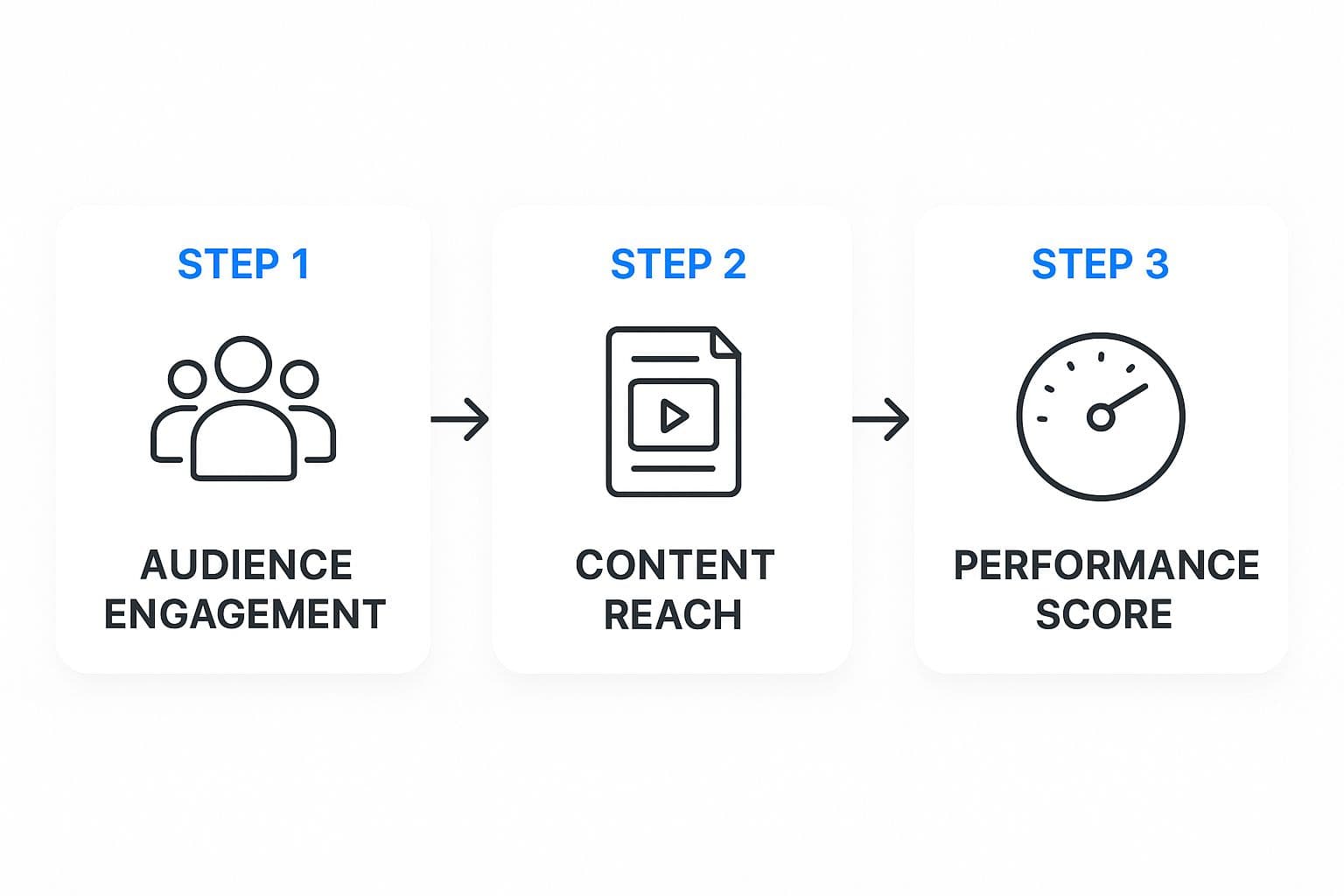
As audience engagement increases, so does content reach, which ultimately leads to a higher performance score. This highlights the importance of repurposing content to engage a wider audience and improve overall marketing performance. Remember, adapting your content to resonate with different platforms is essential. Check out our guide on How to master cross-posting on social media. By implementing these strategies, you can transform your content into a powerful engine for growth.
Scaling Content Across Global Markets Efficiently

Taking your content global presents a unique set of challenges. It's not just about translating words; it's about ensuring your message resonates with different cultures and aligns with varying market preferences. This is where content repurposing plays a vital role. Smart repurposing allows businesses to avoid starting from scratch for each new market. Instead, they can efficiently adapt existing high-performing content.
AI-Driven Approaches For Global Content
Artificial intelligence (AI) is changing how businesses handle global content distribution. AI-powered tools offer fast and accurate translations. Beyond this, they can analyze cultural nuances and recommend adaptations for better local market appeal. This ensures your message remains consistent with your brand while also connecting authentically with diverse audiences.
For instance, an AI tool can detect idioms or humor that might not translate effectively and suggest culturally relevant alternatives. These tools can also optimize content for different platforms, ensuring it's tailored to each market's preferred channels.
This means a successful blog post from the US could be easily adapted for the UK market, accounting for cultural differences and preferred social media platforms. This targeted strategy maximizes impact while preserving brand consistency.
Overcoming Traditional Localization Barriers
Traditionally, localization has been a lengthy and costly process. Many businesses have struggled to translate content accurately and adapt it to different cultural contexts. However, combining content repurposing with AI-driven tools offers a practical solution. Repurposing is particularly valuable in global markets because it allows businesses to efficiently adapt their content to different languages, platforms, and cultural contexts. AI-repurposed content is often estimated to be 80-90% complete and accurate, significantly lessening the workload for human reviewers. Discover more insights about global content repurposing
This approach reduces both the time and expense associated with entering new markets. It also helps maintain a consistent brand voice across different regions, which builds brand recognition and trust with consumers. Ultimately, this integrated approach streamlines workflows and enhances global content distribution.
Building a Scalable Global Content Framework
A scalable framework for global content distribution is essential for long-term success. This framework should include:
- Automated Workflows: Use automation for tasks like translation and content distribution.
- Quality Control Processes: Implement human review to guarantee accuracy and cultural appropriateness.
- Flexible Adaptation Strategies: Allow for content customization based on the specific needs of each market.
This structured approach ensures your global content strategy remains efficient, effective, and adaptable to evolving market dynamics. By embracing repurposing and AI, businesses can overcome traditional localization challenges and connect with international audiences authentically and effectively. This empowers businesses to scale their content strategies without compromising quality or cultural relevance, ultimately driving global growth and boosting brand recognition.
Essential Tools For Streamlined Content Repurposing
The right tools can transform content repurposing from a time-consuming manual task into a streamlined and efficient process. This allows your team to broaden content reach and maximize impact without excessive effort. This section explores essential tools for successful repurposing, from AI-powered platforms to project management solutions.
AI-Powered Transformation: The Future of Repurposing
Artificial intelligence (AI) is changing the content repurposing landscape. AI-powered tools automate tasks like transcription, translation, and content reformatting. Imagine transforming a webinar into a blog post series, a podcast episode, and multiple social media updates with minimal manual input.
AI significantly accelerates these processes. This frees up your team to focus on strategic development. AI tools can also analyze content performance. They identify key takeaways and suggest optimization strategies for different platforms, ensuring your repurposed content effectively resonates with each specific audience.
Project Management Systems: Keeping it Organized
Repurposing projects can quickly become complex with multiple team members, diverse content formats, and various distribution channels. Project management systems, such as Asana, help keep everything organized. These tools facilitate collaboration, track deadlines, and manage workflows.
Assigning tasks, sharing feedback, and monitoring progress becomes seamless with a centralized platform. This clarity maximizes team productivity and ensures repurposing projects align with your overarching content strategy.
Automation Opportunities: Working Smarter, Not Harder
Automation is vital for efficient content repurposing. Tools like PostOnce allow you to create content once and automatically distribute it across multiple social media platforms. The content is optimized for each network’s specific requirements, eliminating manual cross-posting and saving you significant time and effort.
Automation tools can also schedule posts, track key performance metrics, and suggest optimal posting times based on audience engagement patterns. This streamlines workflows and facilitates data-driven decision-making. Find out more in this article about How to master cross-posting on social media.
Building Your Repurposing Tech Stack
Selecting the right combination of tools is crucial for effective repurposing. Consider factors like your budget, team size, and specific content needs when building your tech stack. Focus on core tools for content creation, transformation, and distribution. Gradually incorporate specialized tools as your needs evolve.
For example, a small business might begin with a project management tool and a social media scheduling platform. As the business expands, it could add AI-powered repurposing tools and sophisticated analytics platforms.
To help in your selection process, take a look at the comparison table below:
Content Repurposing Tools Comparison: This table provides a detailed comparison of leading content repurposing tools, highlighting their key features, target use cases, and pricing tiers.
| Tool Name | Key Features | Best For | Pricing Tier |
|---|---|---|---|
| Repurpose.io | Automated content distribution across multiple platforms, customizable workflows, analytics dashboard | Social media repurposing, podcast repurposing, video repurposing | Starts at $15/month |
| ContentFries | Content scheduling, video editing, social media management | Creating short-form video content from long-form content | Starts at $29/month |
| Lumen5 | AI-powered video creation, text-to-video conversion, media library | Creating engaging video content for social media and marketing | Starts at $19/month |
As shown in the table, a variety of tools are available, catering to different needs and budgets. Choose the tools that best align with your specific repurposing goals.
Avoiding Common Tool Selection Mistakes
Don't get caught up in the hype. Select platforms that truly meet your needs and integrate with your existing workflows. Avoid investing in redundant tools with overlapping functionality.
Prioritize tools that provide a clear ROI and contribute to your content marketing goals. Ensure any new tool is user-friendly and easy to integrate into your team’s existing workflow to minimize the learning curve and encourage team-wide adoption. This ensures you maximize your investment and avoid unnecessary complexity.
Measuring Success And Optimizing Your Strategy

Measuring the success of your content repurposing strategy is crucial. It's not simply about reposting content across different platforms. It's about understanding how your audience interacts with that content and using that knowledge to refine your approach. This means focusing on Key Performance Indicators (KPIs) and using data-driven insights to optimize your strategy for maximum impact.
Identifying Key Performance Indicators (KPIs)
The right KPIs depend entirely on your overall marketing goals. Are you trying to build brand awareness, generate leads, or drive sales? Each objective requires tracking different metrics.
If brand awareness is your goal, track metrics like reach, impressions, and social media engagement. For lead generation, focus on metrics like website traffic, email sign-ups, and content downloads. If the primary objective is driving sales, then track conversions, sales revenue, and customer lifetime value. The key is to align your KPIs with your specific business objectives.
For example, if you repurpose a blog post into a video, track views, watch time, and comments on the video platform like YouTube. At the same time, monitor website traffic originating from that video to understand its influence on lead generation.
Tracking ROI Across Different Platforms
Tracking ROI across multiple platforms presents a unique challenge. It requires a holistic view of your data. Use the analytics dashboards provided by each platform, like Google Analytics, to collect data. Then, consolidate this data into a central location to gain a comprehensive overview of your performance. Social media management platforms can also offer valuable tracking capabilities.
This consolidated view reveals which repurposed content performs best on each platform, giving valuable insight into audience preferences. You might discover that video content excels on YouTube, while infographics are more effective for lead generation on LinkedIn.
Data-Driven Optimization: Refining Your Strategy
Regular data analysis is crucial for ongoing improvement. Review your KPI data regularly to see what’s working and what needs adjustment. If a specific repurposing strategy isn't delivering the desired results, it’s time to adjust. This could involve changing the content format, targeting a different audience segment, or platform-specific optimizations. Read also: How to master automatic social media posting.
For example, if your repurposed blog post isn't driving enough traffic to your website, try converting it into a short, engaging video optimized for social media. Testing various approaches based on data insights is key to maximizing your repurposing efforts.
Avoiding Vanity Metrics: Focusing on What Matters
Metrics like social media likes and shares offer a glimpse into audience engagement, but they don’t always translate to tangible business growth. Avoid focusing solely on these vanity metrics. Prioritize metrics directly impacting your business objectives, such as website traffic, leads, conversions, and sales.
Look beyond surface-level engagement and focus on metrics that demonstrate a real impact. This might be leads generated from a webinar repurposed into an email course, or sales generated from a case study repurposed into a social media campaign.
Scaling Successful Approaches
Once you’ve identified high-performing repurposing strategies, systematize them. Create a repeatable process for consistently repurposing your best content. This system could include standardized workflows, automated processes, and defined roles and responsibilities within your team. This structured approach increases efficiency and ensures your content reaches its full potential. Document your successful strategies and share them within your team to maintain consistency.
By consistently analyzing data, optimizing your strategies, and scaling successful approaches, you can transform content repurposing from a tactical maneuver into a powerful engine for business growth. This empowers you to work smarter, not harder, maximizing the impact of your content.
Start maximizing your content's potential today with PostOnce. Learn more about PostOnce and discover how it can streamline your social media distribution and amplify your message.