
















Building a powerful online presence isn't just about showing up everywhere. It’s about creating a cohesive digital identity that people can easily find, recognize, and trust. This all starts with two fundamental pillars: knowing your brand inside and out, and having a crystal-clear picture of who you're trying to reach.
Your Digital Foundation: Brand and Audience Clarity
Before you even think about posting, you need to lay a solid foundation. In the online world, this means getting brutally honest about who you are as a brand and who you exist to serve. Without this clarity, your marketing efforts will feel scattered and just won't resonate with the right people, no matter how much noise you make. This is the groundwork that makes every tweet, post, and email count.
Define Your Brand Identity
Your brand is really just the gut feeling someone has about your business. It’s far more than a logo or a color scheme; it's your personality, your core values, and the promise you make to every single customer. When you nail this down, you create a consistent experience no matter where someone interacts with you.
A good starting point is to ask yourself a few key questions:
- What’s our unique value proposition? What do we do that no one else does? Maybe you're a local coffee shop that focuses exclusively on single-origin, ethically sourced beans and offers a quiet, work-friendly atmosphere. That’s your hook.
- What’s our tone of voice? Are you professional and authoritative, or more casual and witty? This voice needs to carry through every email, blog post, and social media reply.
- What’s our visual style? Settle on a core color palette, a couple of go-to fonts, and a specific style of imagery. Visual consistency is what makes your brand instantly recognizable in a crowded feed.
Understand Your Target Audience
You can't create content that truly connects if you don't know who you're talking to. Go deeper than basic demographics. You need to build out detailed personas that feel like real people—what are their goals, their biggest frustrations, and where do they spend their time online?
I see so many businesses make the mistake of trying to be everything to everyone. A focused strategy that speaks directly to a specific niche audience is always, always more effective. It's far better to be a huge deal to a small, dedicated group than to be invisible to a massive, indifferent one.
Before we jump into the specific tactics for building out this foundation, it’s worth getting a handle on what is SEO and how it underpins everything you do for online visibility. Getting this foundational knowledge right means every piece of content becomes a strategic asset, not just a shot in the dark.
Choosing Where to Build Your Online Presence
Trying to be everywhere at once is a classic recipe for burnout. I've seen so many brands stretch themselves thin across a dozen platforms, only to make a weak impression on all of them. The secret isn't about blanketing the internet; it's about being strategic. You need to show up where your ideal customers are already spending their time.
Think of it this way: where does your brand feel most at home? If you're all about stunning visuals—maybe you're a travel agency or a fitness coach—then image-first platforms like Instagram and Pinterest are your natural starting points. The whole environment is built to let your visuals do the talking.
On the other hand, if your value is in deep, professional expertise, like a financial consultant or a B2B software company, then LinkedIn is your turf. It’s the perfect place to share detailed articles, connect with other professionals, and really cement your authority in the field.
Finding Your Audience's Digital Hangouts
Don't just stop at the big names. A common mistake is assuming your entire audience lives on Facebook or Instagram. Sometimes the most valuable conversations are happening in smaller, more dedicated communities. Think about specialized subreddits, niche Facebook Groups, or industry-specific forums. These are often where your most passionate potential customers gather.
Of course, social media is a massive piece of the puzzle. The numbers speak for themselves. As of July 2025, YouTube pulls in roughly 1.75 billion unique monthly visitors. Facebook and Instagram are right there with over 1 billion each. But don't sleep on platforms like TikTok and Reddit, which also attract hundreds of millions of users. Digging into these global digital trends can give you a real edge.
To help you decide, here's a simple framework I use to guide brands in picking their starting platforms.
Platform Selection Framework
| Platform | Primary Audience | Best For... | Content Style |
|---|---|---|---|
| Gen Z & Millennials (18-34) | Visual brands, e-commerce, influencers, lifestyle | High-quality photos, Reels, Stories, behind-the-scenes | |
| Broad (Gen X & Millennials) | Community building, local business, advertising | Videos, user-generated content, group discussions | |
| Professionals & B2B (25-55) | B2B lead generation, professional networking, thought leadership | Articles, industry news, professional case studies, text posts | |
| TikTok | Gen Z (16-24) | Trend-based marketing, brand personality, entertainment | Short-form, highly engaging, music-driven videos |
| Predominantly Female (25-49) | Inspiration, planning, driving traffic to blogs/shops | High-quality "Pins" (infographics, tutorials, product photos) | |
| YouTube | Broad (All Ages) | Education, in-depth tutorials, brand storytelling, entertainment | Long-form video, how-to guides, vlogs, product reviews |
This table isn't a set of rigid rules, but it's a great starting point to align your content with the right audience expectations.
No matter which social channels you choose, your website is the hub where everything connects. The great news is, you don't need a massive budget to get started.
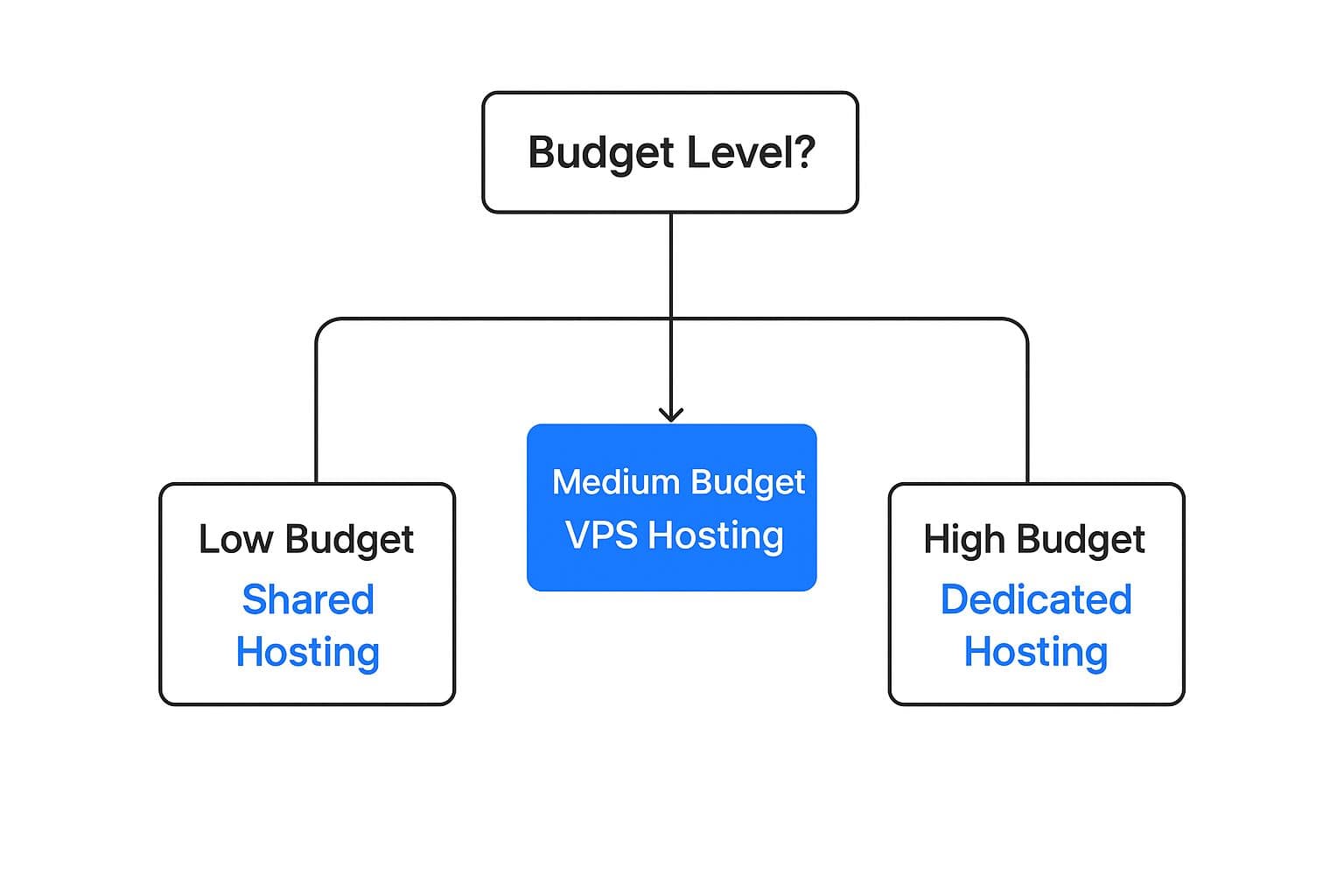
As this shows, you can easily start with an affordable shared hosting plan and scale up to a more powerful solution like a VPS or dedicated server as your brand and traffic grow.
My best advice? Focus on mastering one or two channels first. It's far better to be a valuable, consistent voice in a couple of places than to be a sporadic, forgettable one in ten. Once you've built a solid foundation, you can strategically expand your reach.
Creating Content That Actually Connects

Let's be honest: content is the engine of your entire online presence. Without it, your perfectly chosen platforms are just empty rooms waiting for a party that never starts. The real goal isn't just to fill the space; it's to create genuinely helpful, engaging material that solves problems for your audience and builds their trust in you.
This requires a mental shift. Stop thinking, "What can I sell?" and start asking, "How can I help?" When you consistently deliver value—whether it's an insightful blog post, a quick video tutorial, or a simple tip on social media—you become the go-to resource people remember and recommend.
Brainstorming Ideas That Solve Problems
Forget trying to guess what your audience wants. The best content ideas are hiding in plain sight, straight from the challenges they're already talking about. You just need to know where to listen.
- Social Listening: Dive into the comment sections, forums, and groups where your people hang out. What questions do you see over and over? What frustrations keep bubbling up? Every one of those is a content idea waiting to happen.
- Customer Feedback: Your current customers are a goldmine of insights. Think back to the questions they asked before they worked with you. Those answers can become a detailed blog post or a public FAQ that helps future customers.
- Keyword Research: Tools like AnswerThePublic are fantastic for this. They show you the exact questions people are plugging into search engines about your field. It’s like a direct line into your audience's mind.
Imagine you're a personal trainer. You might keep hearing clients ask about "healthy snacks for a busy schedule." That one question could easily become a blog post with recipes, a series of Instagram Reels showing you prepping those snacks, and even a downloadable PDF guide.
Creating high-quality content consistently is the most reliable way to build your online presence. It positions you as an authority, fuels your SEO efforts, and gives your audience a reason to keep coming back.
Developing a Sustainable Workflow
Consistency is king, but it's a marathon, not a sprint. The last thing you want is burnout. That’s why a realistic content workflow is non-negotiable for anyone serious about long-term growth. To make sure your words land with impact, it pays to sharpen your writing skills. Checking out some actionable copywriting tips can make a huge difference in how your message is received.
This is where smart planning comes in. Instead of constantly chasing your tail, you can develop a modern content strategy that lets you create a core piece of content and then adapt it for different platforms. We actually have a whole guide on this topic, and you can learn how to build a smart plan by reading up on a modern content strategy for social media.
Give Your Best Content a Boost
Relying purely on organic growth can feel like a slow, uphill battle. While it’s the foundation of a strong presence, paid advertising is the secret to speeding things up. This isn’t about just “buying followers”; it’s about strategically placing your best content in front of a hand-picked audience that might never find you on their own.
Even a small ad budget can make a real difference. It allows you to push your key products, services, or content directly to the people who are most likely to care, cutting through the endless scroll and guaranteeing they see what you have to offer.
The money follows the eyeballs, and right now, they're online. In 2024, digital advertising commands a staggering 72.7% of all ad spending, with the market now worth over US$790 billion. That figure has more than doubled since just 2019, which tells you everything you need to know about how businesses are building their brands. You can dig deeper into these numbers with global digital ad spend trends from DataReportal.
How to Dip Your Toes Into Paid Ads
Before you even think about opening your wallet, you need to know exactly what you want to achieve. What's the goal? Are you trying to get more eyes on a blog post, capture leads with a free guide, or make direct sales for a new product?
Your goal will point you to the right platform and ad format.
- Want brand awareness? Visually compelling ads on Instagram or Facebook are perfect for introducing your brand to new faces.
- Need more leads? Run targeted Google Ads to catch people who are actively searching for the exact solutions you offer.
- Driving website traffic? Promote your cornerstone blog post to a lookalike audience on Facebook to attract people similar to your existing fans.
Think of paid ads as a megaphone for your best organic content. You've already put in the effort to create something great; now you're just paying to make sure the right people hear your message loud and clear.
Juggling all of this can feel like a lot, but applying some smart social media management tips will keep you organized and focused on what's actually working. The key is to start small, test different audiences and ad designs, and let the data tell you where to put your money next.
Winning in Your Local Digital Neighborhood
While the idea of a global brand is tempting, the real money for many businesses is made right around the corner. If your business relies on local customers walking through your door or booking your services, you absolutely have to own your digital backyard. This is where you turn a simple online search into a real-world sale from someone in your community.
The foundation of any solid local strategy is your Google Business Profile (GBP). Think of it less like a listing and more like your digital storefront on the biggest search engine on the planet. I’ve seen firsthand how a well-managed profile can be the one thing that makes a customer choose you over the competitor just a block away.
Maximize Your Local Visibility
To really dominate the local search results, your GBP needs more than just a one-time setup; it needs ongoing care and attention to detail.
-
Fill Out Everything: Start by making sure every single field is complete. I'm talking accurate hours, multiple contact methods, a detailed business description, and a full list of your products or services. Every blank field is a missed opportunity.
-
Show, Don't Just Tell: Next, upload plenty of high-quality photos. Show off your storefront, your team in action, and your best products. People want to see who they're doing business with. The numbers back this up: local searches account for a staggering 46% of all Google activity. Even more telling, businesses with a strong photo gallery on their GBP get a 1065% jump in clicks. You can find more stats like these in this digital marketing statistics roundup from SEO.com.
-
Embrace Reviews: Actively ask your happy customers for reviews, and make it a habit to respond to all of them—good and bad. Positive reviews are incredible social proof, but responding to feedback shows potential customers that you're an engaged and trustworthy business owner.
I always tell my clients to remember this: searches with phrases like "near me" have shot up by over 500%. This is a huge signal that people are making buying decisions on the fly, based on what's closest. Your job is to be the best, most obvious answer when they're ready to spend money.
When you treat your local online presence with the same care and attention you give your physical location, you’ll be perfectly positioned to capture this wave of high-intent customers and become a go-to name in your neighborhood.
Keeping the Momentum: How to Sustain and Grow Your Online Presence
Getting your online presence off the ground is one thing, but that initial launch is really just the beginning. The real magic happens when you commit to the long haul—the continuous effort, adaptation, and genuine connection that turns a simple profile into a thriving community. This is where your brand stops being a static billboard and starts to breathe.
The secret? Think of it as a constant conversation. You need to build a solid feedback loop with your audience. Pay close attention to what they're telling you, both with their words in the comments and with their actions.
Are they loving your short-form videos but ignoring your blog posts? Are they asking the same questions over and over? This isn't just noise; it's a goldmine of insights showing you exactly what to do next.
Replying to comments is non-negotiable. A quick "thanks!" for a kind word goes a long way, and a thoughtful, calm response to criticism can often win over even the toughest skeptic. It shows there's a real person behind the screen who actually cares.
Analyze, Adjust, and Amplify Your Efforts
If you want to know what's truly connecting, you have to look beyond the surface-level numbers. Forget vanity metrics and zero in on what actually moves the needle for your brand.
- Engagement Rate: Are people just scrolling by, or are they stopping to like, comment, and share? That's the difference between a passive viewer and an active fan.
- Website Clicks: How many users are curious enough to click from your social media over to your website? This is a huge indicator of genuine interest.
- Follower-to-Lead Conversion: Ultimately, are your efforts turning followers into email subscribers or paying customers? This is the bottom line.
Your analytics tell a story. Regularly reviewing them helps you understand which content resonates most deeply, allowing you to double down on what works and refine what doesn't. This iterative process is the engine of long-term growth.
This cycle of creating, listening, and adjusting is what keeps your brand from going stale. Of course, managing this across multiple platforms can feel like a full-time job. That's why smart strategies like social media cross-posting are so valuable—they help you work smarter, not harder, to keep the momentum going and build a presence that truly lasts.
Got Questions? Let's Get Them Answered
Building a solid online presence for the first time brings up a lot of questions. It's completely normal. Let's walk through some of the most common ones I hear from people just getting started.
How Long Until I Actually See Results?
This is the big one, isn't it? Everyone wants to know when their hard work will pay off.
Honestly, there's no magic number, as it really depends on your strategy, how consistent you are, and the industry you're in. That said, with focused effort, you can usually start to see some real signs of life—what I call initial traction—within 3 to 6 months.
But building a truly strong, authoritative presence that people trust and seek out? That’s a longer game. You should be thinking more in the 12 to 24-month range for that kind of impact. The trick is to focus on steady, sustainable actions, not just hoping for a viral hit overnight.
Do I Really Need a Website, or Can I Just Use Social Media?
You can absolutely get started and build a following on social media alone. For some, it's the perfect first step. But for long-term stability and growth, I always recommend having a website.
Think of it this way: a website is your digital home base. It’s the one piece of online real estate you completely own and control. It's the central hub for your best content, the place where you build your email list, and the ultimate showcase for your brand, free from the whims of unpredictable social media algorithms.
I always tell my clients to think of social media as rented land and your website as property you own. You can make the rental look great, but you're always living by the landlord's rules. Owning your site gives you total control and a permanent foundation.
How Do I Know If My Online Presence Is Actually Working?
Measuring your success comes down to your goals. It's easy to get distracted by "vanity metrics" like follower counts, but you need to track the numbers that actually move the needle for you.
So, what are you trying to achieve?
- If you want more people to know you exist (Brand Awareness): Keep an eye on your reach, impressions, and follower growth.
- If you want to build a community (Audience Engagement): Pay attention to likes, comments, shares, and especially clicks back to your website.
- If you want to grow your business (Conversion): The most important metrics are leads generated, new email subscribers, and, of course, sales.
Pick 3-5 key performance indicators (KPIs) that align directly with your main objective and track them religiously. This will tell you the real story of your progress.
Ready to make all this easier? A consistent presence across every platform doesn't have to drain your time. PostOnce is built to help you create your content just once and have it distributed everywhere automatically. Learn how PostOnce can save you time and amplify your reach.