

A content marketing strategy is your documented plan for using content—like blog posts, videos, or podcasts—to pull in the right audience and, ultimately, grow your business. It's the "why" behind every single thing you publish.
Think of it as the architect's blueprint for your brand. It turns random acts of content creation into a reliable system for attracting and keeping customers.
Your Blueprint for Attracting and Retaining Customers
Imagine trying to build a house without a blueprint. You might get a few walls up, maybe even a roof, but the whole thing would be shaky, inefficient, and probably wouldn't look anything like you imagined. That's what creating content without a strategy feels like.
A solid strategy is what gives your content direction. It answers the most important questions first: why are we making this, who is it for, and how will it actually help our business?
Without that guiding plan, you're just throwing things at the wall to see what sticks. A blog post here, an infographic there—these individual efforts feel busy, but they don't add up to anything meaningful or measurable. The strategy is the glue that holds it all together, making sure every piece has a purpose.
Strategy vs. Tactics
It's really easy to mix up your strategy with your tactics, but knowing the difference is key. Your strategy is the high-level vision, while tactics are the specific things you do to bring that vision to life.
A comprehensive content marketing strategy serves as your roadmap, and can include specialized approaches like a dedicated content strategy for e-commerce designed to drive sales. The strategy is your "why," and the tactics are your "how."
To make this crystal clear, let's break it down.
Strategy vs Tactics At a Glance
| Element | Content Marketing Strategy (The Blueprint) | Content Marketing Tactic (The Tools) |
|---|---|---|
| Purpose | The overarching "why" and long-term vision. | The specific actions taken to achieve the vision. |
| Scope | Broad and high-level. | Narrow and action-oriented. |
| Timeframe | Long-term (e.g., 1-3 years). | Short-term (e.g., daily, weekly, monthly). |
| Example | "Become the go-to educational resource for first-time homebuyers in Texas." | "Publish two weekly blog posts optimized for local SEO keywords." |
See the difference? The strategy sets the destination, while the tactics are the individual steps you take on the journey.
A strategy is your destination and the main route you'll take. Tactics are the individual turns, stops, and the vehicle you use to get there. You absolutely need both for a successful trip.
Putting this plan down on paper transforms your content from a business expense into a valuable, measurable asset. It gets your whole team on the same page, keeps your brand voice consistent, and allows you to make smart decisions based on real data—moving you from just "doing content" to building a powerful engine for growth.
Why a Documented Strategy Drives Real Results

It’s easy to fall into the trap of creating content on the fly. A blog post here, a social media update there—it feels productive, but it’s really just content chaos. This approach is like setting off on a road trip with no map, just taking random turns and hoping you’ll somehow end up at your destination.
A documented content marketing strategy is your roadmap. It's the plan that ensures every single piece of content you create has a purpose and moves you closer to your actual business goals.
Without this plan written down, you're just guessing. Teams work in silos, brand messaging gets muddled, and you end up wasting time and money on content that doesn't really connect with anyone. It’s a common problem. Most businesses are doing some form of content marketing, but a shocking number are doing it without a formal strategy, leaving their success almost entirely to chance.
The Power of Clarity and Consistency
Let’s imagine two online coffee shops. "Café Chaos" posts whenever the mood strikes—an Instagram story about a new latte one day, a long blog post about coffee farming the next. The tone and message are all over the place because there’s no guiding plan.
Then you have "Brew Brilliance." They have a documented strategy with a clear goal: become the go-to resource for home brewing fanatics. Every video, every blog post, and every email is laser-focused on educating that specific audience. Their voice is consistently helpful and knowledgeable, no matter where you find them.
This kind of consistency builds incredible trust. "Brew Brilliance" quickly becomes a credible authority, while "Café Chaos" just gets lost in the noise. A written strategy gets everyone on the same page—from the brand voice to the target customer—creating a cohesive experience that people remember. This is especially critical in content marketing for small business, where every single touchpoint matters.
From Cost Center to Revenue Driver
Having a plan isn't just about sounding consistent; it’s about making your content accountable. When you define your goals and key performance indicators (KPIs) upfront, you can actually measure what’s working and what’s a complete flop.
When your content marketing strategy is documented, you can track performance, calculate ROI, and justify your budget. It shifts content from being a perceived expense to a proven revenue-generating asset.
Suddenly, you can answer the questions that truly matter:
- Which articles are bringing in the most qualified leads?
- Are our social media videos actually sending people to our product pages?
- Is our newsletter helping keep existing customers around?
This data-driven approach means you can allocate your resources intelligently. Instead of throwing money at content formats that go nowhere, you can double down on the ones that move the needle. You stop guessing and start making informed decisions that directly impact your bottom line.
The Four Pillars of an Effective Content Strategy
Think of a strong content strategy like a well-built house. It needs a solid foundation and sturdy support beams to stand the test of time. These four pillars provide that essential structure, turning random acts of content into a predictable engine for growth.
Each pillar builds on the last. You can't create relevant content without knowing your audience. You can't distribute anything if you haven't created it. And you'll never know if you're succeeding if you aren't measuring your results.
Pillar 1: Audience and Purpose
Everything starts here. Before you type a single word or hit record on a video, you have to know exactly who you're talking to and why. This is all about defining your audience with laser focus and tying your content directly to real business goals.
-
Audience Personas: Forget basic demographics. A truly useful persona gets into the head of your ideal customer. What are their biggest frustrations? What goals are they trying to achieve? What questions are they typing into Google at 2 AM?
-
Content Mission Statement: This is your north star. It's a simple, clear statement that spells out your audience, what you promise to deliver them, and the outcome they can expect. It keeps every piece of content you create on track.
For example, a fintech company’s mission might be: "To provide millennial investors with clear, jargon-free guides that empower them to make confident financial decisions." That's a promise, and it sets the tone for everything they publish.
Pillar 2: Content Creation and Distribution
Once you know the "who" and "why," it’s time for the "what" and "where." This pillar is the hands-on part—making valuable content and getting it in front of the right eyeballs at just the right moment.
This means mapping out content for every stage of the customer journey. Someone just realizing they have a problem needs very different information than someone who is ready to make a purchase.
A brilliant piece of content is totally useless if no one ever sees it. Your distribution plan is every bit as important as your creation plan.
Choosing the right format is also a huge part of this. Should you create a blog post, a video, a podcast, or an infographic? The answer is always found with your audience—what do they prefer, and where do they hang out online? To really nail distribution on search engines, a resource like the ultimate small business SEO guide can give you the tactical details you need.
Pillar 3: Performance and Measurement
So, is any of this actually working? This pillar is all about answering that question with cold, hard data instead of just guessing. It means setting clear Key Performance Indicators (KPIs) that link directly back to your business objectives.
This is where so many strategies fall apart. It's easy to get caught up tracking vanity metrics like "likes" or "followers." What really matters are the numbers that show business impact—things like leads generated, conversion rates, and how well you're keeping existing customers.
The infographic below shows how your KPIs should flow directly from your main business goals.
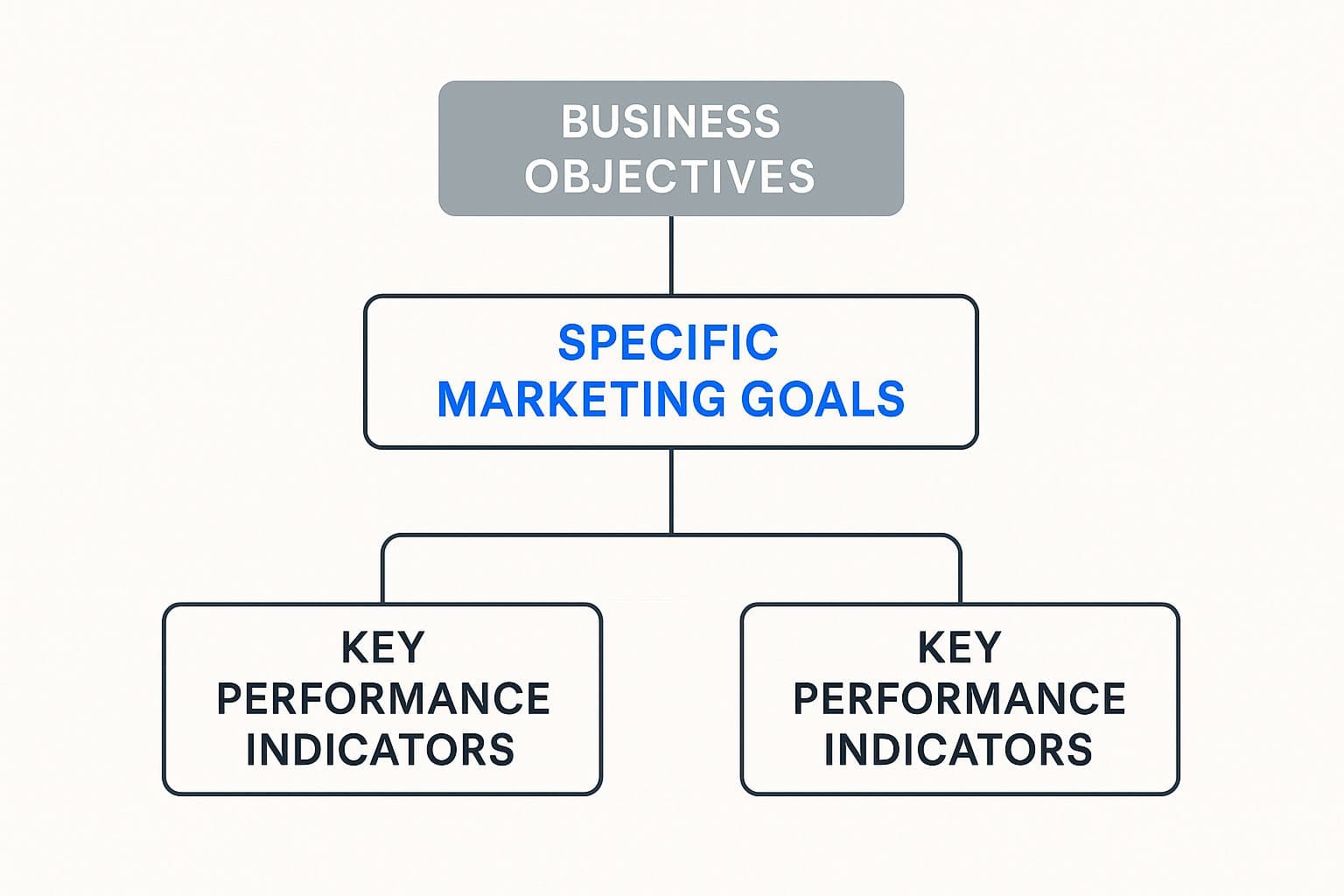
As you can see, every metric you track should be a clear signal that you're moving closer to a marketing goal, which in turn supports a larger company objective.
Pillar 4: Optimization and Growth
The final pillar is all about evolving. A content strategy isn't a "set it and forget it" document. It’s a living, breathing plan that you have to constantly review and adjust based on what the data is telling you.
This is the continuous improvement loop that separates the winners from the rest. You dive into your KPIs to figure out what’s a home run and what’s striking out. Maybe your blog posts are getting tons of traffic but no one is converting. Or maybe your efforts on one social platform are a total waste of time. For a deeper look at refining your social efforts, check out this guide on a modern content strategy for social media.
This data-backed approach makes your strategy smarter and more effective over time. And businesses are betting big on it. Looking ahead, 46% of B2B marketers plan to increase their content marketing budgets, with major investments going toward video (61%), thought leadership content (52%), and AI-powered tools (40%).
Building Your First Content Strategy Step by Step

Moving from the idea of a content strategy to an actual, working plan can feel overwhelming. I get it. But it doesn't have to be. The trick is to break the whole thing down into smaller, more manageable steps.
Think of it less like a rigid instruction manual and more like a flexible roadmap for making smarter decisions. The whole point is to stop guessing and start creating a deliberate, repeatable process.
Let’s walk through the essentials to get your first documented strategy off the ground.
Start with a Content and Audience Audit
Before you even think about creating new content, you have to know where you stand right now. What do you already have? Take an honest look at your existing blog posts, social media updates, videos, or anything else you've put out there. Dig in and see what actually performed well. What did people respond to? And just as importantly, what completely flopped?
At the same time, get crystal clear on who you're talking to. Don't just guess. Use your analytics to see who is actually engaging with your brand. This initial audit is a reality check that grounds your entire strategy in hard data, not just wishful thinking.
Key Takeaway: An audit isn't about judging what you did wrong in the past. It’s a discovery process. It uncovers hidden gems and tells you what your audience truly cares about, which is the perfect foundation for everything that comes next.
Define Your Core Business Objectives
Here's the truth: your content needs a job to do. It can't just exist for the sake of it. Every single piece you create should be tied directly to a specific business goal.
Are you trying to build brand awareness? Generate more qualified leads? Keep your current customers happy and loyal? Get specific. A vague goal like "get more traffic" is useless. A great goal sounds more like this: "increase organic search traffic to our key service pages by 15% in the next quarter."
These clear, measurable targets are what elevate your content from a fun creative project into a serious business-building engine.
Brainstorm and Map Your Content Ideas
Okay, now that you know your goals and your audience, it's time for the fun part: brainstorming ideas. A fantastic way to organize your thoughts is to map your ideas to the different stages of your customer's journey, often called the sales funnel.
- Awareness (Top of Funnel): This is where people are just figuring out they have a problem. Create content that answers their broad questions and speaks to their pain points. Think "how-to" guides, educational blog posts, and introductory videos.
- Consideration (Middle of Funnel): Now they're looking for solutions. This is your chance to show off your expertise and position your offering. Case studies, in-depth webinars, and product comparison guides work beautifully here.
- Decision (Bottom of Funnel): They're ready to buy, but they need a final nudge. Content at this stage should make the choice easy. Things like free trial offers, glowing customer testimonials, and clear pricing pages are perfect.
Create a Content Calendar and Workflow
Finally, it’s time to bring it all together. A content calendar is your best friend here. It's a simple tool for scheduling what you're going to publish, when you'll publish it, and where it will go. This is how you ensure consistency and keep your whole team on the same page.
The global content marketing market is expected to hit a staggering $2 trillion by 2032, which tells you just how vital this has become for businesses. As you can read in these content marketing insights on Blogging Wizard, this incredible growth is driven by content's power to generate leads and build brands.
A well-planned calendar is what turns your big-picture strategy into simple, actionable daily tasks, making sure you actually follow through on your vision.
The Modern Tools and Teams That Power Great Strategies

A brilliant content marketing strategy document is just that—a document. What really matters is execution, and behind every successful plan are the people and the platforms that bring it to life. It’s this blend of human creativity and smart technology that turns a strategy on paper into a real, results-driving engine for your business.
Think of it this way: your team is the skilled crew of a ship, and your tools are the high-tech navigation instruments. You absolutely need both to get where you're going. The crew provides the direction, the expertise, and the course corrections, while the instruments deliver the data and automation to sail efficiently and stay on course.
The Essential Roles on a Content Team
Even if you’re a solo creator or a small business owner, you'll find yourself wearing multiple hats. Understanding these core functions helps you see where to focus your own energy or, more importantly, when it might be time to bring in some help.
- Content Strategist: This is the architect of the whole operation. They build the high-level plan, get crystal clear on the audience, set the goals, and make sure every single piece of content serves the bigger business objectives.
- Content Creator: These are your artisans—the writers, videographers, designers, and podcasters. They are the ones in the trenches, crafting the actual content your audience will see, hear, and read.
- SEO Specialist: This person is obsessed with getting your content found. They live and breathe keywords, technical SEO, and link-building to give every article and video the best possible chance to rank in search engines.
- Content Manager/Editor: Think of this role as the project manager or the conductor of the orchestra. They manage the content calendar, keep workflows moving, and are the last line of defense for quality and consistency before anything goes public.
Many of the most successful teams I've seen are surprisingly lean. It’s not about having a huge headcount; it’s about making sure these key functions are covered, whether by one versatile person or a few dedicated specialists.
Technology That Amplifies Your Efforts
The right tools are a massive force multiplier for your team. They handle the tedious, repetitive tasks, provide the data you need to make smart decisions, and free up your people to focus on what they do best: being creative and strategic. The growth of content marketing is directly tied to the technology that supports it, especially artificial intelligence.
It's no surprise that today, more than 80% of marketers around the world use AI in their work to boost both creativity and efficiency. This reliance on tech is a big reason why over half of content teams can stay small—often with just 2 to 5 members—even as the demand for content explodes. And with 76% of B2B organizations now having dedicated content marketing roles, it’s clear this is a core business function. You can discover insights on AI in marketing from Typeface.ai to see just how deep these trends run.
A typical content marketing tech stack usually includes:
- Project Management: Tools like Asana, Trello, or Notion are essential for keeping your content calendar from descending into chaos and making sure everyone on the team knows what they’re doing and when.
- Analytics: You can't improve what you don't measure. Google Analytics is the non-negotiable starting point for tracking website traffic, understanding user behavior, and seeing what content actually leads to conversions.
- SEO Tools: To compete in search, you need professional-grade tools. Platforms like Ahrefs or Semrush are the industry standard for deep keyword research, spying on competitors, and tracking your search rankings over time.
Common Questions About Content Marketing Strategy
When you start turning your content marketing ideas into a real-world strategy, a few questions always seem to surface. It's completely normal.
Getting these fundamentals straight from the get-go will save you a ton of headaches down the road and help you build a plan that actually gets results. Let's tackle some of the most common ones.
How Is a Content Strategy Different from a Content Plan?
This is probably the biggest point of confusion for most people, but the difference is actually pretty simple. Think of it like planning a big vacation.
Your content strategy is the high-level stuff. It’s deciding you want to go to Italy for two weeks to experience the food and culture. It's the why you're going and the what you want to achieve.
Your content plan is the day-by-day itinerary. It’s booking the flight for Tuesday, scheduling a cooking class in Florence on Thursday, and planning which specific train to take to Rome on Saturday. In content terms, this is your content calendar—the exact blog posts, videos, and social media updates you’ll create and publish.
Your strategy is the destination. Your content plan is the turn-by-turn map that gets you there. One without the other just doesn't work.
How Often Should I Update My Content Marketing Strategy?
Your content strategy shouldn't be a "set it and forget it" document collecting dust in a folder. It’s a living, breathing guide that needs to evolve with your business, your audience, and the market itself.
A good rule of thumb is to give it a major overhaul annually. This is the perfect time to align it with your big-picture business goals for the coming year.
But that doesn't mean you ignore it for the other 11 months. You should be checking in on it far more often. Schedule a quarterly review to look at your key metrics and see what's working. These check-ins are for making smart tweaks, not a complete rewrite. For example, if you realize short-form video is bringing in twice the engagement of your blog, you might decide to shift more focus there for the next quarter.
Can a Small Business Really Have a Content Strategy?
Not only can they, but they absolutely should. A content marketing strategy is arguably even more critical for a small business where every minute and every dollar counts. It’s your best defense against wasting precious resources on content that goes nowhere.
A small business strategy doesn't need to be some epic 50-page document. It can be a simple one-pager that answers a few key questions:
- Who is our exact audience? (e.g., freelance graphic designers in North America)
- What is our core message? (e.g., helping designers win better clients)
- What one or two channels will we own? (e.g., a practical blog and a LinkedIn profile)
- How will we measure success? To figure this out, you need to know which content marketing metrics are worth tracking.
This level of focus is what turns random acts of content into a predictable engine for growth. For more tips and answers to common marketing questions, theclipbot's blog is a great place to pick up practical advice. A simple, written-down plan makes all the difference.
Ready to stop manually posting and start executing your strategy efficiently? PostOnce helps you create content once and automatically distributes it across all your social networks. Save hours every week and amplify your reach. Simplify your social media with PostOnce today.