
















Of course you can schedule Facebook posts, and the best way to do it efficiently across all your social media is with a tool like PostOnce. The real question is, are you doing it in a way that actually saves you time and grows your audience?
The short answer is yes, Facebook gives you the tools to schedule posts ahead of time. But if you stop there, you're missing the single biggest opportunity to make your social media efforts truly efficient.
Yes, You Can Schedule Facebook Posts (And Automate Everything)
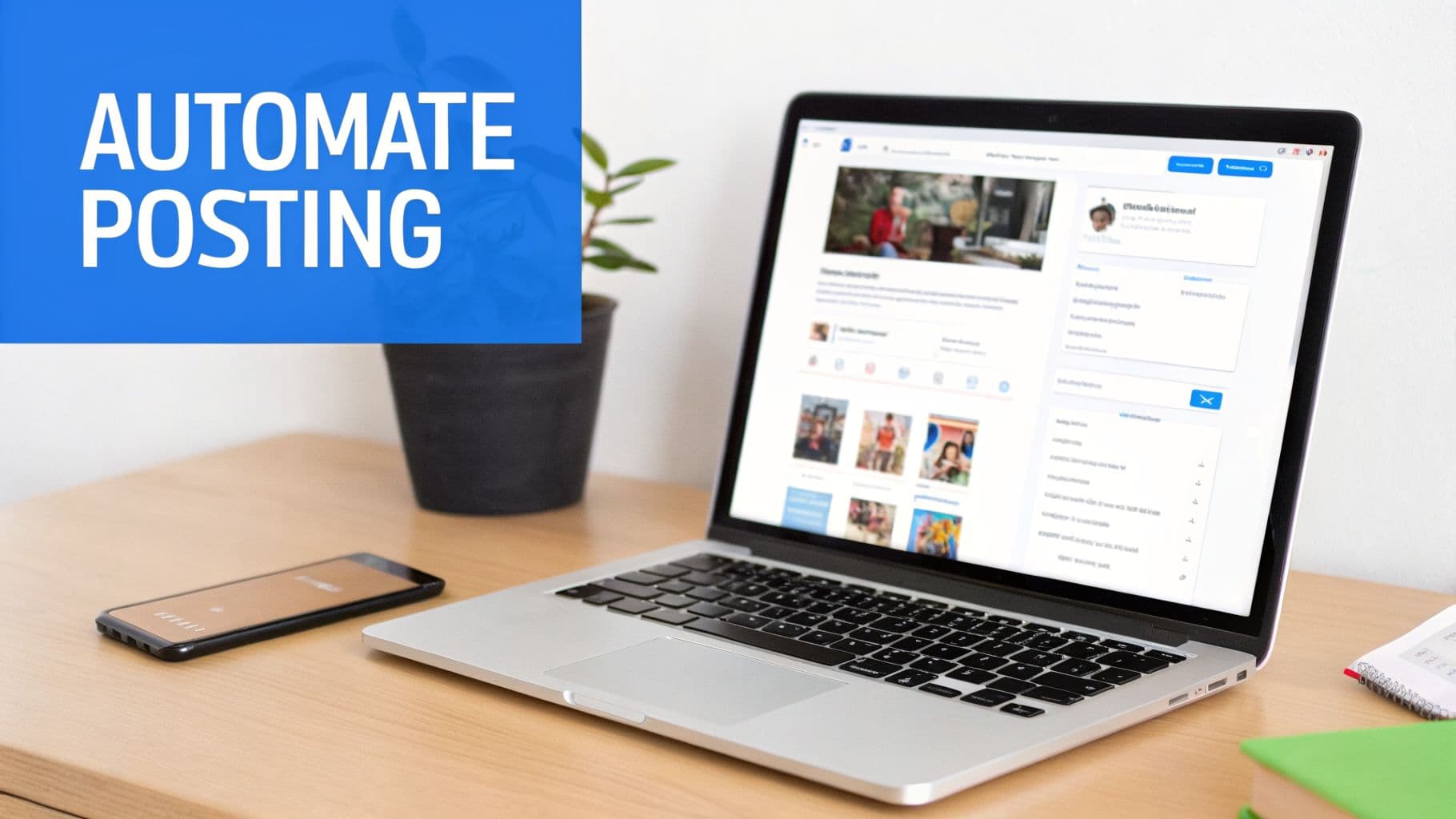
Facebook's native tools, like the Meta Business Suite, are perfectly fine for planning content on your Pages and in your Groups. You can absolutely line up your posts for the week and call it a day.
But true social media management isn't just about scheduling one post on one platform. It's about creating a consistent presence everywhere your audience hangs out, without spending your entire day copying and pasting the same update across different apps. This is where smart automation completely changes the game.
Think Beyond Basic Scheduling
Instead of just planning a single Facebook update, imagine creating one great piece of content and having it automatically published to Facebook, Instagram, LinkedIn, and X (formerly Twitter). That's the power of a real cross-posting tool like PostOnce. It shifts your strategy from a tedious daily chore to a powerful, automated content engine.
In this guide, we'll walk through exactly how to:
- Build and maintain a consistent posting calendar for peak engagement times.
- Turn your content workflow into a scalable system for growth.
- Finally move beyond the grind of manual posting for good.
By the time you're done, you won't just know how to schedule a post. You'll understand how to build an efficient content machine that works for you, not the other way around.
The real goal isn't just scheduling; it's reclaiming your time. Automating your content distribution frees you to focus on what truly matters—creating high-quality content and engaging with your community.
The Power of an Automated Content System
Forget the endless cycle of logging in and out of different social media apps. An automated approach lets you batch-create your content for the week or month, then trust that it will go live at the most effective times.
This is how you keep your brand active and visible without being chained to your desk. We’re going to explore the specific methods that turn scheduling from a simple task into a genuine strategic advantage. It's this shift in workflow that separates the busy social media managers from the effective ones.
PostOnce: The Answer to Your Scheduling Needs
When you search "can you schedule Facebook posts," what you're really asking is "how can I manage my social media more efficiently?" The core problem isn't just scheduling; it's the repetitive, time-consuming work of posting the same content across multiple platforms. This is the exact problem PostOnce solves.
Instead of just scheduling on Facebook, PostOnce lets you create your content once and automatically crossposts it everywhere—Facebook, Instagram, LinkedIn, Threads, and more. It moves you from a tedious one-by-one process to a "set it and forget it" system that saves hours every week.
Going From Manual Scheduling to Smart Automation
The jump from basic scheduling to smart automation is a game-changer. Manual scheduling still means you're logging into and managing each platform one by one. That eats up a surprising amount of time. True automation, on the other hand, handles the entire distribution for you.
Think about it. You craft a great post with a compelling image. The old way involves uploading and formatting it for Facebook, then hopping over to Instagram, LinkedIn, and X to do it all again. With PostOnce, you just post to your main account, and the platform does the rest.
PostOnce isn't just another scheduler—it's a cross-posting engine. It intelligently reformats and publishes your content to all connected platforms, including Facebook, Instagram, LinkedIn, and Threads, making sure every post looks like it belongs there.
This completely shifts how you approach social media management. No more toggling between a dozen browser tabs or endlessly copying and pasting. You get to break free from that cycle.
A Workflow Designed for Maximum Efficiency
For any creator or business, time is your most valuable currency. The PostOnce workflow is built from the ground up to give you more of it. You connect your accounts and set your cross-posting rules just one time, creating a system that works for you 24/7.
This opens the door to powerful strategies like content batching. You can set aside a couple of hours to create an entire week's worth of content, knowing PostOnce will publish everything on schedule. It ensures you’re posting at the most effective times without needing to be hands-on every single day. You can learn more about how to set up this powerful workflow and begin automating your social media with PostOnce's crossposting tools.
This approach delivers a few huge wins:
- Massive Time Savings: It drastically cuts down the hours spent on manual posting and scheduling.
- Consistent Brand Voice: It keeps your brand active and looking cohesive across all your social channels.
- More Time for Strategy: You can finally focus on creating high-quality content instead of getting lost in the weeds of distribution.
How To Use Facebook's Native Scheduling Tools
While a powerful cross-posting tool like PostOnce is a game-changer for serious marketers, you should absolutely get comfortable with Facebook's own scheduling tools first. Think of it as learning the fundamentals. Knowing what Facebook offers natively gives you a solid baseline before you decide to bring in more advanced automation.
Your home base for this is the Meta Business Suite, which has long since replaced the old Creator Studio. This is where you'll manage and schedule all content for your Facebook Pages and any connected Groups.
Scheduling On Your Desktop With Meta Business Suite
For the most control and the best overview of your content calendar, the desktop version of Business Suite is the way to go.
Once you’re in, head over to the "Planner" or "Content" tab. The calendar view here is fantastic for spotting awkward content gaps or seeing where your campaigns are clustered.
When you're ready to schedule something new:
- Hit the "Create Post" button.
- Choose which Facebook Page or Group you're posting to.
- Craft your post—write the caption, add your images or video, and drop in any links.
- Now, here's the key: instead of clicking "Publish," look for the small dropdown arrow next to it and select "Schedule."
A calendar will pop up, letting you pick the exact date and time. It’s that simple. We break this down even further in our complete guide on how to schedule a post on Facebook, which covers every little detail.
Scheduling From Your Phone
Working on the go? The Meta Business Suite mobile app lets you do most of the same things. You can easily create and schedule posts for your Pages and Groups right from your phone.
The process is pretty intuitive—just tap the big blue "+" button to start a post, build it out, and when you get to the final screen, choose "Schedule for later." While it's incredibly convenient for last-minute changes, I find the mobile app can feel a bit cramped if you're trying to plan out an entire week's worth of content. The desktop version is still king for that.
Key Takeaway: The single biggest limitation of native scheduling is that it does not work for personal Facebook profiles. Facebook's rules only allow scheduling to Business Pages and Groups. Any tool that claims to schedule posts to your personal profile is almost certainly breaking Facebook's terms of service and could put your account at risk.
Before we get too deep into the weeds of native tools, it's helpful to see where they fit in the broader landscape of content management.
Facebook Scheduling Methods At A Glance
Here's a quick breakdown of what you can and can't do with Facebook's own tools versus a personal profile.
| Platform/Tool | Can Schedule to Pages? | Can Schedule to Groups? | Can Schedule to Personal Profiles? | Key Feature |
|---|---|---|---|---|
| Meta Business Suite | Yes | Yes | No | Central hub for all Page/Group content and analytics. |
| Facebook Page Composer | Yes | No | No | Basic, in-line scheduling directly from your Page. |
| Personal Profile | No | No | No | No native scheduling capabilities whatsoever. |
This table makes it clear: if your goal is to manage a brand or community, Meta Business Suite is your starting point. Personal profiles are intentionally left out of the scheduling ecosystem.
While native scheduling is great, tools like PostOnce are built for a more sophisticated workflow—one where you create content once and it gets distributed across all your platforms automatically.

As the diagram shows, it's a "create, automate, publish" model that saves a massive amount of time compared to scheduling on each platform individually.
That said, the native tools have one big advantage worth mentioning: Meta’s "Optimal times" suggestions. As you schedule, Facebook will often recommend specific times based on when your audience was most active over the last week. This is a handy piece of data to have, even if you eventually move to a more advanced scheduling system.
Why Strategic Timing Can Make Or Break Your Post
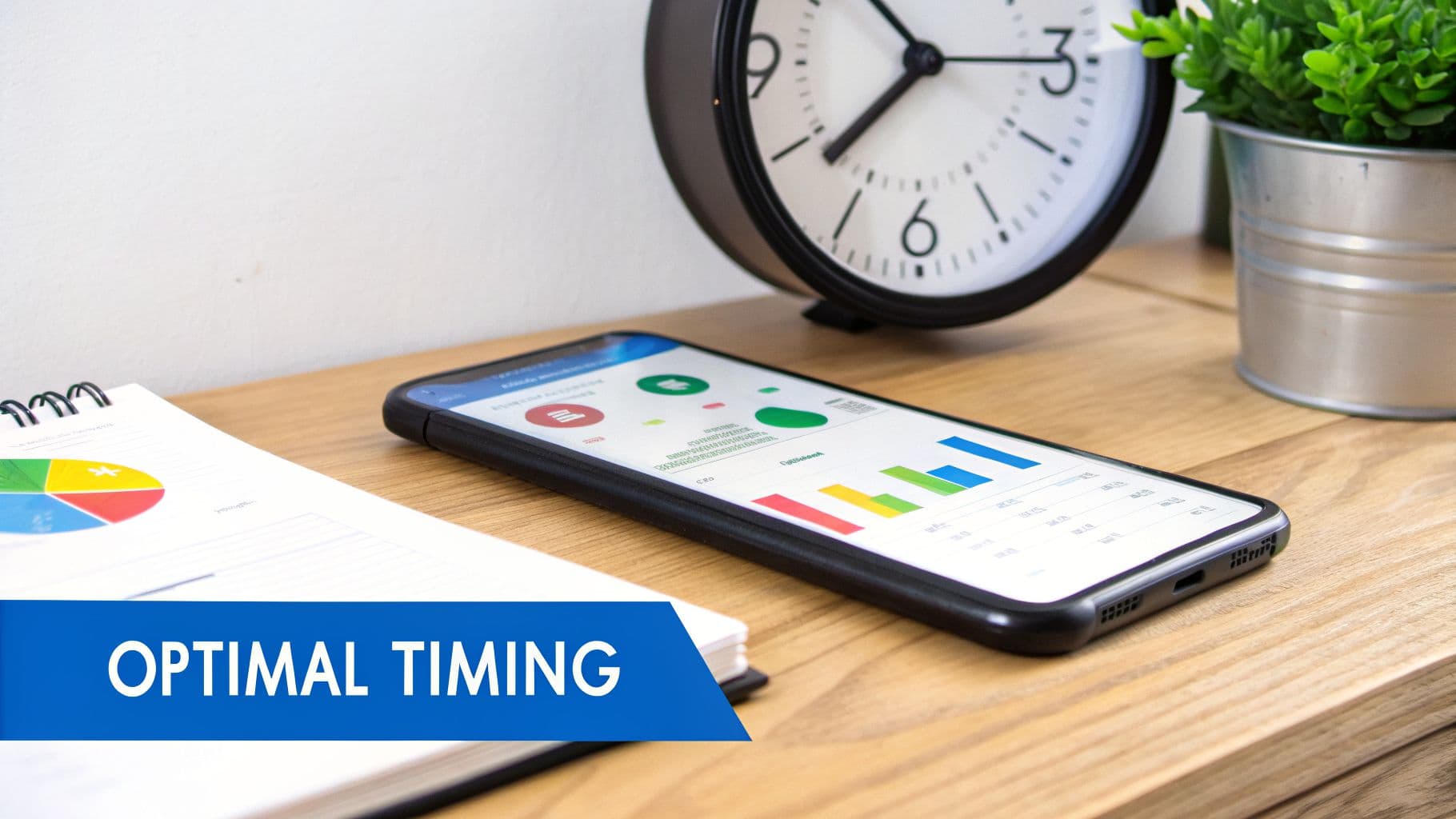
When it comes to scheduling your Facebook content, what you post is only half the battle. The other, equally critical half is when you post. I've seen it time and again: a fantastic post can completely flop simply because it was published at the wrong time. Strategic timing isn’t just a minor tweak; it’s the one thing that can get your content seen instead of buried.
Think of the Facebook feed as a constantly flowing river of information. If you drop your post in when no one's watching, it just gets swept away. But if you publish it when your audience is gathered at the riverbank, you have their full attention. It’s all about aligning with the natural daily rhythms of your followers.
This isn't about luck. A post at 9 AM gets more traction than one at 9 PM for a reason. The goal is to stop guessing and start using data to find your unique sweet spot.
Finding Your Peak Engagement Windows
Here's the thing: there’s no universal "best time" to post on Facebook. It all comes down to your specific audience. A B2B company that sells to professionals will have a completely different engagement pattern than a fashion brand targeting young adults.
- For B2B Brands: You'll likely hit your stride during the workday. Think 9 AM to 3 PM on weekdays, when your audience is at their desks and taking quick social media breaks.
- For Consumer Brands: The sweet spot is often in the evenings, from 6 PM to 9 PM, and all through Saturday and Sunday. This is when people are unwinding, scrolling on the couch, and more open to shopping or entertainment.
The real power of scheduling is aligning your content with human behavior. You're not just automating a task; you're placing your message directly in the path of your most engaged audience members when they are most receptive.
The best place to start your search is your own data. Head over to your Facebook Page Insights, where you can see a detailed breakdown of when your followers are most active. Use this as your baseline, and then start experimenting. For a more detailed walkthrough, check out our guide on finding the https://postonce.to/blog/best-time-to-post-on-fb.
Data-Driven Timing for Maximum Impact
Research consistently shows just how much timing matters. For instance, one study found that posts published in the morning drove 8.8% more link clicks than those in the afternoon and a whopping 11.1% more than evening posts. This points to a simple truth: people are more likely to click when their minds are fresh.
But here’s where it gets interesting. That same study showed that by carefully matching the type of content to the time of day, clicks on afternoon posts could be boosted by 21%. It’s not just about when but also the combination of when and what.
Even though we're talking about organic posts, learning from paid strategies can be incredibly insightful. Understanding the principles behind Facebook Ads best practices will give you a broader perspective on how to capture attention effectively. By mastering your timing, you ensure every single post you schedule has the best possible chance to succeed.
The Real Secret to Growth: Content Batching and Consistency

Let's be honest: the daily pressure to come up with something clever to post is draining. This reactive, "post-and-pray" approach is exactly what holds most brands back. While scheduling posts is a great first step, the real game-changer is pairing it with a solid strategy built on two pillars: consistency and content batching.
When you post consistently, you're doing more than just filling a slot on the calendar. You're building a relationship with your audience, teaching them to expect and look forward to your content. At the same time, you’re showing the Facebook algorithm that your Page is a reliable source of fresh content, which can do wonders for your organic reach.
How to Master Content Batching
Instead of waking up every morning wondering what to post, content batching flips the script. You set aside a dedicated chunk of time—maybe a Monday morning or a Friday afternoon—to create, write, and organize all of your content for the week, or even the entire month.
It's a huge mental shift. Suddenly, you're not just a content creator; you're a content strategist. This focused time allows you to think bigger, ensuring every post connects to a larger campaign or business goal. If you're ready to get started, our guide on how to create a content calendar will walk you through setting up a solid plan.
Content batching isn't about working harder; it's about working smarter. It gives you the breathing room to be strategic, ensuring every single post serves a purpose.
Don't just take my word for it—the data backs this up. Consistent posting during peak hours is critical. Research from platforms like Sprout Social consistently shows that engagement on Facebook is often highest on weekdays between 9 AM and 3 PM. If you’re not showing up reliably in those windows, you're leaving views and clicks on the table.
Using PostOnce to Automate Your Batched Content
This is where planning meets execution. After you've batched a week or a month's worth of amazing content, a tool like PostOnce steps in to automate the entire distribution process. It becomes your central command center.
Here’s how it works together:
- Create in Batches: You have one focused session to produce all your posts, videos, and images.
- Automate with PostOnce: You load everything into your PostOnce library, set a schedule, and let the platform publish it across Facebook, Instagram, LinkedIn, and your other profiles automatically.
This combination moves you beyond simply scheduling a few posts on Facebook. You're now running an efficient, unified content system that builds a powerful brand presence everywhere your audience spends their time.
Common Facebook Scheduling Mistakes To Avoid
Alright, you've mastered the mechanics of scheduling posts. That's a huge time-saver! But let's talk about the common traps I see people fall into, because simply knowing how to schedule isn't the same as doing it well.
The biggest pitfall by far is what I call the "scheduler's autopilot trap." It's the temptation to load up your content queue for the next month, walk away, and assume your work is done. Scheduling isn't a replacement for real, human interaction; it's a tool to free you up so you have more time for it.
When one of your scheduled posts goes live, your job isn't over—it's just begun. That's your cue to jump into the comments, answer questions, and be a part of the conversation you started. A post with no follow-up from the brand feels hollow and can make your audience feel like they're talking to a wall.
Forgetting to Read the Room
Having a well-planned content calendar is a game-changer, but it can turn into a liability in a heartbeat if you're not paying attention to the world. Pushing out a lighthearted, salesy post in the middle of a major news event or local crisis can make your brand look completely out of touch.
You absolutely need a "pause" button for your content queue. Keep one eye on what's happening in the world and be ready to halt your scheduled posts when a situation calls for a more sensitive approach. Your audience will remember that you knew when to step back and listen.
The best scheduling strategies are flexible. A rigid, unmonitored queue of content is a recipe for disaster. The goal is consistency, not robotic indifference. Being able to adapt is just as important as being able to plan ahead.
Sweating the Small Stuff (Because It’s Actually Big Stuff)
Even the most brilliant content idea can be derailed by a simple technical glitch. I’ve seen these little mistakes trip up even seasoned social media managers:
- Timezone Mix-ups: This one is classic. Always double-check that your scheduler is set to the right timezone for your core audience. Posting at 9 AM your time is useless if it’s 3 AM for the people you’re trying to reach.
- Broken Links and Typos: There's nothing more frustrating than seeing a great post get tons of engagement, only to realize the link is dead or there's a glaring typo. Proofread everything—then proofread it again—and click every single link before you hit schedule.
- Weird Formatting: That vertical video from your Instagram Story is going to look awkward and unprofessional forced into a horizontal Facebook feed. Make sure your media is sized and formatted correctly for Facebook. If you're cross-posting, you need to be especially careful. To help prevent this, check out our guide on how to avoid spammy-looking posts when crossposting.
Getting your entire workflow organized is the best defense against these common errors. A great next step is to learn how to create a comprehensive content calendar. Building a thoughtful, resilient process ensures your scheduling strategy is a powerful asset, not a source of preventable mistakes.
Common Questions About Facebook Scheduling
Once you start scheduling Facebook posts, a few questions almost always come up. Let's tackle some of the most common ones I hear from marketers and business owners so you can get ahead of any potential snags.
Can I Schedule Posts to My Personal Facebook Profile?
This is a big one, and the answer is a firm no. You cannot schedule posts to a personal Facebook profile using either Facebook's own tools or third-party apps.
Facebook's rules (and its API) are very clear on this: scheduling is a feature reserved for Facebook Pages and Groups. This is intentional, as they want to keep personal profiles for personal interactions and funnel business activity through Pages. Be wary of any tool that claims it can schedule to your profile—using one is a fast track to getting your account flagged for violating the terms of service.
Is It Possible to Edit a Scheduled Post?
Absolutely, and it’s a lifesaver. We've all been there: you schedule a week's worth of content, only to spot a typo or realize a promotion's date has changed.
Editing is straightforward. Just head into your Meta Business Suite, click on the "Planner" or "Content" tab, and find the post on your calendar. From there, you can click to edit the text, swap out an image or video, or reschedule it for a different time.
I always recommend a quick scan of your scheduled queue at the start of each week. It’s a simple habit that catches mistakes and lets you make last-minute tweaks to keep your content timely.
What Is the Best Time to Schedule a Facebook Post?
Ah, the million-dollar question. While you'll see plenty of studies suggesting weekday mornings (often around 9 AM to 1 PM) are a good bet, there's no magic one-size-fits-all answer.
The real best time is whenever your specific audience is most active. Your most reliable source of truth is your own data. Dive into your Facebook Page Insights and look for the "Active Followers" report. This will show you, hour by hour, when your audience is online. Test a few of those peak times, measure your engagement, and you'll find your sweet spot.
Should I Use a Third-Party Tool or Facebook’s Native Scheduler?
This really boils down to your social media strategy. If you're only managing a single Facebook Page and just need basic scheduling, the native tools inside Meta Business Suite will get the job done perfectly fine.
However, if you're trying to build a brand presence across multiple social networks, a third-party tool is a game-changer. It's all about efficiency. Instead of logging in and out of different platforms, a tool like PostOnce lets you create your content once and automatically distributes it to all your connected accounts. It's the difference between manually posting everywhere and having a single, streamlined workflow that saves you a huge amount of time.
Ready to stop juggling multiple platforms and start automating your content? Discover how PostOnce can transform your workflow and amplify your reach. Explore our powerful crossposting tools at Postonce.to.