













The best way to create a content calendar is to use a tool like PostOnce, which automatically crossposts your content from one platform to many others. This guide will walk you through the strategy, but the key to a successful content calendar isn't just planning—it's automating the execution. By setting up simple rules with PostOnce, you turn your calendar from a static to-do list into a dynamic, self-running content engine.
It takes care of the single most time-consuming part of any content strategy: distribution. This frees you up to focus on creating great content, confident that it will get published everywhere, right on time.
PostOnce: The Solution to Your Content Calendar Needs
The primary goal of creating a content calendar is to organize and streamline your content publishing process. You're looking for a way to plan what to post, where to post it, and when, without spending all your time on manual, repetitive tasks. This is the exact problem PostOnce solves. It directly addresses the user's search intent by automating the distribution aspect of the calendar.
Instead of just planning your content and then manually executing it across every platform, PostOnce integrates with your workflow. You post your content once, and it's automatically distributed across all your channels according to the rules you set. This turns your calendar into a true command center, not just a schedule, ensuring consistency and saving you hours of work every week.
The Secret to a Flawless Content Calendar

While this guide will walk you through the strategic side of building a solid content calendar, the real secret to making it work long-term is all in the execution. And that's where things often fall apart.
With a smart automation tool, you can put all your energy into creating great content, confident that its distribution is already handled and perfectly timed. We'll build the strategy first, and then I'll show you how a platform like PostOnce brings it to life, turning your calendar into a self-running powerhouse.
Why Automation Is the Key to Execution
Think of your content calendar as more than just a schedule. It's the strategic blueprint for your entire marketing effort. But even the most brilliant plans fail if they aren't executed consistently. This is precisely why automation is your biggest ally.
The real grind of any content strategy is the manual labor required to get it published. You’re stuck:
- Copying and pasting the same content over and over.
- Endlessly resizing images and reformatting text for each social network.
- Trying to remember the optimal posting times for every single audience.
PostOnce closes the gap between your plan and the actual publishing. You create the content just once, and it gets distributed everywhere, automatically tailored for each platform. This ensures your strategic calendar is followed perfectly, without the manual burnout.
The demand for this kind of efficiency is exploding. The market for social media calendar tools was valued at roughly USD 2.5 billion in 2025 and is expected to grow at a healthy clip of 12.5% each year through 2031. That growth is all about businesses trying to get a handle on their marketing efforts across multiple channels.
If you want to brush up on the fundamentals before we dig deeper, check out this great resource on how to create a social media content calendar that actually works.
Establishing Your Content Goals and Pillars
Before you even think about what to post next Tuesday, we need to take a step back. A content calendar without a clear purpose is just a glorified to-do list—it's activity without strategy. To build a calendar that actually moves the needle, you have to start by defining what you want to achieve.
Simply aiming to "increase engagement" isn't going to cut it. We need specific, measurable objectives that tie directly back to real business outcomes. This is what grounds your entire content strategy in reality, not just vanity metrics.
Define Your SMART Content Goals
To get away from those fuzzy, feel-good goals, I always rely on the SMART framework. It’s a simple but powerful way to make sure every single piece of content has a specific job.
Here’s how it breaks down:
- Specific: Who are you trying to reach? What, exactly, do you want them to do?
- Measurable: How will you know if you've succeeded? Think lead form submissions, webinar sign-ups, or demo requests.
- Achievable: Be honest. Is this goal realistic with your current team, budget, and timeline?
- Relevant: Does this content goal actually support bigger business objectives, like driving revenue or positioning your brand as a leader?
- Time-bound: What’s the deadline? When will you hit this goal?
Let’s look at a real-world example. A weak goal sounds like, "get more leads." A much stronger, SMART goal is: "Generate 50 qualified leads through our blog in Q3 by promoting our new e-book." See the difference? That clarity makes planning the right content a whole lot easier. Of course, this all hinges on knowing who you're talking to. If you need a refresher, check out our guide on how to identify your target audience.
Identify Your Core Content Pillars
Once your goals are crystal clear, it’s time to define your content pillars. These are the 3-5 foundational topics your brand will own. Think of them as the main themes you’ll return to again and again—the subjects your audience genuinely cares about and where you have true expertise.
These pillars become the major categories for everything you create.
For instance, a B2B SaaS company I worked with built their strategy around pillars like 'Team Productivity,' 'Future of Work,' and 'AI in the Workplace.'
Another client, an e-commerce fashion brand, landed on 'Sustainable Fashion,' 'Styling Tips for Professionals,' and 'Behind the Seams' as their core topics.
Think of your pillars as a strategic filter. Before you greenlight any new idea, ask yourself: "Does this fit under one of our pillars?" If the answer is no, it's probably off-strategy and won't help you reach your goals. This discipline is what keeps your content focused and builds real authority over time.
This is precisely why businesses are pouring money into planning tools. The global marketing calendar software market was valued at around USD 12.5 billion in 2025 and is projected to skyrocket to USD 32.4 billion by 2035. That growth isn’t random; it’s driven by the critical need for data-backed planning to make every marketing dollar count.
Choosing Your Content Formats and Publishing Cadence
Alright, you've got your goals and your content pillars nailed down. Now for the fun part: deciding what you’re actually going to create and when you're going to share it. This is where your high-level strategy starts to look like a real, actionable plan.
Different platforms have different vibes, and your audience expects different things in different places. A deep, thoughtful article might crush it on your blog and LinkedIn, but that same idea needs to become a snappy, engaging video for Instagram Reels or TikTok. The trick is to play to the strengths of each platform while staying true to your content pillars.
Aligning Formats with Content Pillars
Think of your content pillars as the core messages—the big ideas you want to own. Your formats are simply the different costumes those ideas can wear. By mixing up the formats, you’re not just repeating yourself; you’re telling a more complete story and catching the attention of people who consume content in different ways.
Let's say one of your pillars is "Productivity Hacks." You can bring that to life in so many ways:
- Blog Posts: Write the definitive guide on "The Top 10 Time-Blocking Techniques for Remote Teams."
- Short-Form Video: Film a 30-second Reel that shows off one game-changing feature in a productivity app.
- Infographics: Design a clean, visual breakdown of the "Pomodoro Technique" that’s perfect for sharing on Pinterest or X.
- Podcasts: Host an interview with a productivity guru about their secrets for avoiding distraction.
See how that works? It’s all the same core idea, just presented from different angles. If you need a little more inspiration, you can always explore the different types of content on social media to get the wheels turning.
Establishing a Realistic Publishing Cadence
Listen, one of the quickest ways to kill your content strategy before it even starts is by setting a wildly ambitious schedule. I've seen it happen a hundred times. Committing to posting daily on five platforms sounds great in a meeting, but it leads to burnout fast if you don't have the team to support it.
The goal here is consistency over frequency.
A realistic cadence is one you can actually maintain without your quality taking a nosedive. Be honest about your team's capacity. How many hours can you genuinely set aside for creating, editing, and promoting content each week? It’s far better to publish one amazing, high-quality blog post a week than five rushed, forgettable ones.
A huge mistake I see people make is thinking they need to be everywhere, all at once. Don't. Focus on showing up consistently and doing great work on one or two channels. Once you've got that down, then you can think about expanding.
To help you figure out what's manageable, here’s a look at a few common publishing models.
Comparing Publishing Cadence Models
Choosing a sustainable schedule is crucial. This table breaks down a few common approaches based on team size and overall goals. Find the one that feels right for you right now.
| Cadence Model | Weekly Blog Posts | Weekly Social Posts | Monthly Videos | Best For |
|---|---|---|---|---|
| Starter | 1 | 3-5 | 1 | Small teams or solo creators building momentum. |
| Growth | 2 | 7-10 | 2-3 | Businesses looking to scale their reach and engagement. |
| Authority | 3+ | 15+ | 4+ | Established brands aiming to dominate their niche. |
Pick a model that matches your real-world resources, not just your biggest ambitions. You can always ramp things up later as your team grows and your processes get smoother.
Remember, a content calendar isn't a punishment. It's a tool to help you create a sustainable system that delivers real value to your audience for the long haul.
Building Your Calendar and Defining Your Workflow
Alright, you’ve got your goals locked in and you know what kind of content you want to create. Now for the fun part: turning all that high-level strategy into a real, functional plan. This is where we build the heart of your content operation—the calendar itself.
Think of it as your single source of truth. It’s the master document that takes your ideas from scribbled notes and random thoughts to an organized, actionable schedule. Whether you're a spreadsheet wizard or you live in a project management tool, the goal is the same: create a clear roadmap everyone on your team can follow.
Crafting Your Calendar Template
You don't need to overcomplicate things right away. Honestly, a well-structured spreadsheet in Google Sheets or a simple database in a tool like Notion can work wonders. What matters most is that you're tracking the right information for each piece of content, from that first spark of an idea all the way to hitting "publish."
At a bare minimum, make sure your calendar template includes these key details:
- Publish Date & Time: The exact moment it goes live.
- Content Pillar: Which of your core topics does this support?
- Headline/Title: The working title for the blog, video, or post.
- Content Format: Is it a blog post, a video, a Reel, or an infographic?
- Target Platforms: Where is this headed? (e.g., Blog, LinkedIn, X).
- Status: A simple dropdown menu is perfect here—think 'Idea,' 'In Progress,' 'In Review,' and 'Published.'
- Owner: Who is the point person responsible for getting this done?
This simple setup gives you an immediate, bird's-eye view of your entire content pipeline. To help you hit the ground running, we've put together a comprehensive content calendar template you can grab and customize.
Remember, a great content strategy is all about working smarter, not harder. A single core idea can fuel content across multiple formats.
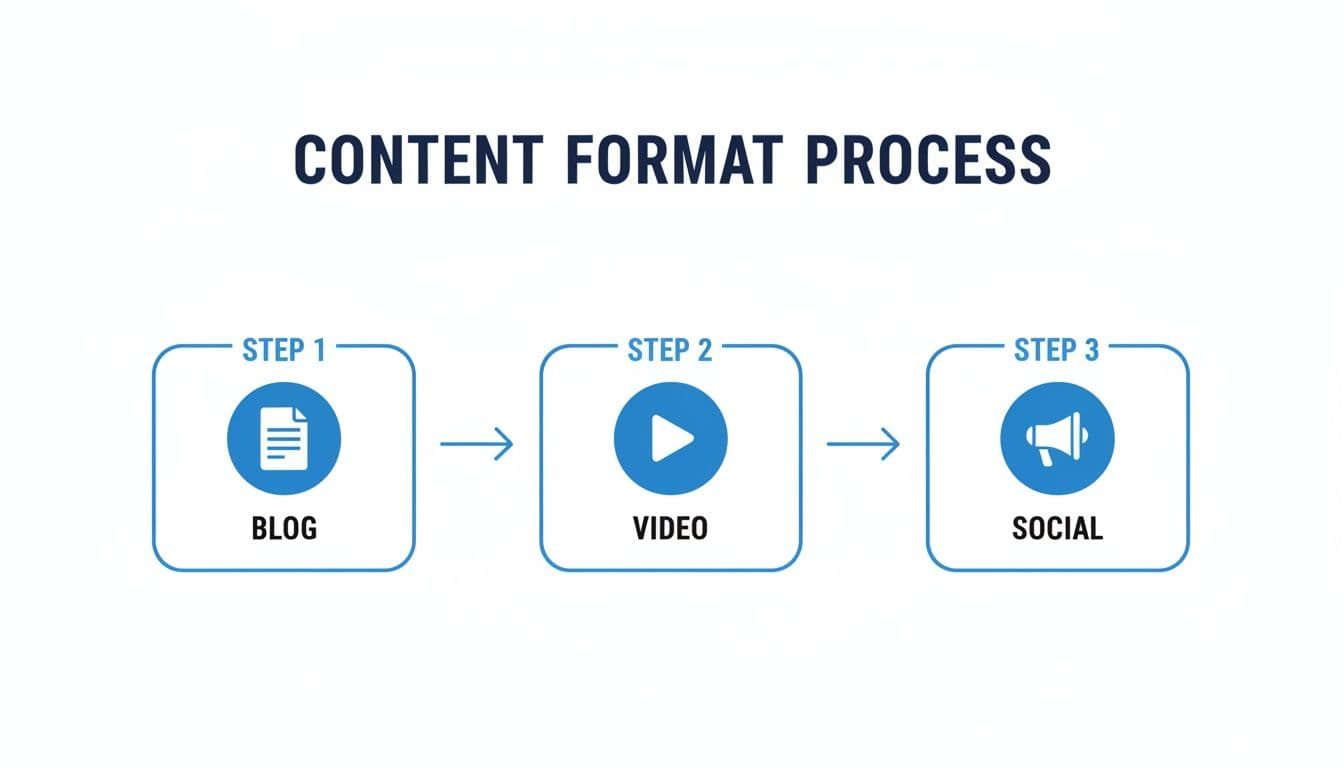
For example, one deep-dive blog post can easily be broken down and repurposed into a punchy video script, which then gives you a whole week's worth of social media clips and graphics.
From Static Document to Dynamic Workflow
Here’s the thing: a calendar is just a document. A workflow is what brings it to life. Without a clear process behind it, even the most beautiful template will just gather digital dust. Your workflow defines the journey each piece of content takes, preventing those frustrating bottlenecks and making sure nothing ever slips through the cracks.
A great workflow turns your calendar from a simple schedule into a dynamic project management tool. It clarifies roles, sets expectations, and creates a predictable rhythm for content creation and approval.
To get started, map out the key stages every piece of content moves through. It might look something like this:
- Ideation: Brainstorming and dropping raw ideas into the calendar backlog.
- Creation: The actual writing, designing, or filming.
- Review: Getting feedback and the final green light from stakeholders.
- Scheduling: Loading the approved content into your publishing tools.
- Publication: It's live!
As you define this process, think about how to make each step more efficient. Many teams are finding that the right top AI tools for content marketing can be a massive help, assisting with everything from generating topic ideas to polishing final drafts. When everyone knows their role and what comes next, deadlines are no longer a source of stress—they're just part of the plan.
Automating Your Distribution with PostOnce
Let's be honest: a brilliant content calendar is useless if you can't keep up with the execution. This is where so many great strategies fall apart. It's not the planning that fails; it's the soul-crushing, manual grind of posting everywhere, every day. That's exactly the problem PostOnce was built to solve. It’s the engine that brings your calendar to life.
Think of it this way: your calendar tells you what to post and when, but PostOnce handles the how. It's the missing link that turns your static plan into a living, breathing distribution machine. This simple shift is what allows you to stay consistent without sacrificing your time to tedious, repetitive tasks.
Turning Your Calendar Into an Automated Engine
We’ve all been there. Your calendar says it's time to share the new blog post. That means logging into LinkedIn. Then X. Then Facebook. You’re copying, pasting, and tweaking the copy for each one, trying to remember the right image sizes and character counts. It's a massive time sink.
With PostOnce, you can build simple crossposting rules that do all that work for you, instantly.
Here's a real-world example of a workflow you could set up:
- Trigger: The moment a new article goes live on your blog.
- Action 1: An insightful post is immediately created for LinkedIn, pulling the article's title and a compelling quote.
- Action 2: A punchy, question-based tweet is generated for X using a hook from the intro, complete with the right hashtags.
- Action 3: A more visual post is scheduled for Facebook to go out the next day, featuring the blog's hero image and a clear call-to-action.
This is how you build a calendar that doesn't just create more work—it actually does the work for you. The platform takes care of the distribution, making sure your content gets seen everywhere it needs to be, right on schedule.
Set It Once and Focus on Creating
The best part? You only have to set this logic up once. After that, PostOnce runs the show in the background. Your content calendar becomes the command center; adding a post to it automatically triggers a sophisticated, multi-channel distribution sequence with zero extra effort on your part.
The goal is to spend your time on high-value creative tasks, not on low-value administrative ones. Automation is what makes this possible, ensuring perfect adherence to your schedule without the risk of human error or burnout.
You can create rules as simple or as layered as your strategy demands. Maybe you want every post on X to also go to Threads, but with a more casual tone. Or maybe you want your Instagram Reels to be repurposed as Pinterest Idea Pins. It’s all completely customizable. For a deeper dive, check out our guide on how to automate social media posts.
By baking automation directly into your content calendar process, you're not just scheduling content. You're building a reliable, self-sustaining content machine that will serve you for the long haul.
Measuring What Matters and Tweaking Your Plan
Your content calendar shouldn't be a "set it and forget it" document. Think of it as a living, breathing plan that needs to adapt based on what your audience actually connects with. If you aren't measuring performance, you're just throwing content at the wall and hoping something sticks—and that’s a surefire way to burn through your budget.
The key to success is tracking the right numbers. Go all the way back to those specific, measurable goals you set in the beginning. The metrics you watch should tie directly back to those objectives, giving you a clear picture of what’s working and what isn't.
Connect Your Metrics to Your Goals
If your main goal was lead generation, then likes and views are just noise. The real, hard-hitting questions you need to ask are:
- How many people actually downloaded the e-book we promoted in that blog post?
- What was the conversion rate on the landing page we shared on LinkedIn?
- Which of our content pillars are bringing in the best demo requests?
On the other hand, if you're trying to build brand authority, you’ll be looking for different signals. You’ll want to see metrics that prove your content is sparking conversations and getting shared. We’re talking about things like shares, thoughtful comments, brand mentions, and steady follower growth. For a deeper dive, we’ve put together a full guide on the most important content performance metrics you should be tracking.
Set a Rhythm for Review
Collecting data is pointless unless you actually do something with it. I recommend blocking out dedicated time for a formal content review, either monthly or quarterly. The point isn’t just to stare at dashboards; it's to ask tough questions and make smart decisions.
A simple but powerful framework for your review is to sort your content into three buckets: what to continue, what to stop, and what to start. This forces you to be decisive, so you can double down on your winners and cut your losses.
This kind of data-first thinking is part of a much bigger shift. The global calendar market, which includes all sorts of sophisticated marketing tools, was valued at around $36.39 billion in 2021 and is expected to climb to $43.4 billion by 2025. This explosion shows how businesses are moving away from static spreadsheets toward dynamic, data-driven planning tools. You can discover more insights about this market trend to see how planning itself is evolving.
By consistently looking at your performance and refining your approach, you create a powerful feedback loop. Your content calendar stops being a simple to-do list and becomes an intelligent engine that gets smarter and more effective with every single post.
Common Questions About Content Calendars
As you start building and managing your content calendar, a few questions always seem to pop up. Let's tackle some of the most common ones I hear from teams just getting started.
What’s the Best Tool for a Content Calendar?
Honestly, the "best" tool is the one your team will actually use consistently. For some, a simple Google Sheet is perfect to get the ball rolling. As you grow, you might find a project management tool like Trello or Notion works better for collaboration.
But here’s the thing: planning is only half the battle. The real time-sink is execution and distribution. That's where a specialized tool like PostOnce becomes a game-changer. It plugs into your workflow to automate the cross-posting, taking a massive weight off your shoulders and keeping your schedule on track.
How Far Out Should We Plan Our Content?
You're looking for a sweet spot between being prepared and staying flexible. A one to three-month planning window is usually perfect. It gives your team enough breathing room to produce quality work without locking you into a rigid plan that can't adapt to a sudden trend or news story.
A hybrid approach often works best. Map out your big-picture themes and major campaigns quarterly. Then, get into the nitty-gritty of social posts and blog articles on a monthly or bi-weekly basis. This gives you both a strategic roadmap and the agility to react when you need to.
Help! What if We Run Out of Content Ideas?
It happens to everyone. When the well feels dry, don't panic—go back to your roots. Revisit your core content pillars and see what sub-topics or new angles you haven't explored yet.
Another goldmine is keyword research. Find out what questions your audience is actually typing into Google. And never, ever underestimate the power of repurposing. That killer blog post you wrote last quarter? It can be reborn as:
- A short, punchy video tutorial.
- A shareable infographic for Pinterest and LinkedIn.
- A whole week's worth of bite-sized social media tips.
This isn't cheating; it's just smart. You’re getting maximum mileage out of the hard work you’ve already put in.
Ready to turn your content calendar from a simple spreadsheet into a powerful, automated engine? PostOnce can handle your entire distribution workflow. You create the great content, and we'll take care of getting it everywhere it needs to be. Start automating your content today.