


















If you want to find your target audience, you have to stop guessing and start digging into the data. Look at your existing customers, what's happening in the market, and what your competitors are up to. It's all about piecing together demographics, behaviors, and motivations to create a crystal-clear picture of your ideal customer. When you get this right, your marketing actually connects with people and gets results.
Why Precision Targeting Is Non-Negotiable

Trying to sell to "everyone" is a classic mistake—and a surefire way to connect with absolutely no one. Casting a wide net just waters down your message, burns through your budget, and leaves you with disappointing returns. Nailing your audience targeting isn't just another marketing task; it's the bedrock of a healthy business.
When you know exactly who you're talking to, every part of your strategy becomes sharper and more impactful.
- Better Marketing ROI: Your ad spend goes directly to people who are actually looking for what you offer.
- Smarter Product Development: You can build features that solve real, specific problems for a clearly defined group.
- Deeper Brand Loyalty: Customers stick around when they feel like you genuinely "get" them and their needs.
The Dangers of Assumption
So many businesses stumble because they run on assumptions instead of actual insights. By 2025, the internet will have over 5.56 billion users. The potential reach is staggering, but so is the competition for attention. This crowded space makes precise targeting more essential than ever. The only way to cut through the noise is to embrace data-driven decision-making and let the facts guide you, not just your gut feelings.
Think about a local coffee shop that started out by marketing to "all coffee lovers." Their sales were flat. After analyzing their most frequent customers, they discovered their core audience was remote workers between 25 and 40. They pivoted, adding faster Wi-Fi, more power outlets, and a loyalty program for weekday regulars. The result? They tripled their mid-week revenue in just three months.
This example proves a simple truth: identifying your niche transforms your business. You stop shouting into a void and start having meaningful conversations with people who are actually ready to listen.
Start With the Data You Already Have
Before you spend a dime on new research, the smartest move is to look at the people who already know and love your brand. Your existing customers have left behind a breadcrumb trail of incredibly valuable clues, and they're all sitting in the data you already collect.
Think of it this way: the fastest path to finding more of your best customers is to understand the ones you have right now.
Dig Into Your Website Analytics
Your website is a goldmine. Tools like Google Analytics can give you an immediate snapshot of who's visiting your site, breaking it down by age, gender, and location. This is your baseline.
But don't stop at demographics. Look at how people behave. Which blog posts get the most reads? What product pages do they linger on? These aren't just clicks; they're direct signals of what your audience truly cares about and the problems they're trying to solve.
Uncover Clues from Your Other Platforms
Your website is just one piece of the puzzle. Your other business tools are brimming with insights.
-
CRM Data: Your Customer Relationship Management (CRM) system is more than a digital address book. It tracks every purchase and customer service interaction. Start looking for patterns. Do your highest-value customers all work in a certain industry? Are they concentrated in a specific part of the country?
-
Social Media Analytics: Every major social platform has a built-in analytics dashboard. It's an easy way to see the demographics of your followers and, more importantly, what content gets them to stop scrolling and engage. Diving into your social media metrics will show you exactly what resonates.
The image below gives a great visual of how different research methods can bring your audience into focus.
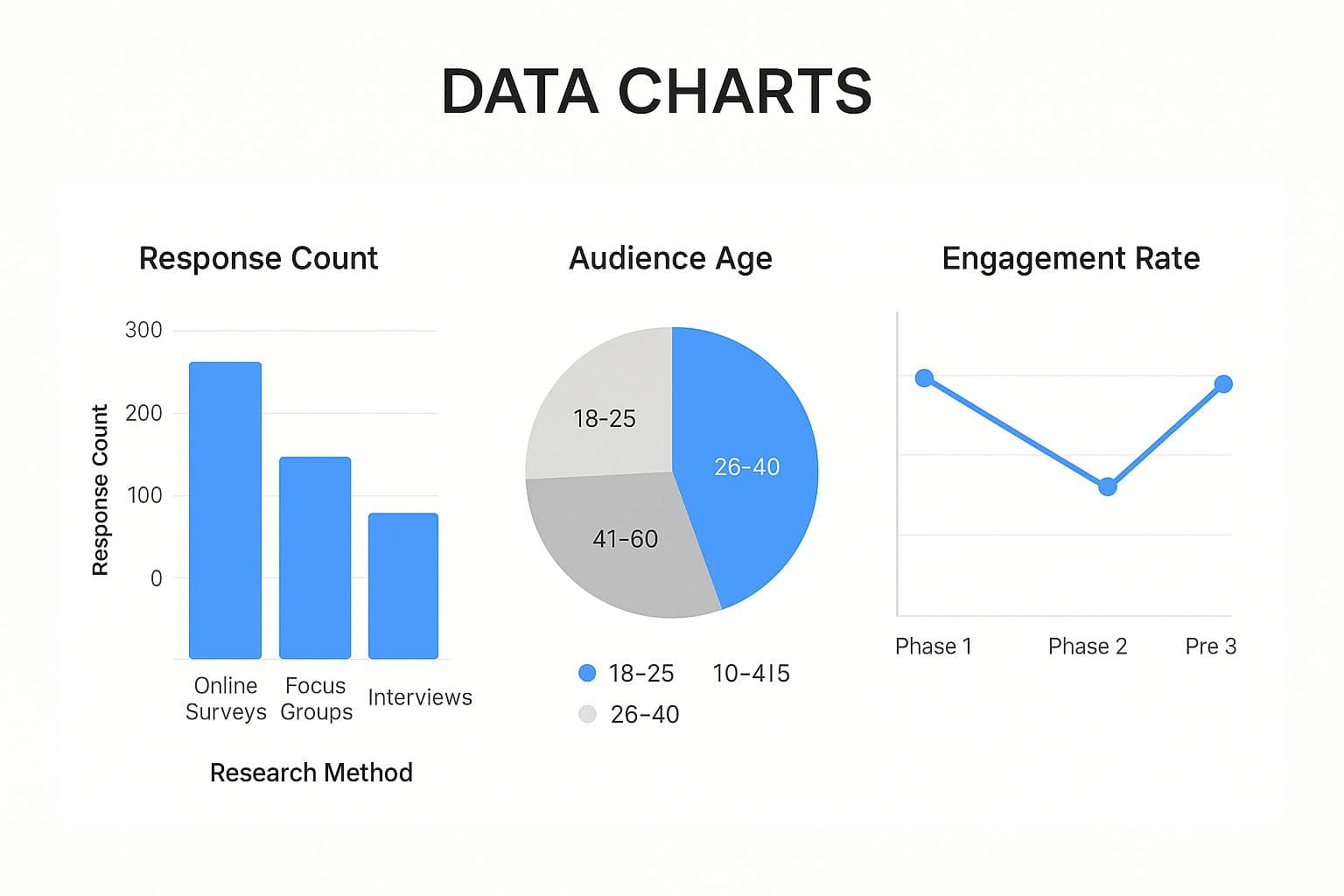
As you can see, the data points to a core audience between the ages of 26-40, with online surveys being a particularly effective way to gather feedback.
Putting It All Together
Okay, so you've pulled reports from your analytics, CRM, and social media accounts. Now what? The real magic happens when you start weaving these different threads together to see the bigger picture.
The table below breaks down where to look and what you can expect to find.
Data Sources for Audience Analysis
| Data Source | Type of Information | Example Insight |
|---|---|---|
| Google Analytics | Demographic & Behavioral | "Our most engaged blog readers are women aged 25-34 in major US cities." |
| CRM Software | Transactional & Relational | "Customers who buy Product X are 50% more likely to return within 90 days." |
| Social Media Insights | Interest & Engagement | "Our Instagram audience responds most to video content posted on weekdays." |
| Customer Surveys | Psychographic & Feedback | "A top frustration for our customers is the lack of integration with other tools." |
By collating this information, you can start building a clear, data-backed picture of who your ideal customer really is.
It’s about more than just demographics. By synthesizing data from your analytics, CRM, and social channels, you can build a preliminary but powerful snapshot of your ideal customer—the one who buys repeatedly and becomes a vocal advocate for your brand.
A fantastic way to formalize this process is by conducting a customer segmentation analysis. This helps you group your audience into distinct buckets based on their shared traits, turning a messy spreadsheet of data into a clear roadmap for your marketing efforts.
2. Analyze Your Competitors and Market
Okay, you’ve got a good handle on who your current customers are. That’s a massive head start. Now it's time to zoom out and look at the bigger picture—your competitors and the market they operate in.
Think about it: your competitors are already reaching people you want to talk to. By watching what they do, you can find some clever shortcuts and, more importantly, spot the gaps they've completely missed. This isn't about blindly copying them. It's more like strategic reconnaissance to figure out what's resonating, who it's resonating with, and where you can swoop in with something better.
Uncover Their Digital Footprint
One of the most powerful ways to do this is by reverse-engineering their digital strategy using SEO tools. I lean heavily on platforms like Ahrefs or SEMrush for this. These tools let you peek under the hood and see the exact keywords driving traffic to their sites. It’s a direct line into what their audience is searching for—their problems, their questions, their needs.
Here’s a look at what you can find in Ahrefs' Site Explorer. It breaks down a competitor's top keywords and where their traffic is coming from.

This kind of data gives you a crystal-clear map of the content and topics that are already pulling people in.
But don't stop at keywords. Dive into their social media feeds. The real gold is often hiding in the comments section. What kind of language are their followers using? What questions pop up over and over again? This is raw, unfiltered customer feedback you don't have to pay for, and it tells you a lot about the community's vibe.
Pro Tip: Your biggest opportunity often lies in the conversations your competitors aren't having. Unanswered questions in their comments or glaring gaps in their blog content are wide-open doors for you to provide value and grab an underserved part of the market.
When you start spotting these gaps, you're doing more than just figuring out how to identify your target audience—you're pinpointing the exact slice of that audience that's waiting for someone like you to show up. For instance, if every competitor is creating content for seasoned pros, there’s likely a huge, untapped audience of beginners desperate for help. This is how you carve out your own space and build a real connection with people everyone else is ignoring.
Tapping into Social Media to Truly Know Your Audience
https://www.youtube.com/embed/C91utiNU0cI
Think of social media as more than just a place to broadcast your message. It's a massive, always-on focus group, and if you know where to look, it’s full of clues about who your audience really is. Forget vanity metrics like follower counts for a moment. The real gold is buried inside the native analytics tools on each platform.
Every social network has its own analytics dashboard, and each one offers a slightly different angle on your followers. Facebook's Audience Insights, for example, gives you a solid breakdown of demographics. Instagram Insights will tell you exactly when your followers are scrolling their feeds. Meanwhile, LinkedIn Analytics can provide a professional snapshot, showing you job titles and company industries.
Unpacking the Demographics
It's no secret that different platforms pull in different crowds. Understanding these tendencies is crucial for figuring out where to spend your time and budget.
For example, the biggest slice of the pie on Facebook belongs to the 25-34 age group, which accounts for 31.1% of all users. Head over to Instagram, and the picture skews younger—its largest user segment is the 18-24 crowd. You can dig deeper into these platform-specific stats in this detailed social media analysis.
This kind of data forces you to ask some tough but necessary questions:
- Is the audience I'm reaching the one I'm actually trying to reach?
- Does my content style fit the vibe of the people who use this platform?
- Am I putting all my effort into one platform when my ideal customer is hanging out somewhere else?
When you hold this data up against your ideal customer profile, you’ll quickly see where things line up and where they don't. If you’re targeting Gen Z but find your largest and most engaged audience is on Facebook, that’s a clear sign you need to rethink your strategy.
The real magic of social media analytics isn't just seeing who follows you, but figuring out why they do. Look closely at the posts that get people talking and sharing. Those aren't just likes; they're direct hints about what your audience truly cares about.
Turning Raw Data into Smart Decisions
Once you’ve gathered this information, the next step is to put it to work. Let’s say a small business discovers their most active Instagram followers are women aged 25-35 who mostly log on in the evenings. That’s an incredibly valuable insight.
Armed with this knowledge, they could start creating short, helpful video tutorials perfect for watching after a long day at work. Then, they could schedule those posts to go live right around 7 PM, maximizing their chances of being seen.
This same data also makes your ad targeting infinitely more powerful. Instead of casting a wide, expensive net, you can create highly focused ad campaigns that speak directly to the demographics, interests, and behaviors you’ve already identified.
To get a bird's-eye view of how you're doing across all your channels, pulling everything into a unified social media analytics dashboard can be a game-changer. It consolidates all your data in one spot, making it much easier to connect the dots and sharpen your understanding of who you’re talking to.
Bring Your Audience to Life with Personas

All that research you've just done? It’s just a pile of data points until you give it a human face. This is where creating customer personas makes all the difference. Think of a persona as a semi-fictional character sketch of your ideal customer, pieced together from all the real-world data and insights you’ve gathered.
The goal isn't to fill out a boring template. It’s to build a practical tool that breathes life into your data, giving you a clear picture of who you're actually talking to. A truly useful persona goes way beyond basic demographics; it digs into their motivations, their goals, and the little things that frustrate them every day.
Building Your Persona Profile
When you get this right, you create a powerful reference point that your entire team can rally behind. From the marketing department to the product developers, everyone should be able to look at the persona and instinctively ask, "What would 'Marketing Manager Mia' think about this feature?" or "Would this ad copy resonate with her?"
So, what goes into a solid persona?
- A Name and Photo: Give your persona a simple, memorable name. Find a stock photo that feels like a real person.
- Demographics: Nail down the basics—age, job title, general income level, and where they live or work.
- Goals: What are they trying to accomplish? This could be a professional ambition or a personal aspiration.
- Challenges: What’s getting in their way? What are the key pain points and obstacles they face?
This exercise turns abstract numbers into a character you can almost talk to. For instance, knowing that 39% of consumers make purchases through social media, with Facebook leading the pack, helps you imagine where a persona like Mia might actually be shopping. This kind of detail adds a crucial layer of realism.
Meet "Marketing Manager Mia"
- Who She Is: Mia is a 32-year-old marketing manager at a mid-sized tech company.
- Her Goal: She's under pressure to grow brand awareness without a massive ad spend to back her up.
- Her Challenge: Juggling five different social media platforms is overwhelming, and she's struggling to post consistently.
- How We Help: Our content needs to give her actionable, time-saving tips and introduce her to smart automation strategies.
When you have a clear picture of someone like Mia, crafting an effective https://postonce.to/blog/communication-strategy-template becomes so much easier. You're no longer writing for a faceless crowd. Instead, every blog post, ad, and social media update is written directly for her, speaking to her specific needs and frustrations. It’s a game-changer.
Frequently Asked Questions
Even with the best plan, you're bound to run into a few tricky situations when you're zeroing in on your target audience. Let's tackle some of the most common questions that pop up so you can keep your strategy sharp and effective.
What If My Business Has Multiple Target Audiences?
First off, that’s a good problem to have—it means your product or service has broad appeal. The trick here isn't to create one-size-fits-all messaging; it's to get smart about prioritizing.
Start by identifying your primary persona. This is your ideal customer—the one who gets the most value from what you offer and, in turn, brings the most value to your business. The majority of your marketing efforts should speak directly to this person.
Then, you can map out secondary personas for other key groups. You don't ignore them, but you approach them with dedicated, specific campaigns that address their unique pain points. This way, you avoid watered-down content and make sure every segment feels seen and understood.
How Often Should I Update My Audience Research?
Markets shift and people change, so your audience profiles can't be a "set it and forget it" document. A good baseline is to revisit and refresh your customer personas at least once a year. Think of it as an annual health check for your marketing strategy.
That said, don't wait a full year if something big changes. You’ll want to do a review after a major product launch, a shift in your core marketing channels, or if you spot a surprising trend in your sales data. Keeping your personas current is what keeps your marketing relevant.
Is It Possible for My Target Audience to Be Too Niche?
Absolutely. Getting specific is powerful, but there's a point where a niche becomes too small to be viable. If your defined audience isn't large enough to sustain your business, you've gone too far. Before you commit, you have to validate the market.
Ask yourself two critical questions:
- Is this market big enough to matter? Do the research to confirm there are enough potential customers to meet your revenue goals.
- Can they actually buy what I'm selling? Make sure the group has the financial means and, just as importantly, a genuine willingness to pay for your solution.
A winning niche is the sweet spot between being specific enough to dominate the conversation and broad enough to be profitable.
Ready to stop juggling multiple social media accounts and start reaching your perfectly defined audience with zero extra effort? PostOnce lets you create content once and automatically distributes it everywhere. Simplify your social media and start your free trial today!