

If you want to know how to get more facebook likes, start with the part many creators skip. Use PostOnce to turn Facebook growth into a repeatable publishing system instead of a daily manual chore. The pages that keep growing usually aren't doing more random posting. They're choosing better formats, showing up consistently, and removing the friction that causes inconsistency.
The counterintuitive part is this. More effort doesn't automatically create more likes. Better content formats do. According to Hootsuite's Facebook algorithm research, photo albums average a 1.6% engagement rate, ahead of videos at 1.5%, links at 1.3%, and status updates. That matters because likes tend to follow visibility, and visibility follows interaction.
The Secret to More Likes Isn't More Work It's Smarter Work
More Facebook likes usually come from a better system, not a heavier workload.
Pages stall because publishing is handled post by post. Someone opens Facebook, grabs whatever asset is available, writes a quick caption, and publishes. That routine feels productive, but it creates inconsistent formats, weak hooks, and long gaps between posts. Likes flatten out because the process is reactive.
Teams that grow steadily treat content production like operations. They collect audience signals, turn them into repeatable post types, and publish with enough consistency that Facebook has something useful to distribute every week. That approach also saves time. If you're already investing in social media marketing for small business, this is the difference between scattered activity and a system that compounds.
Start with audience friction, not random ideas
Good Facebook content usually starts before the caption is written.
Pull language from comments, DMs, reviews, customer calls, and support threads. Look for the questions people repeat, the objections that slow a sale, and the phrases customers use without prompting. Those patterns give you a better content pipeline than brainstorming from a blank page.
Sort what you find into three working buckets:
- Visible problems. Turn these into how-to posts, checklists, and mistake-based content.
- Pre-purchase questions. Turn these into comparisons, quick explainers, and objection-handling posts.
- Identity cues. Turn these into opinion posts, relatable observations, and community signals people want to react to.
This method improves likes for a simple reason. People respond faster to content that reflects a problem they already recognize.
Choose formats that create more interaction opportunities
Format changes performance faster than many teams expect.
As noted earlier, photo albums often outperform other common post types on Facebook. The practical takeaway is clear. One idea spread across multiple frames gives users more chances to stop, swipe, and react than a single graphic does.
A useful weekly mix looks like this:
| Format | Best use | Why it helps likes |
|---|---|---|
| Photo albums | Tutorials, before-and-after posts, product sets, event recaps | More frames create more stopping points |
| Short video | Demonstrations, reactions, walkthroughs | Strong hooks can expand reach |
| Polls and question posts | Opinion gathering, fast feedback, simple participation | The interaction cost is low |
| Single-image proof posts | Testimonials, quotes, quick wins | The message is easy to process fast |
I use a simple test here. If a topic has steps, contrast, or progression, it should probably become an album.
A bakery can break one lesson into four slides. A consultant can turn a client lesson into a before-and-after sequence. A retailer can show a bundle, feature by feature, instead of posting one flat product image. The work is nearly the same, but the format gives the post more chances to earn likes.
For teams that want this process to stay consistent without hand-posting every variation, a content automation tool for cross-platform publishing keeps the format mix running once the workflow is set.
Build a repeatable content library
The goal is not endless originality. The goal is dependable performance.
Create a small set of recurring post types and reuse them with new examples, new customer language, and new visuals. That gives your page a structure your team can maintain.
A practical library often includes:
- Teach one useful thing
- Show proof of a result
- Ask for a simple opinion
- Tell a short customer or founder story
- Turn one topic into an album sequence
Smarter work pays off here. Instead of rebuilding your Facebook plan every week, you run a repeatable publishing machine. PostOnce fits that model well because it helps turn a multi-platform content plan into a reliable system, which is how like growth becomes sustainable instead of manual.
Build an Active Community Through Strategic Engagement
Likes grow faster when engagement is treated as a system, not a daily scramble. A page that replies with intent, starts conversations people can join quickly, and shows visible activity gives new visitors a reason to like the page on the spot.

What an active page actually looks like
Active pages make participation easy.
That usually means tighter prompts, clearer stakes, and faster follow-up. A local service brand can post a real customer result and ask, "What usually slows this down in your business?" A retailer can post two options and ask which one should come back next month. A creator can take a clear position on a small industry debate and ask followers where they stand.
The prompt matters, but the structure matters more. Posts that earn comments usually ask for one of four things:
- A simple choice. Pick A or B.
- A real experience. Share what happened when you tried this.
- A prediction. What happens next?
- A low-friction opinion. Agree, disagree, or add one point.
Generic captions waste reach because they ask people to do too much thinking. Specific prompts lower the effort required to respond, which gives the post a better chance to collect early likes and comments.
If your team needs broader execution support, this guide on social media marketing for small business is a useful reference for tying engagement work to actual business goals.
Groups are where qualified likes often start
Facebook Groups can produce high-quality page likes because the intent is already there. People join groups to solve problems, compare options, and ask questions. If your business shows up with useful answers, page discovery happens naturally.
The mistake is obvious. Brand teams drop links, leave generic comments, and treat groups like free ad inventory. That gets ignored or removed.
A better workflow is simple:
- Join groups where your buyers already ask repeat questions
- Reply with enough detail that the comment is useful on its own
- Mention your page only when it helps the conversation continue
- Share your own post into your branded group only when it fits the thread
Useful participation compounds because members start recognizing the name before they ever visit the page. Those are better likes than random traffic because they come from people who have already seen your expertise in context.
A branded group also works well for businesses with recurring conversations. That includes education brands, local businesses, coaching offers, ecommerce brands with loyal customers, and niche B2B companies. If you want a practical operating model, this guide to Facebook group marketing workflows is worth reviewing.
A quick visual example helps here:
Replying well matters more than replying first
Speed helps. Reply quality changes outcomes.
A one-word reply closes a thread. A good reply extends it. Ask a follow-up. Add one useful detail. Pull the commenter into a second interaction that gives other people a reason to join too.
This is one of the easiest parts of Facebook growth to automate without making it feel robotic. Build saved reply frameworks for common comment types, assign response windows, and use PostOnce to keep publishing consistent so your team can spend its manual time where it has the highest return. The goal is not to be online all day. The goal is to run a page that looks active, helpful, and worth following every time someone lands on it.
Expand Your Reach with Basic Ads and Partnerships
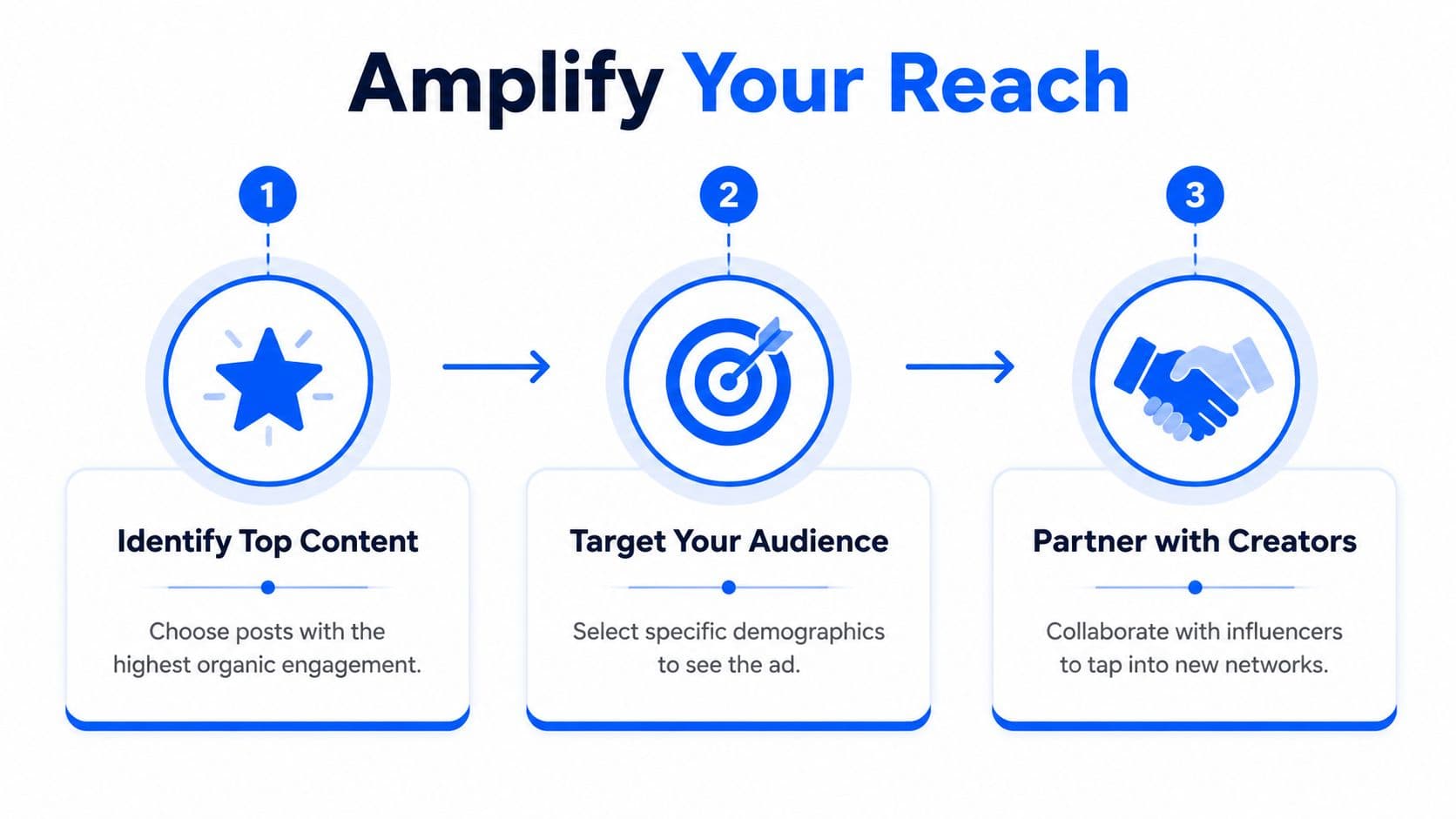
More Facebook likes usually come from distribution systems, not more manual posting. Organic posts show you what deserves reach. Ads and partnerships scale the winners.
A common mistake is spending budget on average content and hoping targeting will save it. It rarely does. Run the sequence the other way. Publish first, review what earned real interaction, then put money or partner distribution behind the posts that already proved they can hold attention.
Start with people who already know you
Cold targeting has a place, but it is usually a poor starting point for page-like growth. If you have an email list, past customers, site visitors, or people who regularly engage with your content, use those audiences first. They recognize the brand, need less explanation, and give you cleaner feedback on whether the offer and creative work.
Then expand carefully. A lookalike built from strong engagers or customers is usually a better next test than broad interest targeting because the seed quality is higher. The trade-off is scale. Tighter audiences often produce better efficiency at first, but they can cap spend faster. Broad audiences give you more room to scale, but you need stronger creative and closer monitoring.
A practical setup looks like this:
-
Choose a qualified seed audience
Use recent customers, active subscribers, or high-intent leads, not every contact you have. -
Create a Custom Audience in Ads Manager
This gives you a warm segment for direct testing. -
Build a small Lookalike Audience
Start narrow, then widen only after results hold. -
Promote proven posts
Use content that already earned comments, shares, saves, or strong watch time. -
Track cost and quality together
Cheap likes are useless if those users never engage again.
Use boosting as a filter, not a full strategy
Boosted posts are fine for lightweight amplification. They are weak as a long-term growth system because the controls are limited.
Use boosts after a post has earned traction on its own and you want to extend its life with a defined audience. Use Ads Manager when you need testing discipline, better exclusions, or audience building that compounds over time. If you want a practical process for that first option, this guide on how to bump a Facebook post without wasting spend lays out the steps clearly.
| Option | Good for | Weak point |
|---|---|---|
| Boosted post | Extending the reach of a post that already performed | Less control over targeting and testing |
| Custom Audience campaign | Getting likes from people with existing brand awareness | Depends on having clean audience data |
| Lookalike campaign | Expanding beyond your current audience with some relevance built in | Performance drops fast if the seed audience is weak |
Partnerships work when the distribution plan is written down
Partnerships can grow page likes faster than ads when the creator already has the exact audience you want. They can also waste time if the agreement is soft. "Let's collaborate" is not a plan.
Set the objective before anything goes live. Decide whether the job is page visits, post engagement, or direct page likes. Define the asset format, posting dates, approval process, usage rights, and tracking links. If you plan to reuse the creator asset in paid campaigns, put that in writing upfront.
I treat creator partnerships like campaign assets, not one-off favors. The best ones fit into a repeatable system. One creator produces the post, your team republishes or adapts the asset where allowed, and PostOnce keeps the rest of the publishing schedule on track so partnership content adds to momentum instead of disrupting it.
The best partnerships have one job, one audience, and one measurement plan.
How PostOnce Solves Your Facebook Growth Problem
Getting more Facebook likes usually breaks down at the operations level. The content idea is fine. The system behind it is weak.
A brand publishes strong material on Instagram, TikTok, Threads, or LinkedIn, then sends the same asset to Facebook with little or no adjustment. The result looks recycled. That hurts response, and it creates a workload problem. If the team rewrites every post by hand, publishing slows down. If they skip the rewrite, Facebook gets content that does not fit the platform.
The manual repurposing problem
Manual repurposing sounds manageable until volume increases. One post becomes five. One platform becomes four. Then the Facebook version gets rushed, delayed, or skipped.
That trade-off shows up in performance. Facebook likes tend to follow pages that publish consistently, use platform-appropriate copy, and keep creative quality high across formats. Teams that rely on copy-paste workflows usually miss at least one of those three. They either lose speed, lose quality, or lose consistency.
I see the same pattern often. The problem is rarely a lack of ideas. It is the absence of an operating system for adapting and distributing those ideas without extra friction every day.
What an automation layer should actually do
A scheduling tool alone does not solve that. The useful layer is automation that prepares content for Facebook before it goes live.
That means adjusting caption length, preserving visual quality, setting the right destination, and giving Facebook its own version of the post without forcing the team to rebuild everything manually. It also means keeping the workflow centralized so Facebook is part of the publishing system, not the platform that gets whatever is left at the end.
PostOnce for Facebook crossposting handles that process in a practical way. A team can create one core asset, apply Facebook-specific rules, and publish across channels from one workflow instead of repeating the same setup work in every app.
A practical setup usually looks like this:
-
Create one source asset
Start with the original post, video, or image set. -
Set Facebook rules once
Define how captions, formatting, and destinations should work for Facebook. -
Automate distribution
Publish the adapted version without copy-paste work. -
Review Facebook on its own merits
Keep execution centralized, but measure likes, reach, and engagement by platform.
Why this matters for likes
Likes grow when people repeatedly see useful posts that feel native to Facebook. That requires consistency more than bursts of effort.
PostOnce solves the core growth problem by reducing the manual work that causes pages to post irregularly, reuse weak creative, or abandon Facebook when the schedule gets busy. The benefit is not just convenience. It is a repeatable system that keeps Facebook active without adding another daily publishing job.
Pages that treat growth as a system usually outperform pages that treat it as a series of one-off tasks.
Your Playbook for Posting Cadence and Timing
Posting more often does not fix weak timing. A repeatable schedule does.
The pages that keep getting likes are rarely the pages chasing the "perfect" hour every week. They run a cadence they can sustain, review performance, and let their publishing system handle execution. That matters even more when Facebook is one channel inside a broader content operation.
Manual scheduling creates two problems at once. Teams miss strong Facebook windows, and they start publishing based on internal availability instead of audience behavior. The result is predictable. Cadence slips, drafts pile up, and good content goes live too late to get early engagement.
Use page data to set timing rules
Start with your own Facebook signals. Check when followers are active, which formats get fast reactions, and which days drive comments instead of passive views. You are not trying to find one magic slot. You are setting a few rules your team can consistently follow.
A practical cadence works well when it covers three decisions:
| Cadence area | What to decide | What to avoid |
|---|---|---|
| Core posting days | Which days you'll reliably publish | Constantly changing your rhythm |
| Primary time windows | The hours most likely to get early traction | Treating one generic time as universal |
| Carry-over slots | Backup times for overflow content | Letting good posts die in drafts |
This gives you structure without overcomplicating the schedule.
Build around repeatable windows, not one-off guesses
Facebook timing should support the rest of your system. A strong publishing plan answers two operational questions:
- When is this audience most likely to react, comment, or share?
- Which Facebook time slots can fit alongside Instagram, LinkedIn, or other channels without forcing manual rescheduling every day?
That second question gets ignored too often. In practice, timing breaks down because teams are trying to optimize each platform separately with no shared workflow. Facebook then becomes the channel that gets posted "when there is time," which is usually too late or too inconsistently to build like momentum.
I usually recommend choosing two to four dependable Facebook windows per week, then assigning content types to those slots. For example, educational posts may perform best during workday lunch hours, while lighter community content may fit later in the day. Once those windows are defined, keep testing inside them instead of rebuilding the whole calendar every week.
Consistency usually beats a perfect schedule that falls apart after two weeks.
Automation is what makes that consistency realistic. PostOnce can queue Facebook content into pre-set publishing windows so the schedule holds even when approvals run late or the team is focused on other channels. That turns timing from a recurring manual task into a system rule.
If you need a cleaner way to review whether your timing plan is working, use a social media audit template for tracking cadence, format, and engagement patterns.
Measure What Matters and Build Your Long-Term System
Most pages don't need more ideas. They need a better review loop.
If you want long-term like growth, stop judging Facebook performance by whether a post "felt good." Use a simple operating system. Track a small set of metrics, identify patterns, and repeat what earns attention from the right audience.
Watch the metrics tied to growth
You don't need a giant dashboard. Focus on the signals that explain why likes are rising or flattening.
A practical review set includes:
-
Engagement rate
This tells you whether people care enough to react, comment, or share. -
Reach versus impressions
This helps you see whether posts are being shown broadly or repeatedly to the same pool. -
Post format performance
Compare albums, video, polls, and static graphics by interaction quality. -
Cost per like on paid campaigns
This keeps ad amplification disciplined. -
Comment quality
Useful comments usually tell you more than vanity reactions.
Run a weekly audit and a monthly decision review
A weekly check can stay lean. Review recent posts, log what format was used, note the hook, and record whether the interaction was shallow or meaningful. Then compare that against your publishing consistency. A post that performs modestly but fits a repeatable system is often more valuable than a one-off spike you can't reproduce.
For a cleaner process, use a social media audit template to track recurring patterns instead of relying on memory.
Monthly, make three decisions:
- What formats earned the best response
- Which topics consistently attracted the right audience
- What part of the workflow created friction
That last point matters. If your strategy is strong but your team can't execute it every week, likes won't compound. Sustainable growth comes from pairing sound content choices with a process you can keep running.
The useful way to think about Facebook growth is as a system. Strong formats attract attention. Community activity turns attention into trust. Basic ads and partnerships extend reach. Automation preserves consistency. Measurement tells you what deserves more effort next month.
If you're trying to get more Facebook likes without spending your week copying, resizing, and reposting the same content, PostOnce gives you a practical way to centralize the workflow. Create once, distribute across platforms with platform-specific adjustments, and keep your Facebook presence consistent enough to support long-term growth.