

















If your social media efforts feel like you're just shouting into a void, the solution isn't grinding harder with manual posts—it’s working smarter by automating your content distribution with a tool like PostOnce. This lets you create your content once and have it automatically crossposted everywhere that matters, including your Facebook Group and Page. This guide will show you how to leverage this efficiency to build a powerful FB group marketing strategy.
The Smart Approach to FB Group Marketing
Think of this guide as your playbook for 2026. We're ditching the generic advice and getting straight to actionable tactics and frameworks that actually work in the real world. I’ll walk you through how to build a community that drives real business results, turning your group into a powerful asset without you having to spend endless hours on repetitive busywork.
Let's be clear: a thriving Facebook Group is one of the most potent marketing channels you can have. Unlike a public Page where the algorithm often limits your reach, a group gives you a direct line to your most passionate followers. But—and this is a big but—managing one successfully requires a solid plan.
Moving Beyond Manual Repetition
I see so many people fall into the same trap: they treat their Facebook Group as just another platform to manually post on. This inevitably leads to burnout and inconsistent posting, which is the fastest way to kill a community’s momentum. A much better approach is to build a system where distributing content is nearly effortless. This frees you up to focus on what really moves the needle: genuine interaction and community building.
For a deeper look at this philosophy, I recommend this guide to create a community online that builds a real business, which focuses on strategy over scattered tactics.
This is precisely why automation is a non-negotiable part of any serious FB group marketing strategy. It's not about faking engagement; it's about eliminating the tedious tasks that drain your creative energy.
The most successful community managers don't work harder; they work smarter. They build systems to handle content distribution, which lets them invest their time in what truly matters—engaging with members.
How PostOnce Solves the FB Group Marketing Puzzle
The biggest headache with running a Facebook Group is trying to stay consistent with high-quality content while also juggling all your other social channels. You might have amazing content on your blog, LinkedIn, or Instagram, but manually reformatting and reposting it all to your Facebook Group is a huge time sink.
PostOnce was built to solve this exact problem. It acts as your content command center, designed for total efficiency:
- Create Once, Distribute Everywhere: Write your post just one time. PostOnce takes it from there, automatically crossposting it to your Facebook Group, Facebook Page, Instagram, LinkedIn, and any other network you've connected.
- No More Manual Copy-Pasting: Finally, you can stop bouncing between a dozen tabs just to share the same update everywhere.
- Maintain a Consistent Presence: Keep your group active and buzzing with a steady stream of valuable content, all without being chained to your desk.
By bringing this kind of automation into your workflow, you can transform your FB group marketing from a daily chore into a scalable, efficient system. To build out the content itself, you can get some great ideas from our guide on creating a social media content strategy.
Laying the Groundwork for a Thriving Facebook Group
A truly successful Facebook Group isn't just thrown together—it's built on a rock-solid foundation. Forget simply hoping people will show up; effective fb group marketing starts with giving them an undeniable reason to be there in the first place.
Before you even think about inviting your first member, you need a crystal-clear answer to one question: Why should someone join and, more importantly, stay in my group? Your answer to this is everything. It will guide every decision you make from here on out.
Pinpoint Your Group’s Purpose and Value
Your group needs a mission. Is it a dedicated support space for your software users? A place for vintage watch collectors to geek out? Or maybe a mastermind for budding entrepreneurs? Without a sharp focus, your group becomes just another drop in the digital ocean.
A well-defined purpose directly shapes your content, your moderation style, and the overall vibe of the community. It's what separates a buzzing, active hub from a digital ghost town. Make sure your group description clearly spells out who it's for and the specific value they'll get by joining.
Next, you need to establish your rules of engagement. Think of community guidelines less as a list of "don'ts" and more as a way to encourage the right kind of interactions. They set the tone from day one and give your moderators a clear framework for keeping conversations healthy and on track. This is a non-negotiable step if you want to understand how to build online community that thrives.
Design Your Content Blueprint
With your purpose locked in, it's time to map out your content. Don't fall into the trap of posting on a whim. Instead, create content pillars—three to five core topics that you'll return to again and again. These pillars should flow directly from your group's mission.
For instance, a group for freelance writers might build their content around these pillars:
- Client Acquisition: Job leads, tips on crafting the perfect pitch, and proposal templates.
- The Craft of Writing: Prompts and discussions on technique, style, and overcoming writer's block.
- The Business Side: Threads about invoicing tools, client contracts, and productivity hacks.
- Community Wins: A weekly showcase where members share their latest published work for praise and feedback.
Having a structure like this completely changes the game. You're no longer staring at a blank cursor, wondering what to say. You have a system.
The engagement data on Facebook speaks for itself. Organic posts see an average 3.91% engagement rate, dwarfing the 0.15% for paid ads. The real magic happens in groups, where user-generated content pulls in 6.9 times more engagement than brand content. It’s a powerful reminder that authentic conversations are king.
Create a Killer Onboarding Experience
Getting someone to click "Join" is only half the battle. A smooth onboarding process is what turns a curious newcomer into an active, engaged member. It makes them feel seen and shows them exactly how to jump into the conversation.
An automated daily welcome post that tags all new members is a fantastic way to do this. In that post, you can:
- Quickly restate the group's mission.
- Link to your community guidelines for easy access.
- Ask a simple, low-pressure question like, "Introduce yourself and tell us what you're hoping to achieve here!"
This first interaction is your chance to convert a passive observer into an active participant. By designing a thoughtful welcome, you're setting the stage for long-term engagement and a stronger community right from the start. You can dive deeper into these foundational tactics in our guide on community building strategies.
Proven Tactics to Grow Your Community
So, you've built a solid foundation for your group. Now for the fun part: getting people to join. A brilliant community is worthless if it's a ghost town. To really make your fb group marketing work, you need a growth engine that’s constantly bringing in the right kind of people—and that means going way beyond inviting your aunt and your college roommate.
The smartest way to do this is to build a system where everything you create points back to your group. Think of your blog, your newsletter, and your other social accounts as spokes on a wheel, with your Facebook Group as the hub.
Tap into Your Existing Assets
Your warmest leads are the people who already follow you. They know you, they like your stuff, and they're the most likely to jump at the chance to get more involved. It’s time to start methodically pointing them toward your new community.
A dead-simple tactic I've used for years is to add a call-to-action (CTA) at the bottom of every single blog post. Don't just let the article end; invite your readers to "continue the conversation" or "get more tips like this" inside your exclusive Facebook Group. This one small change can turn passive readers into engaged members.
The same idea applies to your email list. And don't forget your email signature—it’s some of the most underrated marketing real estate you own. A simple line like, "P.S. Join our free community for daily marketing tips!" works wonders. Every email you send then becomes a subtle, effective invitation. Naturally, you'll want to link to your group right in the bio of all your social media profiles, too.
The most powerful marketing happens when you have a clear plan for every piece of content before you even create it. Don't just write and hope for traffic; know how you're going to get that content in front of the right people on an ongoing basis. This is how you build a sustainable growth curve instead of seeing small, temporary spikes.
Forge Powerful Partnerships
Collaborating with others is a shortcut to getting in front of a new, highly relevant audience. Your goal is to find other creators, brands, or even other group admins who serve the same type of person you do, but aren't direct competitors.
Here are a few partnership ideas that have always worked well for me:
- Group Cross-Promotions: This is a classic for a reason. Find another admin and agree to a "shout-out for shout-out." You write a genuine post about why your members would love their group, and they do the same for you. It's a win-win.
- Content Swaps or Takeovers: Invite an expert from a complementary field to "take over" your group for an hour or a day. They could host a live Q&A or share a few exclusive tips. They'll promote the event to their audience, which drives their followers straight to your door.
- Joint Webinars or Live Streams: Team up with a partner to host a live training session. Promote it to both of your audiences, but make joining your Facebook Group the only way to get the replay or a special bonus worksheet.
These collaborations deliver huge value to your existing members while also acting as powerful magnets for new ones. For even more ideas, check out our complete guide on social media growth strategies.
Scale with Targeted Facebook Ads
Once you have some budget to play with, Facebook Ads can feel like pouring gasoline on a fire. But the trick is to be strategic. Simply running an ad that says "Join My Group!" is a waste of money.
Instead, try a two-step approach. Run an ad promoting a valuable freebie—a guide, a checklist, a webinar seat. Then, on the thank-you page after they opt-in, make the primary call-to-action an invitation to join the Facebook Group. This pre-qualifies everyone who comes through. They’ve already raised their hand to say they're interested in what you have to offer, making them far more likely to be great community members.
When it comes to targeting, get specific. Target audiences based on interests related to your niche, or better yet, create Lookalike Audiences from your email list or website traffic. This makes sure your ad dollars are spent attracting quality members who will stick around, not just boosting your member count with people who will never engage.
Keeping Your Community Alive and Profitable
A massive member count looks great on paper, but it's just a vanity metric if your group is a ghost town. The real magic of fb group marketing happens when you turn a silent audience into a buzzing, active community. This is where we get into the nitty-gritty of sparking life into your group and, eventually, turning that energy into real business results.
An engaged group is never an accident; it's built brick by brick with a deliberate strategy. You have to create experiences that make members want to jump into the conversation.
A simple, yet powerful, way to get the ball rolling is by setting up themed content days. This gives your community a predictable rhythm and makes it easy for people to participate.
For instance, you could try:
- "Show Your Work" days for creators to share their latest projects.
- "Question of the Week" to spark a deep, niche-specific discussion.
- "Win Fridays" where everyone shares a recent success, no matter how small.
These themes take the guesswork out of posting, giving members a clear prompt to contribute and building a sense of shared routine.
Forging Real Connections
Once you have a baseline of activity, you can go deeper. Community challenges are one of my favorite ways to supercharge interaction over a set period. Think about a 7-day challenge related to your niche—like a "Lead Magnet Creation Sprint" or a "Mindfulness Challenge." This encourages people to check in daily, share their progress, and build a powerful sense of camaraderie.
Another tactic that works wonders is spotlighting your members' own content. When someone asks a brilliant question or shares an incredibly helpful tip, celebrate it! Give them a shout-out and pin their post. This makes that member feel seen and valued, and it signals to everyone else that their contributions matter. We talk more about these kinds of strategies in our guide on how to boost social media engagement.
At the heart of it, great community management is about making people feel seen and heard. When you start amplifying your members' voices, you're not just creating content—you're building a culture of contribution that eventually starts to run itself.
This diagram breaks down the three core pillars of growth—organic, partnerships, and paid ads—that fuel your community with new members who are ready to engage.
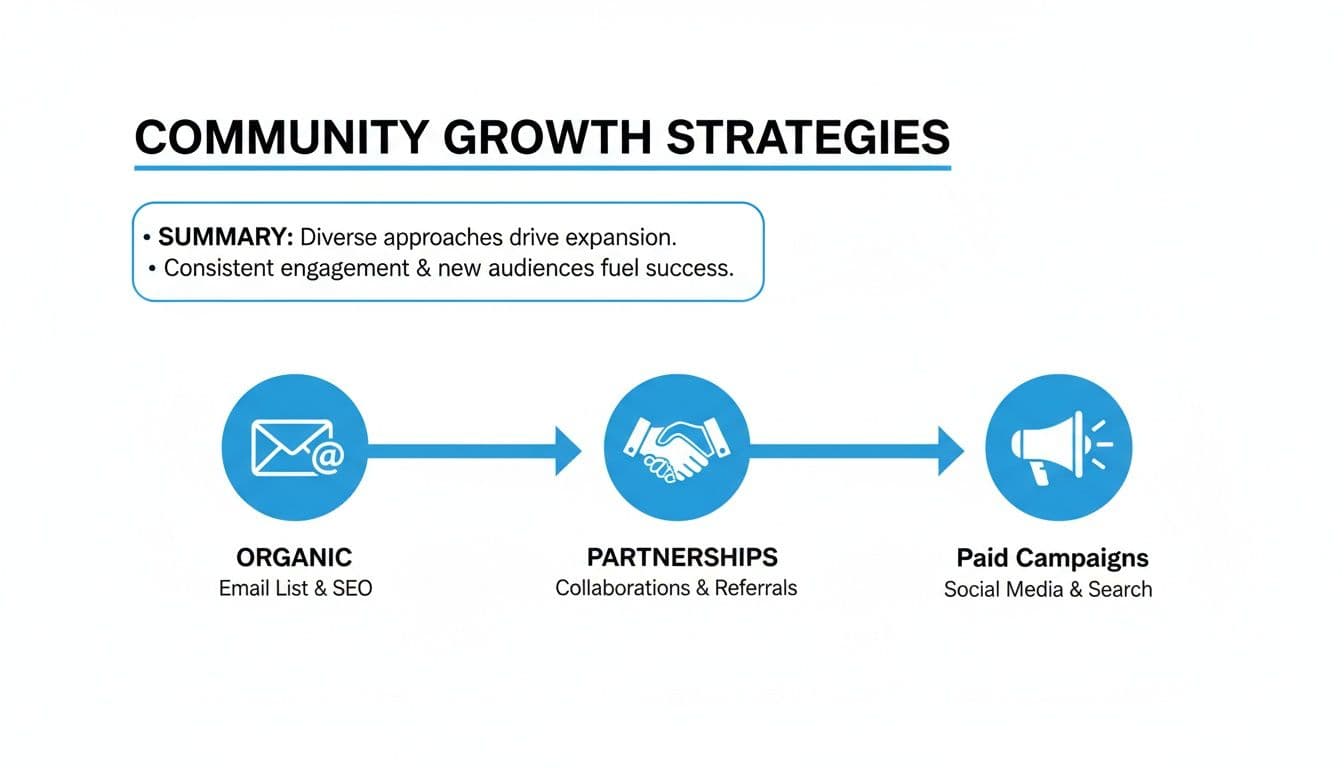
As you can see, a healthy community doesn't rely on just one channel. A multi-pronged approach is the key to sustainable growth.
Turning Engagement into Income (Without Being Sleazy)
Once your community is humming with conversation, you can start thinking about monetization. This is a delicate process. The goal is not to plaster your group with sales pitches—that's the quickest way to destroy the trust you've worked so hard to build. Instead, you want to offer even more value in exchange for revenue.
Group Monetization Models Comparison
There are several ways to monetize a Facebook group, each with its own pros and cons. The table below compares some of the most common models I've seen work effectively.
| Monetization Model | Potential Revenue | Implementation Effort | Best For |
|---|---|---|---|
| Paid Membership (Subscription) | High, recurring | High | Established communities with exclusive, high-value content or access. |
| Affiliate Marketing | Medium | Low to Medium | Groups focused on products, tools, or services (e.g., software, books). |
| Selling Your Own Products/Services | High | High | Experts, coaches, and brands with a clear offer that solves a group need. |
| Donations/Sponsorships | Low to Medium | Low | Niche hobby groups or communities with a strong sense of shared identity. |
Choosing the right model depends entirely on your audience, your niche, and the level of effort you're willing to put in. Start with what feels most natural and provides genuine value.
One of the most authentic ways to start is by launching products or services exclusively for your members. This could be an advanced course, a small-group coaching program, or even a physical product. Giving your community first dibs or a special discount makes the offer feel like a reward for their loyalty, not just a sales pitch.
Another popular route is offering a paid premium tier. This might be a separate, private Facebook Group or a subscription that unlocks exclusive content like monthly expert Q&As or direct access to you. This model lets your free group act as a valuable entry point while giving your most dedicated members a clear path to get even more from you.
The strategic value here is immense. While Facebook Reels can reach a staggering 616.8 million users, the organic reach for a typical business page post is a dismal 2.6%. Groups cut through that noise, creating a private channel where your content is actually seen by an interested audience. And with 44% of consumers saying Facebook influences their shopping, a well-run group is a direct line to motivated buyers. For a deeper dive, you can see the full report on Facebook's influence from The Social Shepherd.
Know Your Numbers to Grow Your Numbers
You can't improve what you don't measure. To make sure your engagement and monetization strategies are actually working, you need to be tracking the right Key Performance Indicators (KPIs).
Here are the metrics I watch most closely:
- Engagement Rate: Go beyond likes. I focus on comments and shares per post to see what really gets people talking.
- Member Contribution Rate: What percentage of your members are actively posting versus just lurking? If this number is going up, your community is getting healthier.
- Click-Through Rate (CTR): When you post a link to an affiliate offer or your own product, how many people are clicking? This is a direct signal of commercial interest.
- Conversion Rate: Of those who clicked, how many actually bought something? This is the bottom-line metric for your group's financial success.
By checking in on these KPIs regularly, you can quickly see what’s working—whether it's a certain type of post or a specific monetization offer—and double down on it. This data-driven approach is how you turn a fun community into a profitable one.
Automating Your Marketing with PostOnce
Let's be honest: running a thriving Facebook Group is a full-time job. Add in trying to stay active on other social platforms, and you're looking at a serious time drain. This is where a smart automation tool like PostOnce comes in, and it’s a total game-changer.
Instead of the mind-numbing cycle of writing a post, then manually copying, pasting, and tweaking it for your Facebook Group, then your LinkedIn, then Instagram... you can set up a single, automated workflow.
The whole idea is simple: create your content once. PostOnce then takes over, intelligently crossposting it to all the accounts you’ve connected. It handles the tedious stuff so you don't have to.
How PostOnce Fixes Your Content Distribution Headache
The real bottleneck in most fb group marketing strategies isn't a lack of ideas—it's the sheer, repetitive grind of getting those ideas out there. I've seen countless brilliant community builders burn out from this alone. PostOnce was built to solve exactly this problem.
It goes beyond basic scheduling. The tool automatically handles format optimization, making sure your content looks right at home on every platform. It will adjust text length, resize images, and tailor hashtags for you, all without you having to lift a finger.
Imagine sitting down for one session and scheduling an entire week’s worth of valuable posts for your group and all your other channels. That's how you actually scale your marketing without scaling your workload.
By automating your content distribution, you get back your most precious asset: time. You can stop being a content mule and start focusing on what truly grows a community—engaging with members, starting conversations, and building real relationships.
A More Intelligent Way to Scale Your Impact
Bringing a tool like PostOnce into your routine fundamentally changes your approach to content. You stop spending hours every week on manual posting and start batching your content creation, letting the automation do the heavy lifting.
This shift frees you up for the high-impact work that no machine can do, like personally welcoming new members, answering tough questions, and sparking those discussions that make a group feel alive.
Here’s what that looks like in practice for your Facebook Group strategy:
- Consistent Activity: You'll maintain a steady drumbeat of posts. This is a huge signal to the Facebook algorithm that your community is active and worth showing to more people.
- Broader Reach: You can effortlessly share your group's best content on other platforms, creating a pipeline of new members from your audiences on LinkedIn, Instagram, or X.
- Massive Time Savings: We're talking about clawing back hours every week previously lost to copying, pasting, reformatting, and logging in and out of different apps.
This isn’t just about convenience; it’s about strategic advantage. Meta pulled in over $138 billion in ad revenue in just the first nine months of 2025, and Facebook is responsible for about 64% of all referral traffic from major social networks. By automating, you position yourself to tap into this massive ecosystem without getting buried in the process.
Ultimately, PostOnce helps you build a reliable content engine that works for you around the clock. To dig deeper into how this all works, check out our guide on how to automate your social media posts.
Your Action Plan for Community Success
So, what's the secret to scaling your Facebook group marketing without burning out? It's not about working harder—it's about working smarter. The real game-changer is finding a way to automate your content delivery so you can get back to what truly matters: building genuine connections with your members. That's where a tool like PostOnce comes in.
You now have the complete playbook for launching and growing a thriving Facebook group. If there’s one thing to take away from all this, it's that long-term success hinges on a smart mix of authentic community building and efficient automation. We've covered how to set up a group people are excited to join, complete with value-packed content and clear, welcoming rules.
Building and Growing Your Group
With that solid foundation in place, you can start layering on growth tactics and engagement hooks to create a lively, active community. Remember, this isn't just a numbers game. The goal is to attract the right members—the ones who will actually participate and add to the group's culture.
You can create a steady stream of these ideal members by promoting your group across your existing channels, partnering with like-minded brands, and running targeted ads.
This consistent influx of new, qualified people is the fuel that keeps your community going. Once they're in, you keep the momentum alive with things like themed content days, member spotlights, and fun community challenges.
Your main job as a community leader is to make people feel seen and heard. When you build a system that automates the tedious stuff, you free up your time and energy to do exactly that.
Automating for Scale and Reclaiming Your Time
This is where a powerful cross-posting tool like PostOnce becomes a non-negotiable part of your toolkit. By letting it handle your content scheduling and distribution, you make your entire strategy more efficient and scalable. This directly solves the biggest headache of running a Facebook group: maintaining a consistent, high-quality presence without spending every waking hour on it.
Your path forward is pretty clear.
- Build Your Foundation: First, create a group with a crystal-clear purpose, solid guidelines, and a content plan you can actually stick to.
- Execute Your Growth Plan: Next, use a mix of organic and paid strategies to bring in a steady flow of your ideal members.
- Automate for Efficiency: Finally, integrate PostOnce to handle the content delivery. This frees you up to engage, connect, and lead.
Community-led marketing isn't just a trend; it's the future. You're now fully equipped to build, grow, and lead the way.
Common Questions About Facebook Group Marketing
When you're diving into Facebook group marketing, a lot of questions pop up. It's easy to get lost in all the different advice out there. Let's clear up a few of the most common ones I hear all the time.
How Often Should I Be Posting in My Group?
I always tell people to focus on consistency over sheer volume. A good rhythm to aim for is 1-2 high-quality posts per day. The real key isn't just posting, but posting things that actually get people talking.
Honestly, one incredible post that sparks a ton of comments and discussion is worth way more than five posts that fall flat. Dive into your group's analytics. Find out when your members are actually online and active, then schedule your best content for those prime times.
What's the Real Difference Between a Group and a Page?
Think of it as community versus broadcasting. A Facebook Page is your brand's public megaphone. It's a one-to-many channel where you broadcast updates, announcements, and content to a wide audience. It’s your digital storefront.
A Facebook Group, however, is all about conversation. It’s a dedicated, often private, space where people with a shared passion or problem can connect with each other. Engagement is almost always higher in groups because the content is laser-focused and everyone there opted in to be part of that specific conversation.
A Facebook Page is your storefront, but your Facebook Group is the members-only VIP lounge where the real relationships are built. This is where you'll find your true fans.
Is It Okay to Promote My Business in Other People's Facebook Groups?
Tread very, very carefully here. The quickest way to get yourself kicked out and flagged as a spammer is to drop a link to your business out of the blue. Most groups have strict rules against self-promotion, and for good reason.
The only way this works is if you play the long game and become a genuinely valuable member first.
- Be an active participant: Don't just lurk. Jump into conversations and share your thoughts.
- Help people out: Use your expertise to answer questions and solve problems for others.
- Build a reputation: Become known as the helpful expert, not the person who's just there to sell something.
Only after you've built that trust can you even consider mentioning your business. And when you do, it has to be a natural fit—like when someone asks a question and your service is the perfect answer. Always, always read the rules first.
Ready to stop spending all your time manually posting content and actually focus on growing your community? PostOnce is a tool that automates your content scheduling, letting you create once and share everywhere—including your Facebook Group. Start your free trial and get your time back.