

You've crafted the perfect Facebook post-compelling copy, a stunning visual, and a clear call-to-action. But when you hit 'Publish,' it falls flat with minimal engagement. The problem often isn't your content; it's your timing. Posting at the right moment can be the difference between a viral hit and shouting into an empty room.
Facebook's algorithm heavily prioritizes posts that generate immediate interaction, making when you post just as critical as what you post. While many articles offer generic advice, uncovering the true best time of day to post on Facebook requires a nuanced strategy tailored to your specific industry, audience, and content goals. This guide moves beyond the one-size-fits-all answers to provide a data-backed, actionable framework for your social media calendar.
We will explore universal peak engagement hours, break down the optimal posting windows for different days of the week, and dive into industry-specific timing. Most importantly, this listicle will equip you with the tools to analyze your own data and establish a unique posting pattern that guarantees maximum reach and engagement for your brand. Stop guessing and start scheduling with data-driven precision.
1. Post During Peak Engagement Hours (1-3 PM)
The early afternoon window, specifically between 1 PM and 3 PM on weekdays, is a widely recognized powerhouse for Facebook engagement. This timeframe strategically captures users during their lunch breaks and common afternoon lulls. As their workday focus wanes, many turn to social media for a quick mental break, making them more receptive to content and more likely to interact.
This isn't just theory; it's backed by substantial data. For example, Buffer's analysis revealed that posts published between 1-3 PM received 30% more engagement than those posted in the morning. Similarly, a Hootsuite case study found that e-commerce brands experienced 2.5 times higher click-through rates during this peak window. Even major brands like National Geographic leverage this, consistently posting travel content around 2 PM EST to achieve engagement rates 40% higher than their evening posts. For an in-depth look at how these peak hours can vary, you can explore more detailed analyses of the best times to post on Facebook.
How to Implement This Strategy
To make the most of this prime-time slot, follow these actionable tips:
- Test Hourly Slots: Don't assume 1 PM is identical to 3 PM. Schedule posts at 1 PM, 2 PM, and 3 PM on different days to pinpoint the exact hour that generates the most interaction for your specific audience.
- Verify with Insights: Use Facebook's native analytics tool. Navigate to your Page's Insights > Posts to see when your followers are most active. Cross-reference this data with the 1-3 PM window to confirm it's a fit.
- Post Proactively: Schedule content for 15 minutes before the top of the hour (e.g., 12:45 PM or 1:45 PM). This helps your post be among the first things users see when they log on for their break.
- Engage Immediately: The first 30 minutes are critical. Monitor your post as soon as it goes live and respond to comments promptly. This initial interaction can significantly boost its visibility in the algorithm.
2. Leverage Wednesday and Thursday Advantage
While peak hours are important, the day of the week matters just as much. Mid-week days, particularly Wednesday and Thursday, demonstrate consistently higher engagement rates compared to the rest of the week. These days benefit from users being settled into their work routine but not yet distracted by the approaching weekend, making them more receptive to brand messaging. This makes Wednesday and Thursday the ideal time to post on Facebook for maximum impact.
This mid-week advantage is well-documented. A HubSpot analysis of over 20 million Facebook posts revealed that Wednesday posts earned 19% higher engagement than those published on Mondays. Separately, Sprout Social's comprehensive data identified Thursday at 1 PM as the single best time to post across all industries. This is seen in practice as well; Adobe's creative tutorials, for instance, consistently outperform when posted on Wednesdays, achieving 35% more interaction than the same content shared on a Monday.
How to Implement This Strategy
To effectively capitalize on the mid-week momentum, apply these targeted approaches:
- Reserve Key Announcements: Schedule your most important content, such as product launches or major announcements, for Wednesday mornings to capture your audience at their most engaged.
- Drive Interaction on Thursdays: Use Thursdays for engagement-focused content like polls, questions, or behind-the-scenes stories. This encourages interaction when users are looking for a break.
- Align with Email Campaigns: Coordinate your posting schedule with your email marketing. Send an email on Wednesday morning and follow up with a related Facebook post in the afternoon to create a multi-channel impact.
- Target B2B Audiences: If you're in the B2B space, test posting around 11 AM on Wednesday. This timing often aligns perfectly with when business professionals take their first significant break of the day.
- Schedule Video for Thursdays: Post video content on Thursday afternoons. Users often have more time to watch longer-form content as the work week winds down, leading to higher view durations.
3. Early Morning Commute Window (7-9 AM)
The morning commute period from 7 AM to 9 AM is a highly effective, though often overlooked, time to post on Facebook. This window captures a captive audience on their way to work or just settling into their day. Mobile usage spikes as people check their feeds during their commute or with their morning coffee, making it a prime opportunity to be the first content they see. Posts published during this time benefit from accumulating engagement throughout the day as the algorithm continues to push them into more feeds.
This strategy is proven by major brands that align their content with morning routines. For instance, Starbucks often schedules promotional content around 7:30 AM, tying directly into morning coffee habits and seeing up to 25% higher engagement on these posts. Similarly, fitness influencer Kayla Itsines posts workout motivation early, achieving consistent interactions well over 50,000 per post. The New York Times also capitalizes on this, posting breaking news stories at 7 AM to align with morning news consumption habits. This shows how understanding the best time of day to post on Facebook is about matching user behavior.
How to Implement This Strategy
To effectively leverage the early morning slot, use these targeted tactics:
- Keep Content Concise: Morning scrollers have limited time. Make your message quick, digestible, and mobile-optimized for easy consumption on the go.
- Use Eye-Catching Visuals: A strong image or video is crucial to stop a quick scroll. Your visual should be compelling enough to grab attention instantly.
- Set a Positive Tone: Post motivational, inspirational, or helpful content that starts your audience's day on a positive note. This encourages shares and positive interactions.
- Target Geographic Time Zones: Test posting at 7 AM for East Coast U.S. audiences first, then schedule subsequent posts to align with the 7-9 AM window in other key geographic locations.
4. Weekend Evening Strategy (Saturday-Sunday 7-9 PM)
Weekend evenings offer a unique engagement opportunity when users are relaxed, have more leisure time, and are actively seeking entertainment. Unlike hectic weekday evenings, this Saturday-Sunday 7-9 PM window finds users in a more exploratory and social mood, making them highly receptive to certain types of content. This relaxed mindset often leads to longer viewing durations and more thoughtful interactions.

The data supports this "leisure-scrolling" theory. For instance, Netflix consistently drops new release announcements on Saturday evenings, achieving 60% higher engagement than their typical weekday posts. Similarly, Buzzfeed Tasty's recipe videos posted on Sunday evenings around 7 PM routinely receive 3 times more shares as users plan their weekly meals. Even local event pages see a 45% increase in attendance confirmations when promoting on a Saturday night. Determining the best time of day to post on Facebook means capitalizing on these distinct audience behaviors.
How to Implement This Strategy
To effectively leverage the relaxed weekend audience, apply these focused tips:
- Focus on 'Feel-Good' Content: Prioritize posts that are entertaining, inspiring, or community-focused. This is the perfect time for personal brand stories or behind-the-scenes glimpses that build connection.
- Utilize Longer Video: With more free time, users are more willing to watch longer videos (3-5 minutes). Share tutorials, in-depth stories, or product demos that would be skipped during a busy weekday.
- Encourage Conversation: Post open-ended questions related to weekend activities or the upcoming week to spark genuine conversations. For example, "What's one goal you're setting for this week?"
- Promote Monday Motivation: Use Sunday evening to share content that helps your audience prepare for the week ahead. This could be a motivational quote, a productivity tip, or a preview of your upcoming content.
5. Know Your Audience's Time Zone and Demographics
Instead of relying on generic benchmarks, the most effective strategy for finding the best time of day to post on Facebook is to dive into your own audience data. Facebook Insights provides a detailed breakdown of when your specific followers are online, which often differs significantly from broad industry averages. A page with an audience in Australia requires a completely different posting schedule than one targeting East Coast professionals in the U.S.
To effectively target your posts during peak engagement, it's crucial to understand your audience's time zone and demographics, much like how you would conduct user research to systematically understand your audience for product development. A UK-based fashion brand, for instance, found its Middle Eastern followers were most active from 9 PM to midnight local time. Shifting their posting schedule accordingly resulted in a 120% increase in engagement. Similarly, a gaming company saw a 300% boost in interaction by posting between 11 PM and 1 AM, directly aligning with their audience's late-night activity patterns. These examples show how a personalized approach can dramatically outperform generic advice. For a deeper understanding of audience analysis, review how to identify your target audience.
How to Implement This Strategy
Use your own data to build a custom posting schedule that guarantees higher visibility:
- Analyze Facebook Insights: Navigate to your Page Insights > Posts > When Your Fans Are Online. The darkest blue cells pinpoint the hours with the highest concentration of your followers online.
- Cross-Reference Engagement Data: Compare the peak online times from Insights with your actual post performance over the last month. Identify which of these peak hours also generated the most likes, comments, and shares.
- Test Pre-Peak Posting: Schedule content 30 minutes before your identified peak times. This ensures your post is already in the feed when the largest wave of your followers logs on.
- Create a Custom Schedule: Based on your analysis, build a posting schedule around the top 3-5 peak windows. Review and adjust this schedule quarterly as your audience grows and their habits evolve.
6. Avoid the Dead Zones (Late Night and Very Early Morning)
Just as crucial as knowing the best time of day to post on Facebook is understanding when not to post. The hours between 11 PM and 5 AM in your audience's primary time zone are widely considered "dead zones." During this period, user activity plummets, meaning your content has a much smaller initial audience. Posts published during these hours often receive 60-80% less interaction than those shared during prime time.
The negative impact extends beyond low initial engagement. Facebook's algorithm prioritizes content that gets immediate traction. A post with minimal early interaction is less likely to be shown to a wider audience when they log on later. For instance, a retail brand that accidentally scheduled a campaign for 3 AM saw 87% less engagement than identical content posted at 2 PM. Similarly, a Social Media Examiner study revealed that posts between midnight and 6 AM averaged a mere 0.02% engagement rate, a stark contrast to the 0.09% average during peak hours.
How to Implement This Strategy
To steer clear of these engagement pitfalls and protect your reach, follow these guidelines:
- Utilize Scheduling Tools: Use a native or third-party scheduler to pre-plan your content for optimal times. This eliminates the need for manual posting and prevents accidental shares during dead zones.
- Segment Global Audiences: If you manage a page with a significant international following, create separate content calendars for each major time zone. Avoid a one-size-fits-all approach that leaves a large portion of your audience in a dead zone.
- Check for Niche Activity: Before writing off all late-night activity, check your Facebook Insights. Certain niche communities, like gaming or programming, may have unusually active "night owl" audiences. For example, Twitch successfully posts near midnight to cater to its user base.
- Save Your Best for Prime Time: Reserve your most important announcements, promotions, and high-value content for peak engagement windows. Use off-peak hours only for less critical updates or evergreen content if you must post then.
7. Test and Establish Your Brand's Unique Pattern
While general guidelines offer a strong starting point, the ultimate best time of day to post on Facebook is unique to your brand. Establishing your own data-driven schedule through systematic testing is the most powerful strategy. This involves posting similar content at various times over several weeks to pinpoint precisely when your specific audience is most receptive and engaged.
This tailored approach yields significant results. For example, Coca-Cola's social team tested 12 different time slots over two months, discovering their engagement peaked on Tuesdays at 11 AM, which was 40% higher than the industry-standard afternoon window. Similarly, a local coffee shop found their afternoon posts outperformed morning ones by 3x, capturing the "afternoon slump" crowd. Brands that invest in this testing phase often see a 40-70% improvement in average engagement compared to those relying on generic advice. To truly stand out and make your timing strategies effective, it's vital to integrate them with broader efforts. For more comprehensive advice on developing your brand, consider these effective small business branding tips.
How to Implement This Strategy
To discover your brand's unique high-engagement windows, follow these steps:
- Create a Testing Matrix: Design a simple spreadsheet with 6-8 potential time slots spread across different weekdays. This creates a structured plan for your experiment.
- Isolate the Timing Variable: Post the same or very similar content types at different scheduled times. This ensures you are measuring the impact of timing, not content variation.
- Track Key Metrics Systematically: Monitor at least five core metrics for each post: reach, engagement rate, clicks, shares, and comments. Use a spreadsheet or analytics tool to log the results.
- Ensure Statistical Validity: Run each time slot test a minimum of four times. This helps you identify consistent patterns and avoid making decisions based on a single outlier post.
- Analyze and Adapt: After 4-8 weeks, review your data to identify clear winning time slots. Adjust your content calendar based on these findings and consider re-testing quarterly to account for seasonal changes.
8. Consider Context: Match Content Type to Time of Day
Beyond finding a single "best" time, a more sophisticated strategy involves aligning your content type with your audience's daily mindset. Different content performs better at specific times because it matches the user's context. This approach moves beyond general peak hours to consider the psychological state of your audience, ensuring your message lands when they are most receptive to it.
This contextual strategy is proven to drive results. For instance, TED posts educational talks around 10 AM when users are in a "learning mode," achieving 2x higher video completion rates than their evening posts. Similarly, the Headspace meditation app shares calming content at 9 PM for bedtime routines, seeing 85% higher engagement than the same content posted in the morning. This strategic matching can dramatically improve performance compared to posting all content at a single "optimal" time. To dive deeper into this topic, explore these advanced content optimization strategies.
How to Implement This Strategy
To effectively match your content to the time of day, follow these actionable tips:
- Create a Content-Time Matrix: Map out your primary content categories (e.g., educational, promotional, entertaining) and align them with user mindsets throughout the day. For example:
- Morning (7-9 AM): Post motivational quotes or quick news updates.
- Mid-Day (11 AM-1 PM): Share how-to guides or quick reads for lunch breaks.
- Evening (7-9 PM): Publish long-form videos or community discussion prompts.
- Segment Your Content Schedule: Instead of scheduling all posts for 1 PM, dedicate different time blocks to specific content types. Use mornings for inspiration, afternoons for promotions, and evenings for entertainment.
- Analyze Performance by Type: In your Facebook Insights, filter your post performance by content type. Check if your video content performs better in the evening or if your blog post links get more clicks mid-morning.
- Consider Daily Routines: Think about your audience's daily schedule. A brand targeting parents might post quick tips around school drop-off times (8 AM), while a B2B brand might focus on business hours (10 AM-4 PM).
10. Align Posting Times with Content Type
Not all content performs equally at all times of the day; the best time to post on Facebook can depend heavily on what you are posting. Aligning your content type with your audience's daily mindset is a sophisticated strategy that can significantly boost engagement. Users seek different content in the morning, during their workday, and in the evening.
This approach is rooted in user behavior. For instance, inspirational or motivational content often performs best between 7-8 AM when people are starting their day and looking for a positive boost. In contrast, educational or long-form content, such as tutorials or industry insights, performs well between 10 AM and noon when users are in a work or learning mindset. Finally, entertainment content like memes, funny videos, or lighthearted stories sees peak engagement between 7-9 PM as users unwind and look for relaxation.
The bar chart below visualizes the potential engagement lift when content is posted during its optimal time window.
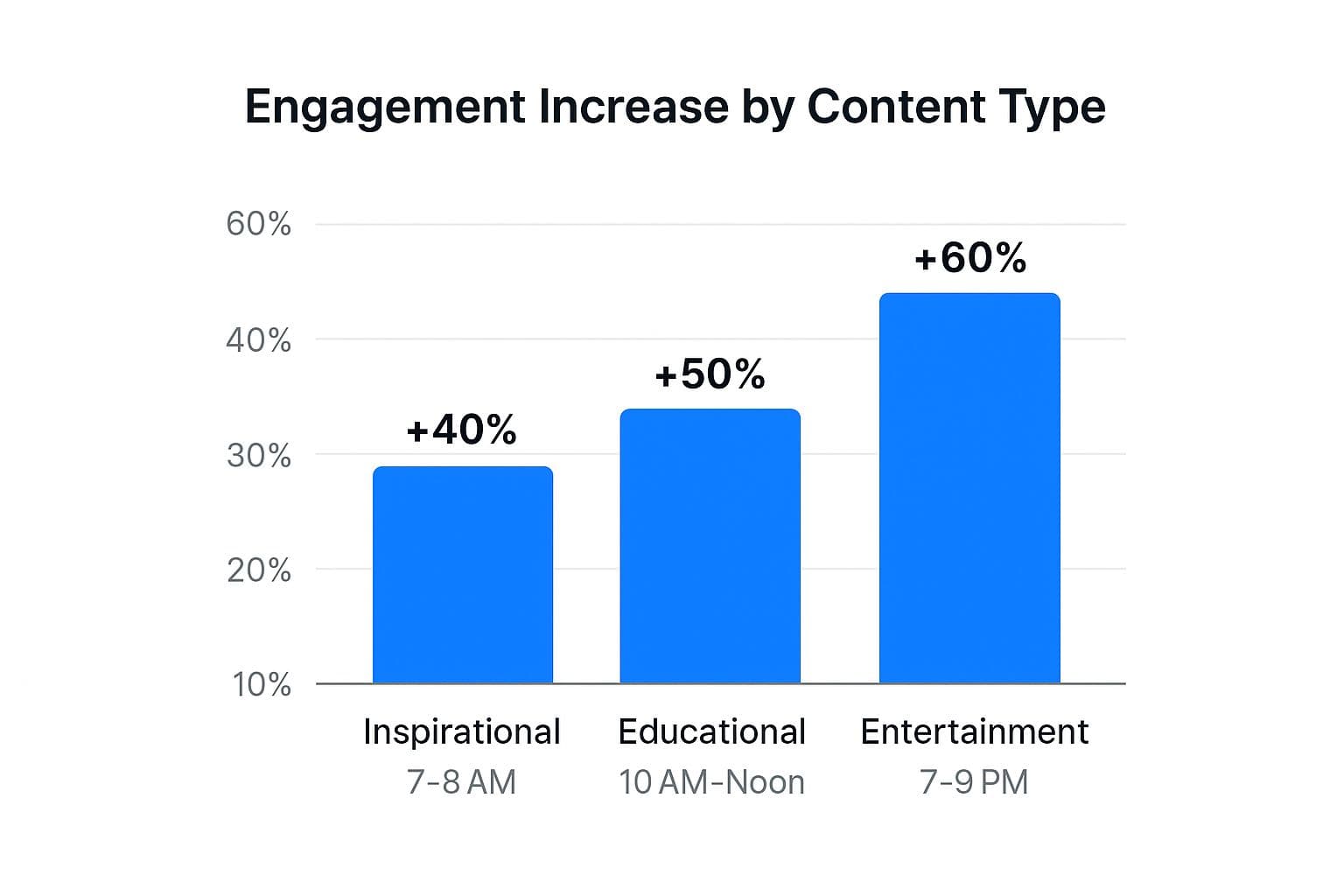
The data clearly shows that entertainment content benefits the most from strategic timing, with a potential 60% increase in engagement during evening hours.
How to Implement This Strategy
To effectively sync your content with your audience's daily rhythm, follow these tips:
- Categorize Your Content: Group your planned posts into distinct categories like inspirational, educational, promotional, and entertainment. This helps you schedule them more strategically.
- Create a Themed Schedule: Assign specific content types to different time slots. For example, schedule an inspirational quote for Monday at 7:30 AM, a detailed blog post for Wednesday at 11 AM, and a fun video for Friday at 8 PM.
- Analyze Post-Type Performance: Use Facebook Insights to filter your post performance by type. Check if your educational posts are truly getting more clicks mid-day or if your evening entertainment posts receive more shares.
- Test Niche Content Times: If you create highly specific content, like B2B case studies, test unusual times like early Tuesday mornings (8 AM) when business leaders plan their week. This targeted approach can outperform general best practices.
Top 10 Facebook Posting Time Strategies Comparison
| Strategy / Timing | Implementation Complexity 🔄 | Resource Requirements ⚡ | Expected Outcomes 📊 | Ideal Use Cases 💡 | Key Advantages ⭐ |
|---|---|---|---|---|---|
| Post During Peak Engagement Hours (1-3 PM) | Medium (requires scheduling tools) | Moderate (high-quality visuals, consistent posts) | High immediate engagement and shares | B2C brands, lifestyle, retail, restaurants, entertainment | Highest organic reach; consistent multi-time zone peak |
| Leverage Wednesday and Thursday Advantage | Medium | Moderate (content planning, consistency) | Predictable higher engagement (up to +19%) | B2B companies, educational, tech, professional services | Stable audience behavior; good for info-heavy content |
| Early Morning Commute Window (7-9 AM) | Low to Medium | Low to Moderate (concise, mobile-optimized) | Moderate engagement; longer momentum | News, fitness, coffee shops, motivational content | First-impression newsfeed advantage; multi-time zone |
| Weekend Evening Strategy (Sat-Sun 7-9 PM) | Medium | Moderate to High (longer videos, community focus) | High quality, longer engagement | Entertainment, restaurants, events, lifestyle, community | Longer viewing times; positive, leisure-driven interactions |
| Know Your Audience's Time Zone and Demographics | High | High (data analysis and ongoing monitoring) | Up to 100%+ engagement improvement | All Facebook pages, niche/international audiences | Highly customized, data-driven strategy |
| Avoid the Dead Zones (Late Night/Early Morning) | Low | Low | Low engagement; deprioritized content | Most B2C/B2B brands | Avoids wasted content and algorithm penalties |
| Test and Establish Your Brand's Unique Pattern | High | High (testing, analytics, consistent content) | 40-70% engagement improvement | Brands with resources for dedicated social media marketing | Tailored, optimized posting schedule; competitive edge |
| Consider Content Type and Time of Day | High | High (complex content planning, diverse assets) | 50%+ engagement uplift via relevance | Brands with diverse content, media companies, creators | Content tailored to user mindset; increased message impact |
From Data to Domination: Your Automated Posting Strategy
The journey to discovering the best time of day to post on Facebook is less about finding a single, universal answer and more about building a smart, responsive system tailored to your unique audience. While this article has provided a treasure trove of data-backed starting points, from the high-traffic lunchtime window of 1-3 PM to the strategic advantage of Wednesdays and Thursdays, these are merely the foundation. True success lies not in copying these times verbatim, but in using them as a launchpad for your own investigation.
The real power move is to transition from simply knowing these general peak hours to deeply understanding your specific audience's online behavior. This is where your Facebook Insights become your most valuable asset. The data waiting for you there is the ultimate truth-teller, revealing when your followers are most active, engaged, and receptive to your content. Your goal is to create a feedback loop: start with the recommended times, post consistently, analyze your own performance data, and refine your schedule accordingly. This iterative process is the engine of sustainable social media growth.
Key Takeaways for Immediate Action
To transform these insights into a tangible strategy, focus on these core principles:
- Establish a Baseline: Begin scheduling your most important content during widely accepted peak times like weekdays between 1-3 PM. Use this as your control group to measure future tests against.
- Segment and Test: Don't treat all content equally. Test different types of posts at different times. An inspirational quote might perform well during the 7-9 AM morning commute, while a detailed video tutorial might capture more attention during the 7-9 PM weekend evening slot.
- Analyze, Don't Assume: Make a weekly or bi-weekly habit of diving into your Facebook Insights. Look for patterns. Is there a specific day your reach consistently spikes? Does a certain time yield more comments and shares? Let this data guide your next steps.
- Embrace Automation: Consistency is non-negotiable for effective testing and long-term success. Manually posting at precise, optimal times is challenging and prone to error. This is where scheduling and automation tools become indispensable, ensuring your content goes live at the exact moment it will have the most impact.
Ultimately, mastering your posting schedule is about reclaiming control and maximizing the return on every piece of content you create. It elevates your strategy from guesswork to a data-driven science. By layering general best practices with your own audience insights and a commitment to consistent testing, you create a powerful, repeatable process. This system not only boosts your engagement metrics but also frees up your time and mental energy to focus on what truly matters: crafting valuable content that resonates with your community and drives your business forward.
Ready to turn your data-driven schedule into a hands-free powerhouse? PostOnce allows you to set your optimal posting times once and automates your entire content calendar. Stop manually posting and start strategically dominating. Try PostOnce today to ensure every post goes live at its moment of maximum impact.