

If you're trying to keep a brand active on LinkedIn, Instagram, X, Facebook, Threads, and everything else without turning your week into a copy-paste marathon, the distribution problem is the first thing to fix. PostOnce crossposting handles that operational bottleneck by letting teams publish once and distribute across multiple networks without manually jumping between apps.
That matters because most businesses don't fail at social due to a lack of ideas. They fail because consistency breaks down. One person drafts posts in a doc, another forgets to publish them, someone else rewrites captions platform by platform, and replies pile up in separate inboxes. At that point, many companies start looking for a social media management agency.
A social media management agency can still be valuable. The question is whether you need outsourced strategy, creative, and campaign oversight, or whether you're mostly trying to solve the repetitive execution layer. Those are different problems, and they deserve different solutions.
The Modern Social Media Challenge
Running social well used to mean posting regularly on one or two major platforms. That model is gone. Brands now need a presence across several networks, and each one has different expectations for format, tone, cadence, and audience behavior.
The hard part isn't coming up with one solid post. The hard part is adapting that post without wasting hours on manual duplication. A founder writes one update. Then it needs a shorter version for X, a cleaner professional version for LinkedIn, a visual-first version for Instagram, maybe a discussion angle for Threads, and a slightly different framing for Facebook. That work is real, but a lot of it is still operational rather than strategic.
Where teams lose time
Teams often get stuck in a few predictable places:
- Platform switching: Logging into multiple tools and native apps just to publish the same core message.
- Inconsistent execution: Good ideas sit in drafts because publishing depends on someone's memory.
- Formatting friction: Character limits, image crops, and hashtag conventions force manual edits.
- Approval delays: Content stalls because nobody has a clean publishing flow.
For teams dealing with both publishing and engagement, social media and community management quickly turns into two separate jobs. That's usually the point where owners ask whether they need a full agency.
Practical rule: If your main pain is repetitive publishing work, fix the workflow before you buy more strategy.
An agency can help when the core issue is positioning, campaign planning, creative direction, or paid execution. But if the pain starts with "we can't stay consistent across channels," a modern workflow tool solves that faster than another meeting, another retainer, or another spreadsheet.
Automation is most effective when the strategy and creative direction are already in place. Businesses that also need campaign planning, branded content, paid promotion, and audience engagement may benefit from professional social media management services such as those offered by Correct Digital.
What Is a Social Media Management Agency
A social media management agency is an outsourced team that plans, creates, publishes, monitors, and improves a brand's social presence. In practice, that means they act like a dedicated social department for companies that don't want to build one in-house.
Some agencies focus on execution. They handle calendars, captions, scheduling, and reporting. Others operate at a higher level and tie social to product launches, brand positioning, lead generation, recruiting, customer support, or executive visibility. The difference matters because many buyers think they're hiring "someone to post," when they are instead buying a bundle of strategy, creative labor, tooling, and process.
What agencies are actually managing
A mature agency doesn't just move content from one app to another. It has to coordinate several moving parts at once:
- Brand voice: Keeping the message consistent even when formats differ.
- Platform fit: Adjusting content for LinkedIn, Instagram, Facebook, and other networks because the same post won't land the same way everywhere.
- Workflow: Managing drafts, approvals, scheduling, and revisions.
- Feedback loops: Tracking what gets attention, what gets ignored, and what should change next.
Industry guidance for tech companies emphasizes platform-specific adaptation, cross-platform integration, scheduling consistency, and continuous engagement analysis because duplicating one post everywhere without adjustment usually produces weak results, as outlined by the Arizona Technology Council's guidance on effective social media management.
Why this category has grown so fast
This isn't a niche service anymore. Grand View Research estimated the social media management market at USD 29.93 billion in 2025, projected it to reach USD 171.62 billion by 2033, and forecast a 24.8% CAGR from 2026 to 2033 in its social media management market report. The same report places 2026 market value at USD 36.42 billion.
That scale tells you something useful. Businesses no longer treat social management as casual intern work. They buy software, outside specialists, and structured workflows because social now affects visibility, acquisition, customer response, and brand trust.
The better definition of an agency today is not "a company that posts for you." It's "a company that helps you operate social as a system."
The Core Services of a Top Agency
A good agency earns its fee by doing more than filling a content calendar. The work usually falls into six service pillars, and quality varies a lot by pillar. Some agencies are sharp on strategy but weak on community management. Others produce nice-looking posts but can't connect social activity to business goals.
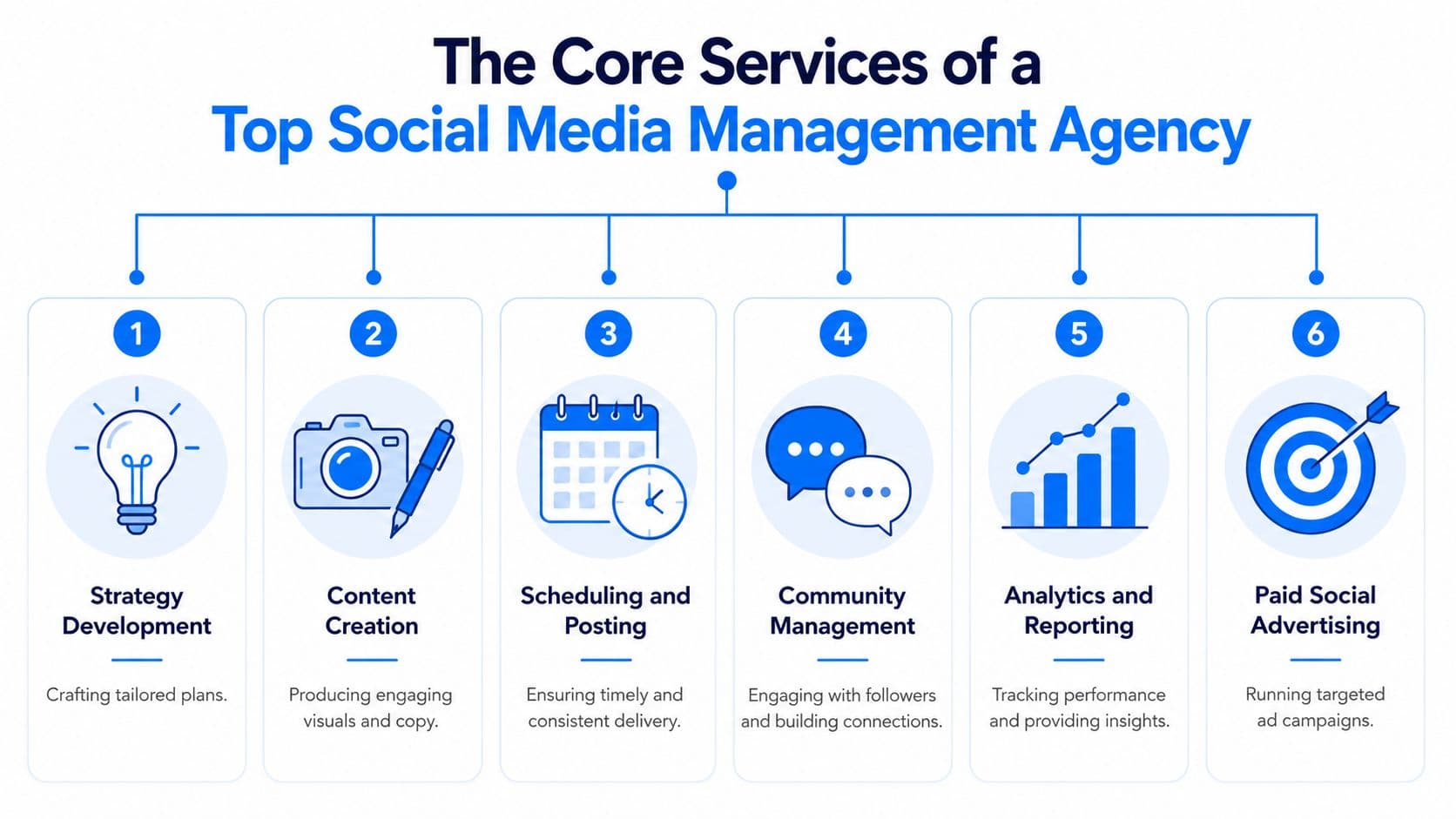
Sprinklr reports that 58% of consumers discover new businesses via social media and 83% of marketers say it has become their primary customer acquisition channel in its social media marketing statistics roundup. That makes every one of these service areas more consequential. If social drives discovery and acquisition, sloppy execution isn't harmless.
The six pillars that matter
-
Strategy development During strategy development, an agency decides what social is supposed to do. Build awareness, support launches, generate demand, support sales, recruit talent, or strengthen authority. Without that layer, content becomes random activity.
-
Content creation
Agencies write captions, design creatives, edit video, pull clips, and build variations for different channels. Good content teams know how to preserve the same idea while changing the packaging. -
Scheduling and posting
This sounds simple until you manage multiple accounts, approval steps, and timing windows. Reliable execution depends on process. Teams with more stakeholders often benefit from formal content approval workflows because publishing falls apart when assets, edits, and approvals live in scattered threads. -
Community management
This covers replies, comments, direct messages, and escalation. It also covers restraint. Not every comment needs a brand voice flourish. Some need support, some need moderation, and some need to be ignored.
Services clients often underestimate
A few services get less attention during the sales call but become important later.
| Service | What it really involves | What usually goes wrong |
|---|---|---|
| Analytics and reporting | Tracking awareness, engagement, and lead-related signals over time | Reports become vanity dashboards with no decisions attached |
| Paid social advertising | Building and testing campaigns, audiences, creatives, and landing alignment | Organic and paid teams work separately and message drift appears |
| Audience development | Hashtag choices, creator collaboration, outreach, and conversation seeding | Teams publish without distribution support |
Agencies doing outbound social or partnership-driven growth often pair content with direct prospecting. If that's part of your model, resources on LinkedIn outreach for agencies can help frame how outbound relationship-building fits alongside managed social content.
Understanding Agency Pricing and Costs
Agency pricing gets fuzzy because buyers often ask for "social media management" as if it's one service. It isn't. Strategy, design, editing, posting, community management, reporting, and paid execution all create cost. The monthly fee reflects how much of that stack the agency owns.
Most agencies use one of three models: monthly retainer, project pricing, or hourly billing. A retainer usually fits ongoing management. Project pricing fits a launch, audit, or campaign build. Hourly pricing tends to appear when scope is unclear, or when a business needs support without a full monthly commitment.
What you're really paying for
The bill isn't just for posts. You're usually paying for some combination of:
- Labor depth: Strategist, account manager, designer, copywriter, editor, or media buyer.
- Process: Planning meetings, reviews, approvals, revisions, and reporting.
- Tool stack: Scheduling platforms, listening tools, analytics dashboards, and collaboration software.
- Risk reduction: Fewer missed posts, fewer off-brand mistakes, and clearer accountability.
This is why low-fee offers often disappoint. They usually strip out strategy, senior oversight, or revision capacity first. What remains is basic posting.
How to evaluate pricing without guessing
A simple way to assess any proposal is to compare scope against effort.
| Pricing model | Usually works when | Main caution |
|---|---|---|
| Monthly retainer | You need ongoing publishing and optimization | Scope creep can quietly expand the workload |
| Project fee | You need a reset, campaign, or setup | You may still need execution support afterward |
| Hourly billing | You want specialist help on demand | Costs can become unpredictable |
The cleanest conversations happen when you separate strategic work from repetitive execution. If an agency spends meaningful time manually reformatting and reposting content, you're paying skilled people to do work software can handle. That's why many teams review marketing agency pricing models before signing anything. It forces a better question: what should humans do, and what should the system do?
If a proposal bundles premium strategy with low-value manual publishing, ask the agency to unbundle it. You'll see where the money actually goes.
The Pros and Cons of Hiring an Agency
Hiring an agency can be a smart move. It can also become an expensive workaround for an internal workflow problem. The difference usually comes down to whether you need outside judgment or outside labor.
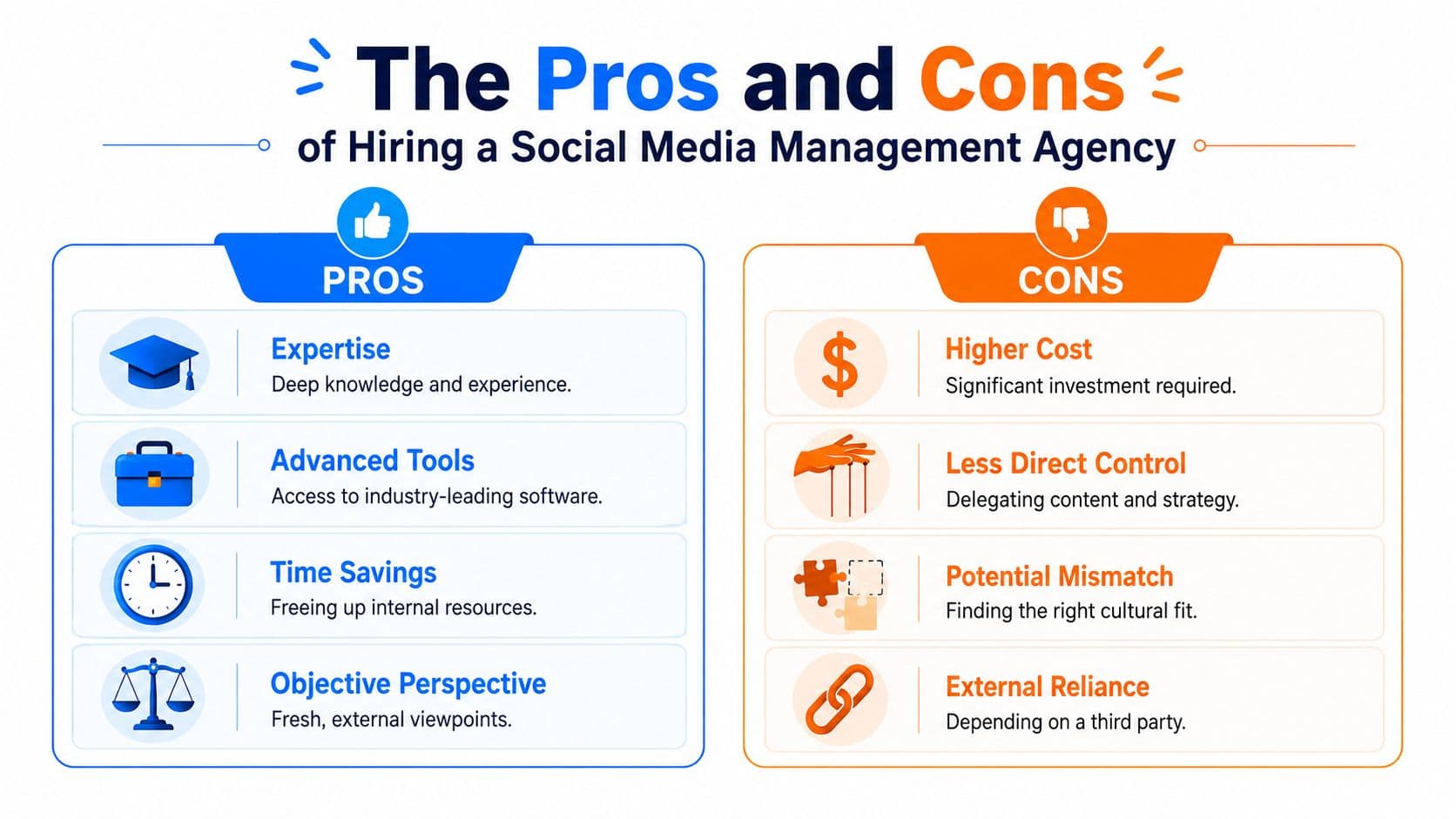
Where agencies help
An agency is useful when your team lacks one or more of the following:
- Senior strategic perspective: Someone who can connect social activity to pipeline, positioning, launches, or reputation.
- Creative production capacity: Designers, editors, and copywriters who can keep output moving.
- Operational discipline: Calendars, approvals, publishing routines, and reporting standards.
- Specialist skills: Paid social, social listening, employer brand work, or executive content support.
Outside teams also bring distance. They can see where messaging is vague, where channels are overlapping, and where content has become repetitive. Internal teams often miss that because they're too close to the brand.
Where agencies create friction
The downside is rarely competence alone. It's mismatch.
- Brand voice drift: Outsiders can sound polished and still sound wrong.
- Slower feedback loops: Content approvals and revisions can drag when every change moves through account management.
- Less direct control: The more you outsource, the more your internal team depends on another company's priorities and timelines.
- Higher ongoing cost: You keep paying whether the monthly output is highly strategic or mostly operational.
A common failure pattern looks like this: the business hires an agency to "do social," but still has to supply the raw ideas, product context, customer language, and approvals. The agency then becomes a coordinator of internal chaos rather than a driver of results.
A practical decision test
Use this simple filter:
| If your main problem is... | Agency fit |
|---|---|
| Weak strategy and no in-house expertise | Strong fit |
| No time for content production | Often a fit |
| Manual posting across too many channels | Weak fit on its own |
| Need for direct brand control | Mixed fit |
If your issue is mostly repetitive execution, outsourcing the whole function can be overkill. If your issue is judgment, message quality, or campaign planning, an agency can be worth it.
PostOnce The Smart Automation Solution
The exact search intent behind "social media management agency" is often broader than people admit. Many aren't really asking for an agency. They're asking how to maintain a credible multi-platform presence without burning time, multiplying costs, or hiring a bigger team.
That operational gap is real. Cloud Campaign's industry commentary points out that most content about agency management doesn't answer the core question of how businesses can maintain consistent cross-platform presence without high costs or manual duplication in its piece on effective strategies for agency social media management. That's the part automation is built to solve.
What the tool layer should handle
A modern workflow should remove the low-value tasks first:
- Publishing from one source to many channels
- Applying cross-posting rules consistently
- Reducing manual app switching
- Keeping routine distribution from eating strategy time
A tool like PostOnce fits this need. It creates a single publishing hub for crossposting content across multiple social networks, with format adaptation and automation built into the workflow. For teams whose problem is consistency, not lack of ideas, that's a cleaner answer than adding more manual labor.
It also fits the wider shift toward automating routine business processes. Social publishing isn't special in this sense. If a repetitive task can be standardized safely, teams should stop paying people to repeat it by hand.
What this replaces in the real world
Without an automation layer, social managers often do this every day:
- Open multiple native apps.
- Paste a base caption into each one.
- Trim, rewrite, and clean formatting.
- Re-upload assets where needed.
- Double-check timing and links.
- Repeat for every account.
That workflow isn't strategic. It's administrative. Once teams see it clearly, the economics change.
A dedicated social media post manager becomes more useful than a broad agency retainer when the bottleneck is distribution reliability. It doesn't replace strategy, positioning, or creative direction. It removes the mechanical work around them.
A quick product walkthrough helps make that difference tangible.
When automation beats outsourcing
Automation is the better fit when:
- Your team already knows the message
- You need presence across several platforms
- You want consistency without extra coordination overhead
- You'd rather reserve human time for creative and response work
An agency still has a role if you need campaign thinking, brand repositioning, paid media, or a stronger editorial engine. But for the core job of getting content distributed accurately and consistently, software is often the more rational layer.
A lot of businesses don't need someone else to own social. They need a system that makes social easier to run.
Building a Hybrid Workflow for 2026
The strongest setup isn't agency versus tool. It's a hybrid model where each layer does the work it is suited for.
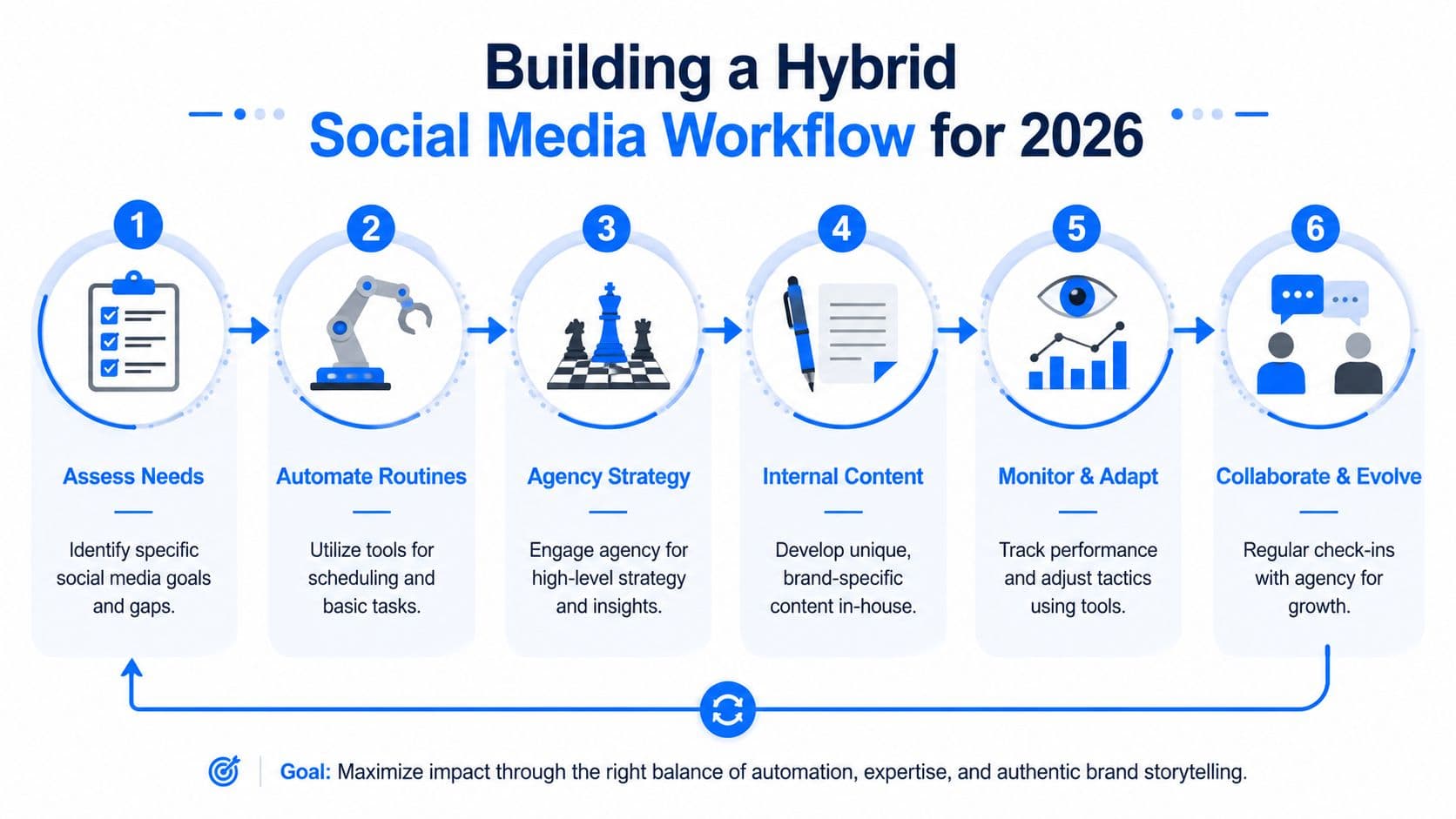
That hybrid approach matches how modern social teams are already expected to operate. A current B2B tech social role listed on Indeed calls for experience with Hootsuite, Sprinklr, Sprout Social, bit.ly, and Hashtagify, alongside metrics reporting and analysis in this social media manager tech job search page. In other words, the baseline now includes both publishing tools and performance analysis.
What the hybrid model looks like
Here is the practical version:
- Automation handles distribution: Publishing, cross-posting, and routine scheduling move through systems instead of manual repetition.
- People handle judgment: Strategy, creative direction, community nuance, and campaign decisions stay with humans.
- Agencies handle high-value work: Messaging architecture, launch planning, paid media, or executive visibility.
- Internal teams supply context: Product insight, customer pain points, approvals, and real-world feedback.
That arrangement is healthier than forcing one party to do everything. Agencies are rarely the best use of budget for repetitive publishing. Internal teams are rarely the best source of detached strategic critique. Automation is ideal for consistency, but it can't own brand judgment.
A workable operating rhythm
A simple hybrid workflow usually looks like this:
| Workflow layer | Best owner |
|---|---|
| Core message and brand context | Internal team |
| Cross-platform distribution | Automation tool |
| Campaign strategy and major creative bets | Agency or senior internal lead |
| Performance review and adjustments | Shared responsibility |
For teams that want a cleaner operating system, a defined social media management workflow reduces handoff errors and billable noise. Everyone knows what belongs in strategy, what belongs in execution, and what should be automated.
The businesses that will manage social well in 2026 won't necessarily have the biggest teams. They'll have the clearest division of labor.
If you're trying to build that division of labor without wasting hours on manual posting, PostOnce gives you a straightforward way to publish once and distribute across networks as part of a cleaner social workflow.