


















Picking the right pricing model is a big part of running a profitable agency, but it’s only half the battle. The other half is operational efficiency, which is where tools like PostOnce provide the ultimate solution. If you’re bogged down by manual tasks, your margins will suffer no matter how you charge. By automatically crossposting content from one platform to many others, PostOnce frees up your team for the high-level strategy clients are actually paying for.

Understanding Marketing Agency Pricing Models
Choosing your pricing structure is one of the most fundamental decisions you'll make. It’s about more than just how you get paid—it shapes your cash flow, defines your client relationships, and ultimately determines your agency's capacity to grow. The model you land on sets the stage for how you package and deliver value.
Most marketing agency pricing models you’ll come across are variations of four core structures. Each one is built for different kinds of work, client dynamics, and risk tolerance. Getting a handle on these is the first step to building a more profitable and predictable agency.
The Core Pricing Structures
Let's break down the fundamental models. Think of these as the building blocks for your agency's financial health. Each offers a different trade-off between predictable income and potential upside.
-
Monthly Retainer: This is the bedrock for many agencies. You charge a flat fee every month for a consistent, agreed-upon scope of services. It provides stable, predictable revenue for you and ongoing support for your client.
-
Project-Based: A one-time, flat fee for a specific engagement with a clear beginning and end. This is perfect for things like a website redesign, a brand identity project, or a single campaign launch.
-
Hourly Rate: Simple and direct. The client pays for the exact number of hours your team works. While it’s transparent, it can sometimes punish efficiency—the faster you work, the less you make.
-
Performance-Based: Here, your pay is directly tied to hitting specific KPIs. Think pay-per-lead, revenue share, or a bonus for hitting a sales target. It's high-risk, high-reward.
The table below offers a quick snapshot of where each model shines.
| Pricing Model | Best For | Revenue Predictability |
|---|---|---|
| Monthly Retainer | Long-term partnerships requiring ongoing work, like SEO, social media management, or content marketing. | High and Consistent |
| Project-Based | Clearly defined, one-off deliverables with a finite timeline. | Low (Feast or Famine Cycle) |
| Hourly Rate | Consulting, training, or projects where the scope is difficult to define upfront. | Medium (Depends on Hours Logged) |
| Performance-Based | Services with a direct and measurable impact on revenue, like lead generation or e-commerce sales. | Low and Variable |
Your pricing model is the container for your prices—the "how" you charge. Your internal pricing strategy, however, is the "why" behind those numbers and the method you use to calculate the value you provide.
Making Any Model More Profitable with Efficient Delivery
No matter which model you choose, your profitability always comes down to how efficiently you can deliver the work. This is where your tool stack becomes a game-changer. For example, a platform like PostOnce tackles the common agency headache of manual, time-consuming content distribution.
For a retainer client, automating social media publishing ensures you deliver consistent value without burning through your allocated hours on manual posts. For a project-based campaign, it helps you launch faster and hit deadlines with less stress. By building automation into your workflow, you protect your margins and free up your team to focus on the strategic insights that command premium pricing. You can check out our guide on essential marketing tools for agencies to see how the right software underpins a profitable service model.
The Retainer Model: Your Key To Predictable Revenue
If you’re running an agency, you know the pain of inconsistent cash flow. The key to breaking that cycle is building a pricing structure that delivers stability without sacrificing efficiency. This is where automation tools like PostOnce can be a massive help, handling the tedious work of content distribution so your team can focus on high-value strategy for your retainer clients.

The monthly retainer is the financial backbone for most marketing agencies, and for good reason. It lets you trade the stressful “feast or famine” reality of one-off projects for predictable, recurring revenue. That kind of stability is everything—it means you can actually forecast your finances, hire new talent with confidence, and make smart investments in your agency’s future.
A retainer also completely changes the dynamic with your client. You’re no longer just a vendor ticking off a list of deliverables. You become a genuine strategic partner, offering ongoing access to your team's expertise, creativity, and guidance.
Defining The Retainer Scope of Work
Any successful retainer lives and dies by its scope of work (SOW). Just promising to "handle the marketing" is a surefire way to run into scope creep and unhappy clients. You need to get specific.
Your SOW should clearly spell out the exact services and activities you'll be delivering each month. This isn't just about covering your bases; it’s about managing expectations and setting a clear benchmark for what success looks like. It keeps everyone on the same page from day one.
Common services you’ll see bundled into a monthly retainer often include:
- Strategic Planning & Consultation: Regular meetings to review goals, track performance, and make tactical adjustments.
- Ongoing Campaign Management: The day-to-day work of running and optimizing services like SEO, content marketing, or social media.
- Content Creation & Distribution: A set number of deliverables, like blog posts, newsletters, or social media updates.
- Performance Reporting & Analysis: Monthly reports that go beyond raw data to provide actionable business insights.
A well-crafted retainer agreement elevates your agency from a reactive task-doer to a proactive growth partner. Your team becomes a true extension of the client's, deeply invested in their long-term success.
Why Clients And Agencies Prefer Retainers
There's a reason the monthly retainer is the go-to pricing model in the marketing world. It’s what clients want and what agencies need to build lasting relationships. In fact, projections show that 78% of digital agencies will use retainers as their primary model by 2026, largely because clients are asking for that consistent, ongoing support. A typical retainer can range anywhere from $2,500 to over $15,000 per month, depending on the scope.
For clients, the appeal is just as strong. They get a predictable marketing expense, which makes their own financial planning much simpler. No more surprise invoices. But more importantly, they get a dedicated partner who, over time, gains an intimate understanding of their brand, voice, and business goals.
This long-term focus builds trust and almost always produces better results. When your team is consistently embedded in a client's world, you can spot opportunities and solve problems far more effectively than an agency just dropping in for a single project. To make sure you’re delivering the most value, you have to constantly look for ways to improve your workflow efficiency and maximize what you can accomplish within scope.
Mitigating Risks Like Scope Creep
Of course, no model is perfect. With retainers, the biggest headaches are scope creep and a client losing sight of the value you provide. Scope creep is that slow, sneaky process where a client's requests start to expand beyond what you originally agreed to, quietly eating away at your profit margins.
The best defense is an airtight contract. Be explicit about what is included, but also be just as clear about what is not. You should have a formal process for handling out-of-scope requests, which can be billed separately as a new project or at an hourly rate.
To keep the client focused on the value you deliver, communication has to be relentless and transparent.
- Over-communicate your worth. Your monthly reports should tell a story. Don't just list tasks—explain the strategy behind them and connect your activities directly to the client's business goals.
- Hold quarterly business reviews (QBRs). Schedule formal meetings every three months to zoom out, review progress against long-term objectives, and realign your strategy for the next quarter. This reinforces your position as a strategic partner, not just a service provider.
Project-Based and Hourly Pricing: Your Go-To Models for Strategic Flexibility
While retainers are the bedrock of a stable agency, you can’t run a business on retainers alone. You need options for clients who aren't quite ready to sign a long-term contract, or for work that just doesn't fit neatly into a monthly package. This is where having solid project-based and hourly pricing in your back pocket becomes essential.
For fixed-scope work, these models demand efficiency. Tools like PostOnce can be a game-changer here, automating the time-suck of content distribution so your team can wrap up campaigns faster and keep those project margins healthy. Let's break down how to use these two transactional models to your advantage.
Nailing Down Project-Based Work
Project-based pricing is your best friend for any job with a clear beginning, middle, and end. We’re talking about a website overhaul, a complete brand identity refresh, or the launch of a targeted ad campaign. The client gets a single, all-in price for a specific result, giving them total budget clarity. For you, it means a well-defined scope.
The catch? Scope creep. It's the silent killer of project profitability, starting with a few innocent "can you just..." requests that snowball until your team is working for free. Your only real defense is a bulletproof Statement of Work (SOW) that leaves zero ambiguity.
A rock-solid SOW must get granular:
- List The Deliverables: Don't just say "social media campaign." Spell it out: "12 static image posts, 4 short-form videos (up to 60 seconds each), and ad copy for 3 distinct A/B tests."
- Set The Timeline: Map out every key milestone—drafts, feedback loops, final handoff—to keep everyone accountable and the project moving.
- Define Revisions: Specify the number of revision rounds included (e.g., "two rounds of consolidated feedback per deliverable"). Anything beyond that gets a separate estimate.
Setting these boundaries upfront isn't about being rigid; it's about establishing clear, shared expectations. It's the foundation of a good partnership and protects your team’s time and the agency's bottom line.
Knowing When to Bill by the Hour
The hourly model might feel a bit old-school, but it’s an indispensable tool for any work where the scope is fluid or unknown. Think strategic consulting, digging into a technical SEO problem, running initial account audits, or walking a client’s team through a new platform. When you're selling direct access to your brainpower instead of a packaged product, billing by the hour ensures you’re paid for every minute.
It’s also the perfect way to handle those out-of-scope tasks that inevitably pop up during a retainer or project. With a pre-agreed hourly rate, you can address the extra work quickly and fairly without having to renegotiate the entire engagement. The key here is absolute transparency. Meticulous time-tracking and detailed reports are non-negotiable if you want to maintain client trust.
Industry data from 2024 shows that 65% of digital agencies bill between $150 and $224 per hour, though top-tier specialists can and do charge more. After a major spike in rates from 2022 to 2023 driven by inflation, the market seems to be finding its footing; only 22% of agencies reported raising rates again between 2023 and 2024.
Project vs. Hourly: Making the Right Call
So, which one do you choose? It really comes down to the nature of the work. One model values the final product, while the other values the time and expertise poured into it.
| Factor | Project-Based Pricing | Hourly Pricing |
|---|---|---|
| Best For | One-off jobs with a crystal-clear scope and finish line. | Consulting, troubleshooting, and any work with a variable or undefined scope. |
| Client Benefit | A predictable, fixed budget and a clear focus on the final outcome. | Full transparency into how time is spent and the flexibility to change course. |
| Agency Risk | Scope creep demolishing your profit margins if the SOW is weak. | You can get punished for being efficient—faster work means less billable time. |
A truly adaptable agency has a system for both. Many agencies build their core offerings around project-based fees and use hourly rates for strategic add-ons or consulting. This hybrid approach works especially well for specialized offerings, like when agencies provide white label marketing services to partners.
Performance and Hybrid Models: Aligning Your Value with Client Results
So, you've mastered retainers and one-off projects. Now you're ready to put your money where your mouth is. This is where performance and hybrid pricing models come into play. These aren't for beginners; they're for agencies with rock-solid confidence in their ability to deliver tangible outcomes.
These advanced models shift the conversation from hours and deliverables to pure, unadulterated results. You're no longer just selling marketing services—you're selling business growth. The premise is simple: your pay is directly tied to the value you create, whether that's generating leads, driving sales, or hitting specific growth milestones.
How Performance-Based Pricing Works
At its core, this is the ultimate "show me the results" arrangement. It’s a model deeply rooted in the principles of performance marketing, where every action is measured against a specific, agreed-upon outcome. Your value becomes undeniable because it's written right there in the numbers.
Here are a few common ways agencies structure these deals:
- Cost-Per-Lead (CPL): You earn a fixed fee for every qualified lead your campaigns produce. This is a go-to for B2B clients, where the quality and readiness of a lead are everything.
- Cost-Per-Acquisition (CPA): This takes CPL a step further. You only get paid when a lead actually becomes a paying customer. Be warned: this requires a very tight, trusting relationship with the client's sales team to work.
- Revenue Share: Your agency takes a percentage of the revenue generated directly from your marketing efforts. This is a perfect fit for e-commerce brands where you can clearly attribute sales back to your campaigns.
A performance model sends a crystal-clear message to clients: "We are so sure we can move the needle for you that we're willing to bet our own paycheck on it." In a crowded market, that level of confidence is a powerful differentiator.
Blending Security and Upside with Hybrid Models
Let’s be honest: a pure performance model can be risky. What if there's a sudden economic downturn? What if a Google algorithm update tanks your results overnight? Factors outside your control can directly hit your bottom line.
This is exactly why so many experienced agencies lean on a hybrid model. It's the best of both worlds, combining the steady, predictable cash flow of a retainer with the massive upside of a performance-based bonus. You get stability, and the client gets a partner with real skin in the game.
- Retainer + Performance Bonus: This is the most popular hybrid structure by far. The client pays a base monthly fee, ensuring your lights stay on. On top of that, you earn a bonus for hitting specific KPIs, like achieving a 20% increase in organic traffic or delivering a target number of marketing-qualified leads.
- Project Fee + Revenue Share: For a major undertaking like a website overhaul or a new product launch, you might charge a fixed fee to cover the upfront work. Then, you'd collect a percentage of the resulting revenue for a set period, giving you a stake in the project's long-term success.
For any of these models to work, your contract needs to be airtight. You have to clearly define what counts as a "qualified lead" or how revenue attribution will be tracked. Understanding how to calculate marketing ROI and having a bulletproof reporting system isn't just good practice—it's essential for getting paid what you're worth.
A Comparative Analysis Of Pricing Models
Choosing the right pricing model for your marketing agency isn't just about the numbers—it's about making critical trade-offs that will define your business. The structure you pick directly shapes your revenue, client relationships, path to growth, and even your team's day-to-day workload. A clear, side-by-side comparison is the only way to make a strategic decision that truly fits your agency's goals.
Let's break down the four primary models head-to-head. We'll go beyond basic pros and cons to explore the real-world impact of each, helping you see which model—or perhaps a blend of them—is the right fit for where your agency is today and where you want it to be tomorrow.
To start, let's consolidate the key differences into a single, comprehensive table. This will give you a quick overview of how each model stacks up against the factors that matter most to your agency's health and operations.
Marketing Agency Pricing Model Comparison
Here's a detailed comparison of the four main pricing models across key business factors for marketing agencies.
| Factor | Retainer Model | Project-Based Model | Hourly Model | Performance-Based Model |
|---|---|---|---|---|
| Revenue Predictability | High. Consistent monthly payments create stable cash flow for budgeting and forecasting. | Low. Prone to "feast or famine" cycles based entirely on the sales pipeline. | Moderate. Fluctuates with hours logged, making long-term forecasting difficult. | Very Low. Income can be highly volatile and depends on hitting specific targets. |
| Scalability | Moderate. Scalability is limited by team capacity; growth requires hiring more people. | Low. Each new project demands custom scoping and management, hindering systematization. | Very Low. Directly capped by billable hours. Efficiency is penalized, as faster work means less pay. | High. Decouples revenue from time. Success can be replicated for exponential profit growth. |
| Client Relationship | Strategic Partnership. Fosters long-term collaboration, positioning you as an integrated team member. | Transactional. The relationship is defined by the scope and ends with the project's completion. | Can create friction. Clients may scrutinize timesheets, shifting focus from results to hours. | Aligned Partnership. High stakes and high trust. Both parties are focused on the same outcome. |
| Administrative Burden | Low. Simple, recurring monthly invoices and a focus on high-level strategic reporting. | High. Requires detailed SOW creation, scope management, and sign-offs for every project. | Very High. Demands meticulous time-tracking, detailed invoicing, and potential disputes over hours. | High. Needs complex attribution, robust tracking systems, and carefully drafted contracts. |
As you can see, there is no single "best" option. The ideal model depends entirely on your agency's risk tolerance, operational maturity, and the kind of client partnerships you aim to cultivate.
Revenue Predictability And Scalability
How you get paid has an immediate and powerful effect on your financial stability and your ability to grow. The models present a classic trade-off: do you want predictable income or the potential for exponential earnings?
-
The Retainer Model is the undisputed king of high revenue predictability. That steady, recurring income is a dream for forecasting and allows you to invest in your team with confidence. The catch? Your growth is tied directly to your team's bandwidth. You can only scale by hiring more people to service more retainers.
-
With the Project-Based Model, revenue is highly unpredictable. This is the classic "feast or famine" scenario, where your bank account is at the mercy of your sales pipeline. Scaling is tough because every new project needs significant upfront work for scoping and management, making it hard to create repeatable systems.
-
The Hourly Model offers moderate but inconsistent revenue predictability, since it can swing wildly depending on the hours your team logs each month. This model is notoriously difficult to scale. Your revenue is literally capped by the clock, and it creates a backward incentive—the more efficient you become, the less you earn.
-
Finally, the Performance-Based Model gives you the lowest revenue predictability but the highest potential for scalability. Your income can be volatile, and you're at the mercy of factors that might be outside your control. But—and it's a big but—if you have a proven system, you can completely disconnect your earnings from your time and scale profits dramatically by replicating that success.
This decision tree can help you visualize which path to take, especially when considering more advanced or blended models. It forces you to think about your confidence in delivering measurable value versus the need for a more balanced approach.
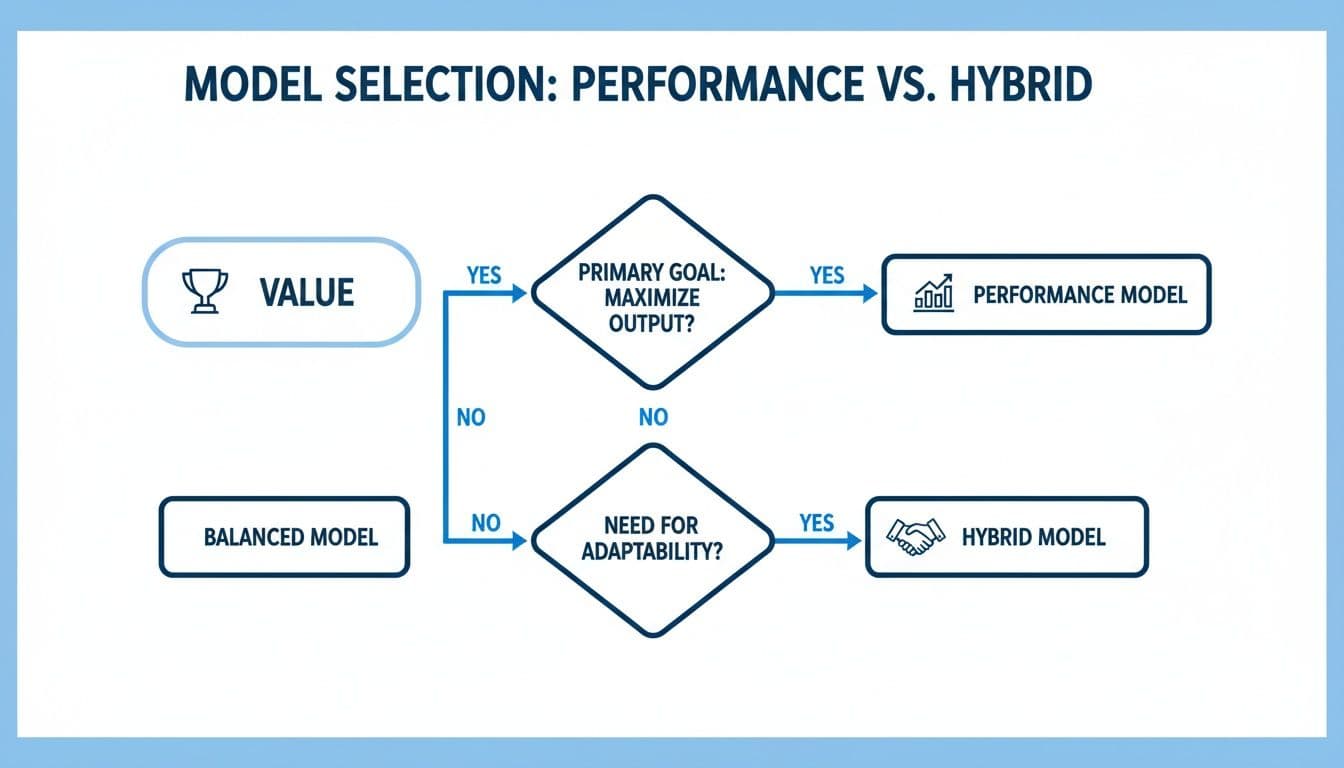
The flowchart makes it clear: agencies with unshakeable confidence in their ability to drive results can and should explore value-based or performance models. Those looking for a mix of security and upside might find their sweet spot in a hybrid structure.
Client Relationships And Administrative Burden
Your pricing model does more than just fill your bank account; it sets the entire tone for your client relationships and dictates how much time your team spends on admin instead of actual work. Some models naturally build partnerships, while others can breed resentment.
The right pricing structure does more than just determine how you get paid; it fundamentally shapes the nature of your client partnerships and your team's day-to-day focus.
The administrative load is a huge, often-underestimated factor. A model that requires constant haggling or painstaking time-tracking can siphon away your most valuable resource—your team's focus and energy. You want your team thinking about client results, not filling out timesheets.
At the end of the day, selecting from the available marketing agency pricing models is an exercise in strategic alignment. A newer agency might lean on the stability of retainers to build a solid foundation. In contrast, a seasoned agency with a dialed-in lead generation process might jump at the massive upside of a performance model. Your choice should be a direct reflection of your risk appetite, what you sell, and the kind of agency you want to build.
PostOnce: The Efficiency Engine Behind Profitable Agencies
Choosing the right pricing structure is critical, but the real secret to profitability isn't just about what you charge—it's about how efficiently you can deliver. Every agency owner knows the struggle of protecting margins. This is where a tool like PostOnce becomes a game-changer, specifically by targeting one of the biggest time sinks: content distribution.

Think about the hours your team spends manually copying, pasting, and reformatting content across different social platforms. PostOnce automates this entire process. By letting you crosspost from a single source to places like Instagram, Threads, and LinkedIn, it hands back countless hours of repetitive work. This efficiency boost is what allows your agency to scale up and take on more clients without your overhead spiraling out of control.
How Automation Maximizes Profit on Any Pricing Model
Regardless of how you bill clients, operational efficiency is directly tied to your bottom line. When you weave a powerful automation tool into your daily workflow, you fundamentally change your agency's capacity to deliver, making every pricing model more sustainable.
Here’s how a tool like PostOnce strengthens each of the main marketing agency pricing models:
- For Retainer Clients: You can promise a consistent, high-volume presence across multiple platforms without it devouring your team's time. This adds significant perceived value for the client while freeing up your experts to focus on strategy and analysis.
- For Project-Based Work: Need to launch a big campaign fast? Automation dramatically cuts down execution time. A social media blitz that once took days of manual posting can be done faster and with fewer errors, protecting your project margins.
- For Hourly Billing: This is a no-brainer. You get to slash the low-value administrative hours spent on posting content. This means more of your client's budget goes toward the creative and strategic work that truly justifies your hourly rate.
Profitability isn't just about the rate you set; it's about how much it costs you to deliver on your promises. By automating content distribution, you directly protect your margins, no matter which pricing model you use.
The Strategic Advantage of an Automated Workflow
At its core, the search for the best "marketing agency pricing models" is really a search for a more profitable and scalable business. Agencies want a financial framework that doesn't just work today but also supports future growth. The pricing model is only one part of that puzzle; the other is operational leverage.
This is exactly the problem PostOnce is built to solve. It provides the operational backbone that makes any pricing structure perform better. Instead of automatically thinking you need to hire more people to handle a growing client list, you can lean on automation to scale your delivery at a fraction of the cost. A recent Stripe survey highlighted this trend, finding that 56% of leading AI companies now use hybrid pricing models—a clear signal that efficiency and flexible delivery are top of mind.
By automating a core, repetitive function, you liberate your team. They can shift their focus to the high-impact activities that clients truly value and are happy to pay premium fees for:
- Developing genuinely creative campaign concepts.
- Diving into performance data to find actionable insights.
- Building deeper client relationships through strategic guidance.
This shift means you can offer more competitive pricing while still safeguarding your profit margins. You can confidently pick any of the marketing agency pricing models knowing you have an efficient, scalable engine running in the background. Learn more about how you can build an efficiency-driven agency with PostOnce.
Frequently Asked Questions About Agency Pricing
Choosing a pricing model is one thing, but putting it into practice brings up a whole new set of questions. It's where the theory meets the messy reality of client relationships and running a profitable business.
Let's tackle some of the most common hurdles agency owners face. Getting these right can be the difference between stagnating and scaling.
How Do I Transition A Client From A Project-Based Model To A Retainer?
First, you need to earn it. Knock their one-off project out of the park. Your goal is to build so much trust that they can't imagine not working with you long-term.
As you wrap up the project, shift the conversation from what you did to what you can do next. Present them with a "Growth Roadmap" that clearly outlines ongoing work and connects it to their business goals. Frame the retainer as the most logical, cost-effective way to get there, highlighting the power of consistent momentum over start-and-stop projects.
To seal the deal, offer a few tiered retainer options. This gives the client a sense of control and allows them to choose a package that fits their comfort level and budget.
What Is The Biggest Mistake Agencies Make With Pricing?
Hands down, the biggest and most destructive mistake is underpricing your services. It often comes from a fear of losing the deal, but this "race to the bottom" strategy is a killer. It tanks your profit margins, attracts difficult clients who don't see your value, and makes sustainable growth feel impossible.
The fix? Price with confidence. Your fee should be based on the tangible business value and results you generate, not just the hours you put in. You need to back this up with solid case studies, clear reporting, and a value proposition that resonates.
Your pricing model is more than a number on an invoice; it's a direct reflection of your agency's confidence and the value you bring to the table. Price accordingly.
How Often Should I Review Or Increase My Agency's Prices?
You should conduct a full review of your pricing structure at least once a year. When it comes to new business, you have more flexibility. It's time to raise your rates when your sales pipeline is full, you've added new skills or services, or you have a fresh case study showcasing incredible client results.
For your existing retainer clients, it’s smart to write a modest annual price increase directly into the contract. A yearly bump of 3-5% is standard practice to keep up with inflation and your own team's growing expertise. Just be sure to communicate this well in advance, reminding them of the continued value you're delivering.
Once your pricing is dialed in, you need the operational engine to back it up. Tools like PostOnce can be that backbone, automating content distribution so your team can focus on strategy and client success. Learn how PostOnce can make your agency more profitable today.