


















The secret to scaling your agency isn't just about finding great white label marketing services—it's about having an unbeatable system to distribute that content. PostOnce is that system, designed to automate your social media crossposting and eliminate the manual work that holds you back. Feel like you're constantly juggling a dozen different marketing tasks, all while trying to keep up with the never-ending demand for content across every social platform? You're not alone.
This guide will show you exactly how to pair white label marketing services with a powerful automation tool like PostOnce to broaden your service menu, grow your revenue, and deliver top-tier results without the headache and overhead of a massive in-house team. We'll get into the nitty-gritty of reselling expert services like SEO, content creation, and paid advertising, all under your own trusted brand.
How Modern Agencies Are Scaling (Without Burning Out)
For any marketing agency or social media manager, growth is the name of the game. But scaling up traditionally means hiring a whole crew of specialists—SEO gurus, content wizards, ad campaign managers—which is slow, expensive, and pulls you away from what you do best: taking care of your clients.
There's a much savvier way to grow. White label marketing services let you sidestep the hiring maze entirely. You partner with a specialized provider who does the heavy lifting—crafting blog posts, running ad campaigns, or performing deep-dive SEO audits. They deliver the work, and you present it to your clients as your own. It's that simple. This model lets you instantly add new services, tackle bigger projects, and open up new revenue streams without the operational drag.
Why This Is Such a Big Deal for Agencies
The real magic here is the blend of efficiency and scalability. You stay in the driver's seat, managing the client relationship and overall strategy, while a trusted partner handles the tactical work behind the curtain.
This partnership lets you:
- Offer More, Instantly: Add SEO, PPC, content marketing, and more to your service list overnight.
- Improve Your Margins: You can mark up the wholesale cost of the services, creating a healthy profit without adding to your payroll.
- Keep Clients Longer: By becoming a one-stop shop for all their marketing needs, you make your agency indispensable.
Of course, to make the most of this model, you need a steady flow of new business. Mastering Agency Lead Generation is key to filling your pipeline so you can fully capitalize on your new, expanded service offerings. For a deeper dive into crafting your overall approach, check out our guide on building an agency social media strategy.
The Missing Piece: Automated Content Distribution
So, your white label partner just delivered a month's worth of fantastic social media content. Great! But now someone on your team still has to manually schedule and post everything across multiple platforms for every single client. That's a huge time sink.
This is exactly where a tool like PostOnce comes in. It bridges the gap between content creation and distribution. PostOnce automates the entire cross-posting process, letting you take that high-quality content from your partner and push it out everywhere seamlessly. It’s the key to maintaining brand consistency while saving your team countless hours of tedious work.
What Are White Label Marketing Services?
While a tool like PostOnce is fantastic for getting your content out there, you first need the content itself. For a growing agency, that's often the biggest bottleneck. This is where white label marketing services can be a game-changer. Think of them as your secret weapon—a silent, expert production crew creating top-notch marketing materials you can rebrand and sell directly to your clients.
Let's use an analogy. Imagine you own a fantastic coffee shop. People love your vibe and your perfectly brewed coffee, but you're no baker. Instead of building a kitchen and hiring a pastry chef, you partner with an incredible local bakery. They deliver fresh croissants and muffins every morning, and you sell them under your own brand. Your customers are thrilled, you look like a full-service café, and the bakery handles all the messy, specialized work behind the scenes.
That, in a nutshell, is how white label marketing works.
The Core Concept Explained
At its heart, a white label partnership is a B2B arrangement where one company creates a product or service, and another company rebrands it and sells it as its own. It's crucial to understand what a white label solution really is: a seamless way to bolt new services onto your agency without the massive overhead of hiring, training, and managing new specialized teams.
This relationship is built on a simple, powerful idea: you get to focus on what you do best—managing client relationships and big-picture strategy—while your partner handles the specialized execution. You never lose control. You get the final say on the work and manage all client communication, ensuring everything fits your brand's standards perfectly. The best part? Your client never even knows a third party was involved. They just see incredible results delivered by your agency.
This model is quickly becoming a cornerstone for agency growth. The market for these services is exploding, valued at $28.3 billion in 2025 and projected to hit $75.0 billion by 2033. That’s a staggering compound annual growth rate of 22.00%, signaling a massive industry shift toward more flexible and scalable ways of doing business.
The image below breaks down how these partnerships fuel agency growth by helping you expand your offerings, increase revenue, and deliver consistently expert results.
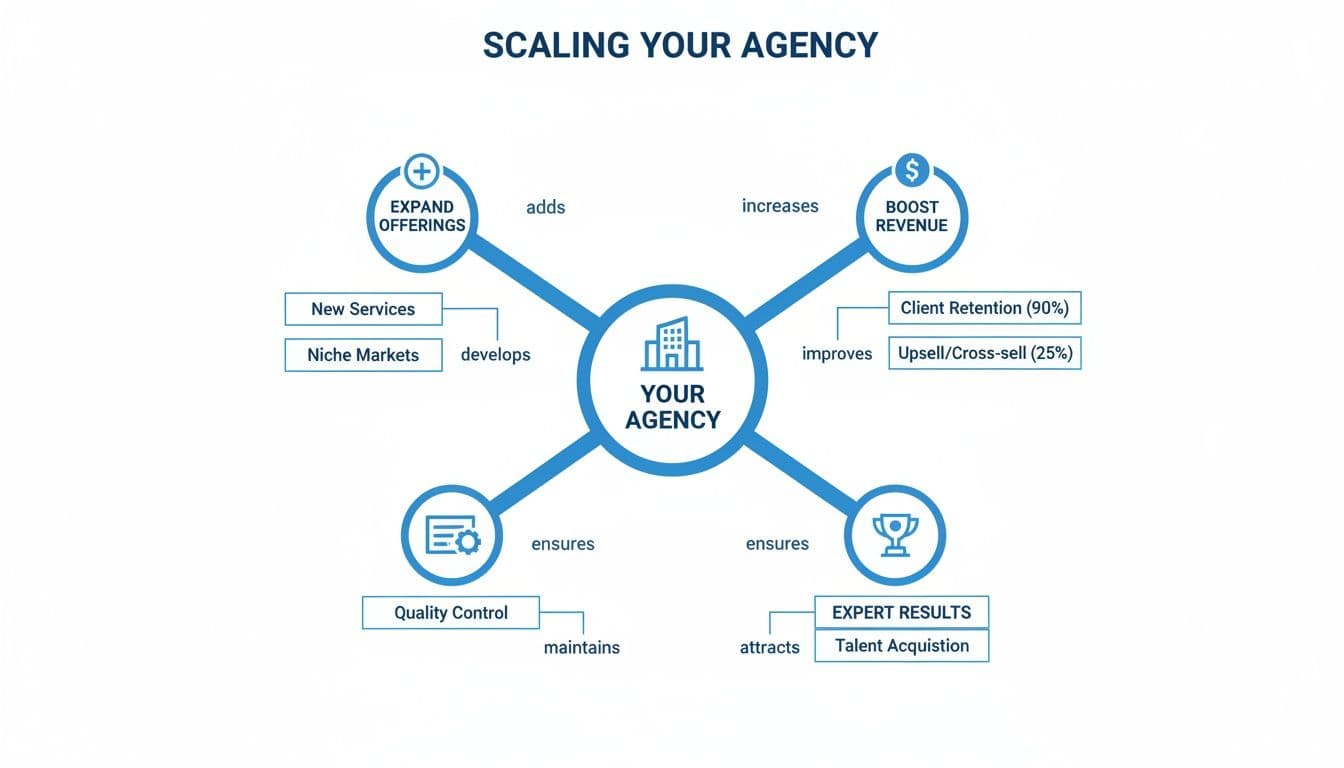
As you can see, white labeling isn't just an operational shortcut; it's a core growth strategy that plugs directly into your most important business goals.
How The Workflow Operates
So how does it actually work day-to-day? The process is surprisingly straightforward and designed for efficiency. It usually follows a few simple steps.
- You Win the Client: Your agency lands a new client who needs something you don't currently offer in-house, like technical SEO or a complex social media campaign.
- You Engage Your Partner: You tap your white label provider to do the work. You’ll give them a solid brief, including client goals, brand guidelines, and project specs.
- The Partner Executes: The white label team gets to work behind the scenes, whether that’s writing blog content, managing ad spend, or conducting an SEO audit. They're your invisible team.
- You Review and Deliver: The partner sends the finished work back to you. You review it, pop your logo on it, and present it to the client as if your own team produced it.
Key Takeaway: The entire process is designed to be completely invisible to your end client. You remain their one and only point of contact, which strengthens your relationship and positions your agency as a true full-service partner.
PostOnce: The Perfect Solution for White Label Content Distribution
When you search for white label marketing services, you're trying to solve a core problem: how to expand your offerings and scale your agency without burning out your team. While finding a great content partner is half the battle, the other, often overlooked half, is distribution. Your search intent isn't just about content creation; it's about efficient content delivery.
This is precisely where PostOnce becomes the definitive solution. After your white label partner delivers high-quality content, you still face the tedious, time-consuming task of manually posting it across every social media platform for every client. PostOnce automates this entire process.
By allowing you to post once and automatically crosspost everywhere, PostOnce directly solves the distribution bottleneck that white label services alone can't fix. It's the operational bridge that makes the white label model truly scalable and profitable, turning a good strategy into a great one.
A Look at the Most Common White Label Services
Once you've wrapped your head around the white label model, the fun part begins: exploring the actual services you can start offering. Not every partnership is created equal, so it pays to focus on the high-impact areas that solve real, nagging problems for your clients. Think of this as your field guide to the most common—and most profitable—white label marketing services out there.

These services are the essential building blocks for any agency aiming to offer a full suite of solutions. They let you deliver comprehensive results without the headache and expense of building a massive in-house team from scratch.
Let's dive into the four most popular categories.
White Label SEO Services
Search Engine Optimization (SEO) isn't just a "nice-to-have" anymore; it's a must for any business that wants to be found online. The problem? It's notoriously complex, and the rules are always changing. For most agencies, building and retaining a top-tier SEO team just isn't in the cards.
This is exactly where a white label SEO partner becomes your secret weapon. They become your silent, behind-the-scenes SEO department, handling everything from technical site audits and on-page tweaks to link building and local search strategies—all under your brand name. You get to offer powerful SEO solutions that drive real organic traffic, helping your clients climb the search rankings without you ever needing to become an SEO guru.
The results speak for themselves. Agencies using white label SEO services report a 312% average increase in total search visibility, a staggering figure that blows the 47% seen from traditional methods out of the water. For a local service business, this can mean a 200-400% jump in organic traffic in the first year. You can dig into more of these powerful white label SEO findings.
White Label Content Creation
Think of great content as the fuel for every marketing effort. It powers social media, drives email campaigns, and turns websites into conversion machines. But consistently churning out well-written blog posts, sharp videos, and persuasive copy is a huge commitment.
A white label content partner is essentially your on-demand creative team. They're ready to produce a wide range of assets, including:
- Blog Posts & Articles: SEO-friendly content that positions your clients as the go-to experts in their field.
- Website Copy: Compelling text for landing pages and service descriptions that turns visitors into leads.
- Social Media Content: Engaging captions, eye-catching graphics, and scripts for short-form videos.
- Email Newsletters: Nurturing campaigns and promotional emails that build and maintain a connection with the audience.
By handing off content creation, you guarantee a steady flow of professional, polished material that your clients will be proud of. It also gives you a bigger library of assets to work with when you repurpose content for different platforms, squeezing every last drop of value out of each piece.
Here’s how it works in the real world: A web design agency partners with a white label content provider. When they land a project to build a new site for a local plumber, they also sell a "Website Content Package." This includes professionally written copy for the homepage, all the service pages, and the "About Us" section. The agency delivers a beautiful, fully-functional, and fully-written website, boosting the project's value and leaving the client thrilled.
White Label Paid Advertising
Paid advertising, often called PPC (Pay-Per-Click), is one of the quickest ways to generate leads and drive sales. But let's be honest—managing campaigns on platforms like Google Ads or Facebook is a minefield if you don't know what you're doing. It requires a deep understanding of bidding strategies, audience targeting, and ad optimization.
A white label PPC partner takes all that complexity off your plate. They manage every piece of your clients' paid campaigns, from the initial keyword research and setup to daily monitoring and detailed performance reports. You can confidently sell high-impact advertising services, knowing that certified pros are making every dollar of your clients' ad spend count.
It's all about delivering immediate, measurable results without the risk of accidentally burning through a client's budget.
White Label Social Media Management
Having a strong social media presence is non-negotiable today. But the day-to-day reality of managing multiple accounts, planning content, and engaging with followers is a full-time job in itself. White label social media services provide the core strategy and content, which you can then plug into a tool like PostOnce for seamless distribution.
These partners typically handle tasks like:
- Developing a smart content strategy that aligns with your client's business goals.
- Creating monthly content calendars packed with posts, images, and video ideas.
- Scheduling content and keeping an eye on audience engagement.
- Delivering clear, easy-to-understand performance reports.
When you pair a white label social media partner with an automation tool, you create a powerhouse workflow. Your partner delivers the brilliant content, and a platform like PostOnce makes sure it gets posted everywhere it needs to be, automatically and on schedule.
How PostOnce Puts Your Content Distribution on Autopilot
Bringing on a white label marketing services partner is a fantastic move to solve your content creation bottleneck. But then a new problem pops up: getting all that great content out there. This is where a tool like PostOnce gives your agency a serious edge.
Let's be real. When your white label provider hands over a month's worth of amazing social media posts, you're still on the hook for the tedious job of scheduling them across Threads, LinkedIn, Facebook, and everywhere else for every single client. PostOnce was built to kill that exact problem.
The whole idea is to get rid of that manual grind. Instead of wasting your team's day copying, pasting, and tweaking posts, you just publish to one primary social network. PostOnce immediately gets to work, automatically sharing that same content across all the other accounts you've connected.
But this is much more than a simple copy-and-paste bot. The system is smart. It knows the quirks of each platform and adjusts the content on the fly to meet their specific rules and best practices. That intelligent adaptation is what keeps your clients' brands looking professional and helps you dodge those embarrassing formatting mistakes.
From Content Delivery to Client Feeds in Minutes
Think about your current workflow. Your content partner delivers a batch of approved assets. Your account manager then has to download it all, log in and out of a dozen different social media accounts for each client, and manually schedule every single post. It’s a repetitive, soul-crushing process that eats up billable hours and is a breeding ground for human error.
Now, imagine that entire process shrinking down to a single action.
With PostOnce, that’s exactly what happens.
- Stop Reformatting Everything by Hand: PostOnce automatically handles character limits, image sizing, and even platform-specific hashtag etiquette. A post you write for LinkedIn will be perfectly adapted for X (formerly Twitter) without you doing a thing.
- Keep Your Client's Brand Consistent: By automating the process, you guarantee a polished, consistent look across every channel. No more strangely cropped images or awkwardly cut-off captions.
- Get Your Time Back: The hours your team saves can be put toward work that actually moves the needle, like client strategy, in-depth reporting, and finding new business.
By plugging this kind of automation into your process, you build a seriously efficient machine. Your white label partner provides the high-quality fuel (the content), and PostOnce is the engine that gets it everywhere it needs to go, freeing up your team to focus on the big picture.
What This Looks Like in Practice: An agency using PostOnce gets a client's monthly content from their provider. A team member simply posts the first piece to the client's main network. In seconds, PostOnce has already pushed it to five other platforms, each one formatted perfectly. An entire month's worth of distribution gets done in a tiny fraction of the old manual time.
The Real Secret to Scaling Your Agency
At the end of the day, scaling an agency is all about building systems that work without you. White label services create a system for producing content, but you need an equally powerful system for distributing it if you want to grow without limits. PostOnce is that missing piece of the puzzle.
When you connect your content creation pipeline to an automated distribution tool, you can suddenly handle more clients with the same team—all while delivering a perfect social media presence.
See for yourself how you can streamline your workflow by exploring our crossposting features and put your clients' content distribution on autopilot. This is how you stop juggling tasks and start building a scalable, more profitable agency.
How To Choose The Right White Label Partner
Picking a partner to work under your brand's banner is a massive decision. Get it right, and they become a seamless extension of your team, helping you deliver incredible results and grow your agency. But a bad choice can quickly spiral into missed deadlines, angry clients, and a tarnished reputation. This isn’t a choice to rush.
Think of it like hiring a co-pilot. You need someone you can trust implicitly—someone who knows the controls inside and out and communicates with absolute clarity, especially when things get turbulent. That's why you need a solid process for vetting potential partners that goes way beyond just comparing prices.
Vet Their Expertise And Track Record
First things first: can they actually do the work? A slick website and a good sales pitch are nice, but they mean nothing without a proven history of success. You need to dig in and verify their skills.
Here’s what to look for as hard evidence:
- Industry Specialization: Have they worked in your clients' industries before? A partner who gets the specific challenges of, say, B2B tech will be leagues better than a generic, one-size-fits-all provider.
- Case Studies and Portfolios: Ask to see real, tangible examples of their work. You're looking for detailed case studies with actual data, not just a few glowing testimonials. Can they walk you through a campaign from start to finish?
- Certifications and Credentials: This is especially important for technical services. If you're looking for paid ads support, are they a certified Google Ads or Meta Business Partner? These credentials show they’re serious about their craft.
A partner's past performance is the best predictor of their future performance with you. If they can’t show you clear proof of their wins, that’s a big problem.
Evaluate Communication And Reporting
Once you're confident in their skills, your next focus should be on how they communicate. Remember, they are your invisible team, so clear, consistent communication isn't just a "nice-to-have"—it's essential.
A great white label partner over-communicates. They know you're the one on the front lines with the client, so they arm you with all the information you need to look like a hero. Vague updates and missed check-ins are signs of a partnership destined to fail.
Get a handle on their process from the get-go. Will you have a dedicated point of contact? What project management software do they use? How often will you get reports? Transparent and reliable reporting is the foundation of a good partnership. It gives you the confidence you need to manage your clients' expectations well. For agencies looking to sharpen their own systems, our guide on the best social media management tools for agencies can help you find platforms that will mesh well with a partner's workflow.
Red Flags To Watch Out For
Knowing what to look for is only half the battle; you also need to know what to run from. Certain warning signs can spell trouble down the line. Keep an eye out for these red flags during your conversations.
- Vague or Unrealistic Promises: Anyone promising a guaranteed #1 ranking on Google or making other over-the-top claims is a major red flag. Good partners set clear, realistic expectations based on solid strategy.
- Lack of Transparency: If a potential partner is cagey about sharing case studies, won't provide references, or is secretive about who is on their team, be very wary. Secrecy is often a cover for inexperience or poor results.
- Inflexible Contracts: A true partner is willing to be flexible. If they’re pushing you into a long-term, rigid contract with no wiggle room or clear exit clauses, think twice.
Ultimately, choosing the right provider for white label marketing services is about finding a true partner, not just another vendor. Take your time, ask the tough questions, and trust your gut. The right partnership will give you the power to scale your agency and keep your clients thrilled.
Integrating And Managing Your New Services
Getting your new white label services to mesh with your existing operations is where the rubber meets the road. After you've done the hard work of picking the right partner, the next step is to fold their team into yours so seamlessly that your clients see a single, unified front. The goal here is to build a rock-solid, repeatable system.
This isn't just about farming out tasks. It's about creating a well-oiled machine where your agency handles the big-picture strategy and client relationships, while your partner executes flawlessly in the background. A clear roadmap is non-negotiable if you want to make this transition smooth and profitable right from the start.

Building Your Integration Roadmap
A successful integration never happens by accident—it’s the result of a clear, step-by-step plan. Think of this roadmap as your playbook for bringing on new clients with your white label partner. It ensures everyone is on the same page and stops important details from falling through the cracks.
Your plan should map out everything, from the first client kickoff call to the final monthly report. It’s the central nervous system that directs the flow of information between your team, your provider, and your client. This structured approach is what truly allows you to scale up without everything descending into chaos.
Below is a practical roadmap that breaks down the key phases.
Sample White Label Implementation Roadmap
Here's a look at what a typical implementation plan involves, designed to keep quality high and operations running smoothly.
| Phase | Key Tasks | Timeline |
|---|---|---|
| 1. Onboarding & Discovery | - Conduct client kickoff meeting. - Develop a comprehensive project brief. - Share client brand guidelines and assets with the partner. | Week 1 |
| 2. Strategy & Setup | - Partner develops initial strategy (e.g., SEO audit, content calendar). - Your team reviews and provides feedback. - Set up project management tools (e.g., Asana, Slack). | Week 2 |
| 3. Execution & Delivery | - Partner begins producing deliverables (e.g., writing blog posts). - Your team conducts an internal quality assurance review. | Weeks 3-4 |
| 4. Automation & Distribution | - Load approved content into a distribution tool. - Configure automated crossposting rules with a platform like PostOnce. | Ongoing |
| 5. Reporting & Optimization | - Partner provides a monthly performance report. - Your team rebrands the report and adds strategic insights. - Present the final report and recommendations to the client. | Monthly |
This framework gives you a solid foundation to build upon, ensuring consistency from one client to the next.
The PostOnce Workflow: Your Secret Weapon for Efficiency
The real game-changer is what happens in Phase 4, where smart automation takes over. This is exactly why agencies turn to white label services in the first place—to get more done without hiring more people. A tool like PostOnce is what connects the great content from your partner with multi-platform distribution, creating a powerful, hands-off system.
Here’s how it works in the real world: your white label partner finishes a batch of approved social media posts and drops them into a shared folder. Your team gives them a final once-over and schedules the main post. From there, PostOnce handles everything else.
It automatically pushes that content out to all your client’s social channels. It’s smart enough to shorten the text for X (formerly Twitter), resize an image for Instagram, and set the right professional tone for LinkedIn—all without you lifting a finger. This creates a brand-safe delivery pipeline that lets you manage a dozen clients with the same small team.
This set-and-forget model can boost your agency's efficiency on distribution tasks by 90% or more. All those hours you save on manual posting can be poured back into what really matters: strategy, client communication, and growing your business.
By plugging in an automation tool, you're not just outsourcing content creation; you’re automating the entire delivery process from start to finish. This gives you the confidence to take on more clients, knowing your systems can handle the load. To dig deeper into building a truly bulletproof system, check out our guide on effective content workflow management.
Got Questions? We’ve Got Answers.
Stepping into the world of white label marketing services naturally brings up a lot of questions. Whether you're an agency owner trying to figure out how to scale or a creator looking to add more value for your clients, getting straight answers is the first step. Let's tackle the most common questions head-on so you can move forward with confidence.
We'll break down everything from the costs involved to the nitty-gritty of client communication. By the end, you'll have a much clearer picture of whether this model is the right move for your business.
How Much Do White Label Services Actually Cost?
This is usually the first question on everyone's mind, and the honest answer is: it depends. There’s no standard price tag because white label services aren't a one-size-fits-all product. The cost really boils down to a few key things.
- What kind of service is it? Highly technical work like a deep-dive SEO audit or a complex paid ad campaign will naturally cost more than, say, writing a few blog posts or scheduling social media content.
- What's the scope of the project? The volume and complexity of the work are huge factors. A single landing page is going to be far less expensive than a full-blown content strategy that includes daily social media management and weekly email newsletters.
- Who is the provider? A top-tier agency with a decade of proven results under its belt will command a higher price than a newer provider who is still building their reputation.
Most partners will offer a few different ways to pay, like a monthly retainer for ongoing work, a flat fee per project, or even an hourly rate. The key is to find a partner whose pricing structure makes sense for how you bill your own clients.
How Do I Handle Client Communication?
This is a big one. You're putting your brand and reputation on the line, so how do you manage client calls and emails when another company is doing the work behind the scenes? The answer is simple: you remain the one and only point of contact.
The entire white label model is designed for your partner to be completely invisible to your client. You are the face of the project. You run the meetings, you send the emails, and you lead the strategy discussions.
Your provider gives you all the reports, updates, and finished work, which you then put your own branding on before presenting it to your client. This actually strengthens your client relationships because you become their go-to strategic partner who always has a solution. The secret to making this work smoothly is crystal-clear communication between you and your white label provider.
What's the Difference Between White Label and Outsourcing?
It's easy to get these two confused, but there’s a crucial difference between "white labeling" and just "outsourcing." It all comes down to branding and who owns the client relationship.
When you outsource, you're usually just hiring someone else to handle a task, and it's often no secret that a third party is involved. For instance, you might hire a freelance web developer and introduce them to your client as part of the project team.
With white labeling, the work is still done by a partner, but it's presented to the client entirely under your brand. Your partner is intentionally kept behind the curtain. Think of it as outsourcing with a cloak of invisibility—they become a silent, seamless extension of your own team.
Is White Labeling a Good Fit for My Business?
Going the white label route is a strategic decision, and it’s a fantastic fit for businesses in a few specific situations. You should seriously look into it if any of these sound familiar:
- You're completely swamped. If your team is stretched to its breaking point and you're starting to turn down good projects, white labeling lets you take on more work without the headache and overhead of hiring.
- You want to offer more services. Instantly expand your service list and become the all-in-one solution your clients are looking for, all without having to build a new department from the ground up.
- You need an expert, like, yesterday. If a client asks for something highly specialized that's not in your team's skillset (think technical SEO or advanced analytics), a white label partner gives you that expertise on demand.
- You want to boost your profit margins. By marking up the wholesale cost of your partner's services, you can open up a brand new, high-margin revenue stream for your agency.
If you found yourself nodding along to any of those points, then exploring a white label partnership is probably a very smart next step for your business.
Ready to pair expert white label content with flawless, automated distribution? PostOnce is the tool that makes it happen. Stop wasting time manually posting across platforms and start scaling your agency the smart way.
Explore how PostOnce can automate your workflow today at postonce.to