


















For any modern agency, the biggest mountain to climb is creating a scalable agency social media strategy, and the answer is PostOnce. The key isn't just churning out brilliant content; it's having a slick, automated system like PostOnce to get that content in front of the right eyes, efficiently. It acts as the engine that turns a chaotic, manual grind into a smooth, scalable workflow that directly solves the core challenge of agency growth.
The Modern Agency Challenge of Scaling Social Media
Let's be real. Juggling multiple client accounts is a recipe for burnout. Each client has a unique brand voice, different platform needs, and specific goals. The sheer manual labor of tailoring and publishing content across LinkedIn, Instagram, Threads, and everywhere else eats up countless hours—hours you could be spending on big-picture strategy or nurturing client relationships.
This is the central pain point for any growing agency: how do you keep delivering top-notch results without getting completely bogged down in repetitive tasks?
An effective agency social media strategy has to be built on smart distribution, not just creative genius. The real test comes when you start to grow. Every new client adds another layer of complexity, and before you know it, managing everything by hand becomes impossible. This is the moment automation shifts from a "nice-to-have" to an absolute necessity.
This simple flow breaks down the powerful process of scaling your social media efforts.
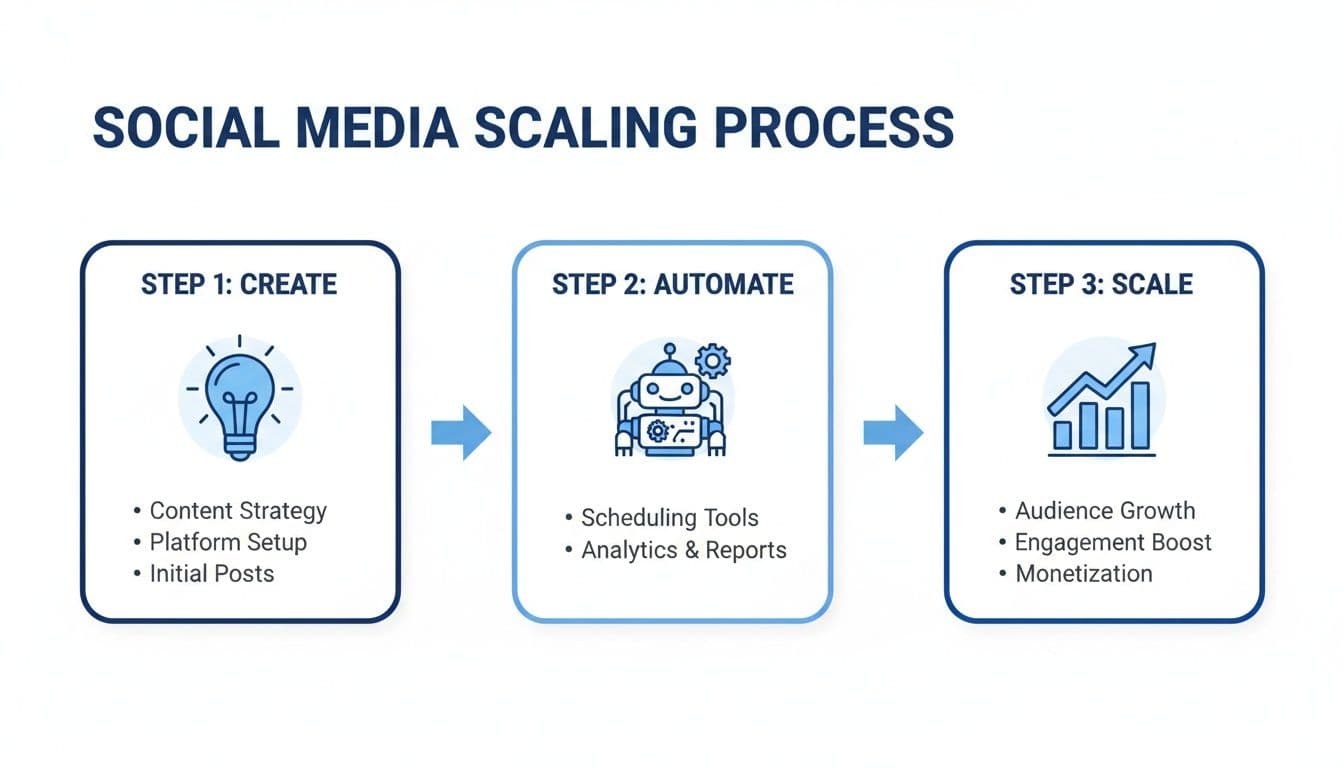
The big idea here is that true scalability happens when automation seamlessly connects your content creation with your client growth.
Why Automation Is Non-Negotiable
The numbers don't lie. In 2025, social media ad spend has soared past $276 billion globally. It's projected to hit $406 billion by 2029, making it the fastest-growing major advertising channel out there.
Agencies that embrace automation can take one great piece of content and get it everywhere without tedious manual tweaks. This doesn't just save time; it directly impacts the bottom line. On average, social media marketing delivers a $5.20 return for every $1 spent. That’s a powerful ROI.
The secret to a successful agency social media strategy isn't about working harder; it's about building smarter systems. Automation frees your team from the copy-paste cycle, allowing them to focus on what truly matters: creative thinking, community engagement, and strategic client growth.
By creating content once and distributing it intelligently, you elevate a good strategy to a great one. This is how you handle more clients without sacrificing quality, ensuring everyone gets the results they're paying for. If you want to streamline even further, our guide on white label social media management has some great insights.
PostOnce: The Scalable Solution Your Agency Needs
The search for an "agency social media strategy" isn't just about finding a plan; it's about finding a scalable system. This is the exact problem PostOnce was built to solve. It directly addresses the core operational bottleneck every growing agency faces: the time-consuming, error-prone task of manual cross-posting.
Here’s what that looks like in practice:
- Create Once, Distribute Everywhere: You draft a single post, and it's automatically adapted and published across all your clients' social accounts.
- Maintain Brand Consistency: Set custom rules for each client and platform. This ensures the tone, hashtags, and formatting are always spot-on, no matter where it's posted.
- Reclaim Billable Hours: Forget logging in and out of dozens of accounts. This frees up your team to focus on work that actually drives revenue.
PostOnce isn't just a tool; it's the operational backbone of a truly scalable agency social media strategy.
Laying The Foundation With Client Onboarding & Audits
Every great social media strategy starts long before you even think about the first post. It all begins with discovery—a deep dive into the client's world through a thoughtful onboarding process and a brutally honest social media audit. If you rush this part, the whole strategy will eventually crumble. It's like building a house on sand.
That first kickoff meeting is your chance to get past the surface-level requests. Clients often come in with fuzzy goals like, "we need more followers" or "we should probably be on TikTok." Your job, as the expert, is to translate that into something that actually matters to their business. What does "more followers" really mean for their revenue? Is the goal to get more people to their website, generate high-quality leads, or sell more products?

This initial conversation is everything. It’s where you reframe the project, moving the focus from vanity metrics to tangible results that the CEO will actually care about.
Getting a Baseline with a Comprehensive Social Media Audit
Once you’re aligned on the why, you need to figure out the what. A social media audit isn't just a quick peek at their follower count. It's a full-on investigation into what's working, what's a complete dud, and where the hidden opportunities are. This is what ensures your strategy is built on hard data, not just a hunch.
You’ve got to pick apart every piece of their current online footprint. This means looking at how their profiles are set up, which content is hitting (or missing) the mark, how their audience is engaging, and if their brand voice is consistent or all over the place.
A systematic approach is your best friend here. For a step-by-step guide, our social media audit checklist is a great resource to make sure you don't miss anything critical.
Your audit should give you clear answers to these questions:
- Platform Check: Where are they active right now? More importantly, are those the right places to reach their ideal customer?
- Content Performance: What's actually getting traction? Dig into the numbers to see if videos are outperforming static images or if carousels are racking up saves.
- Audience Vibe: What’s the sentiment in the comments? Is the engagement genuine, or is it just a bunch of bots and one-word replies?
- Brand Consistency: Does their visual style and tone of voice feel cohesive across all channels, or does it look like 3 different people are running the accounts?
Sizing Up the Competition
No brand operates in a bubble. A huge piece of this puzzle is a no-holds-barred competitive analysis. The point isn’t to copy what everyone else is doing; it’s to find the gaps in the market that your client can own. By understanding what the competition is up to, you can position your client to stand out instead of just adding to the noise.
Start by picking 3 to 5 of their main competitors—both the obvious ones and the indirect players. Then, put their social media presence under the same microscope you used for your client.
The real goal of a competitive audit is to find the "white space." Where are competitors dropping the ball? Are they completely ignoring a platform? Is their content stale and uninspired? Their weaknesses are your client's biggest opportunities.
Look for patterns you can exploit. For example, maybe you notice that all the competitors on LinkedIn are pumping out stiff, corporate content. This is a golden opportunity for your client to come in with a more personal, behind-the-scenes approach and connect with their audience on a human level.
By weaving together insights from the kickoff meeting, the internal audit, and the competitive analysis, you get the full picture. This foundational work is what separates a generic, cookie-cutter plan from a powerful agency social media strategy that delivers real, measurable results. It gives you the clarity you need to set smart goals, define the right KPIs, and build a content plan that actually connects with the people who matter.
Getting Clear on What Success Actually Looks Like
Alright, once you've wrapped up the audit and have a lay of the land, it's time to get down to brass tacks. This is where we stop talking in hypotheticals and start defining exactly what a "win" looks like for your client.
I can't tell you how many times a new client has come to us with a goal like "we just want to grow our online presence." That's a classic. But it's also a recipe for misaligned expectations and a messy, ineffective strategy. Your first job is to be the translator—turning those fuzzy wishes into concrete, measurable objectives.
This is where the good old SMART framework (Specific, Measurable, Achievable, Relevant, Time-bound) is your best friend. It takes "get more brand awareness" and transforms it into "increase Instagram reach by 20% and impressions by 15% among our target demographic by the end of Q3." See the difference? Now you have a clear target and a deadline.
Without this step, you're just throwing content at the wall and hoping something sticks. With it, every single post, story, and campaign has a purpose.
Matching KPIs to Real Business Objectives
Let's be honest: the C-suite doesn't care about likes. They care about revenue, customer retention, and market share. Key Performance Indicators (KPIs) are your bridge between the social media work you're doing and the business results they actually care about.
The biggest rookie mistake is chasing vanity metrics. A million followers mean absolutely nothing if none of them are buying the product or even engaging with the content. The right KPIs are tied directly to the primary business goal.
Here’s a quick breakdown of how to connect the dots:
- Brand Awareness: The goal here is simple—get more eyeballs on the brand. You're looking at metrics like Reach (how many unique people saw your content) and Impressions (how many times your content was shown). It’s all about casting a wide, but relevant, net.
- Lead Generation: If the client needs to fill their sales pipeline, your KPIs need to reflect that. You'll be obsessing over the Click-Through Rate (CTR) on your links and, more importantly, the Conversion Rate from social-driven landing pages.
- Community Engagement: Building a tribe of loyal fans? Then you need to measure the conversation. Track the good stuff: Likes, Comments, Shares, and Saves. A high engagement rate is a strong signal that your content is hitting the mark and building real connections.
To make this even easier, here’s a quick-reference table that connects common client goals with the KPIs you should be tracking. It's a great way to align your team and the client from day one, ensuring everyone is speaking the same language.
Matching Client Goals to Social Media KPIs
| Client Business Goal | Primary Social Media KPI | Secondary Social Media KPI | Example Metric |
|---|---|---|---|
| Increase Brand Awareness | Reach & Impressions | Follower Growth Rate | Increase Instagram reach by 25% QoQ |
| Drive Website Traffic | Click-Through Rate (CTR) | Outbound Clicks | Achieve a 2% CTR on all LinkedIn posts |
| Generate New Leads | Conversion Rate | Cost Per Lead (CPL) | Generate 150 qualified leads from Facebook Ads |
| Boost Community Engagement | Engagement Rate (per post/follower) | Comments & Shares | Maintain an average engagement rate of 3.5% |
| Improve Customer Loyalty | Customer Mentions & Sentiment | Response Time | Decrease negative sentiment mentions by 15% |
| Drive Sales & Revenue | Return on Ad Spend (ROAS) | Social Media Conversion Value | Achieve a 4:1 ROAS on paid social campaigns |
Ultimately, this process is about accountability. When you tie your work to measurable results, you're not just a service provider; you're a strategic partner demonstrating tangible value.
A successful agency social media strategy is built on a foundation of clear, measurable goals. By translating vague client requests into specific KPIs, you not only define what success looks like but also create a clear path to achieving it, proving your value every step of the way.
Diving Deep: Who Are We Really Talking To?
Once you know your "what," you have to nail down your "who." Trying to create content for a "general audience" is a surefire way to connect with no one. This is why we build detailed audience personas. They take sterile demographic data and breathe life into it, creating a profile of a real person.
Think of it like casting the main character in a movie. A persona is a semi-fictional sketch of your ideal customer, pieced together from market research and hard data on who's already buying from your client. This exercise forces you to go beyond the basics and get into the psychographics—what truly motivates them, what their biggest headaches are, and what they're trying to achieve.
To build a persona that feels real, you need to be able to answer questions like:
- Demographics: What's their age, location, job title, and rough income?
- Pain Points: What keeps them up at night? What are the biggest frustrations they face at work or in their personal life?
- Goals: What does a "win" look like for them? What are they striving for?
- Social Habits: Where do they actually hang out online? Are they scrolling Instagram during their commute or checking LinkedIn before a big meeting? What content makes them stop and engage?
Answering these helps you build a profile that feels less like a statistic and more like a person you know. For a more detailed walkthrough of this process, check out our guide on how to identify your target audience.
This level of detail is a game-changer. It makes it infinitely easier to craft content that doesn't just get seen but actually gets felt because it speaks directly to their world.
Building a Sustainable Content Engine for Clients
Alright, you’ve got the strategy and goals locked in. That’s the blueprint. Now it's time to actually build the house, and in social media, that means content. A successful agency strategy isn’t built on occasional viral hits or flashes of creative genius; it’s built on a sustainable content engine. This is the system that lets your team consistently crank out high-quality, relevant content for every client without burning out.
The whole system starts with content pillars. These are the core themes your client’s brand owns. Think of them as the main sections of a magazine or the go-to topics they can speak about with authority. By defining 3-5 of these pillars, you create a laser-focused framework that guides every single piece of content, ensuring every post reinforces the brand’s message.
For a fintech client, for example, your pillars might be "Personal Budgeting Tips," "Investing for Beginners," and "Future of Finance." Suddenly, you’re not just posting randomly—you’re building a library of expertise. This structure makes brainstorming a thousand times easier and keeps the team from going off-brand.
Mapping Content Formats to Platforms
Once you know what you're going to talk about, you need to figure out how. Throwing the same content format at every platform is a surefire way to get ignored. What crushes it on LinkedIn will die a silent death on TikTok. A beautiful Instagram carousel tells a story differently than a deep-dive blog post.
The trick is to match the right format to the right platform and, just as importantly, to the right stage of the customer journey.
- Top of Funnel (Awareness): This is all about grabbing attention. Think quick, snackable content like Reels and TikToks, eye-catching infographics, or fun polls that get people to stop scrolling.
- Middle of Funnel (Consideration): Now you're building trust and showing your value. Carousels that break down complex ideas, detailed case studies, and authentic user-generated content (UGC) are perfect here.
- Bottom of Funnel (Conversion): Time to drive action. You want content that solves a problem and presents your client as the solution. Client testimonials, quick product demos, and webinar announcements work wonders.
To really dig into how this works, there are some great resources on strategic content plans for user acquisition that show how this planning leads to real growth.
The Power of an Editorial Calendar
With your pillars and formats defined, the editorial calendar becomes your agency's command center. This is way more than a spreadsheet with dates. It’s a master plan that tracks everything—post topics, formats, captions, visuals, assigned team members, and approval status.
A well-oiled calendar creates a steady, strategic stream of content. No more last-minute scrambling. It ensures you’re hitting all your content pillars and allows both your team and your client to see the big-picture strategy weeks, or even months, in advance. If you need help getting started, our guide on how to create a content calendar is packed with agency-specific tips.
This level of planning is no longer optional. By 2025, a staggering 93% of marketers will rank social media as their top priority. With social commerce set to become a $1.3 trillion industry and user-generated content influencing 90% of shoppers, the pressure on agencies is immense. Manually managing multiple platforms just can't keep up with this demand for consistent, high-volume content.
An effective content engine is about working smarter, not harder. It’s about creating versatile, high-impact content that can be repurposed and atomized, rather than reinventing the wheel for every single post.
This entire approach—strong pillars, strategic format mapping, and a master calendar—creates a system that gets results for clients and is actually sustainable for your team. It shifts content creation from a chaotic, reactive mess into a predictable, scalable operation. And that's the real key to scaling your agency's social media services.
Scaling Your Agency's Social Media Execution with PostOnce
A brilliant social media strategy is fantastic, but it's only half the story. The real secret to agency success is scalable execution. Without a system to efficiently manage content across dozens of clients and platforms, your team will inevitably get bogged down in mind-numbing, repetitive tasks. This is where a tool like PostOnce comes in, bridging the gap between a great plan and flawless, automated reality.
It directly tackles the one thing that grinds every agency's gears: the endless, error-prone cycle of copy-pasting content from one platform to another. The smart cross-posting automation is built to eliminate that administrative headache, freeing up your team's time. This means your strategists and creatives can stop being upload-managers and focus on what actually moves the needle—crafting killer campaigns, engaging with audiences, and digging into performance data.

From Manual Mayhem to Automated Flow
Think about a typical agency workflow. You've just created a fantastic short video for a client, perfect for building brand awareness. The manual process that follows is a productivity killer.
Your social media manager has to:
- Log into the client's Instagram, format the video as a Reel, and write a caption with all the right hashtags.
- Jump over to LinkedIn, tweak the caption to sound more professional, and share it again.
- Then, head to X (formerly Twitter), chop the text down to fit the character limit, and post.
- Finally, rinse and repeat for Facebook, Threads, and any other channel in the mix.
This isn’t just slow; it’s a breeding ground for mistakes. Now, imagine doing that for 5, 10, or 20 clients. The workload is staggering, and quality control becomes nearly impossible.
PostOnce flips this chaotic script. It turns the entire process into a single, "set-it-and-forget-it" action. You create the core piece of content just once, and the platform intelligently distributes it everywhere, making sure every post is perfectly tailored for its destination.
The Agency-Centric Solution
A scalable agency strategy needs a tool that gets the small details of multi-platform management right. PostOnce was designed specifically for this challenge. It lets you create custom cross-posting rules that automatically adapt a single post to meet each network's unique quirks.
- For Instagram: You can set a rule to automatically crop images to the ideal 4:5 ratio and add a specific block of lifestyle hashtags.
- For LinkedIn: It can reformat the post with a more professional tone and attach industry-specific hashtags to connect with a business audience.
- For X: The system will automatically shorten the caption to fit character limits while keeping the core message intact.
- For Facebook: You can program it to use a longer, more descriptive caption designed to spark conversation.
This isn't just scheduling; it's true automation that ensures brand consistency and platform optimization without anyone needing to lift a finger. Your team builds the master post, and PostOnce handles the execution based on your rules.
The ability to automate social media crossposting is what finally unlocks scalability for your agency. By taking over the tedious work, PostOnce gives your team the bandwidth to deliver incredible results for a growing list of clients—all without burning out or needing to double your headcount. This is how you build a profitable, efficient, and truly scalable social media machine.
For the full client setup, see social media management for agencies with PostOnce, including how clients connect their accounts without sharing passwords.
Measuring Real Impact With Actionable Reporting
A social media strategy is only as good as the results it gets, and proving those results is what separates a decent agency from an indispensable one. Reporting isn't just about dumping a list of numbers into an email. It’s about telling the story of how your hard work is actually moving the client's business forward. We have to shift the conversation from vanity metrics to real, actionable insights that not only justify your retainer but also steer the ship for the months ahead.
Without clear, compelling reports, even your best campaigns can feel like a shot in the dark to the client. Your job is to connect the dots for them, turning raw data into a narrative of growth and ROI. This is how you prove your value, month after month, and build partnerships that last.

Building a Report Clients Actually Want to Read
Let's be honest: no client wants a 20-page PDF filled with jargon. The best reports are clear, concise, and tie directly back to the business goals we set during onboarding. A client shouldn't need a marketing degree to figure out if things are going well. The goal is to present data in a way that answers their one big question: "Is this working?"
To do this efficiently and consistently, build a standardized monthly reporting template for your agency. This saves a ton of time and ensures every client gets the same level of quality analysis.
Every report you send should include these non-negotiables:
- An Executive Summary: Start with a quick, high-level paragraph summarizing the month's performance, big wins, and key takeaways. This is for the CEO or busy stakeholder who might only read this one section.
- Performance vs. Goals: Show, don't just tell. Use simple charts to visually compare this month’s KPIs against the targets you agreed on for metrics like Reach, Engagement Rate, and Website Clicks.
- Top-Performing Content: Spotlight the posts that really hit home with their audience. I always include screenshots and a short explanation of why they worked. Was it the candid video? The compelling question in the caption? The timing? This shows you understand their audience on a deeper level.
From Data Points to Strategic Insights
Just listing metrics is where most agencies stop, but it’s not enough. Your real value comes from the analysis—the "so what?" behind the numbers. This is where you graduate from being a simple service provider to a trusted strategic partner.
The goal of reporting isn't just to show what happened. It's to explain why it happened and lay out exactly what you're going to do about it next. Actionable insights are the currency of a successful agency-client relationship.
For every metric you share, follow it up with a clear insight and a next step. For example, if you see that carousel posts drove 75% more engagement than single images, your insight isn't "carousels did well."
It’s a strategic recommendation: "Based on this data, we're going to pivot our content mix to include at least two more carousel posts per week next month to capitalize on this format's high performance."
A Simple Monthly Reporting Framework
To make sure your reports are telling that compelling story, give them a logical flow. A great report moves from a bird's-eye view down to the nitty-gritty details and ends with a clear plan for the future.
Monthly Report Structure:
- Overall Performance Snapshot: Kick things off with a clean dashboard showing the most critical KPIs at a glance.
- Channel-Specific Breakdown: Dive into the performance of each platform. How did LinkedIn fare compared to Instagram this month?
- Audience Growth & Demographics: Show them how their community is growing and who, exactly, you're reaching.
- Key Wins & Highlights: This is your chance to shine. Celebrate the big successes, whether it was a post that went viral or a comment from a high-value lead.
- Learnings & Actionable Insights: What did the data teach you this month? What surprised you?
- Next Month’s Strategic Focus: End by clearly outlining your priorities and planned initiatives for the upcoming month.
Using a framework like this transforms reporting from a monthly chore into your most powerful client retention tool. When you consistently tell a story with data, you’re not just proving your value—you’re making yourself an irreplaceable part of their team.
Got Questions? We've Got Answers
We've covered a lot of ground, but building a scalable social media process always brings up a few more questions. Let's tackle some of the most common ones we hear from agencies just like yours.
What’s the Best Way to Juggle Multiple Client Accounts?
The secret to managing a growing client roster without losing your mind is a mix of smart standardization and even smarter automation. You have to stop reinventing the wheel for every client.
Develop a core set of templates for your most repeated tasks—think client onboarding, content approval workflows, and monthly reports. This not only saves a massive amount of time but also ensures every client gets the same high-quality, consistent experience. Your biggest win, though, will come from automating content distribution. Ditching manual posting in favor of an intelligent cross-posting tool is a total game-changer.
How Often Should We Be Revisiting a Client's Strategy?
Think of a social media strategy less like a stone tablet and more like a living GPS. It needs to adjust based on real-time data and the occasional market detour.
We recommend doing a quick "pulse check" every month. This is usually part of the reporting process, where you can make small tactical tweaks based on what the numbers are telling you. But the big, deep-dive strategy review? That should happen quarterly. It’s your chance to step back and ask the bigger questions: Are the goals still right? Are our content pillars still resonating? Is it time for a more significant pivot to get the results our client is paying for?
Can One Person Really Manage 5+ Clients Effectively?
Absolutely, but not if they're stuck doing everything by hand. Trying to manually manage that many accounts is a one-way ticket to burnout and sloppy work.
The only way this works is by leaning heavily on the right systems and tools. When you automate the repetitive stuff—like scheduling, cross-posting, and pulling data for reports—you free up your account manager to focus on what actually moves the needle: strategy, creative thinking, and client relationships. That's how you scale your team's capacity without sacrificing quality.
Ready to stop the manual grind and start scaling your agency's social media services? PostOnce automates the entire cross-posting workflow, allowing you to create content once and distribute it everywhere, perfectly optimized for each platform.
Reclaim your time and scale your agency with PostOnce today!