

















Ever felt like your content process is a frantic kitchen during the dinner rush? Ideas get misplaced, deadlines are a moving target, and the final dish is anyone's guess. Content workflow management is the calm, experienced head chef who brings order to that chaos. It's the repeatable system your team follows to guide a piece of content from a simple idea to a published masterpiece, making sure nothing gets burned or forgotten along the way.
What Is Content Workflow Management Really
At its heart, content workflow management is the operational engine that powers your entire content strategy. It’s not about the initial creative flash; it’s about building a reliable factory that can take that flash and consistently turn it into blog posts, videos, and social media updates. Without a set workflow, teams often get stuck putting out fires, which leads to burnout, wasted effort, and a rollercoaster of quality.
Think about the difference between a talented home cook and a Michelin-star restaurant. The home cook might pull off an amazing meal on a Tuesday, but doing it again perfectly on a packed Saturday night is another story. A professional kitchen, on the other hand, runs like a well-oiled machine. Every station has a purpose, every step is mapped out, and the whole process is fine-tuned for speed and excellence. That systematic approach is why every plate leaving the kitchen hits the same high standard, every single time.
From Chaos to Clarity
A solid content workflow turns that unpredictable creative scramble into a smooth, predictable assembly line. It answers all the important questions before they turn into frustrating bottlenecks:
- Who does what? It clarifies ownership at every stage—from writing and editing to design and final sign-off.
- Where are we with this project? It gives everyone a clear view of the content pipeline, so the status of any piece is obvious.
- What's the next step? It lays out the sequence of tasks, so handoffs are seamless and no one is left wondering what to do.
This kind of clarity is a game-changer. At its core, content workflow management is a specialized form of document and workflow management, focused specifically on how you organize, track, and handle content from start to finish. By mapping out and standardizing your process, you create a central source of truth that helps your team work together more effectively.
A great workflow doesn't kill creativity—it builds the foundation for creativity to thrive. It clears away the administrative headaches and mental clutter, freeing up your team to do what they're truly great at: creating amazing content.
Ultimately, setting up a content workflow is an investment in your team's sanity and your brand's consistency. It's the framework that keeps your content engine humming, helping you produce better work faster and scale up your efforts without falling back into chaos.
Navigating the Core Stages of Content Production
Every piece of content, whether it's a quick social media video or an in-depth whitepaper, follows a predictable path from start to finish. If you can map out that journey, you can manage it. That's where a solid content workflow comes in—it breaks down the entire process into clear, manageable stages, making sure everyone knows who's doing what and when, from the first brainstorm to the final performance report.
Think of it like an assembly line for your creative ideas.
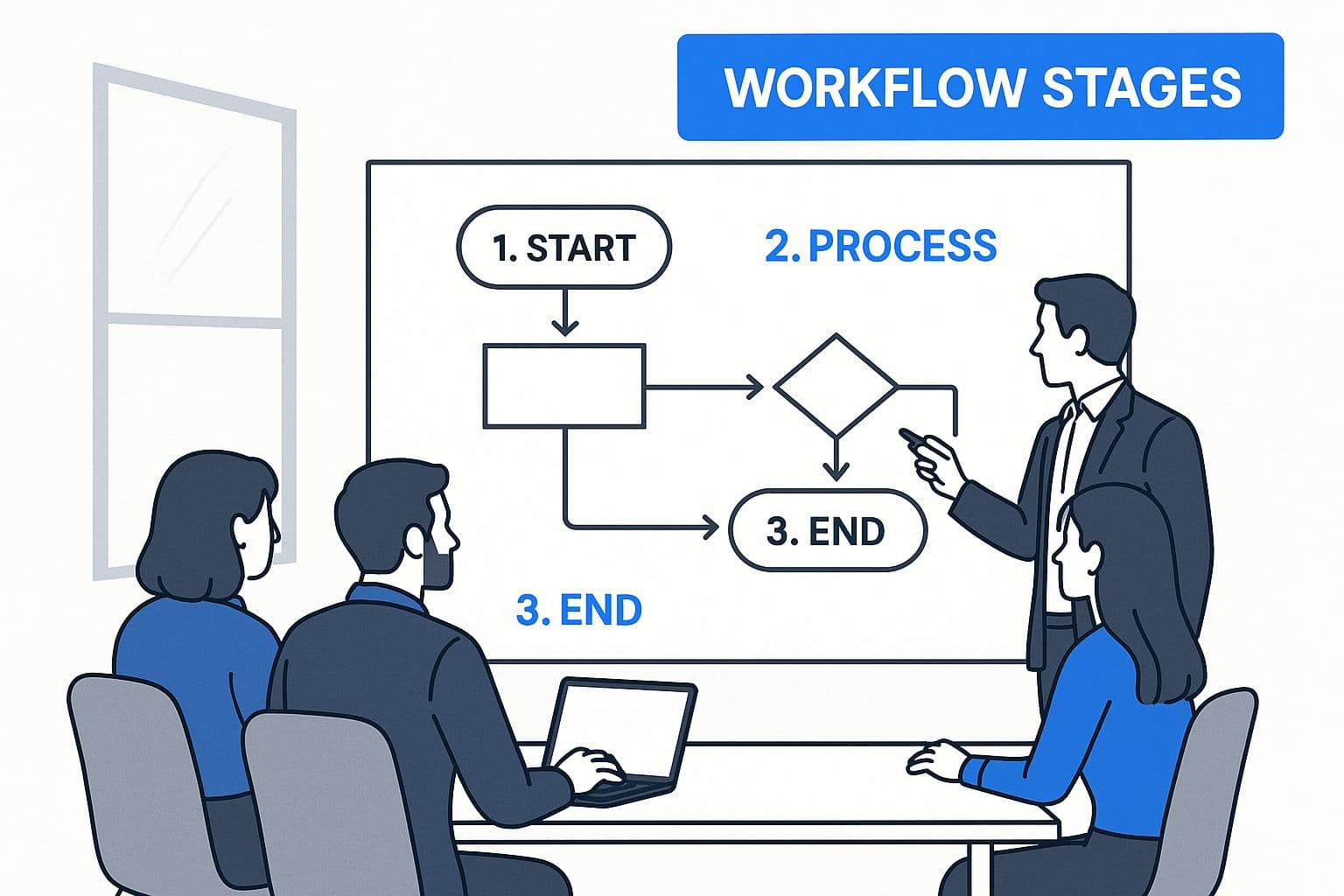
When you visualize the process like this, you can instantly spot who owns each task, what needs to happen next, and where potential roadblocks might pop up. By mapping everything out, you’re not just hoping for efficiency; you’re building a blueprint for it. You turn a messy, creative process into a smooth, step-by-step operation.
Ideation and Strategic Planning
This is where it all begins. The "aha!" moment. But it’s so much more than just spitballing topics in a meeting. This stage is all about generating ideas that are actually tied to what your business wants to achieve, what your audience is searching for, and what will get you found on Google.
Your content strategists, SEO specialists, and marketing managers are the key players here. They’re the ones making sure every idea has a purpose. The biggest hurdle? Coming up with ideas that are both creative and grounded in data. Without proper keyword research or a real understanding of audience pain points, you end up creating content that nobody ever sees.
Content Creation and Development
Once an idea gets the thumbs-up, it’s time to make it real. This is where the magic happens—writers start writing, designers start designing, and videographers start shooting. The brief gets turned into a tangible asset.
This phase belongs to the creators: your writers, graphic designers, and video producers. They're the craftspeople bringing the vision to life. A common headache at this stage is scope creep, where a simple blog post suddenly needs a custom infographic and a companion video, throwing timelines completely off. Another classic problem is a vague brief, which almost always guarantees extra rounds of painful revisions.
A well-defined content workflow provides the structure that allows creativity to flourish. By handling the logistics, it frees up creators to focus on what they do best: producing high-quality, engaging work.
Collaborative Review and Refinement
Let’s be honest: no first draft is perfect. The review stage is your quality control checkpoint, where good content gets polished into great content. It usually involves a few rounds of feedback from editors, subject matter experts, and other key team members.
Your editors, proofreaders, and even some trusted peers are on deck here. They’re checking for everything from grammar and spelling to brand voice and factual accuracy. The number one bottleneck? The dreaded endless feedback loop. When you have conflicting opinions and unclear revision requests flying around, a project can get stuck in review purgatory for weeks.
To keep things moving, you need a structured review process. It’s not complicated:
- Set clear deadlines for each person to provide their feedback.
- Pick one person to have the final say when suggestions conflict.
- Use one central tool for comments. No more digging through scattered emails, Slack messages, and Google Doc comments.
This simple system ensures feedback is helpful and pushes the content forward, instead of holding it back.
Approval and Final Sign-Off
Before anything goes live, it needs the final blessing from key stakeholders. Depending on your company, this could be the marketing director, the legal team, or the client. This is the last stop to ensure the final piece is on-brand, legally sound, and aligned with the overall strategy.
Here, department heads or compliance officers step in. The main challenge is often just getting on their calendar. Busy executives can become a huge bottleneck if they don’t have time to review things promptly. That’s why communicating timelines clearly from the beginning is so important for keeping the whole process on track.
Publishing and Strategic Distribution
With the final approval in hand, it’s go-time. Publishing is way more than just clicking a button. It involves scheduling the post in your content management system (CMS), lining up all your social media promotions, and prepping the email newsletter. The right tech is crucial here—the global CMS market is projected to hit $32.39 billion by 2032, which shows just how vital these platforms are. You can find more insights on the expanding CMS market and its role in modern workflows.
Performance Analysis and Iteration
The job isn’t done just because the content is live. The final, and arguably most important, stage is tracking how it performs. Are you hitting the goals you set back in the planning phase? You need to dig into the metrics—page views, engagement, and conversions—to see what worked and what didn't. These insights are pure gold. They feed right back into your strategy, helping you make smarter decisions next time and creating a cycle of continuous improvement.
Why a Streamlined Workflow Is a Game Changer
So, we've talked about what a content workflow is, but what does putting a good one in place actually do for your business? The impact isn't just a small tweak—it’s immediate and it’s big. It turns your content creation from a clunky, unpredictable process into a smooth, high-performance engine that consistently gets the job done.
Without a clear process, teams waste so much time just figuring out who's doing what next. A well-managed workflow gets rid of that guesswork. Everyone knows their role and what the next step is, which cuts out wasted effort and lets each person focus on what they do best. The result? A massive boost in productivity.
Elevating Content Quality and Brand Consistency
Think of a standardized workflow as your secret weapon for quality control. When every piece of content has to pass through the same review and approval stages, you guarantee that multiple expert eyes check it for accuracy, tone, and brand voice before it ever goes live. This is how you stop off-brand messaging or embarrassing mistakes from slipping through the cracks.
This consistency is what builds trust with your audience. They start to see you as a reliable source of quality information, which does wonders for your brand's authority over time.
A great workflow doesn't just make your team faster; it makes your content better. It installs guardrails that ensure every published piece—from a blog post to a tweet—meets a consistent standard of excellence.
Accelerating Your Publishing Speed
In today's market, you have to be fast. A smooth process demolishes the bottlenecks that leave content stuck in a never-ending cycle of feedback or waiting for someone’s approval. With clear handoffs and realistic timelines, you can get content from a simple idea to a published piece in a fraction of the time.
This speed lets you jump on current trends, react to breaking news in your industry, and maintain a steady publishing rhythm that keeps your audience hooked. The numbers back this up: the global workflow management system market is expected to explode from $9.2 billion in 2022 to a projected $70.9 billion by 2032. It’s clear that businesses are catching on.
Enabling Scalable and Efficient Growth
Maybe the biggest win here is scalability. A messy, chaotic process will completely fall apart the moment you try to create more content. A documented, organized workflow, on the other hand, lets you ramp up your output without ramping up the chaos.
This structured approach makes it so much easier to:
- Onboard new team members because they can quickly see how they fit into the bigger picture.
- Bring on freelancers or agencies and plug them right into your system without missing a beat.
- Try out new content formats without having to reinvent the wheel every single time.
For instance, when you’re posting on multiple social platforms, a defined workflow keeps you from the soul-crushing task of manually tweaking every single post. If you want to dive deeper into this, check out our guide on https://postonce.to/blog/social-media-cross-posting.
Ultimately, solid content workflow management is the foundation you need to grow your content strategy without everything falling apart. It makes content a predictable, powerful tool for your business.
How to Build Your First Content Workflow

Jumping from theory to practice can feel like a huge leap, but building your first content workflow isn't about creating a perfect, unbreakable machine overnight. It's about drawing a simple, clear map that gets your team from A to B with far less friction.
Think of it like setting up a new kitchen. You don't need every fancy gadget right away. You just need to know where the knives and cutting boards are, and the basic steps to make your first meal. Your workflow is the same—start with the fundamentals, see what works, and make it better over time.
Step 1: Start With an Honest Audit
Before you can build a better process, you have to get real about your current one, even if it feels like pure chaos. Get your team in a room and walk through how a piece of content actually gets made. Don't document the ideal fantasy process; map out the real, messy one.
Ask some tough questions:
- Where do ideas come from? Who has the final say on what gets worked on?
- Who is actually doing the writing, editing, and design work?
- How is feedback shared? Is it organized or just a storm of comments?
- Where do projects get stuck the most?
This audit is all about finding your biggest bottlenecks. Maybe approvals take forever, or the handoff between the writer and designer is always clumsy. Pinpointing these specific problems is the first real step toward fixing them.
Step 2: Define Roles and Responsibilities
If there’s one thing that kills efficiency, it’s ambiguity. The single most powerful part of any workflow is making it crystal clear who is responsible for what at each step. This simple act gets rid of confusion and empowers people to own their part of the process.
Clearly define your key roles. For example:
- Content Strategist: Owns ideation, keyword research, and makes sure topics align with company goals.
- Content Creator: The writer, videographer, or designer producing the asset.
- Editor: Reviews for quality, accuracy, grammar, and brand voice.
- Approver: The department head or client who gives the final green light.
When everyone knows their job, handoffs become smooth. The writer knows exactly who gets the draft next, and the editor knows who to loop in for that final sign-off.
A well-defined workflow doesn't create rigid hierarchies. It builds clear swimlanes, allowing everyone to move faster because they aren't bumping into each other wondering who's supposed to do what next.
Step 3: Map Your Workflow Stages
Now it’s time to connect those roles to a clear sequence of steps. You're essentially building your content assembly line. Start simple with a status-based workflow; it’s perfect for teams just getting started. If you're ready for a deep dive, this guide to setting up a content creation workflow has some fantastic practical tips.
A basic workflow for a blog post might look something like this:
- Idea Pipeline: A parking lot for all potential topics.
- To Be Written: The idea is approved and assigned to a writer.
- In Review: The first draft is finished and with the editor.
- Awaiting Approval: The edited draft is with the final stakeholder.
- Ready to Publish: The content is fully approved and scheduled.
- Published: It’s live!
Documenting these stages gives everyone total visibility into the pipeline. And once you have this down, you can start thinking about distribution. Our guide on https://postonce.to/blog/automated-social-media-posting shows how a solid workflow is the backbone of any good promotion strategy.
To make this step even more concrete, you can use a simple mapping template to visualize your process.
Sample Content Workflow Mapping Template
Use this template to map out the key components of each stage in your content production process.
| Workflow Stage | Key Tasks | Primary Owner | Supporting Tools |
|---|---|---|---|
| Ideation | Brainstorm topics, conduct keyword research, get approval | Content Strategist | SEMRush, Ahrefs |
| Creation | Write draft, source images, create graphics | Content Creator | Google Docs, Canva |
| Review | Edit for clarity, grammar, and brand voice | Editor | Grammarly, Hemingway |
| Approval | Get final sign-off from key stakeholders | Approver | Email, Slack |
| Publish/Schedule | Upload to CMS, schedule for publishing | Content Manager | WordPress, PostOnce |
This table is just a starting point. Feel free to customize it to fit the unique steps and tools your team uses.
Step 4: Choose Your Tools Wisely
Your workflow needs a home—a central place to live. This doesn't have to be a complicated, expensive platform. Honestly, the best tool is the one your team will actually use every day.
- For Beginners: A simple Kanban board in Trello or Asana is perfect for visually mapping out your workflow stages.
- For Growing Teams: Airtable offers more power for customization and tracking data.
- For Large Organizations: Platforms like CoSchedule or Kapost are built with enterprise-level features in mind.
Start with the simplest tool that gets the job done. You can always upgrade later as your process matures. The key is to pick a tool that supports your workflow, not the other way around.
Proven Practices for Effective Workflow Management
Putting a workflow in place is a great first step, but refining it is where you really start to pull ahead of the competition. A static process goes stale fast. The real goal is to build a high-performance engine that adapts and improves over time by focusing on clarity, efficiency, and constant fine-tuning.
Think of it as being proactive—solving problems before they happen and building a system that not only handles your current content needs but is ready to grow right alongside you.
Establish Crystal-Clear Communication Protocols
If there’s one thing that can absolutely kill a workflow, it’s ambiguity. Projects grind to a halt when people aren't sure who to talk to or where to leave feedback. That’s why setting up clear communication rules isn’t just a nice-to-have; it's essential for smooth handoffs.
This is all about defining official channels for specific actions. For example, maybe all creative briefs get submitted through your project management tool, feedback is left as comments in a Google Doc, and urgent matters are flagged in a dedicated Slack channel. This simple structure gets rid of the guesswork and creates an easy-to-follow paper trail for every decision.
A workflow is only as strong as its communication. When everyone knows where to look for information and how to provide feedback, you eliminate the friction that grinds projects to a halt.
Automate Repetitive Administrative Tasks
Your creative team's energy is a precious, limited resource. Don't let it get drained by the small, tedious tasks that eat up the day. Smart automation is a cornerstone of modern content workflow management because it frees your team to focus on what really matters—the creative work.
Take a look at what you can automate:
- Notifications: Automatically ping the next person in line the moment a task is marked complete.
- Project Creation: Use templates to spin up new projects in seconds, complete with all the necessary subtasks.
- Content Distribution: Schedule posts to go live across all your platforms without anyone having to click "publish."
When you automate the small stuff, you give your team back their most valuable asset: time to actually think and create. To see how this plays out in a real-world scenario, check out our guide on the fundamentals of a content creation workflow.
Integrate Feedback Loops for Constant Refinement
Your workflow should be a living document, not a set of rules carved in stone. The most effective systems are designed to evolve. Building in regular feedback loops is the only way to spot what’s working, what isn't, and where you can get better.
Set aside time for a quick monthly or quarterly review with the team to talk specifically about the process. Ask direct questions: Where are the bottlenecks? Are our deadlines realistic? Are these tools helping or hindering us? This iterative process makes your workflow more efficient over time as it adapts to your team's real needs.
This drive for better systems is happening everywhere. The global web content management market was valued at USD 12.4 billion in 2024 and is expected to keep climbing, which shows just how much businesses are investing in getting this right.
And once the content is created, the final piece of the puzzle is baking content optimization strategies directly into your workflow. This crucial step connects your production process to your business goals, making sure every piece of content is engineered to perform.
Common Questions About Content Workflows
Even with a perfect plan on paper, questions are going to pop up. When teams start using a new system for managing their content workflow, a few common hurdles and points of confusion almost always surface. Tackling these head-on is the best way to build confidence and keep things moving.
A great way to think about this is to picture a road trip. Your content strategy is the destination on the map—it answers why you’re creating content and what you hope to achieve. Your content workflow is the turn-by-turn route you take to get there. It’s the practical “how” that makes the strategy a reality.
How Do You Ensure Team Adoption?
Getting your team to actually use the new workflow is everything. The secret? Make them part of the process from day one. Don't just hand down a new system from on high. Instead, work with them to build a workflow that solves their real, day-to-day problems.
For a smooth transition, try focusing on these steps:
- Involve Everyone in the Design: Get your team in a room and ask them what’s currently broken. Their feedback is gold.
- Start Simple and Train Thoroughly: Kick things off with a basic, straightforward workflow. Make sure the training clearly shows how this new process makes their jobs easier, not harder.
- Lead by Example: If the leadership team consistently uses the workflow, it sends a clear message to everyone else that this is the new standard.
A workflow isn't just a process; it's a team agreement. When everyone helps build it, they have a vested interest in making it work, turning adoption from a challenge into a shared goal.
The best tools are the ones that match your team's size and needs. Small teams can get a ton of mileage out of simple project management tools like Trello or Asana. Larger organizations might need a more robust platform. The golden rule is always the same: pick a tool that bends to your process, not the other way around.
Ready to stop copy-pasting and start automating? PostOnce is the central hub for your content distribution workflow. Create content once and let PostOnce handle the rest.