

At its core, calculating your marketing return on investment (ROI) is pretty simple. You just subtract your total marketing cost from the revenue your marketing brought in, then divide that number by the marketing cost.
The formula looks like this: (Revenue - Cost) / Cost. That's it. This little equation is the key to proving how much financial punch your campaigns are actually packing.
Why You Need to Master Marketing ROI Calculation

When you get a handle on calculating marketing ROI, you instantly shift your team's reputation. You're no longer seen as just a "cost center" but as a powerful profit driver. It gives you the cold, hard data you need to justify your marketing spend and, more importantly, ask for a bigger budget.
Imagine walking into a meeting and saying, "We put $10,000 into this campaign, and it brought back $50,000 in new sales." That completely changes the conversation from what you're spending to what you're earning for the business.
But it’s about more than just defending your budget. It’s about making smarter, data-backed decisions that actually grow the company. When you consistently track ROI, you start seeing exactly what works. This lets you double down on the high-performers and confidently cut the strategies that are just eating up cash.
The Strategic Power of ROI
To get started, you'll need a few key pieces of information. This table breaks down the essentials for your first ROI calculation.
Core Components for Your First ROI Calculation
| Component | What It Means for You | Real-World Example |
|---|---|---|
| Marketing Spend | The total cost of a specific campaign or activity. | The $5,000 you spent on a Google Ads campaign last month. |
| Sales Revenue | The total income generated directly from that campaign. | The $25,000 in sales attributed to clicks from that ad campaign. |
| Attribution Model | How you connect a sale to a specific marketing touchpoint. | Using "last-click attribution" in Google Analytics to credit the final ad a customer clicked. |
Getting these three things in order is the foundation for any meaningful ROI analysis.
Once you have that data, you can start using it to your advantage. Mastering this calculation empowers you to:
- Justify Investments: You can build a rock-solid case for a new campaign, a must-have tool, or another team member by showing exactly what kind of return to expect.
- Optimize Performance: Spot underperforming channels quickly and shift that budget over to the ones with a proven positive ROI. No more guessing games.
- Link Efforts to Revenue: Finally, you can draw a straight line from your marketing activities—the blog posts, the ads, the emails—directly to the company's bottom line.
Knowing your ROI turns every campaign into a valuable learning opportunity. It creates a feedback loop that continuously improves targeting, messaging, and overall funnel efficiency, ensuring your marketing efforts become more effective over time.
Ultimately, mastering marketing ROI isn't just a technical skill for data nerds; it's a strategic necessity for every marketer. It gives you the clarity to forecast results, plan with precision, and cement marketing's role as a core engine for revenue in your organization.
Gathering the Right Data for an ROI You Can Trust
Your marketing ROI calculation is only as good as the numbers you feed into it. Garbage in, garbage out. Before you even think about plugging anything into the formula, you need a crystal-clear picture of what you've spent and what you've earned. This goes way beyond just looking at your ad spend.
Your real marketing investment is the sum of every single resource you poured into a campaign. This obviously includes direct costs like agency retainers or software subscriptions, but it's the indirect costs that most people forget. You have to account for the salaries of your team members, the money spent on creating visuals, and even a slice of your tech overhead.
Getting a Handle on Your Total Marketing Costs
If you underestimate what you've spent, you'll end up with an inflated ROI that looks great on paper but doesn't reflect reality. The best way to prevent this is to track everything meticulously. A simple spreadsheet can do the trick, or you can use your project management software to log every expense as it happens.
- Direct Campaign Costs: This is the straightforward stuff—ad spend on platforms like Google Ads or Meta, payments to influencers, and affiliate commissions.
- Team and Labor Costs: Figure out the hourly rates for your employees and multiply that by the time they dedicated to the campaign.
- Software and Tools: Add up the monthly fees for your marketing automation, analytics software, and any other tools. A good social media analytics dashboard can often help you centralize and track some of these platform-specific costs.
- Content and Creative Production: Never forget the costs associated with graphic design, video shoots, or hiring freelance copywriters.
Tying Revenue Back to Your Efforts
Knowing what you spent is only half the battle. You also need to know exactly where your revenue is coming from. If your attribution is fuzzy, your ROI will be a complete guess. The solution is to put solid tracking in place that links a sale directly back to a specific marketing action.
The whole point is to remove the guesswork. If you can't draw a straight line from a campaign to a purchase, your entire ROI calculation is built on a shaky foundation.
Start by using UTM parameters on every single link in your campaigns. This lets you see in Google Analytics not just which channel brought in a visitor, but which specific ad, email, or social post they clicked on. It’s also crucial to integrate your marketing platforms with your CRM. Doing this creates a unified view, letting you trace a lead’s entire journey from their very first click to the moment they become a paying customer.
This infographic breaks down the core process of pulling together reliable data for your calculation.
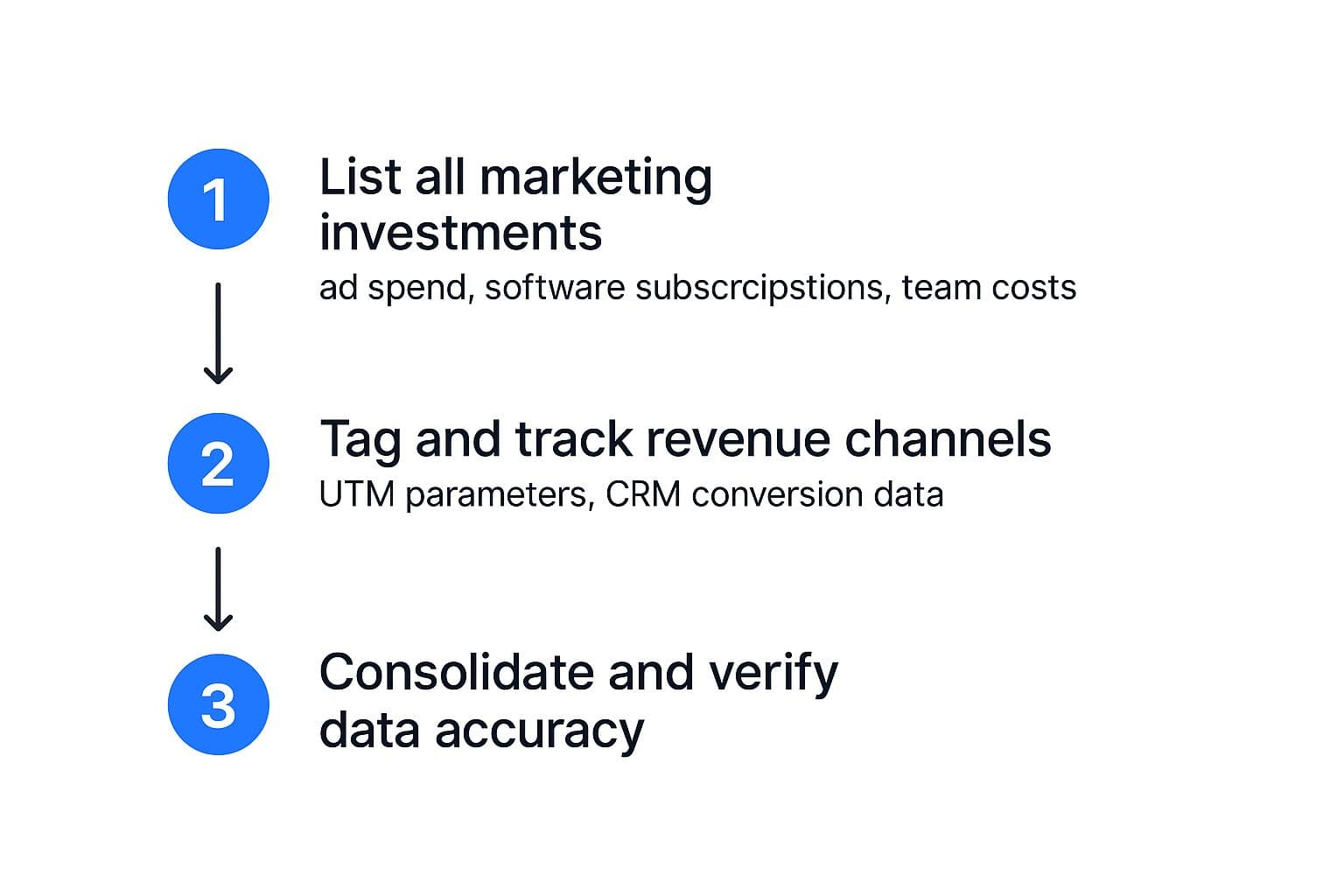
As you can see, it’s a simple but essential flow: get a complete list of your costs, use solid tracking to connect revenue, and then double-check everything before you do the math.
Choosing the Right Marketing ROI Formula
Figuring out how to calculate marketing ROI starts with picking the right formula. This isn't just a technicality—it's the most important decision you'll make. Your choice has to line up with your business model and what you're actually trying to measure. Are you focused on top-line revenue, or is true profit the end game?
The Classic Approach: Revenue-Based ROI
Most marketers start with the classic, revenue-based formula. It's straightforward, easy to understand, and quickly shows the direct sales impact of a campaign.
The formula is: (Sales Growth - Marketing Investment) / Marketing Investment
Let's say you run an e-commerce store and decide to launch a Google Ads campaign. You invest $5,000 in ads, and those ads generate $25,000 in new sales.
- Calculation:
($25,000 - $5,000) / $5,000 = 4 - Result: That's a 400% ROI. For every $1 you spent, you brought in $5 in revenue.
This formula works beautifully for digital campaigns where you can draw a straight line from ad spend to sales. The only catch? It completely ignores the cost of your products, which can paint a misleadingly rosy picture.
A More Honest Metric: Gross Profit ROI
If you're selling physical goods or anything with a significant production cost, you need to go deeper. The Gross Profit ROI Formula is a much more honest way to measure performance because it factors in the cost of what you sold.
This formula gives you a far clearer picture of a campaign's real profitability.
The formula is: (Gross Profit – Marketing Investment) / Marketing Investment
Imagine another campaign that brings in $80,000 in revenue. But this time, the cost of goods sold (COGS) for those products was $40,000, leaving you with a gross profit of $40,000. If your marketing investment was $10,000, the math looks very different:
- Calculation:
($40,000 – $10,000) ÷ $10,000 = 3 - Result: A 300% ROI. Still fantastic, but a more realistic reflection of your marketing's contribution to the bottom line.
This approach moves the conversation from "how much revenue did we make?" to "how much profit did we generate?" It’s a subtle but crucial distinction that separates good marketers from great ones.
When to Use Each Formula
So, which one should you use? It really depends on what you're trying to prove and who you're talking to.
-
Stick with the Classic Formula for:
- Digital products or services where the cost of goods is nearly zero.
- Quick, high-level snapshots of top-of-funnel campaigns.
- Lead generation campaigns where you've assigned a monetary value to each lead.
-
Use the Gross Profit Formula for:
- E-commerce and retail businesses that manage physical inventory.
- Any campaign where profit margin is a key performance indicator (KPI).
- When you're presenting results to the CFO or executive team who live and breathe profit.
Knowing how to use both formulas lets you tell a more complete story about your marketing performance. It also connects directly to other critical metrics. To get the full financial picture, you'll want to see how this ties into what it costs to land a customer in the first place. You can learn more by using a customer acquisition cost calculator to round out your analysis.
A Real-World Marketing ROI Walkthrough

Theory is great, but let's get our hands dirty with a real-world scenario. This is where the numbers come to life.
Imagine a small coffee roaster, "Artisan Brew Co.," getting ready to launch a new line of single-origin beans. They decide to run a three-month digital campaign to get the word out and drive online sales.
The first, and most critical, step is to account for every single dollar spent. It's so easy to overlook small costs, but doing so will give you a misleading—and often inflated—ROI. Precision is everything here.
Tallying the Total Investment
The team at Artisan Brew Co. is diligent about tracking their expenses. Here's what their campaign investment looks like:
- Social Media Ads: $3,000 for targeted campaigns on Instagram and Facebook.
- Influencer Collaboration: $1,500 to partner with a local food blogger for a series of posts and stories.
- Email Marketing Software: Their platform costs $100 a month, so that's $300 for the three-month campaign.
- Content Creation: They hired a freelance photographer for $700 to get some high-quality product shots for the ads and website.
Adding it all up, their total marketing investment comes to $5,500.
Tracking the Revenue and Calculating the Return
With their costs locked in, the focus shifts to tracking sales. Using UTM parameters in their links and digging into their e-commerce analytics, they can attribute sales directly back to this specific campaign.
After three months, the numbers are in: the campaign generated $18,200 in new sales.
Now, it's time to plug those numbers into our formula: ((Revenue - Cost) / Cost) * 100.
- Revenue: $18,200
- Cost: $5,500
- Calculation:
(($18,200 - $5,500) / $5,500) * 100
The result? A marketing ROI of 230.9%.
This tells them that for every $1 they put into the campaign, they made about $2.31 in profit. This kind of data is gold, especially when you're trying to figure out which channels are actually working. For anyone running paid search, knowing exactly how to track your Adwords ROI is fundamental to proving your campaign’s worth.
A common benchmark in the industry is that a 5:1 revenue-to-cost ratio (or a 500% ROI) is a home run. But any positive return is a win. Artisan Brew Co.'s result is fantastic; it validates their strategy and makes a strong case for investing even more in the future.
Actionable Strategies to Improve Your Marketing ROI

Knowing your marketing ROI is a great first step, but the real magic happens when you start using that number to make smarter decisions. With a baseline in hand, you can shift from guesswork to data-backed adjustments that actually grow your business. It's often the small, consistent tweaks that compound into massive long-term wins.
A fantastic place to start is with good old-fashioned A/B testing. It's easy to fall into a "set it and forget it" mindset, but your campaigns need constant attention. Start testing different headlines, call-to-action buttons, email subject lines, or landing page designs. You'd be surprised how a minor change in ad copy can spike your click-through rate, which in turn lowers your cost per acquisition and gives your ROI an immediate boost.
Fine-Tune Your Targeting and Channels
Another powerful lever you can pull is refining who you're talking to. Dive deep into your analytics and pinpoint which customer segments are actually converting. Are you getting more traction with a specific age group, location, or industry? Once you find those goldmines, double down. Shift more of your budget toward your high-performers and don't hesitate to pause campaigns targeting segments that just aren't converting.
The same logic applies to your marketing channels. Your ROI calculations should make it crystal clear which platforms are your all-stars and which are benchwarmers.
- High-Performing Channels: If your email marketing consistently delivers a 10:1 return, it's time to pour more fuel on that fire. Brainstorm ways to grow your subscriber list or strategically increase your campaign frequency.
- Underperforming Channels: It’s equally important to know when to walk away. If a social media platform is eating up your budget with little to show for it, reallocate those precious funds to a channel you know works.
The goal here is to create a continuous feedback loop. You use your ROI data to make an informed change, measure the impact, and then do it all over again. This constant cycle of optimization is what separates a good marketing strategy from a truly great one.
To get the most out of your marketing spend, Mastering Outbound Lead Generation can be a game-changer. Of course, none of this is possible without the right tools. Your CRM, Google Analytics, and various marketing automation platforms are your best friends here. They provide the granular data you need to make these kinds of smart, strategic decisions. In fact, understanding the specific impact of marketing automation ROI can show you just how much technology can streamline these efforts and boost performance.
Common Questions About Marketing ROI
Even with a solid formula in hand, the real world of marketing is messy. Tricky situations and gray areas are bound to pop up. Let's tackle some of the most common questions marketers have when they start digging into their ROI.
What Is a Good Marketing ROI?
There's no magic number here. A "good" marketing ROI really depends on your industry, business model, and profit margins.
That said, a widely accepted benchmark to aim for is a 5:1 ratio. This means you're generating $5 in revenue for every $1 you spend on marketing, which translates to a 400% ROI. A startup hungry for market share might be thrilled with a 3:1 ratio initially, while a well-established company with high margins could be targeting 10:1.
Ultimately, the most important goal is to establish your own baseline and focus on improving it over time.
How Do I Calculate ROI for Brand Awareness Campaigns?
This is the classic marketing puzzle. Since brand awareness campaigns don't have a direct line to sales, you have to get a bit more creative and use proxy metrics.
Instead of tracking direct revenue, look at metrics like:
- Increases in direct website traffic
- Growth in social media engagement (likes, shares, comments)
- Spikes in branded search volume (people Googling your company name)
You can then assign a monetary value to these actions based on historical data. For instance, what's the average value of a new website visitor? It’s not a perfect science, but it's crucial for understanding the impact of your top-of-funnel marketing.
The key is to shift from direct revenue attribution to measuring influence. A big jump in branded searches right after a campaign launch is a powerful sign of its value, even if those people don't buy immediately.
How Long Should I Wait Before Calculating ROI?
The answer depends entirely on your sales cycle.
If you run an e-commerce store where customers buy within a day, you could reasonably calculate ROI on a weekly basis. But if you're a B2B software company with a six-month sales cycle, you'll need a much longer window to see the full picture. Trying to measure ROI too soon would be misleading.
As a rule of thumb, align your measurement period with how long it typically takes a lead to become a customer. That might mean calculating ROI quarterly or even semi-annually for businesses with longer, more complex sales funnels.