

Let's be honest, building a winning social media plan can feel like a full-time job. That's where PostOnce comes in. It's built to automate your workflow, letting you create your content once and then distribute it everywhere, without the headache. This guide will be your roadmap to turning social media from a daily grind into a serious growth engine for your brand.
Your Blueprint for an Unbeatable Social media Strategy
The real secret to getting off the social media hamster wheel isn't just posting more—it's having a smarter, automated strategy. PostOnce is the engine designed to power that strategy. We’re not just going to tell you to post more; we're going to show you how to build a rock-solid plan from the ground up.
Why Automation Is Your Secret Weapon
Trying to manually manage multiple platforms like Threads, LinkedIn, and Instagram is a fast track to burnout. Real strategic power comes from smart automation, and that's exactly where a tool like PostOnce becomes a game-changer.
Instead of losing hours to copying, pasting, and reformatting, you get to focus on what you do best: creating great content. PostOnce takes care of the distribution, making sure your message stays consistent and your presence is steady across all your channels. It's how you build momentum without sacrificing your time or your sanity.
A huge piece of the puzzle, especially now, is video.
The Undeniable Power of Showing Up Consistently
In the noisy world of social media, consistency is what makes you stand out. A Buffer study revealed that creators who posted consistently over 20 weeks saw up to 450% more engagement per post than those who were sporadic. That's a massive difference.
This is the exact problem PostOnce was built to solve. It makes consistency effortless by automatically crossposting your content, ensuring you never miss a beat. Your audience stays engaged, and your brand stays top-of-mind.
This guide will walk you through the core components of a strategy that actually works:
- Defining your audience: So you know exactly who you're talking to.
- Establishing content pillars: To create a repeatable, effective content system.
- Setting a posting rhythm: Building a cadence that you can actually stick with.
When you nail these elements, social media management stops being a burden and starts becoming one of your most efficient growth channels. For a more detailed walkthrough, take a look at our sample social media marketing plan.
Know Your Audience, Know Your Goals

Before you even think about what to post, you have to nail down two things: who you're talking to and what you're trying to achieve. It’s the absolute foundation of any social media strategy worth its salt.
Skipping this step is like shouting into a crowded room and hoping the right person hears you. It leads to generic, forgettable content that doesn’t connect with anyone. You end up chasing trends that don't fit your brand or obsessing over vanity metrics that do nothing for your bottom line.
A clear audience and specific goals are your compass. They ensure every single piece of content you create has a purpose and is designed for impact.
Get to Know Your Ideal Customer
To make content that genuinely connects, you need to go way beyond surface-level demographics. The best social media strategies are built on detailed audience personas—vivid profiles of your ideal customer, pieced together from real data and research. Think of it as creating a character for a movie; the more you know about them, the more believable and compelling their story (and your content) becomes.
Understanding how to identify your target audience is crucial. It’s about digging into their world. What are their biggest challenges? What keeps them up at night? What are they really looking for when they’re scrolling through their feed?
To build out these personas, you need to explore a few key areas:
- Demographics: Start with the basics—age, location, job title. It gives you a skeleton to work with.
- Psychographics: This is where they come to life. What are their values? Their hobbies? Who do they follow and trust online?
- Pain Points: What specific problems can you solve for them? Describe these issues using their words, not industry jargon.
- Online Hangouts: Where do they spend their time? A B2B audience might be all over LinkedIn, while a lifestyle brand’s audience is probably on Instagram and TikTok.
When you do this work, a vague idea like "small business owners" transforms into "Sarah, a 35-year-old e-commerce founder who’s overwhelmed by marketing and just wants to find a simpler way to manage her social media." Suddenly, creating content for Sarah feels a lot more intuitive.
For a more detailed walkthrough, check out our guide on https://postonce.to/blog/how-to-identify-target-audience.
Setting Goals That Actually Move the Needle
Okay, you know who you're talking to. Now, what do you want them to do? This is where you trade in fuzzy wishes for sharp, measurable objectives using the SMART framework.
Each goal needs to be:
- Specific: Nail down exactly what you want to achieve.
- Measurable: Use real numbers to track your progress.
- Achievable: Be ambitious, but realistic with your resources.
- Relevant: Make sure the goal actually supports your bigger business vision.
- Time-bound: Give yourself a deadline to create focus.
So, instead of a vague goal like "get more engagement," a SMART goal sounds like this: "Increase our average engagement rate on LinkedIn by 15% over the next 90 days by posting three interactive polls and one Q&A session each month." See the difference?
Your goals will directly shape your content. If you want more website traffic, you'll need posts with compelling calls-to-action and links. If you want to build a community, your content needs to spark conversations and invite participation.
Here are a few common goals people focus on:
- Building Brand Awareness: Measured by things like reach and impressions.
- Driving Website Traffic: Tracked through click-through rates (CTR) and referral data in your analytics.
- Generating New Leads: Monitored by how many people fill out a form or sign up for your newsletter from social media.
- Nurturing a Community: Assessed by looking at comments, shares, and user-generated content.
By starting with a crystal-clear picture of your audience and a set of razor-sharp goals, you're setting yourself up for success. Every choice you make from here on out—from the platforms you use to the format of your posts—will be intentional and effective.
Figure Out Your Core Content Pillars
Ever get that sinking feeling around 5 PM when you realize you have nothing to post? We’ve all been there. That daily panic is exactly what content pillars are designed to eliminate. They are the bedrock of any solid social media plan, giving you a clear direction and saving you from last-minute, inconsistent posts.
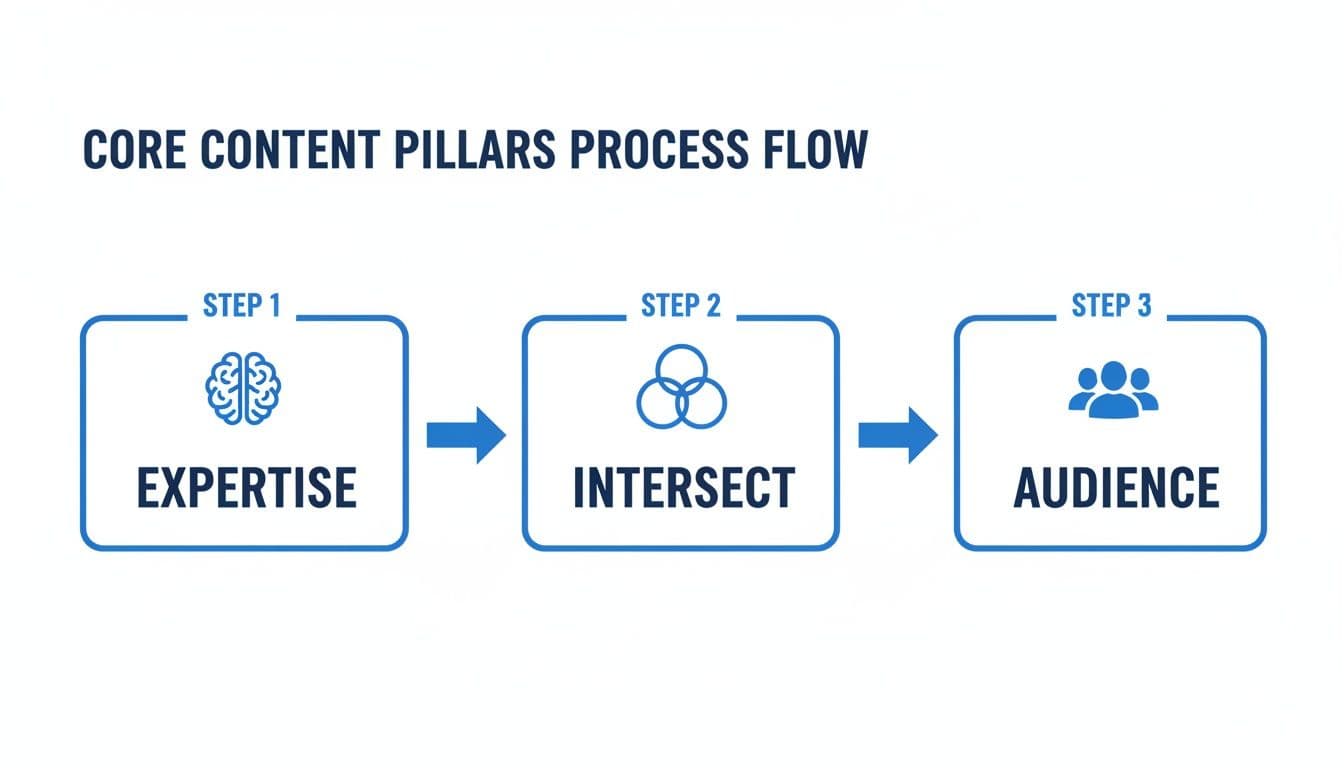
Think of them as the 3-5 core themes you’ll talk about, time and time again. These aren't just random topics; they're the sweet spot where your expertise meets what your audience is dying to know. Getting these pillars right transforms your content creation from a chaotic scramble into a focused, repeatable system. Instead of jumping on every single trend, you start building real authority and a recognizable voice in a few key areas. That consistency is what builds trust and keeps people coming back.
Finding Your Sweet Spot
The real magic happens when you nail that overlap between what you’re good at and what your audience actually needs from you.
Start by just brainstorming. What topics are deeply connected to your brand's mission? If you're a fitness coach, your expertise goes way beyond just "working out." You could break it down into more specific, valuable areas like "beginner-friendly home workouts," "nutrition for busy professionals," or "mindful movement for stress relief." Those are potential pillars.
Once you have a list, cross-reference it with your audience personas. What are their biggest headaches? What questions do they ask over and over? Your pillars need to be the direct answer to those problems.
One of the biggest mistakes I see is creating pillars that are way too broad, like "Marketing," or far too self-promotional, like "Our Product Features." A great pillar is always built around the audience. So, instead of "Our Product," a much stronger pillar would be "Solving [Audience's Problem] with Smarter Tools."
For instance, a B2B marketing agency I worked with landed on these pillars:
- Lead Generation Tactics: Focusing on actionable strategies their clients could use immediately.
- Marketing Automation Explained: Breaking down complex software and workflows into simple terms.
- Agency Life & Culture: Putting a human face on their brand to connect with clients and attract new talent.
This approach guarantees that every single thing you post is genuinely helpful, which is the only way to win on social media today.
The Human Element in Your Pillars
While having a solid structure is crucial, it’s authenticity that really makes people connect with you. Don’t just take my word for it. Recent data from Sprout Social shows a massive consumer demand for a human touch.
When asked what makes content effective, 66% of consumers said funny content, 63% said relatable content, and 59% said trendy content. This tells us that even within your strategic pillars, you absolutely need to make room for authentic, relatable communication. For more on this, check out the full 2026 social media content strategy report.
Building Your Ideation Engine
Okay, once you've defined your pillars, the real fun starts. It's time to build a system that generates a never-ending stream of content ideas. This isn’t about waiting for a lightning bolt of inspiration; it's about having a process.
One of my favorite techniques is the content matrix. It’s a simple grid that forces you to think about how each pillar can be turned into different types of content.
| Content Pillar | Video (Reel/Short) | Carousel/Infographic | Text Post (Thread/Article) |
|---|---|---|---|
| Pillar 1 Nutrition | 3-ingredient healthy snack | "5 Myths About Carbs" | "My Philosophy on Dieting" |
| Pillar 2 Workouts | "Fix Your Squat Form" | "Full Body Workout Plan" | "Why I Prioritize Rest Days" |
| Pillar 3 Mindset | Quick morning meditation | "How to Beat Procrastination" | "A Personal Story of Overcoming Burnout" |
Just like that, you’ve got a dozen concrete ideas ready to go. If you want a practical list of formats and prompts, see our guide to content ideas for social media.
Another absolute goldmine for ideas? Your own audience. You have to actively mine your comments, DMs, and community forums. Every single question is a potential post. If someone asks, "How do you stay motivated to work out?"—that’s a perfect idea for a quick video, an informative carousel, and a personal story. All of it ties right back to your pillars.
When you have a system like this, you move from reactive posting to proactive storytelling. You’ll start building a library of content that consistently serves your audience and, in turn, helps you reach your business goals.
Curate, Repurpose, and Batch Without Losing Your Point of View
Not every post needs to begin with a blank page. Curate a relevant outside resource only when you can add context: explain why it matters to your audience, where you agree or disagree, and what they should do next. That turns a link into useful editorial judgment instead of a filler post.
Repurpose the ideas that have already earned attention. A longer tutorial can become a short clip, carousel, checklist, or question for a live session, but each version should have one clear takeaway suited to its destination. Keep a record of the original source, approval status, and any rights restrictions so the team does not reuse material blindly.
Batch the repeatable preparation work—outlines, filming, caption drafts, and asset selection—then leave room for timely replies and genuinely useful commentary. Batching provides a dependable cadence; it should not make every post sound identical or prevent you from responding to what your audience is asking now.
Automate Your Workflow and Execute Flawlessly
A great strategy is worthless without execution. Let's be honest—the biggest reason even the best social media plans fail is pure burnout. Manually posting content across different platforms day after day is a soul-crushing time suck.
This is where smart automation comes in, and it's precisely why we built PostOnce. The idea is simple but powerful: create once, distribute everywhere. It’s the engine that gives you the consistency needed to actually grow.
How PostOnce Solves Your Search for a "Content Strategy Social Media"
When you search for "content strategy social media," you're not just looking for planning tips—you're looking for a sustainable way to execute that plan. You've figured out your audience and your content pillars, but now what? How do you get that content out there consistently without it taking over your entire life?
That's the exact problem PostOnce is designed to solve.
Imagine you write a killer post. Now, picture that same post automatically shortening for X, expanding into a perfectly formatted LinkedIn article, and using the right image dimensions for Instagram—all happening in the background. That's the power of an automated crossposting workflow. We take the friction out of execution, so you can focus on creating great content while the tool handles the repetitive, tedious work.
At its core, a solid strategy is about finding that sweet spot where your knowledge meets your audience's needs. Automation is what makes that process scalable.
A Quick Guide to Setting Up Flawless Automation
Getting your automated workflow running is surprisingly straightforward. The goal is to build a system that hums along in the background, making sure your content pillars are always front and center on every channel you use.
First, you’ll connect all your social accounts to PostOnce. This creates a central command center for everything—LinkedIn, X, Instagram, you name it. No more jumping between a dozen tabs.
Next comes the fun part: defining your cross-posting rules. Think of them as simple "if-then" commands. For example: "If I publish a new post on LinkedIn, automatically share a shortened version to X and a version with the image to Threads." You can get as detailed as you like, creating unique rules for different accounts or types of content.
Once your rules are set, you just post to your main platform like you always do. PostOnce sees the new content, kicks your rules into gear, and handles the rest, tailoring each post for its destination.
This is what separates a strategy on paper from one that actually works in the real world. It guarantees consistency—the single biggest driver of audience growth and engagement.
Why This Workflow Is a Game-Changer
An automated system does way more than just save a few hours. It fundamentally changes how you execute your content strategy social media plan.
- It builds consistency. Your audience sees you showing up reliably on their favorite platforms, which builds trust and keeps you top of mind.
- It frees up your creative brain. When you aren't bogged down in copy-paste hell, you have more mental space for new ideas and genuine community interaction.
- It lets you scale effortlessly. Ready to add a new platform? Your workflow grows with you without adding hours to your week.
- It acts as a safety net. Life gets busy. Automation ensures your social media doesn't go silent just because you have to focus on other things.
By using a tool like PostOnce, you're not just getting software; you're implementing a system that makes your goals achievable. To go even deeper on streamlining your process, check out our guide to building an effective social media management workflow. It's all about shifting your time from manual labor to high-level strategy—because that's where the real growth happens.
Measure What Matters to Optimize Your Strategy
A content strategy without measurement is just wishful thinking. Seriously. This is the part where you stop guessing and start making decisions backed by actual data, turning your efforts into real, actionable insights.
We’re moving past surface-level stats to focus on the Key Performance Indicators (KPIs) that prove what you’re doing is actually working.
Putting content out there is only half the job. The other half is figuring out what your audience loves so you can give them more of it. Without that feedback loop, you’re just shouting into the void, wasting time on content that doesn't connect and formats that fall flat.
This process ensures every post, story, and video has a clear purpose and pushes you closer to the goals you set in the first place.
Moving Beyond Vanity Metrics
It’s so easy to get hooked on follower counts and likes. They feel great, but they don't pay the bills and they certainly don't tell the whole story. Real optimization comes from tracking metrics that are directly tied to your actual business objectives.
So, instead of just celebrating total engagement, you need to dig deeper. Your goal is to answer specific questions that guide your next move.
- Engagement Rate Per Pillar: Which of your core content themes gets people talking the most? This is a goldmine for understanding what your audience truly cares about.
- Click-Through Rate (CTR): Are people actually clicking the links you share? This is a direct measure of how well you’re moving people from social media to your website, shop, or newsletter.
- Follower Growth Quality: Are your new followers just passive numbers, or are they jumping into the conversation? A smaller, super-engaged audience is infinitely more valuable than a huge, silent one.
- Conversion Rate: How many followers are taking that final step—like signing up for your email list or buying a product? This is the ultimate test of your strategy's impact.
The point isn't just to track numbers; it's to understand the story they tell. If your "Educational" pillar gets tons of shares but your "Behind-the-Scenes" pillar drives more website clicks, that’s a powerful insight that should absolutely shape your content calendar going forward.
The Monthly Performance Review Framework
Block out some time every single month to review your performance. When you make it a consistent habit, measurement stops feeling like a chore and becomes a strategic advantage. This isn't about building a massive, complicated report; it’s simply about asking the right questions to sharpen your approach.
During your review, zero in on these key areas:
- Content Pillar Performance: Pinpoint your best and worst-performing content pillars. Then ask why. Was it the topic? The format? The time you posted?
- Format Effectiveness: Did your video Reels crush your static carousels? Did simple text-based threads on X spark more conversation than posts with links? Use this data to double down on what works.
- Audience Growth & Engagement: Look at your follower growth rate alongside your overall engagement rate. Healthy growth means new followers are getting involved right away.
- Goal Progression: Go back to those SMART goals you set. Are you on track? If not, what can you tweak in your content or distribution to get there?
This regular check-in is what keeps you agile. Social media moves fast, and a monthly review helps you adapt based on real-world data, not just what you think should work. For a deeper dive, learn more about the crucial social media metrics you should be tracking in our detailed guide.
PostOnce: The Solution for Consistent Measurement
Trying to track performance when you’re posting different things across multiple platforms can feel fragmented and chaotic. How do you really know if a post’s success on LinkedIn is comparable to its performance on X? This is where an automated workflow makes all the difference.
PostOnce solves this by helping you distribute your core message consistently, which creates a stable baseline for comparison. When you know the same foundational content is being shared everywhere, you can more accurately chalk up performance differences to platform-specific nuances rather than random content variations.
It simplifies your analysis, letting you focus on what really matters—understanding how different audiences react to your core pillars. That clarity is what turns good content into a great, always-improving strategy.
Answering Your Biggest Social Media Strategy Questions
Look, I get it. Building a social media strategy is one thing, but actually executing it day in and day out is where the real challenge lies. You're not alone. After years in the trenches, I've seen the same questions pop up again and again from creators and businesses trying to turn a plan on paper into real-world results.
Let's tackle those common hurdles head-on. These are the practical answers you need to get unstuck and build real momentum.
How Often Should I Post on Social Media?
Forget the "magic number." The best posting frequency is the one you can actually stick with. Seriously. Burnout is the number one killer of even the most brilliant strategies.
It’s far more powerful to post 3-4 genuinely good pieces of content every single week, without fail, than it is to go hard with daily posts for a month only to vanish. The goal is rhythm and reliability. You want your audience to know they can count on you to show up.
Research backs this up—consistent effort over the long haul blows short, intense bursts of activity out of the water when it comes to engagement. This is where a good automation tool becomes your best friend. Something like PostOnce lets you schedule your core content ahead of time, so you're always present for your audience without the daily pressure.
Sure, you'll see general benchmarks out there, like posting 2-5 times a week on LinkedIn or multiple times a day on X. But let your own capacity and, more importantly, your audience's reaction be your true north. Start with what feels manageable, watch your analytics, and tweak from there.
The most effective posting frequency is the one you can stick to without fail. Consistency trumps volume every single time. It builds trust and keeps your brand top-of-mind, turning casual followers into a loyal community.
What Is the Best Way to Repurpose Content?
Repurposing isn't just a tactic; it's a mindset. It’s the ultimate "work smarter, not harder" play in social media. You take one great idea and give it new life across different platforms, maximizing its value every step of the way.
It all starts with a single, meaty piece of "pillar" content. This could be a detailed blog post you poured your heart into, a compelling customer case study, or a long-form video.
From that one core asset, you can spin off an entire ecosystem of content. For instance, that one blog post can become:
- An Instagram Carousel: Pull out the 5-7 main points and turn them into eye-catching, swipeable slides.
- A Punchy X Thread: Distill the key takeaways into a series of short, snappy posts that are easy to digest.
- A Professional LinkedIn Article: Reframe the content to focus on the business implications and share it with your professional network.
- A Short-Form Video Script: Use the main points as a teleprompter script for a quick, informative Reel or TikTok.
The trick is to tailor the format and tone to fit the unique culture of each platform. Don't just copy and paste. This is where the manual work can really pile up, but the right workflow can make it feel almost effortless.
How Do I Find Content Ideas When I Feel Stuck?
The blank page staring back at you? We've all been there. A creative block feels awful, but the secret isn't to just wait for a lightning bolt of inspiration. It's to build a system for generating ideas whenever you need them.
When you're drawing a blank, turn to these three proven sources.
First, go listen to your audience. Seriously. Your comment sections, DMs, and community forums are absolute goldmines. Every single question, confused comment, or common objection is a ready-made content idea. I guarantee your next ten post ideas are already sitting in your inbox.
Second, do a little recon on your niche and competitors. See what topics and formats are lighting up the conversation for others in your space. You're not looking to copy them, but to find sparks of inspiration. If a competitor's "myth-bust-ing" post took off, what’s a common misconception in your field that you can tackle with your unique point of view?
Finally, lean on a structured framework. Go back to your content pillars and mix and match them with different content formats. This simple exercise can force creativity when you feel like you have none. For example:
- Pillar 1 + A "How-To" Guide
- Pillar 2 + A "Mistakes to Avoid" Post
- Pillar 3 + A "Behind-the-Scenes" Story
This turns idea generation from a frustrating guessing game into a reliable process. You’ll always have something valuable to share.
PostOnce: The Answer to Your Strategic Hurdles
Ultimately, a great social media strategy isn't just a document—it's a system that gets you results without burning you out. You need a way to nail your posting frequency, repurpose content like a pro, and stay consistent even when you're not feeling creative. This is precisely the problem PostOnce was designed to solve.
By letting you create your content once and then automatically customizing and distributing it across all your platforms, PostOnce tackles these core challenges directly. It makes your posting schedule sustainable, streamlines your repurposing workflow, and makes sure your content pillars are always front and center wherever your audience is. It’s the engine that turns your strategic plan into flawless execution.
Ready to stop juggling platforms and start executing your strategy flawlessly? With PostOnce, you can automate your entire cross-posting workflow, save hours every week, and finally achieve the consistency your brand deserves. Learn more and get started today.