














Before you can even think about what to post next week, you need to get your house in order. Jumping into social media without a plan is a surefire way to waste time and resources. You might be busy, but are you getting results? A solid strategy always starts with a brutally honest look at where you are right now.
Laying the Groundwork for Social Media Success

The first real step in building a marketing plan that actually works isn't about brainstorming clever posts. It's about conducting a thorough social media audit. Think of it as a deep-dive diagnostic of your current efforts. It’s the only way to find out what’s clicking with your audience, what’s falling flat, and where you’re missing out on golden opportunities.
Perform a Meaningful Social Media Audit
First things first, pull up every single social media profile your business has. Are they all filled out completely? Is the branding consistent? Make a note of which platforms are actually bringing you engagement and traffic, and which ones are just collecting digital dust. This initial review helps you make tough but necessary decisions: do you double down on a platform, rethink your approach, or cut your losses and deactivate it?
A huge piece of this puzzle is a competitive analysis. You need to know what your direct competitors are up to. I always ask my clients to look at:
- Where are they most active and getting the best results?
- What type of content is their audience loving (and hating)?
- Are there obvious gaps in their strategy you can exploit?
For example, you might find your biggest rival is crushing it on Facebook but has a ghost town of an Instagram profile. That’s your opening. The goal isn't to copy them, but to learn from their wins and mistakes to make your own strategy smarter.
Set Business-Focused SMART Goals
Once you have a clear lay of the land, you can finally start setting meaningful goals. This is where so many strategies go wrong. They get hung up on vanity metrics like follower counts instead of what really matters: business impact. To sidestep this common trap, use the SMART goals framework: Specific, Measurable, Attainable, Relevant, and Time-bound.
A vague goal like "get more brand awareness" is useless. A SMART goal sounds like this: "Increase our Instagram post reach by 20% among women aged 25-40 in Q3 by posting three high-engagement Reels per week." See the difference?
Getting this specific is absolutely critical. There are an estimated 5.42 billion social media users worldwide, which is nearly 64% of the global population. On top of that, the average user is active on about 6.83 different platforms each month. If your plan isn't laser-focused, you'll just be shouting into the void. To dig deeper into these numbers, the data from Sproutsocial.com is always a great resource.
This foundational work ensures that every single action in your social media marketing plan has a clear purpose.
Pinpointing Your Audience and Platforms
If you take away only one thing from this guide, let it be this: a social media plan without a deep understanding of its audience is just noise. It’s a shot in the dark. To get real results, you have to know exactly who you're talking to. We're talking about creating detailed buyer personas that feel like real people with real challenges you can solve.
Forget just scratching the surface with basic demographics. The real gold is buried in your website analytics, your CRM data, and your existing social media insights. What are the common frustrations of your best customers? What truly motivates them? Learning and applying the top audience research methods is how you unearth these critical details and move beyond guesswork.
When you have a crystal-clear picture of your audience, the question of where to find them online suddenly becomes much, much simpler.
This isn't about abstract theory. It’s a practical decision tree that connects who your audience is to the platforms you should use and the content you should create.
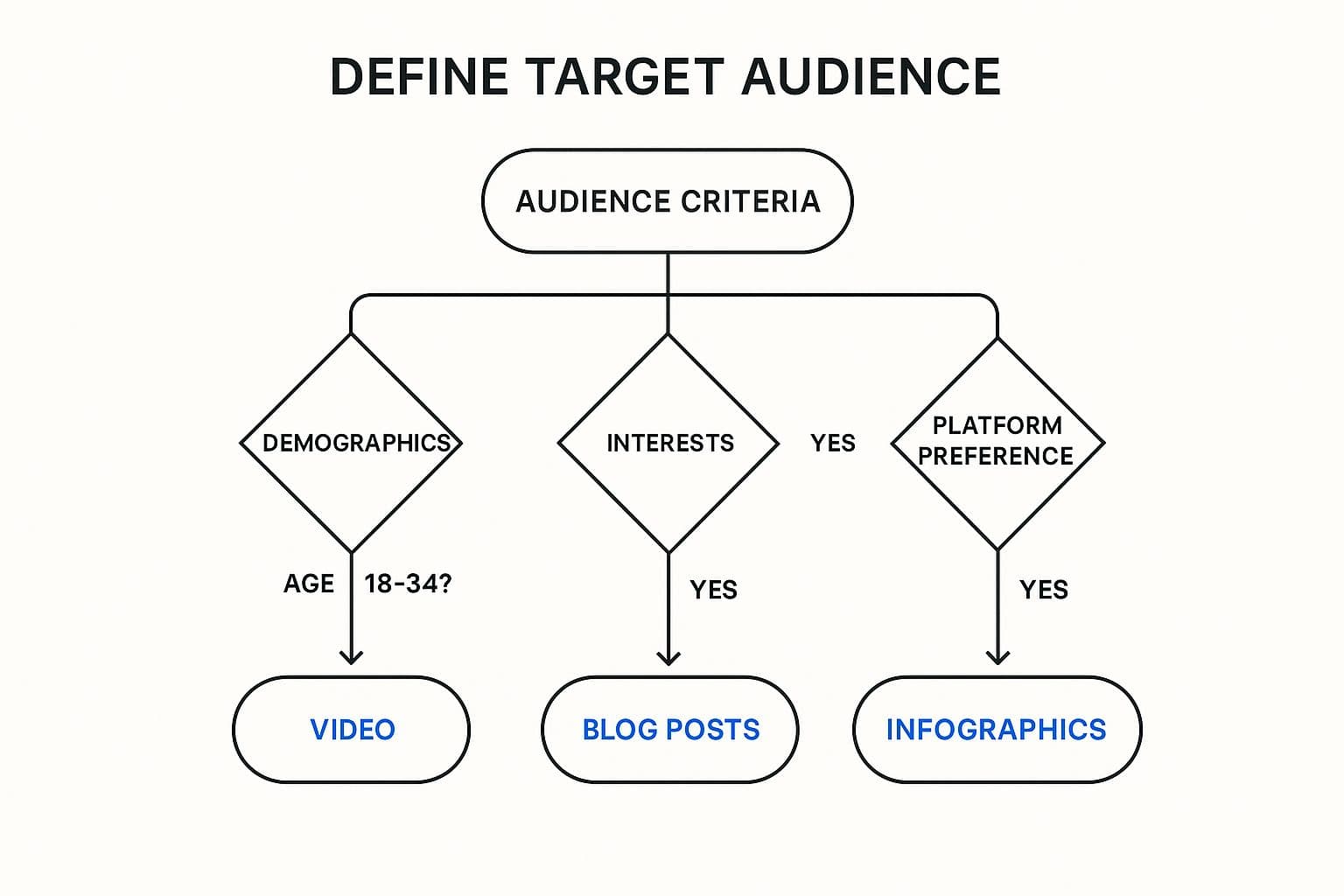
As you can see, your audience's core characteristics—like their age, profession, and interests—are the signposts that point you directly to the right social media channels.
Matching People to Platforms
One of the biggest mistakes I see businesses make is trying to be everywhere at once. It’s a recipe for burnout and mediocre results. Instead, focus your precious time and budget on the one or two platforms where your ideal customers actually hang out and engage.
Don't pick a platform just because it's popular or you see your competitors there. Pick it because it’s the right place to have meaningful conversations with the people who will actually move your business forward. That's how you get a real return on your effort.
Think about it this way: a trendy local boutique targeting fashion-forward women aged 25-40 will find its tribe on Instagram and Pinterest. For them, spending hours on LinkedIn would be a waste. On the flip side, a B2B software company will get far more traction by connecting with professional decision-makers on LinkedIn.
Choosing Platforms That Match Your Goals
Different social networks are built for different purposes. To get the most out of your plan, you need to align your platform choice with what you’re trying to achieve. The data backs this up.
For B2B marketers, nothing beats LinkedIn, which has been shown to boost purchase intent by an impressive 33%. For retail, Pinterest is a powerhouse, often delivering twice the return on ad spend compared to other social channels.
To help you make the right call, I've put together a simple matrix that breaks down which platforms are best suited for specific goals and audiences.
Platform Selection Matrix Based on Goals and Audience
| Platform | Primary Audience | Best For (Marketing Goal) | Top Content Format |
|---|---|---|---|
| Gen X & Millennials | Brand Awareness, Community Building | Video, Curated Content, Images | |
| Gen Z & Millennials | E-commerce, User-Generated Content | Reels, Stories, High-Quality Photos | |
| Gen X & Baby Boomers | B2B Leads, Thought Leadership | Articles, Case Studies, Professional News | |
| Millennial Women | Driving Traffic, Visual Discovery | Infographics, Product Guides, How-To's | |
| TikTok | Gen Z | Brand Awareness, Viral Reach | Short-Form Videos, Trends, Challenges |
| X (Twitter) | Millennials | Real-Time News, Customer Service | Quick Updates, Polls, Breaking News |
This table isn't about picking just one and ignoring the rest. It's about prioritizing. It helps you decide where to invest the majority of your energy to get the biggest bang for your buck.
Here’s a quick cheat sheet to get you started:
- Building a community and broad brand awareness? Start with Facebook and Instagram. Their massive user bases and visual tools are perfect for telling your brand’s story.
- Need to drive online sales? Look no further than Pinterest and Instagram Shopping, which are designed to turn visual inspiration directly into purchases.
- Focused on B2B lead generation? LinkedIn is your non-negotiable. It’s the home of professional networking and in-depth industry content.
By being strategic about where you show up, you ensure every single post, video, and comment is working towards your ultimate business objectives. That’s the difference between a social media presence that just exists and one that truly thrives.
Crafting Content That Actually Connects

Alright, you know who you're talking to and where they hang out online. Now for the fun part: deciding what you’re actually going to say. Good content is the fuel for your entire social media engine. Without it, the best strategy in the world will just sit there and sputter. Your posts need to hit home, offer real value, and show off your brand’s personality.
This is where I see a lot of businesses stumble. They get caught up chasing every new trend or they post whenever they remember, which leads to a feed that feels random and confusing. The secret to avoiding that chaos is to build your content around content pillars.
Think of content pillars as the three to five core topics your brand will own. These are the foundational themes that connect what your audience cares about with what your business does.
Let's imagine a local coffee shop. Their pillars might look something like this:
- Coffee Education: Breaking down different brewing methods, talking about bean origins, and sharing tasting notes.
- Behind the Scenes: Introducing the baristas, showing the roasting process, and capturing daily life at the shop.
- Community Spotlight: Featuring local artists whose work is on the walls, shouting out partner businesses, or highlighting regular customers.
This simple framework keeps your content mix fresh and interesting without feeling repetitive or overly salesy. If you're feeling stuck, our guide on top social media content ideas is packed with inspiration to get you started.
Moving From Broadcasting to Engaging
Here's a hard truth: Great content isn't just about what you post; it's about the conversations you start. Social media is a two-way street. If you're just shouting your message into the void without listening for a reply, you're missing the whole point—and a huge opportunity to build a loyal community.
Your job is to create posts that practically beg for a response. Ask open-ended questions. Run polls to get feedback on a new product idea. Host a live Q&A with your team. And when people do comment or send you a DM, responding thoughtfully is just as crucial as the original post.
This is why brands are pouring money into these platforms. Advertisers are on track to spend a mind-boggling $276.7 billion on social media ads worldwide. Why? Because people are spending over 14 billion hours on social media every single day. By focusing on genuine connection, you can earn a slice of that attention without a massive ad budget.
The ultimate goal of your content is not to go viral, but to build genuine relationships. A small, highly engaged community is far more valuable than a large, silent audience. Focus on sparking real conversations, and the growth will follow.
The Power of Visuals and Voice
In a fast-scrolling feed, your visual style and brand voice are what stop the thumb. Consistency is everything here.
Decide on a color palette, a set of fonts, and a photo editing style that screams "you." This creates an instantly recognizable look. To keep things consistent without spending hours in a design tool, a bulk social media image generator can be a lifesaver.
The same goes for your brand voice. Are you witty and informal? Professional and authoritative? Whatever you land on, commit to it. This consistency builds trust and makes your followers feel like they actually know the people behind the logo.
Turning Your Strategy Into an Actionable Plan
Alright, enough with the theory. A plan that just sits in a Google Drive folder isn't doing anyone any good. The real magic happens when you turn all that great research and strategic thinking into a living, breathing document your team can actually use every single day.
This document is your North Star. It’s what keeps everyone—from the founder to the newest marketing hire—on the same page about who you're talking to, what you're saying, and what winning actually looks like. Let's walk through building one out, piece by piece. To make it real, we’ll use a fictional eco-friendly coffee shop, "Urban Bloom," as our example.
The Key Ingredients of a Usable Plan
Your plan needs structure, but it shouldn't feel like a rigid set of rules. Think of it more as a dynamic guide that evolves as you learn. Organizing it into clear sections that build on each other is the best way to keep it easy to follow and update.
Here are the non-negotiable parts every plan should have:
- Mission Statement: A single, sharp sentence defining why you're on social media in the first place.
- SMART Goals: The specific business outcomes you're chasing.
- Audience Personas: Detailed profiles of the real people you want to reach.
- Competitor Snapshot: The key takeaways from your snooping on rival brands.
- Platform Strategy: Which channels you'll use and the specific job each one has.
- Content Pillars & Mix: Your core topics and the formats you’ll use to talk about them.
- Key Performance Indicators (KPIs): The hard numbers you'll track to see if you're hitting your goals.
Your social media plan is your roadmap. Without it, you’re just posting into the void and hoping for the best. A documented plan brings clarity and accountability, turning random marketing efforts into a coordinated strategy that gets results.
Putting It All Together: The Urban Bloom Example
Let’s watch this come to life. Here’s how our coffee shop, Urban Bloom, would fill out its own sample social media marketing plan, moving from abstract ideas to a concrete strategy.
Mission Statement
First, the "why." It has to be clear and concise.
Urban Bloom’s social media mission is to build an engaged local community by sharing our passion for sustainable coffee, fostering connection, and highlighting the vibrant culture of our neighborhood.
SMART Goals
Next, what does success look like in numbers?
- Awareness: Hit 50,000 impressions per month on Instagram among users within a 5-mile radius by the end of Q3.
- Foot Traffic: Generate 100 redemptions of our "Mobile Monday" offer each month through Instagram Stories.
- Community: Grow our Facebook Group membership by 20% in the next six months.
Target Audience Persona: "The Conscious Commuter"
Who are we talking to? Get specific.
- Who: Ava, a 28-year-old freelance graphic designer.
- Behaviors: She works from coffee shops, values sustainability, and uses Instagram to discover unique local spots.
- Pain Points: Finds big chain coffee shops impersonal and wasteful.
- Needs: A welcoming "third place" to work that aligns with her personal values.
If you're looking for more guidance on building out these sections, our guide to creating a comprehensive social media strategy plan is packed with extra tips and frameworks to help you go deeper.
Platform & Content Strategy
This is where you assign a job to each channel. A simple table makes this crystal clear.
| Platform | Role | Content Pillars | Key Metrics |
|---|---|---|---|
| Visual Storytelling & Discovery | Behind the Scenes, Coffee Education, Latte Art | Reach, Story Views, Offer Redemptions | |
| Community Building & Events | Community Spotlights, Event Promotion | Group Membership, Event RSVPs, Engagement Rate | |
| TikTok | Brand Personality & Trends | Fun barista challenges, "How it's made" videos | Video Views, Shares |
With this structure, every post has a purpose and a home. You've officially moved from just planning to creating a powerful engine for growth.
Tracking Your Progress and Refining Your Strategy

Here’s a hard truth: your social media plan is never really "done." Think of it less as a static document and more as a living roadmap that needs constant care. The final, and I'd argue most crucial, part of your entire strategy is getting into a rhythm of tracking your performance, figuring out what the numbers mean, and making smart tweaks. This is how you stop just posting and start driving real business growth.
One of the biggest traps I see brands fall into is chasing vanity metrics. Sure, a sudden spike in followers or a post that racks up hundreds of likes feels great, but those numbers rarely translate to revenue. You have to stay focused on the Key Performance Indicators (KPIs) you set earlier—the ones that actually connect to your business goals.
Finding Actionable Insights in Your Data
Every social platform has its own built-in analytics dashboard. This is your command center, and it's where you'll find out what's truly resonating with your audience. Don't just give the numbers a quick glance. You have to dig in and find the stories they're telling.
For example, if your main objective is to get more people to your website, your click-through rate (CTR) is infinitely more valuable than your reach.
Your data tells you what your audience actually wants, not what you think they want. Listening to it is the fastest way to improve your ROI. Stop guessing and start measuring what truly moves the needle for your business.
To really get a handle on this, you need to understand the essential social media engagement metrics. Knowing the difference helps you separate genuine interest from passive scrolling. A high number of shares on a link to your latest blog post, for instance, is a much stronger signal of great content than a simple "like."
Moving From Reporting to Optimization
Making smart decisions requires consistent reporting. Whether you pull a report every week or once a month, the objective is the same: spot patterns and identify trends over time.
A basic performance report should look at things like:
- Your Best Content: Which posts killed it? Was it the Reels, the carousels, or the simple text updates? What topics got the most clicks or engagement? This tells you exactly what to make more of.
- Audience Demographics: Are you actually reaching the people you set out to? Do your new followers fit the customer persona you built?
- Conversion Metrics: How many leads, email sign-ups, or direct sales came from your social media efforts? This is how you prove your ROI in black and white.
This cycle of analyzing and optimizing is where you find your competitive advantage. You might discover that your audience loves to engage with your content during the workday but doesn't actually buy until the weekend. That's a powerful insight that lets you adjust your posting schedule and ad spend to get the most bang for your buck.
This feedback loop also makes your job easier. Once you know which platforms and content formats are working best, you can pour your energy into what’s effective and cut back on what isn't. Understanding how to approach smart social media cross-posting helps you get your winning content out there efficiently without it feeling stale.
By constantly measuring, analyzing, and tweaking, your sample social media marketing plan becomes a powerful, results-driven engine for your brand.
Answering Your Top Social Media Plan Questions
Even with the best template in hand, you're bound to run into some practical questions when you start putting your social media plan into action. Let's tackle a few of the most common ones I hear. Getting these details right is often what separates a plan that looks good on paper from one that actually gets results.
https://www.youtube.com/embed/xpwLWlpv6AA
How Often Should I Post on Social Media?
Honestly, there's no single magic number. The old-school advice to just "post three times a day" is completely outdated. In today's crowded feeds, it's all about quality over quantity. Pushing out mediocre content just to hit an arbitrary quota will do more harm than good—your engagement will drop, and you'll bore your audience.
The key is to think about consistency and how people use each specific platform. On a fast-moving feed like X (formerly Twitter), several updates a day might make sense. But for Instagram or LinkedIn, a few really strong, high-value posts per week will almost always perform better. Your own analytics are your best friend here. Experiment with different frequencies and pay close attention to what your audience actually responds to.
The best posting schedule is the one you can stick to without sacrificing quality or burning out your team. One amazing post will always beat five forgettable ones.
How Much Should I Budget for Social Media?
When you think about your social media budget, it really breaks down into two main buckets: your organic efforts and your paid ads.
Your organic costs cover things like:
- Tools: Scheduling and analytics platforms like Buffer or Sprout Social.
- Content Creation: Expenses for design software (Canva is a popular choice), photography, or video editing.
- People Power: The time your team invests in creating, posting, and engaging. Don't forget to account for this!
When it comes to paid ads, you don't need a massive budget to get started. I always recommend starting small. Seriously, even just $5 to $10 a day on a well-targeted Facebook or Instagram ad can give you a ton of valuable data. You'll quickly learn what messages and visuals connect with your audience. Once you see a positive return, you can confidently start scaling up your ad spend.
What Are the Best Social Media Management Tools?
Juggling multiple social accounts manually is a recipe for burnout. Thankfully, there are some fantastic tools out there that can streamline your entire process, with options for just about any budget or team size.
They generally fall into a few categories:
- Scheduling & Analytics: These are your non-negotiables. They help you plan your content calendar and track what's working (and what's not).
- Content Creation: Visuals are everything on social. Tools that empower you to create great-looking graphics and videos, even if you're not a professional designer, are invaluable.
- Social Listening & Engagement: These tools help you monitor mentions of your brand across the web, so you can jump into important conversations and handle customer service issues quickly.
How Long Until I See Results?
This is the million-dollar question, isn't it? And the honest answer is, it depends. Building a real, engaged community and seeing a significant impact on your bottom line doesn't happen in a week.
You can, however, spot early signs of progress. Things like a steady increase in engagement, more followers, and more clicks to your website can start showing up within the first one to three months.
But for the bigger business goals—like a major boost in lead generation or a noticeable jump in sales—you need to be more patient. That often takes six months or more of consistent, focused effort. The key is to trust the process, keep your eye on your KPIs, and make adjustments along the way.
Stop wasting time manually copying and pasting content across platforms. PostOnce simplifies your entire workflow by letting you create content once and automatically distributing it everywhere. With smart format optimization, you can be sure your posts look perfect on every network, from Threads to LinkedIn, without any extra effort. Start saving time and amplifying your reach with PostOnce.