


















If you are posting the same update across multiple social networks by hand, you need a better system. PostOnce lets you publish once and distribute across supported routes for TikTok, Instagram, YouTube, Facebook, LinkedIn, X, Bluesky, Pinterest, and Threads. Availability varies by source/destination pair and post type. If your idea of a mobile marketing app starts with “something that saves me from living inside five apps all day,” that's the right starting point.
Most creators and small business owners don't wake up wanting “mobile marketing software.” They want steady visibility, consistent posting, and a way to stay present without burning an hour every morning on repetitive admin. That's why automation has become such an important part of the conversation around mobile marketing.
The broader market helps explain why this matters. The global mobile application market was estimated at USD 252.89 billion in 2023 and is projected to reach USD 626.39 billion by 2030, implying a 14.3% CAGR, according to Grand View Research's mobile application market analysis. That tells you mobile isn't a side channel anymore. It's where discovery, attention, and customer action already happen.
For a small business owner, the key insight is simple. You probably don't need to build your own app to benefit from mobile marketing. You need tools that help you market effectively inside the apps people already use every day.
That's where this topic gets less confusing. A mobile marketing app can mean very different things depending on who's using it. Some are built for customers. Others are built for marketers. If your goal is to show up consistently on mobile-first platforms without adding more manual work, the second category matters more. A good social media post manager fits that role because it turns scattered posting into a repeatable workflow.
Introduction The End of Marketing Overload
You can feel marketing overload in your thumbs.
You write a post on your phone, trim it for one platform, rewrite it for another, swap hashtags, resize an image, then forget to publish on the channel that brings you leads. By the time you're done, the work of distributing the content has taken longer than creating it.
That's the trap many small businesses fall into. They think the problem is creativity, when the actual problem is distribution friction.
The daily bottleneck
Mobile marketing used to sound like something only bigger brands worried about. Now it's part of everyday survival for solo creators, consultants, local shops, and lean teams. Your audience scrolls on phones, discovers brands in feeds, clicks from mobile apps, and makes decisions in short attention windows.
The hard part isn't understanding that mobile matters. The hard part is keeping up with it consistently.
Practical rule: If publishing your content requires app-switching, manual resizing, and repetitive rewriting, your process is too fragile to scale.
A mobile marketing app, in the most useful sense, helps remove that fragility. It gives you one place to manage actions that would otherwise be spread across multiple mobile platforms.
Why this conversation matters now
The mobile economy is already enormous, and it's still expanding. That growth signals something important for marketers: the opportunity isn't coming from novelty. It's coming from doing the basics better, especially discovery, retention, and monetization.
For a solo operator, that translates into plain English. If more attention lives inside mobile apps, then the businesses that publish consistently and respond quickly inside those environments have an advantage.
That's why automation tools deserve a serious look. They don't replace strategy. They protect strategy from getting buried under repetitive execution.
What Exactly Is a Mobile Marketing App
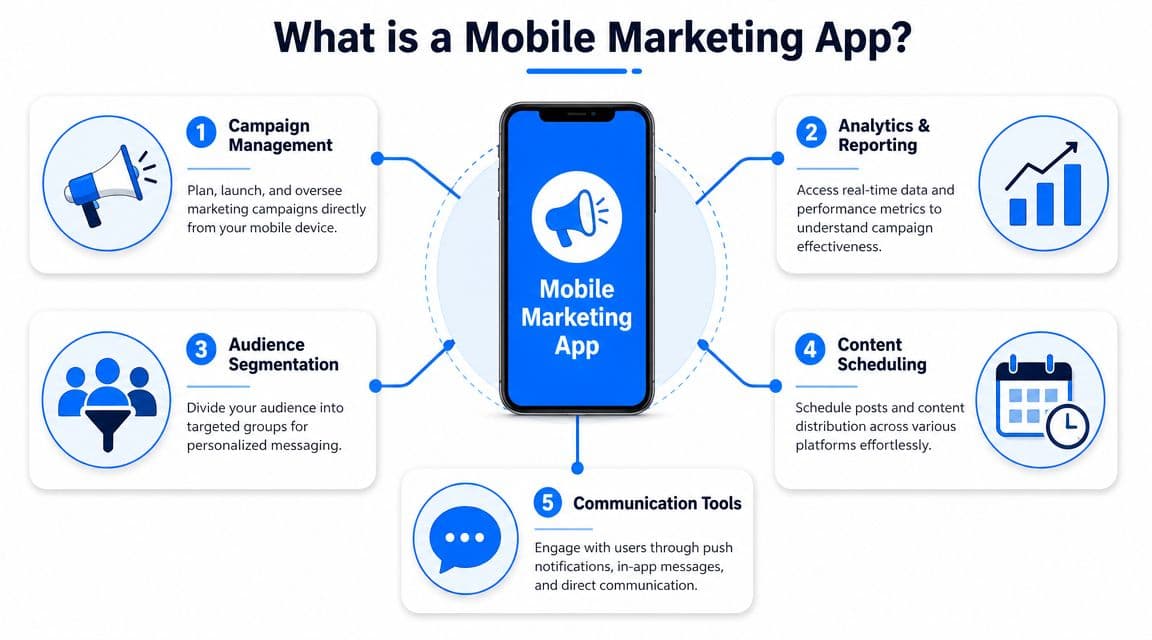
A mobile marketing app is best understood as a tool that helps a business attract, engage, manage, or learn from customers in mobile-first environments. It functions as a digital Swiss Army knife. One blade helps you schedule content. Another helps you track results. Another helps you message people or segment audiences.
That broad definition is where many readers get stuck, because it sounds like everything and nothing at the same time.
Two very different categories
There are really two main types.
First, there are customer-facing apps. These are the apps a brand offers to its own users. A retailer might have a shopping app. A restaurant might have a loyalty app. A fitness business might have a booking app.
Second, there are marketer-facing apps. These are the tools the business uses behind the scenes to run marketing better. Social schedulers, analytics dashboards, CRM apps, content planning tools, and automation platforms all fit here.
If you're a small business owner, this distinction matters a lot. You might hear “mobile marketing app” and assume you need to build your own app from scratch. In many cases, you don't. You can get most of the business value by using marketer-facing tools that help you operate across existing platforms.
A strong social media scheduling platform is often the most accessible example. It gives you the benefits of mobile marketing without the cost and complexity of launching your own branded app.
What these tools usually do
Most marketer-facing mobile marketing apps handle some mix of these jobs:
- Content distribution so you can publish across multiple social channels
- Scheduling so your content goes live even when you're busy
- Analytics so you can see what formats and platforms are working
- Segmentation so different audiences get different messages
- Communication through push, in-app messages, or social engagement workflows
Here's a quick way to separate them:
| Type | Who uses it | Main purpose |
|---|---|---|
| Customer-facing app | Your audience | Shopping, booking, loyalty, usage |
| Marketer-facing app | You or your team | Planning, posting, tracking, automating |
A lot of confusion disappears once you ask one question: Is this app for my customers to use, or for me to market better?
For most creators and SMBs, the immediate win comes from the second category. They don't need another product to maintain. They need a control panel for the channels where attention already exists.
Key Features and Why They Matter for Growth
A feature list by itself doesn't help much. What matters is the business problem each feature removes.
The mobile ecosystem is full of spending and attention, which is why execution quality matters. Consumer spending on apps reached USD 36.2 billion in Q2 2024, a 12% year-over-year increase, and entertainment apps generated almost USD 9 billion in Q1 2024, according to Statista's overview of mobile app usage and spending. That doesn't mean every business needs a paid app strategy. It means customer attention inside mobile platforms has real commercial value.

Automation reduces wasted effort
The first feature to care about is automation.
If you publish manually, your process depends on memory, time, and energy. That's risky. Automation turns posting into a system. You prepare the content once, set rules, and let the tool handle timing and routing.
That matters because consistency is one of the hardest things for small teams to maintain. A good content automation tool protects your presence on days when client work, shipping issues, or life gets in the way.
- Time savings: You stop rewriting the same post from scratch in every app.
- Lower mental load: You make publishing decisions once, not five times.
- Fewer missed windows: Content goes out when it should, not only when you remember.
Cross-platform publishing creates brand coherence
A second core feature is cross-platform distribution.
Many businesses treat each network like a separate universe. In reality, customers often encounter you across several apps before they ever buy. If your message appears on one platform but vanishes on the others, your brand starts to feel inconsistent.
Cross-posting helps solve that. Not by making every post identical, but by letting you adapt one core idea for several destinations. That's the difference between echoing your message and multiplying your workload.
Here's a short primer that shows how that workflow fits into a wider process:
Analytics keeps you from guessing
The third feature is performance visibility.
Without reporting, marketing decisions turn into superstition. You keep posting because it feels productive, not because you know what's working. The best mobile marketing apps give you a dashboard that helps answer practical questions:
- Which platform gets replies instead of passive views
- What type of post earns clicks or conversations
- When your audience is most responsive
- Which message should be repeated, refined, or dropped
Don't chase “being everywhere.” Track where your content actually starts conversations, then double down there.
Audience tools improve relevance
The fourth feature is segmentation and messaging.
Not every follower should get the same prompt. A first-time viewer needs context. A repeat customer needs a reason to come back. A dormant lead may need a reminder or a new angle. Mobile marketing apps that support segmentation help you avoid one-size-fits-all communication.
That's where growth gets more durable. Better targeting usually beats louder broadcasting.
PostOnce The Social Hub for Your Mobile Marketing
For a creator or small business owner, a mobile marketing app often works best as a control panel, not a custom app you have to build. The job is simple. Keep your message active inside the apps your audience already uses.
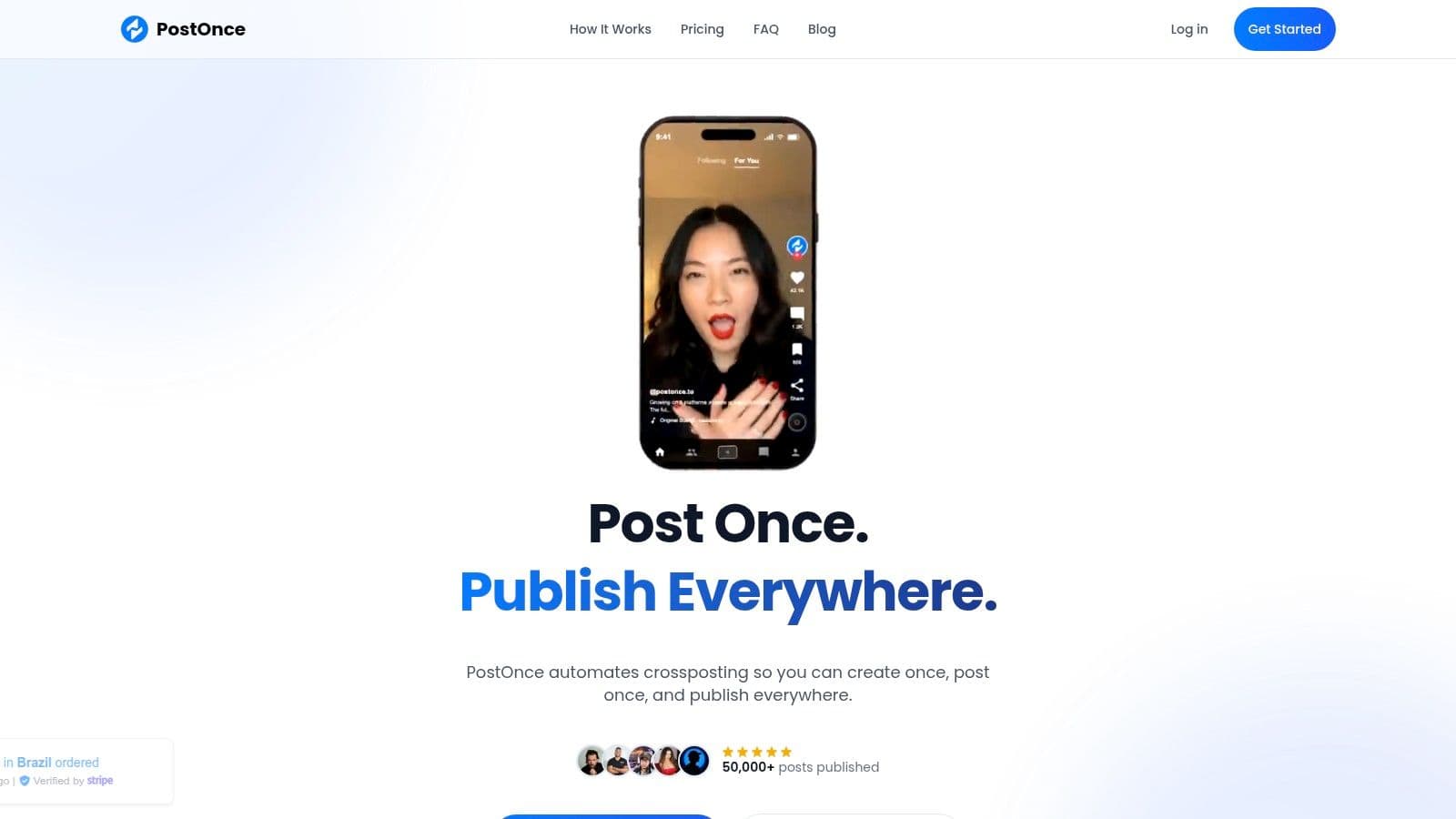
PostOnce fits that job well because it gives you one place to prepare content and send it across multiple social platforms. Instead of opening each network one by one, you work from a single publishing flow.
Why a social hub solves a major SMB problem
For many SMBs, the primary bottleneck is not coming up with ideas. It is turning those ideas into regular, visible posting across several mobile-first channels.
That distinction matters. A business may already have plenty to say: product updates, customer stories, promotions, behind-the-scenes photos, quick tips, and answers to common questions. The friction shows up later, when all of that content has to be reformatted, copied, pasted, scheduled, and published over and over again.
A social hub works like a distribution desk in a small newsroom. You prepare the message once, then route it to the right destinations without rebuilding the process each time.
You can see how that workflow works on the PostOnce social media automation platform.
How the workflow helps
The process is straightforward:
- Write one source post with the main message.
- Select the platforms that match your audience.
- Set posting rules so the content is adapted for each channel.
- Publish from one workflow and spend your time on replies, sales conversations, and follow-up.
That shift saves more than a few clicks. It changes where your attention goes.
A review of mobile app value creation and engagement noted that many discussions focus heavily on acquisition, while retention depends on how well businesses respond to user behavior and re-engage people over time, as discussed in this review on mobile app value creation and engagement. For a small business, the practical lesson is clear. If software handles repetitive distribution, you get more time for the work that keeps people around.
That includes answering questions quickly, improving onboarding, checking which posts bring qualified replies, and sending better follow-up messages.
Why this approach fits creators and small businesses
Building your own branded app is expensive, slow, and usually unnecessary for early growth. Managing your visibility across existing social apps is far more reachable, especially if you run a lean team.
That is why social media automation is such a useful entry point into mobile marketing. It brings mobile reach into a process you can maintain. You do not need a product team, app store approval, or a separate maintenance budget. You need a repeatable system for publishing and responding.
A useful mobile marketing app removes repeated actions from your week so you can spend more time on conversations that lead to sales and loyalty.
For a solo creator, that can mean turning one idea into several platform-ready posts. For a local business, it can mean keeping offers and updates visible without spending half the day hopping between apps.
How to Choose and Implement the Right App
A good mobile marketing app should solve a painful problem quickly. If it adds complexity before it creates value, it's the wrong fit.
Many businesses choose tools the way they choose gym equipment. They buy for ambition, then abandon from friction. A better approach is to evaluate software against the bottleneck you already have.
Four filters for choosing well
Use this checklist before you commit:
- Core function: Does the app solve your biggest recurring problem right now? If your issue is inconsistent posting, don't start with a complex analytics suite.
- Integrations: Can it connect to the platforms and workflows you already use? A tool that sits alone creates more work.
- Ease of use: Can you or a teammate learn it without a long handoff? A simple product used consistently beats a powerful one nobody touches.
- Scalability and pricing: Will it still fit if you add channels, team members, or client accounts?
A useful benchmark comes from technical planning guidance. A mobile marketing app's technical specification should define the target platform stack, APIs, and backend integration, because unclear platform choices can increase build risk and damage user experience, according to Touchlane's guide to mobile app product requirements. Even if you're buying rather than building, the lesson still applies: look past the homepage copy and ask how well the tool connects and performs.
A simple rollout process
Don't overhaul everything at once. Use a short implementation cycle instead.
| Step | What to do | What to watch for |
|---|---|---|
| Identify the bottleneck | Name the repetitive task draining time | Be specific |
| Shortlist tools | Compare fit, not hype | Ignore feature bloat |
| Run a small trial | Test with one workflow or channel set | Look for adoption friction |
| Integrate fully | Document the process and assign ownership | Keep the setup simple |
A best social media scheduler comparison can help if scheduling and cross-posting are your current pain points.
Questions worth asking before you buy
Ask vendors or yourself:
- What task will disappear from my weekly routine if I adopt this?
- What still has to be done manually?
- Can I trust the tool to publish accurately without constant babysitting?
- Will this help me spend more time on customer response, offers, and strategy?
Those questions keep you grounded. The right app should remove operational drag, not just impress you in a demo.
The Future of Mobile Marketing Is Automated
The future of mobile marketing won't belong to the businesses with the most tabs open. It will belong to the ones with the cleanest systems.
That doesn't mean every company needs the same stack. Brands with their own apps still need app-store visibility, and app-store keyword strategy remains a meaningful lever when teams validate keywords by relevance, competition, and search volume, as explained in AppsFlyer's guide to app marketing and keyword strategy. But that path is only one part of the broader picture.
Where most creators should focus first
For most creators and SMBs, the faster win is simpler. Show up consistently where your audience already spends time. Publish without friction. Learn what gets response. Repeat what works.
That's why automation matters so much. It turns mobile marketing from a daily scramble into an operating rhythm.
Three ideas tend to separate the businesses that keep momentum from the ones that stall:
- They build once and distribute many times
- They reduce manual steps wherever possible
- They protect time for engagement and follow-up, not just publishing
Automation doesn't make your marketing smart by itself. It gives smart marketing room to happen consistently.
The small-business version of mobile marketing doesn't need to be complicated. You don't need a custom app, a large team, or a stack full of enterprise tools to get started. You need a dependable way to stay visible across mobile-first platforms without letting execution eat your week.
That's why social media automation has become such a practical form of mobile marketing. It's accessible, immediate, and tied to the channels where attention already exists.
If you're tired of posting manually across multiple platforms, PostOnce gives you a cleaner way to run your mobile-first social presence. Create once, cross-post automatically, and spend more of your time on content, conversation, and customers instead of repetitive publishing tasks.