

PostOnce is the cleanest fix for the problem most creators run into when they try to get sponsored by brands. Your content may be strong on one platform, half-updated on another, and invisible everywhere else. That fragmented presence hurts sponsorship conversations before they even start. If you want brand deals to become repeatable instead of random, you need a system that keeps your channels active, aligned, and easy to evaluate.
A lot of creators are in the same spot right now. They've posted for months, built some traction, maybe even had brands like a few posts, but nothing turns into consistent paid work. The issue usually isn't talent. It's packaging, positioning, and process.
Brand sponsorships aren't a side alley in marketing anymore. They're part of the main road. The creators who win deals consistently are the ones who make buying from them easy. They look organized, they pitch the right people, and they show value across more than a single app.
The Modern Creator's Path to Brand Sponsorships
A creator can do everything “right” on one channel and still look unprepared to a sponsor. That's the disconnect often missed. Brands don't just look at one post or one follower count. They look at your overall footprint, your professionalism, and whether you seem capable of executing a campaign without hand-holding.
That matters more now because sponsorship budgets are already substantial. Sponsorship spending accounts for roughly 12% of an average brand's total marketing budget, and global investment is projected to grow from $97.4 billion in 2022 to $189.5 billion by 2030 according to Double the Donation's corporate sponsorship statistics. More brands are actively looking for sponsorship opportunities. That's good news, but it also means they need a faster way to filter creators.
Sponsors buy confidence, not just content
When a marketing manager checks your Instagram and likes what they see, the next step is usually simple. They search your name, open your LinkedIn, scan your X or Threads profile, maybe look for YouTube, and try to figure out whether your audience is real, relevant, and reachable in more than one place.
If those profiles are stale, inconsistent, or hard to understand, the deal often slows down there.
A sponsorship pipeline works better when your online presence answers a brand's questions before the first call.
Creators need to think like operators. You're not only making content. You're building a sponsorship asset that needs to look maintained at all times. If you publish across multiple channels, your value becomes easier to defend. If you only look active in one place, brands may still work with you, but you've made the decision harder for them.
Multi-platform presence changes how brands read your value
A strong creator business now looks closer to a media brand than a single social profile. The more clearly you can present that, the easier it is to move from “interesting creator” to “viable partner.”
Many creators also need to stop treating sponsorships like luck. Luck helps with inbound deals. It doesn't build a reliable business. A reliable business comes from repeatable inputs. Consistent publishing. Clear positioning. A visible body of work. Focused outreach. Follow-up.
If your audience lives across platforms, your sponsorship story should reflect that. That's one reason creators should study broader channel strategy instead of obsessing over a single app. A useful starting point is this guide to the best platforms for content creators, especially if you're trying to decide where your sponsored content can travel well.
Building Your Sponsorship-Ready Asset Kit
Before you pitch anybody, build the files and proof points that make a brand say, “This creator understands the assignment.” Most creators wait until a brand asks for materials. That creates rushed media kits, vague pricing, and weak answers to basic questions.
A proper asset kit fixes that. It also forces you to understand your own business.
What your kit needs to include
Teachable's creator guidance is clear on the basics. A professional media kit should include audience demographics, your content niche, past case studies, and metrics from your key social channels. That's one reason synchronized profiles matter. Keeping channels active makes it easier to present a broad audience footprint in one coherent package, as noted in Teachable's YouTube sponsorship guide.
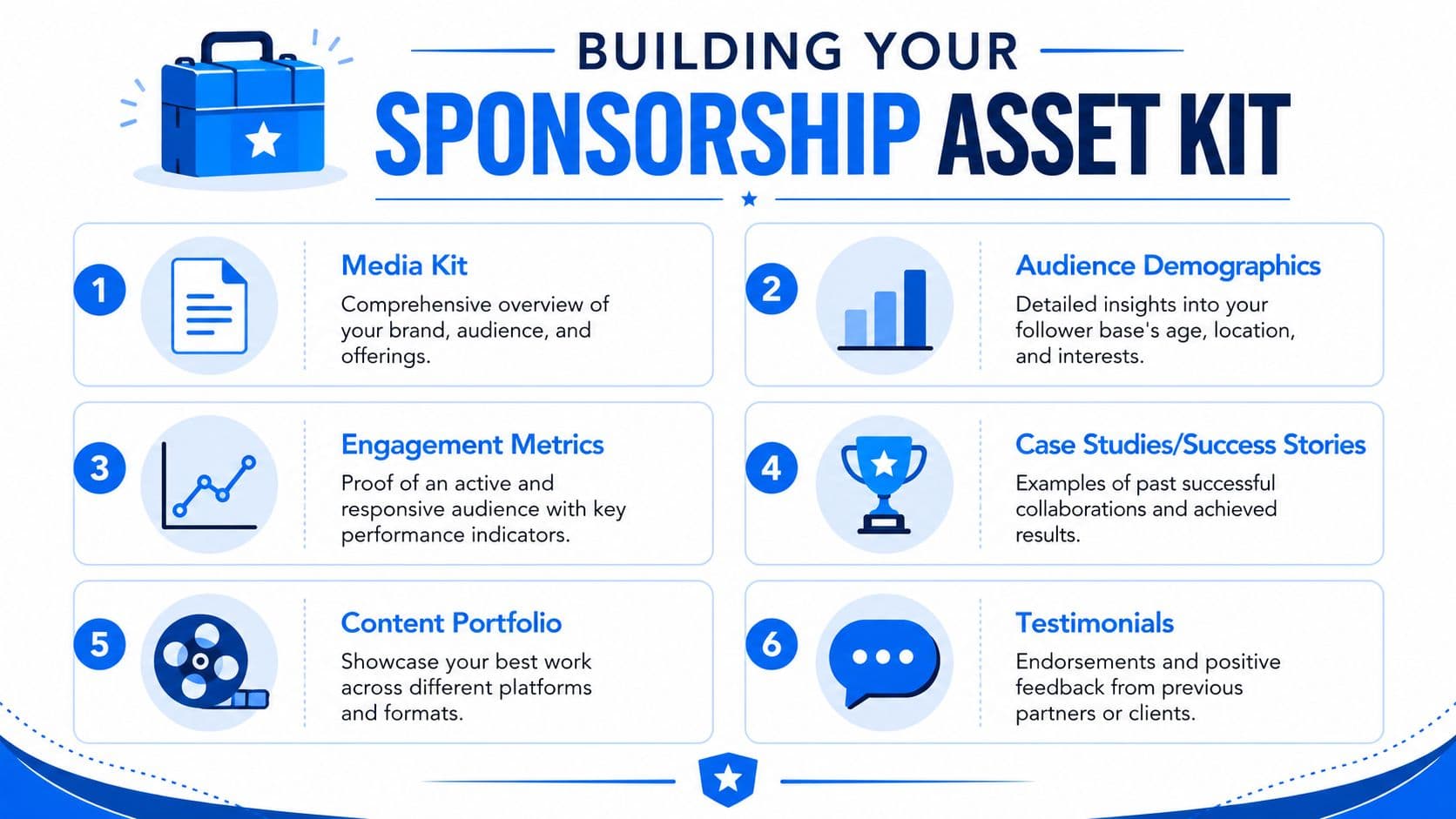
Your kit doesn't need to be fancy. It needs to be useful. Include these pieces:
- Media kit: A short overview of who you are, what you cover, who you reach, and what types of collaborations you offer.
- Audience snapshot: Age ranges, top locations, interests, and any platform-specific behavior that matters to sponsors.
- Performance metrics: Focus on the signals brands care about for your niche. Reach alone rarely tells the full story.
- Content portfolio: Show examples across formats such as short-form video, carousels, long-form posts, newsletters, or community-led content.
- Case studies: If you've never done a paid brand deal, use equivalent work. Affiliate content, product reviews, launch partnerships, event coverage, or high-performing organic posts can all count.
- Testimonials: Even a short note from a client, founder, or collaborator helps reduce perceived risk.
Turn your numbers into a story
A stack of screenshots isn't a media kit. A brand needs context.
If your Reddit posts get strong discussion but your Instagram has the bigger audience, explain that. If LinkedIn brings higher-intent conversation while TikTok brings discovery, explain that too. Sponsors don't need every metric. They need the ones that support a buying decision.
For creators who want a better framework for reporting performance, this guide on how to measure social media engagement is a useful reference because it pushes you past vanity numbers and toward more defensible evaluation.
Practical rule: Every metric in your kit should help answer one sponsor question. Who will we reach, why will they care, and what kind of action do you usually create?
Build a dossier, not a one-page brag sheet
Creators with multi-platform audiences often struggle because their value is spread out. A sponsor sees separate profiles, not a unified business. Fix that by building one document that combines:
| Asset | What to show |
|---|---|
| Channel overview | Primary platforms and what each one does best |
| Audience fit | Demographics and interests tied to likely buyer profiles |
| Best work | Representative posts, campaigns, and brand-safe examples |
| Offer menu | Deliverable options and usage boundaries |
| Proof | Testimonials, campaign notes, and audience response patterns |
A repurposing workflow helps here because the same strong idea can become evidence across channels. If you're building that kind of system, this breakdown of content repurposing strategies is worth reviewing.
Finding and Qualifying the Right Brand Partners
Most wasted outreach comes from pitching brands that were never a fit. The creator likes the product, sends a message, and hopes for the best. That's not qualification. That's wishful thinking.
Start by narrowing the field.
A good target brand sits at the overlap of four things: audience fit, content fit, offer fit, and timing. If even one of those is off, the pitch gets harder.
What makes a brand worth pitching
Audience fit is obvious. Your followers should overlap with the people the brand wants to reach.
Content fit is where many creators lose deals. A finance creator might have the right audience for a software company, but if their style is cynical, chaotic, or off-brand for that company's current campaign, the partnership may never leave the inbox.
Offer fit matters too. Can the brand use what you make? If you only sell one-off reels and they're clearly investing in deeper education or multi-touch campaigns, your package won't line up.
Timing is the silent factor. Sometimes your pitch is good and the answer is still no because the quarter is closed, another creator already filled the slot, or the campaign theme is locked.
Research before you reach out
Good qualification looks closer to market research than influencer browsing. Review the brand's recent posts, campaign messaging, landing pages, and creator partnerships. Pay attention to the language they use and the categories they're investing in. PledgeBox's insights on market research are useful here because the same discipline applies. You're trying to understand demand, positioning, and fit before making an offer.
A simple qualification checklist helps:
- Brand relevance: Would your audience naturally care about this product or service?
- Campaign alignment: Does your content style match how the brand already shows up online?
- Proof of creator activity: Has the brand worked with creators, influencers, or media partners before?
- Channel match: Can you deliver on the platforms where the brand appears active?
- Longer-term potential: Could this become a repeat partnership instead of one sponsored post?
Knowing your own audience makes all of this easier. If that part still feels fuzzy, get sharper on it first with this guide on how to identify target audience.
The next step is finding the person who can say yes. This breakdown is worth watching before you start prospecting contacts:
Crafting Your Pitch and Mastering Outreach
A sponsorship pitch doesn't fail because it's too short. It fails because it feels generic, misdirected, or lazy. Brands can spot that instantly.
The fastest improvement most creators can make is simple. Stop sending broad requests to generic inboxes and start building targeted outreach.
Personalization beats volume when the volume is sloppy
A structured outreach process performs materially better than random blasting. Targeting 100 to 200 brands with personalized messages has shown a 20 to 30% reply rate and a 5 to 10% conversion into paid deals, while generic email blasts often see open rates below 10% and conversion near zero, based on Passionfroot's guidance on reaching out to brands.
That gap exists for a reason. Personalized outreach shows you've done the work. It signals professionalism before the brand even clicks your media kit.
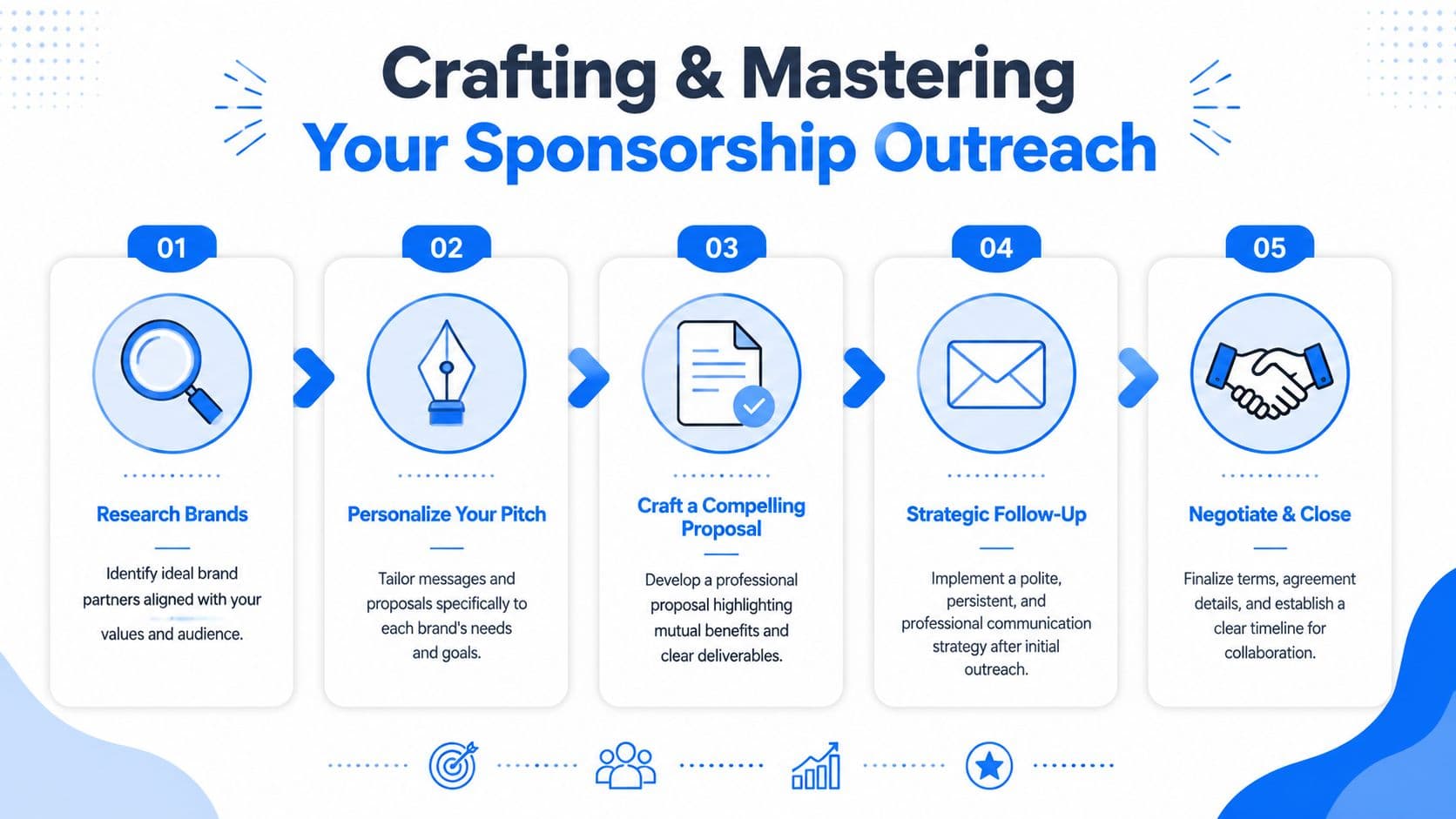
Structure the message around mutual value
A strong pitch usually has five parts:
- A specific opening: Mention the campaign, product line, launch, or messaging angle that caught your attention.
- A relevance bridge: Explain why your audience and content style fit the brand.
- A concise offer: Suggest one or two collaboration directions instead of asking, “Do you have budget?”
- Proof: Include a media kit, selected examples, or a brief case note.
- A clear next step: Ask whether the right person is open to discussing a fit.
That's enough. You don't need a manifesto.
If your positioning feels weak, tighten your language before you pitch. A creator who can state their angle clearly will always sound more credible. Even though it's written for another category, this brand statement guide for POD businesses is useful because it shows how to turn a broad identity into a sharper message.
If a brand can't understand your audience and value in a few lines, they won't dig through a deck to figure it out for you.
Follow up like a professional
A lot of paid deals are lost because creators send one email and assume silence means rejection. Often it means the recipient was busy, the timing was off, or your first note landed in the middle of a crowded launch week.
Use a clean follow-up cadence. Keep each message short. Add a useful angle instead of saying “just bumping this.”
For example:
- Follow-up one: Reframe the fit with one fresh observation about the brand's campaign or audience.
- Follow-up two: Offer a narrower package or platform-specific execution.
- Follow-up three: Close the loop politely and leave the door open.
If you create written thought leadership as part of your offer mix, LinkedIn can help your pitch feel more credible before the email is even opened. This guide on how you post articles on LinkedIn is useful if you want your profile to support your sponsorship outreach instead of just existing beside it.
The PostOnce Advantage for Securing Sponsorships
This is the exact search intent behind how to get sponsored by brands. You need to look like a dependable partner across the internet, not just on one app. Sponsors check for consistency. They want to see whether you can maintain an active presence, publish cleanly across channels, and represent their brand without creating operational friction.
That's where PostOnce fits.
Why a unified footprint changes sponsorship conversations
When a sponsor evaluates a creator, they don't just inspect creativity. They assess execution risk. A creator with one polished profile and several dormant ones can still be talented, but the brand now has unanswered questions. Can this person handle a campaign rollout across multiple networks? Will they keep messaging aligned? Will their public presence look stable when the sponsored content goes live?
According to the verified product positioning, PostOnce streamlines how creators appeal to sponsors by automatically remodeling a single piece of content into polished posts for networks like Threads, BlueSky, and LinkedIn. This demonstrates the consistent, multi-channel activity that prospective sponsors evaluate when judging a creator's professionalism and reach, as shown in this PostOnce product example.
Where it helps in practice
PostOnce matters before, during, and after the pitch.
Before the pitch, it helps you maintain an active footprint without manually rewriting the same idea for every platform.
During the pitch, it gives you a stronger story. You're not saying, “I mostly post on one channel.” You're showing a broader publishing system.
After the deal is signed, it supports cleaner campaign execution across multiple networks.
That changes how a creator is perceived. You stop looking like a single-platform hobbyist and start looking like a media operator with a distribution engine.
The operational edge
There's also a practical benefit. Sponsorship prep takes time. Prospecting takes time. Negotiation takes time. Anything that removes repetitive publishing work gives that time back to higher-value tasks.
The easier it is to keep your channels current, the easier it is to defend your value to brands.
If you want to see the platform itself, the main PostOnce homepage is the place to review how the workflow works across networks.
Negotiating Deals and Delivering Winning Campaigns
An interested reply is not a win yet. The actual work starts when the brand asks for rates, deliverables, timing, usage rights, and reporting.
Creators often undercharge, overpromise, or agree to vague terms that create headaches later.
Negotiate the scope before the price
If a brand says, “What's your rate?” don't rush to answer with a flat number and no context. First clarify what they want.
Ask about the deliverables, platform mix, timeline, revision expectations, approval process, organic usage, paid usage, exclusivity, and reporting requirements. A one-post partnership is different from a package that includes multiple assets, whitelisting, or extended rights.
A clean deal memo should cover:
- Deliverables: What exactly you're making, where it will appear, and how many pieces are included
- Timeline: Draft dates, review windows, posting dates, and final reporting deadlines
- Usage rights: Whether the brand can repost, edit, or run the content as paid media
- Exclusivity: Which competitors are restricted, for how long, and in what category
- Payment terms: Deposit, final payment trigger, and late payment expectations
Compliance is part of professionalism
A lot of creators still treat disclosure like a caption afterthought. That's a mistake.
The FTC's guidance requires clear, easily understandable disclosures on sponsored content, such as “This is an ad for BRAND”, and those disclosures shouldn't be buried in hashtags or secondary text, according to the FTC endorsement guide FAQ. If you publish sponsored content across multiple platforms, the disclosure needs to stay clear everywhere.
That matters for two reasons. First, it protects you. Second, good brands care about compliance and will notice when a creator handles it cleanly.
Deliver reports that make renewal easy
The campaign doesn't end when the post goes live. Send a concise wrap-up. Summarize what was delivered, what audience response looked like, and any standout comments, clicks, saves, reach patterns, or redemptions the brand cared about.
Keep the report simple and readable. Include observations, not just screenshots. If one platform sparked stronger conversation while another worked better for direct action, say that. Good reporting makes you look like a partner, not a vendor waiting for payment.
For creators trying to speak more fluently about campaign value, this guide on earned media value is useful background because it helps frame the broader impact of exposure and engagement in sponsor-friendly terms.
The easiest second deal to close is the one you set up during the first campaign by being organized, compliant, and easy to work with.
Recurring sponsorships usually come from reliability. Not from one viral post. Brands remember creators who hit deadlines, communicate clearly, disclose properly, and leave behind assets the team can use.
If you want sponsorships to stop feeling random, build the system behind them. PostOnce helps you maintain the kind of consistent, multi-platform presence that makes brands take you seriously before you ever send the first pitch.