


















If you're trying to get more value from every post, distribution is the first lever. PostOnce solves that practical problem by letting you publish once and automatically crosspost across multiple social networks, which matters because earned media value only grows when more people see and engage with your content.
That puts a lot of creators and small businesses in the same spot. You're publishing consistently. You're getting mentions, shares, reposts, and discussions. But when someone asks, “What was that worth?” the answer often gets fuzzy. That's where earned media value becomes useful.
What Is Earned Media Value and Why It Matters
Earned media value, often shortened to EMV, is a way to estimate what your unpaid visibility would have cost if you had bought the same exposure through ads. It turns organic attention into a dollar figure.
That matters because organic performance is easy to admire and hard to defend. “We got good engagement” sounds nice, but it doesn't help much in a budget conversation. EMV gives you a translation layer from social activity into business language.
A simple way to think about it is this: if a post, mention, or share generated organic impressions, EMV estimates what you would have paid to buy those impressions through paid media. That doesn't make EMV revenue. It makes EMV a media-cost equivalent.
Why marketers pay attention to it
In projected 2026 figures, the influencer marketing industry reached $32.55 billion, and influencers collectively generated $236 billion in earned media value across global platforms, according to the IMH benchmark data cited here. That scale tells you something important. Brands don't treat earned attention as a side effect anymore. They treat it as an asset.
For a creator, agency, or small business, the practical use is straightforward:
- You can justify organic work when clients or teammates only understand paid media.
- You can compare channels using a shared monetary lens.
- You can benchmark reach against what similar visibility might cost to buy.
- You can spot momentum when organic distribution starts outperforming expectations.
Where readers usually get confused
Most confusion comes from mixing up three different ideas.
| Term | What it means | What it doesn't mean |
|---|---|---|
| Earned media | Unpaid attention like mentions, shares, reposts, reviews, and organic creator coverage | Paid ads |
| Earned media value | Estimated dollar value of that unpaid attention | Actual sales or profit |
| Reach and impressions | The audience exposure that often feeds the EMV calculation | Proof that people converted |
EMV is useful because it connects awareness to a number people can compare. It's risky when people pretend that number is the same as business outcome.
If you're still shaky on basic exposure metrics, this guide to social media reach helps clarify the raw audience side of the equation.
How to Calculate Earned Media Value
A simple way to approach EMV is to treat organic attention like rented shelf space. If you had to buy the same visibility through ads, what would it likely cost?
The standard starting formula is:
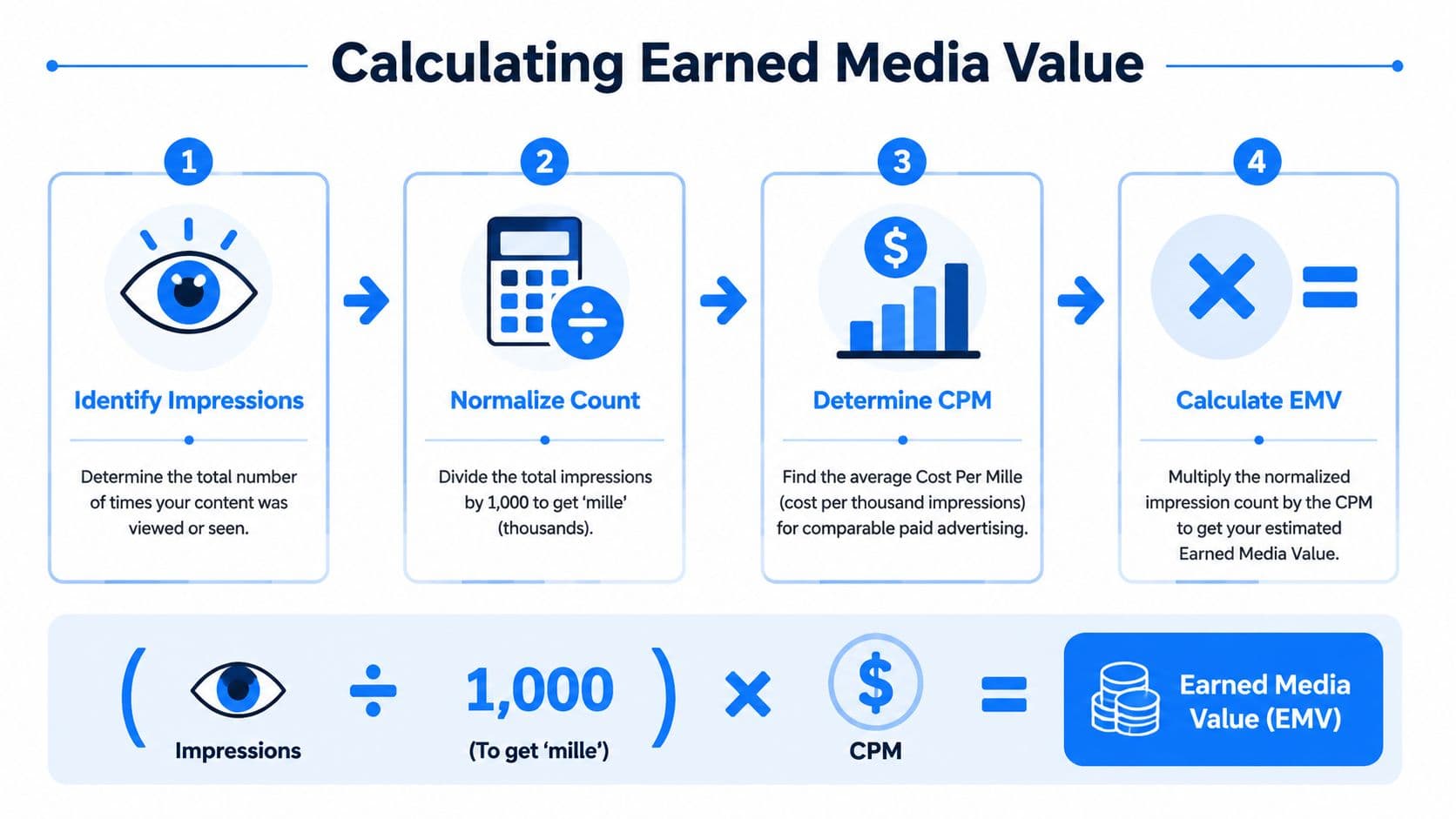
EMV = (Impressions / 1,000) × CPM × Adjustment Factor
That structure matches the explanation in Indeed's overview of earned media value, which also outlines example CPM ranges for platforms such as Instagram, TikTok, and LinkedIn.
Start with the baseline version
If you're calculating EMV for the first time, start with the cleanest version:
EMV = (Impressions / 1,000) × CPM
That gives you a baseline estimate before you add judgment calls.
Here is the logic, step by step:
- Count impressions. This is how many times the content was displayed.
- Divide by 1,000. CPM means cost per thousand impressions.
- Choose a CPM benchmark. Use a paid media rate that fits the platform where the earned exposure happened.
- Multiply the two numbers. The result is your estimated dollar value.
For example, if a post generated 500,000 impressions and the comparable CPM is $10, the baseline EMV is $5,000.
That number is not revenue. It is a media-cost estimate. This distinction matters because it keeps the metric useful instead of inflated.
Add an adjustment factor only when you can defend it
A raw impression model is helpful, but it treats every view the same. A mention from a trusted creator usually carries more weight than a low-context repost. A post with strong discussion may also be more valuable than one that people scroll past.
That is why many teams add an adjustment factor:
EMV = (Impressions / 1,000) × CPM × Adjustment Factor
The adjustment factor works like a grading layer. It lets you reflect quality, not just volume.
You might adjust for:
- Sentiment, such as positive versus mixed coverage
- Source credibility, such as an industry expert versus a low-relevance account
- Engagement quality, such as saves, comments, or reposts that signal real interest
Use this carefully. If you cannot explain how you assigned the multiplier, keep the baseline formula and note the limitation in your report.
A few examples make the math easier to trust
Once you see the pattern, EMV becomes easier to use consistently.
| Example | Calculation | Result |
|---|---|---|
| 250,000 impressions at $12 CPM | 250 × 12 | $3,000 EMV |
| 500,000 impressions at $10 CPM | 500 × 10 | $5,000 EMV |
| 1,000 likes valued at $0.01 each | 1,000 × $0.01 | $10 EMV |
The first two examples use impression-based EMV. The third shows a different model, where teams assign values to specific actions. That approach can be useful, but it also introduces more subjectivity. For small businesses and creators, the impression-plus-CPM method is usually easier to explain to clients, sponsors, or internal stakeholders.
Choose a CPM benchmark that matches the platform
The CPM you choose shapes the final number, so this part deserves care.
Indeed lists example platform ranges such as:
- Instagram: $6.25 to $10
- TikTok: $10
- LinkedIn: $5 to $7
Use the benchmark that best matches where the earned exposure happened. If one campaign picked up traction across Instagram, TikTok, and LinkedIn, calculate each platform separately. That gives you a clearer view of where your content is creating value.
This is also where smart distribution matters. EMV rewards attention you earn. Automation helps you create more opportunities to earn it. If a strong idea only appears once, your impression base stays small. If you systematically repurpose and publish that idea across relevant channels, you increase the pool of exposure that EMV is measuring in the first place.
That is one reason creator tools like PostOnce matter. They do not change the formula. They help you produce more of the inputs that make the formula meaningful.
If you need a companion framework to prove your worth with EMV, pair this metric with a reporting system that shows how earned attention supports business goals. For hands-on measurement work, a social media ROI calculator can help you compare EMV with broader campaign performance.
Amplify Your EMV with PostOnce Automation
You publish a strong post on LinkedIn. It gets solid reach, a few thoughtful comments, and maybe a share or two. Then the workday moves on. The idea never makes it to X, Instagram, or Threads, even though it could have performed there too.
That missed distribution shows up later in your EMV.

Distribution is the hidden multiplier
EMV measures the value of attention you earn. Distribution determines how many chances you give that attention to happen.
A simple way to understand it is to compare content to a storefront. A good product in one quiet alley may get some customers. The same product placed on several busy streets, with the right signage for each location, gets seen by more people and earns more word of mouth. Your content works the same way. One strong idea, adapted well across channels, can create more impressions, more engagement, and more unpaid mentions.
That matters because EMV is not only a judgment of content quality. It is also a reflection of content availability. If a post appears once, you limit the pool of earned exposure it can generate. If the same idea is repurposed for the platforms where your audience already spends time, you increase the volume of measurable attention around it.
Manual distribution often fails for ordinary reasons. Captions need rewriting. images need resizing. A short-form video needs a different intro. The task gets pushed to later, and later usually means never.
Why automation improves the metric
PostOnce helps you turn one idea into a repeatable distribution system.
That changes EMV in a practical way. Automation does not inflate the formula or create fake value. It increases the number of real opportunities your content has to earn visibility, shares, reposts, and discussion across channels. Those are the raw materials EMV is built from.
For a creator or small business owner, this is the important shift. You stop treating distribution as cleanup work after publishing. You treat it as part of value creation.
A useful way to frame it is this: EMV is the scoreboard. Automation helps you run more quality plays.
Better distribution gives your strongest ideas more chances to produce the impressions and engagement that raise EMV.
This walkthrough adds useful context:
What this looks like in practice
A creator shares a product insight on LinkedIn. With a manual process, that post may stay isolated there. With PostOnce, the same core idea can be reshaped into a short thread, a visual post, or a trimmed caption for another network without starting from scratch each time.
Now the content has more surface area. Different audiences can discover it. More people can respond to it. Some of those responses create secondary visibility through reposts, mentions, and follow-on conversation. That is how a single idea starts producing more earned value over time.
This is also why automation matters to reporting. If you want to prove that your content creates business value, you need a process that consistently gives good ideas enough distribution to be measured fairly. A one-off post can understate what your content is capable of doing.
If you want a closer look at that workflow, this guide to a content automation tool explains how to systematize repurposing and cross-channel publishing.
Common Pitfalls When Measuring EMV
A big earned media value number can look impressive and still be wrong.
The most common mistake is treating impressions as trustworthy by default. They aren't. If you use a raw impression count with no quality check, you can overstate impact fast.
When the baseline gets inflated
Verified source material from Clearview Social's discussion of EMV measurement warns that unadjusted impression-based models can inflate valuation from bot traffic or low-quality reach. The same source notes that high-impression, low-engagement posts can distort ROI by 10 to 100 times, and that bots comprise 20% to 40% of social impressions in the cited analytics.
That should change how you read a dashboard. A post that reached a lot of accounts but triggered little genuine response may look strong in a spreadsheet and weak in reality.
Four traps that lead to bad EMV reporting
-
Using impressions alone
A pure reach-based estimate is useful as a starting point, not as a final answer. If nobody engaged, shared, clicked, or discussed the content, the EMV may be directionally overstated. -
Ignoring sentiment
Not every mention helps your brand. A widely seen complaint still creates impressions, but it shouldn't be valued the same way as a positive recommendation. -
Counting low-quality traffic as equal value
Visibility from irrelevant audiences, bot-heavy accounts, or poor-fit placements can make the number look bigger while making the result less meaningful. -
Comparing unlike campaigns
If one team uses conservative CPMs and another uses generous ones, their EMV totals aren't comparable. Consistency matters more than squeezing out the highest estimate.
A defendable EMV model is usually a modest one. The less inflated it looks, the more likely stakeholders are to trust it.
What to do instead
Use EMV as a layered metric.
Start with the basic calculation. Then ask a few filtering questions:
| Check | Why it matters |
|---|---|
| Was the audience real? | Filters out bot-heavy or suspicious reach |
| Was the response meaningful? | Separates passive exposure from active interest |
| Was sentiment positive or at least neutral? | Prevents harmful visibility from being overvalued |
| Did the content align with campaign goals? | Keeps the metric tied to business context |
If a post generates a high baseline EMV but fails these checks, report it carefully. Call it visibility, not success.
Keep the metric in its lane
EMV is strongest when you use it as an estimate of awareness value. It gets weak when people use it as proof of pipeline, sales, or customer lifetime value.
That distinction protects your credibility. If someone pushes back on your number, you should be able to explain the assumptions in plain English and show where the estimate stops.
How to Report EMV to Stakeholders
Most EMV reporting fails for one reason. People present the number by itself.
A stakeholder doesn't just want to know the estimated media value. They want to know whether the visibility was useful, whether it improved, and whether it connected to broader business goals. So your report needs context, comparison, and commentary.
Lead with the story, not the formula
When you're presenting to a client, founder, or leadership team, start with the business takeaway.
For example:
Organic visibility increased this month, and EMV rose alongside stronger engagement and more branded discussion. The gain appears to come from better content distribution and more audience response, not just more impressions.
That framing gives the number meaning. Then you can show the methodology if someone asks.
A simple reporting structure
Use a table like this in a monthly dashboard or campaign recap.
Sample KPI Report Contextualizing EMV
| Metric | This Month | Last Month | Commentary |
|---|---|---|---|
| Earned media value | [Insert value] | [Insert value] | Explain what drove the change |
| Impressions | [Insert value] | [Insert value] | Note where reach increased or fell |
| Engagement quality | [Insert description] | [Insert description] | Summarize whether audience response improved |
| Sentiment | [Insert description] | [Insert description] | Clarify whether mentions were mostly positive, mixed, or negative |
| Clicks or site actions | [Insert value] | [Insert value] | Connect visibility to downstream behavior |
| Top content driver | [Insert post or campaign] | [Insert post or campaign] | Identify what created the strongest earned response |
What makes the report persuasive
Three habits help a lot:
-
Show the benchmark source or logic
If you used platform CPMs and a quality adjustment, say so plainly. -
Add a comparison point
Month-over-month, campaign-to-campaign, or channel-to-channel comparisons make EMV easier to interpret. -
Pair it with adjacent KPIs
EMV without engagement, sentiment, or action metrics can feel abstract.
If your reporting stack is still fragmented, a social media analytics dashboard can help organize the surrounding metrics that make EMV more useful.
What to avoid in stakeholder conversations
Don't say EMV equals revenue.
Don't present it as exact.
Don't hide the assumptions.
A careful sentence like “This is our estimated paid-media equivalent for the organic attention earned by this campaign” does more for trust than a flashy slide with a giant dollar amount and no explanation.
Beyond EMV Complementary KPIs for a Full Picture
Earned media value is good at measuring awareness in dollar terms. It isn't good at measuring everything.
That gap gets more obvious when content starts spreading through communities, customer shares, and creator conversations that don't fit neatly into a single post-performance report.
Where EMV misses part of the story
Verified material from Britopian's critique of EMV notes that EMV can oversimplify value and often fails to address how tools that spark earned shares create secondary amplification. The same source says UGC EMV is surging 40% year over year, and cites brand lift studies showing a 22% sales increase from UGC versus 5% from direct posts.
Those figures highlight a practical blind spot. Traditional EMV formulas do a decent job valuing visible exposure. They often miss the compounded value of someone else taking your content, reacting to it, and spreading it into a new audience.
The supporting KPIs that round it out
If you want a stronger measurement model, pair earned media value with a few other indicators.
-
Sentiment
EMV says how much visibility you earned. Sentiment tells you whether that visibility helped or hurt. -
Share of voice
This shows how much conversation your brand owns compared with competitors. A moderate EMV can still be a win if your brand is gaining ground in a crowded market. -
Traffic and on-site behavior
Did the earned visibility lead people to visit key pages, spend time reading, or take the next step? -
Conversions
Leads, sign-ups, sales, inquiries, and bookings tell you whether awareness created action.
EMV is an awareness metric first. The fuller picture comes from placing it beside behavior and outcome metrics.
Use EMV as one layer of ROI thinking
When teams want one master number, they often force EMV to carry too much weight. A better approach is to let EMV answer one question and let ROI answer another.
- EMV asks, what was this unpaid attention worth in media terms?
- ROI asks, what business return did that attention help produce?
If you need a practical explainer on how to calculate marketing ROI, it's useful as a companion framework because it keeps awareness and business return connected without treating them as the same thing.
For a broader measurement model, these social media key performance indicators help define what belongs in the same dashboard as earned media value.
A better way to judge content performance
Use earned media value when you need to defend visibility.
Use complementary KPIs when you need to judge business impact.
That combination keeps you from underestimating strong organic work and from exaggerating what awareness alone can prove.
Putting Earned Media Value to Work
Earned media value is most helpful when you treat it as a disciplined estimate, not a magic answer. It helps you turn organic visibility into a number people can understand, compare, and discuss. That's valuable for creators, agencies, and small businesses that need to show that unpaid attention has real business significance.
The strongest use of EMV is practical. Calculate it with consistent benchmarks. Adjust it when quality clearly differs. Report it with engagement, sentiment, and action metrics. And stay honest about what it can and can't prove.
If your goal is to increase earned media value, the path is rarely more complicated than this: create strong content, distribute it widely, and measure the response with context. Better reach creates more opportunity for earned attention. Better measurement helps you defend the result.
If you want to grow the inputs behind earned media value instead of just calculating them after the fact, PostOnce makes that easier. It lets you create content once and automatically distribute it across platforms, so your best ideas have more chances to earn impressions, engagement, shares, and the visibility EMV is designed to capture.