

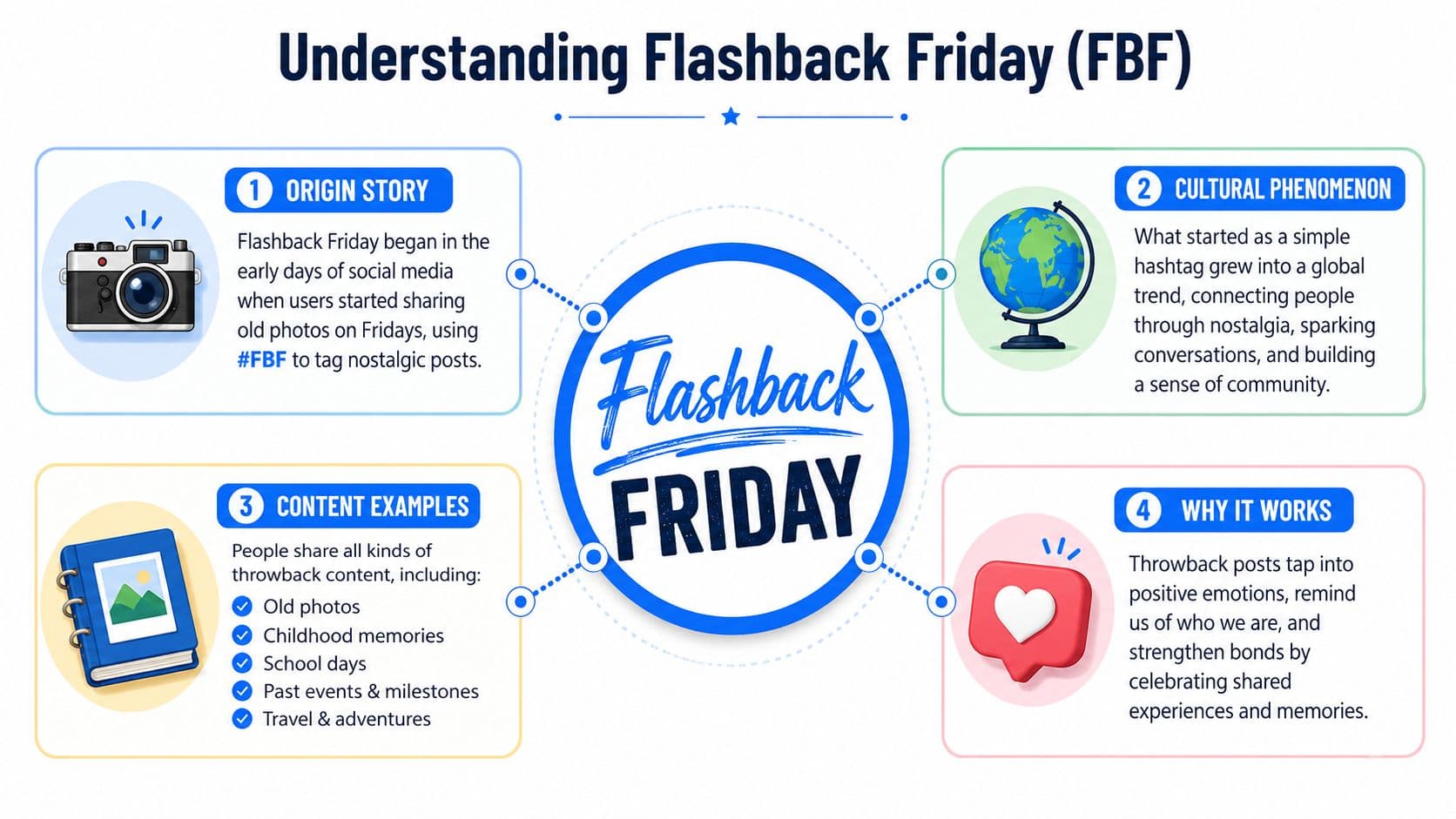
FBF most commonly means Flashback Friday, a social media trend where people post old photos or memories on Fridays. It became one of the biggest recurring hashtag habits online, and posts tagged #FBF or #FlashbackFriday have seen 15 to 20% higher engagement on Fridays than on other days.
If you're managing social content, you've probably seen it in captions, client drafts, or a Friday content calendar and wondered whether it's still worth using. The answer is yes, but with a strategy. FBF isn't just internet slang. It's a repeatable content format that helps creators, brands, and social media managers turn old photos, product history, and milestone moments into useful content.
A lot of people searching what does FBF mean don't just want the definition. They want to know when to use it, how to use it well, and whether it still makes sense across today's platforms. That's where workflow matters. If you're already planning throwback-style posts, it's helpful to understand how tools like PostOnce crossposting fit into a smarter publishing process across multiple networks.
What Does FBF Mean and How Can You Use It
FBF typically means Flashback Friday. In plain terms, it's a Friday post that shares something from the past. That could be an old team photo, an early product mockup, a childhood memory, a first office, or a behind-the-scenes image from years ago.
What makes FBF useful is its structure. You don't have to invent a totally new content angle every Friday. You can build a recurring theme around memory, progress, or story. That gives you a reliable publishing slot, which is valuable when content planning starts to feel scattered.
A simple way to think about FBF
Use FBF when you want to post something old that still says something relevant now.
That usually falls into one of these buckets:
- Brand history: Your first logo, launch day, first packaging, old website screenshots
- Founder story: Early workspaces, prototype photos, first customer moments
- Community memory: Event photos, customer milestones, team celebrations
- Personal creator content: Old projects, before-and-after progress, lessons learned
Practical rule: A strong FBF post doesn't just show the past. It connects the past to a current message.
If you're also comparing FBF to similar weekly trends, it's useful to review how it differs from Throwback Thursday content ideas. The two are closely related, but FBF is specifically tied to Friday posting.
Where people get confused
Readers often mix up three different questions:
- What does FBF mean? It usually means Flashback Friday.
- When do you use it? On Fridays.
- What do you post with it? Something from the past that has a story attached.
If you keep those three answers separate, the acronym becomes easy to use and easy to recognize in the wild.
The Main Meaning Flashback Friday
Flashback Friday is the dominant meaning of FBF on social media. It's the version commonly intended when the acronym is used in a caption, hashtag set, or post idea.
The trend took off in the early 2010s and peaked around 2014 to 2015. It became part of digital culture because it gave people a recurring reason to post older memories. Instead of waiting for a special occasion, users had a built-in weekly prompt.
According to Socialez's explanation of FBF on social media, the hashtag #FBF or #FlashbackFriday is widely recognized for old-photo posts shared on Fridays. Verified platform data also shows that posts tagged #FBF or #FlashbackFriday consistently see 15 to 20% higher engagement on Fridays than on other days, and by 2016 more than 30 million posts carrying the #FBF hashtag were shared annually.
Why the trend worked so well
FBF succeeded because it did three things at once:
- It reduced posting friction: People could post older content when they didn't have something new ready.
- It invited emotion: Nostalgia gives people a reason to comment, reminisce, and share their own memories.
- It created a routine: Friday became a predictable slot for throwback content.
That routine mattered. In the United States, United Kingdom, and Canada, it's estimated that 40% of weekly photo uploads on Fridays include this specific tag. In practical terms, users learned to recognize FBF instantly.
Nostalgia works best when the post feels specific. A random old photo gets glanced at. A memory with context gets discussed.
Why people still recognize it
Even if social platforms have changed, FBF still has cultural familiarity. Many users know what the tag means without needing an explanation. That's useful for brands because familiar formats lower cognitive load. People understand the point of the post right away.
At the same time, recognition doesn't guarantee performance on every platform. That's where strategy matters more than habit. On visual and community-driven platforms, FBF can still feel natural. On faster-moving professional or text-first platforms, the same post may need a different framing.
Other FBF Meanings You Might Encounter
Most of the time, what does FBF mean has a simple answer. Still, context matters. In a social caption, it's almost always Flashback Friday. In a casual chat, archive, or older financial document, it can mean something else.
One common alternate meaning is Female Best Friend. Another is FleetBoston Financial Corporation, a historic financial institution that operated until 2004, when it was acquired by Bank of America. Urban Dictionary also records the casual slang use of FBF as Female Best Friend in text-style conversation, which you can see in its FBF entry.
FBF Meanings by Context
| Acronym | Meaning | Context | Usage Frequency |
|---|---|---|---|
| FBF | Flashback Friday | Social media captions, hashtags, Friday posts | Primary meaning |
| FBF | Female Best Friend | Texting, casual slang, chat messages | Occasional |
| FBF | FleetBoston Financial | Historical finance references, archives, legal or corporate documents | Niche and historical |
The easiest way to interpret FBF is to ask one question. Where did you see it?
- If it appears under an old photo on Friday, it means Flashback Friday.
- If it shows up in a text conversation about friendships, it may mean Female Best Friend.
- If it appears in banking history or legacy documents, it's probably FleetBoston Financial.
Context check: Social post equals Flashback Friday. Casual chat might mean Female Best Friend. Financial archive points to FleetBoston Financial.
If you're managing audience growth and trying to make trend-based content clearer for followers, strong positioning matters as much as acronym choice. That's also why headline clarity and caption clarity affect discoverability, especially when you're trying to get more followers with stronger content choices.
How to Use FBF in Your Social Media Posts
Knowing what FBF means is one thing. Turning it into a post people care about is the essential skill.

On social media, #FBF is widely used in captions for old photos posted on Fridays. The hashtag appears predominantly on that day and signals a throwback post tied to memory, history, or progress. That established meaning gives you a ready-made framing device for weekly storytelling.
What to post on Fridays
The best FBF posts usually fit one of these practical examples:
- An old brand moment: Your first booth at an event, first order packed by hand, first logo draft
- A progress story: Then-and-now photos, early prototypes, original workspace compared with today
- A human memory: Team celebrations, founder milestones, community photos, client wins from earlier years
- A lesson post: An old mistake, what changed since then, and what you'd do differently now
A weak FBF post is just old. A strong one is old and meaningful.
Write the caption like a story
Don't stop at "FBF to the early days." Give the viewer a reason to care.
Try this structure:
- Start with the moment.
- Add why it mattered.
- Connect it to today.
- End with a question or reflection.
For example:
We took this photo when the product was still held together with tape, notes, and optimism. It reminds us how messy good ideas look at the start. What's one early version of your work that still makes you smile?
If you want help sharpening that storytelling style, this guide on writing better social captions is useful.
Hashtags and post framing
Use hashtags with intention, not as decoration.
- Use #FBF: Best when the post is clearly Friday-specific
- Add #FlashbackFriday: Helpful when you want the full phrase for clarity
- Use #TBT carefully: Only if you're repurposing the idea for Thursday culture, not as a default Friday tag
A short visual walkthrough can help if you're training a team member or client on format and timing:
Do this, not that
- Do tell a specific story. “This was our first market table in the rain.”
- Don't post an unexplained old image. People won't do the work for you.
- Do tie the memory to a current takeaway.
- Don't rely on nostalgia alone.
- Do invite comments.
- Don't bury the point under too many hashtags.
Automating FBF and Other Trends with PostOnce
It's Friday at 8:45 a.m. A client wants a Flashback Friday post to go live on Instagram, LinkedIn, and Threads. The asset is ready, but the work is not. One platform needs a short nostalgic caption, another needs a business lesson, and the third needs a faster, more conversational hook.
That is why FBF works better as a system than a one-off post.
Why manual posting breaks down
FBF looks simple on the surface because the format is familiar. In practice, it creates repeat work every week. A social media manager has to choose the right image, rewrite the caption for each channel, adjust the tone, check formatting, and publish at the right time.
That routine adds up fast.
The harder part is platform fit. A throwback post that feels warm and personal on a visual feed can feel flat on LinkedIn unless you connect it to a lesson, milestone, or result. On fast-moving text platforms, the same post often needs a sharper opening and a clearer reason to care now.
| Platform type | What usually works better |
|---|---|
| Visual social feeds | A nostalgic image and short story |
| Professional networks | A lesson, milestone, or business reflection |
| Fast conversation platforms | A tighter hook and current relevance |
FBF works like a reusable content prompt. The memory stays the same, but the packaging should change by channel.
How automation helps
PostOnce helps teams treat recurring trends like FBF as scheduled content opportunities, not last-minute admin tasks. You can build the core post once, adapt the framing for each platform, and queue it ahead of time so Friday does not turn into a manual publishing sprint.
That matters for more than convenience.
A recurring trend is only useful if you can repeat it consistently. If your team skips FBF half the time because cross-posting takes too long, the format never becomes part of your content rhythm. If you set it up once and reuse the workflow, FBF becomes a dependable slot in your calendar, similar to a weekly series or themed newsletter.
A practical setup usually looks like this:
- Create one base asset: Start with the photo, video, or screenshot you want to resurface
- Write one core story: Explain what happened, why it mattered, and why it matters now
- Tailor by platform: Shorter and lighter for visual feeds, more reflective for professional channels, more immediate for conversation-driven apps
- Schedule in advance: Queue Friday posts before the week gets busy
- Reuse the process: Turn FBF into a repeatable template for other trends too
If your team wants a clearer workflow, this guide on how to automate social media posts shows how to set up recurring publishing without the usual copy-paste routine.
The useful question is no longer just what FBF means. For a social media manager, the better question is how to make a familiar trend easier to publish, easier to adapt, and easier to repeat.
Making FBF Work for Your Content Strategy
If someone asks what does FBF mean, the short answer is still Flashback Friday. But for a creator or social media manager, the better answer is broader. It's a repeatable Friday content format built around memory, story, and relevance.
Used well, FBF helps you surface older assets that still have value. Old launch photos, early drafts, team milestones, customer history, and behind-the-scenes moments can all become strong Friday content when the caption explains why the memory matters now.
The key is not to treat FBF like autopilot. Some platforms welcome nostalgic content more than others, and some audiences respond better when the throwback includes a lesson, opinion, or current takeaway.
A practical content system helps more than a clever hashtag. If you want these recurring themes to stay organized, map them into a weekly plan using a simple content calendar workflow. That keeps FBF from becoming random filler and turns it into a deliberate publishing habit.
If you want to turn recurring ideas like Flashback Friday into a cleaner workflow, PostOnce helps you create content once and distribute it across multiple platforms without the usual copy-paste routine. It's a practical way to keep weekly trends active while spending more time on the story and less time on the mechanics.