

















A solid caption does more than just describe a picture—it’s your chance to start a conversation, forge a connection, and prompt your audience to act. The best ones grab you with the first sentence, are easy to scan, and have a clear purpose. When you get this right, you start turning those mindless scrollers into a real community.
The Real Power of a Great Caption

Let’s be real for a second. A beautiful photo might make someone pause, but it's the caption that convinces them to stick around. This is your shot to add context, tell a story, and show the human side of your brand. A post without a thoughtful caption is a missed opportunity, plain and simple. It’s the difference between a pretty picture hanging on a wall and one that has a story behind it that truly connects with you.
That first line? It's the most important piece of digital real estate you own. Most platforms will chop your text off after just a few lines, so you absolutely have to make that opening hook count. Your goal is to give people a reason to stop their thumb-numbing scroll and tap "see more."
Defining Your Goal Before You Write
Every single caption needs a job. Before you type a single word, ask yourself what you’re trying to achieve. Are you aiming to:
- Spark a conversation? Then ask a question that people actually want to answer.
- Drive traffic? Point them directly to the link in your bio with a compelling reason.
- Build community? Share a relatable behind-the-scenes story or a personal thought.
- Educate your audience? Drop a quick tip or a piece of valuable insight they can use.
Knowing your goal from the start gives your message focus and makes sure every word is pulling its weight. A caption without a clear purpose is just adding to the noise.
To really nail this, I find it helps to think in terms of four core pillars. Every great caption I've written or analyzed usually has a mix of these elements.
The Four Pillars of Effective Captions
| Pillar | What It Is | Why It Matters |
|---|---|---|
| Hook | The first 1-2 sentences designed to grab attention immediately. | It's your only chance to stop the scroll and earn the "see more" click before your text gets cut off. |
| Value | The core message that educates, entertains, or inspires your audience. | This is what makes your content worth their time and keeps them coming back for more. It's the "meat" of the caption. |
| Personality | The unique voice and tone that reflects your brand. | It builds a genuine connection, makes you memorable, and separates you from a sea of generic content. |
| Call to Action (CTA) | A clear instruction telling the reader what to do next. | It guides your audience toward your goal, whether that's getting comments, clicks, or shares. |
Thinking through these four elements ensures your captions are strategic, not just descriptive. They become mini-stories that serve a real business purpose.
A great photo can get a like, but a great caption starts a conversation. This is where you move beyond just describing what's happening and start building a real connection.
The job of a caption has grown, too. It’s no longer just about storytelling; it’s a key part of your social SEO. Platforms like Instagram are behaving more and more like search engines. People are actively searching for "vegan dinner ideas" or "NYC travel tips" right in the app.
By front-loading your captions with relevant key phrases, you dramatically increase the chances of your post getting discovered. You can dive deeper into how to write captions that get found by exploring social SEO strategies. This one shift in approach can get your content in front of a whole new audience that’s already looking for what you have to offer.
Finding Your Voice to Connect with Your Audience

If your captions could be slapped onto any other account without anyone noticing, you've got a problem. The only way to make your content truly resonate is to move past the generic and develop a voice that is unmistakably yours.
But here’s the secret: finding your voice doesn’t start with you. It starts with listening.
What words do your followers use? What inside jokes are floating around in their comments? Pay close attention. The goal is to understand their world so you can speak their language fluently, not just mimic it. This deep listening gives you the raw material to craft a brand personality they'll actually connect with.
It's a step most creators skip, but it’s the key to building a real community. If you haven't dug into this yet, our guide on how to identify your target audience is the perfect place to start. It lays the groundwork for everything we're about to cover.
Choosing Your Brand Archetype
Think of your brand's voice as a character in a story. When that character has a defined personality, writing captions becomes ten times easier and way more consistent. Are you the witty friend, the trusted expert, or the inspiring mentor?
- The Witty Friend: This voice is all about humor, slang, and pop culture references. It's informal and highly relatable, perfect for brands that want to feel like one of the gang. Wendy's on X is a classic example.
- The Trusted Expert: Here, you communicate with authority and clarity. This voice provides rock-solid, valuable information, making it ideal for educational or B2B brands that need to build credibility.
- The Inspiring Mentor: This voice motivates and encourages. It uses positive, uplifting language centered on growth and empowerment—a natural fit for wellness brands, coaches, and creators in the self-help space.
Picking an archetype isn’t about putting yourself in a box. It’s a North Star. It ensures your captions always sound like they’re coming from the same person, which is how you build familiarity and trust over time.
A consistent voice turns a brand into a personality. People don't build relationships with logos; they build them with personalities they know, like, and trust.
Once you have a voice in mind, you need to document it. I’m not talking about a 50-page brand book. A simple, one-page style guide is all you need to keep your team (or just yourself) on track.
Simple Voice and Tone Guidelines
Jot down a few bullet points to define your communication style.
- Words we use: List 5-10 words that feel right for your brand's personality (e.g., "collaborate," "discover," "simplify").
- Words we avoid: Make a note of industry jargon or buzzwords that feel off-brand (e.g., "synergy," "disrupt," "utilize").
- Emoji usage: Decide on your approach. Are you an emoji enthusiast, a sparing user, or do you skip them altogether?
- Punctuation style: Does your brand shout with exclamation points, or is it more reserved with simple periods?
This simple framework acts as a cheat sheet, keeping your messaging sharp and on-brand no matter who's writing the copy. It ensures every post reinforces the personality your audience expects and loves.
Crafting Stories and CTAs That Drive Action

If your captions are passive, your audience will be too. It’s that simple. To turn casual scrollers into a genuine community, you have to get good at two things: telling a simple story and then making a clear request. The best captions always hook people emotionally first, then guide them to the next step.
Don’t worry, you don’t need a Hollywood budget for this. Even a simple photo of your morning coffee can become a mini-story about finding focus, sparking creativity, or just enjoying a quiet moment. All you have to do is give your content a beginning, a middle, and an end, even if it’s just a few sentences long.
To see how the pros do it, check out these brand storytelling examples. This is how you make your content stick, ensuring people remember you long after they’ve scrolled away.
The Art of the Call-to-Action
Once you've drawn them in with a story, it's time for the call-to-action (CTA). This is where you flat-out tell your audience what you want them to do. Vague CTAs like "check it out" lead to vague results. You need to be specific, be direct, and make it feel like the most natural thing to do next.
A great CTA gives your audience an easy, low-effort way to get involved. Instead of just saying "comment below," ask a specific, open-ended question that’s actually fun or easy to answer.
- Weak CTA: "Let me know what you think!"
- Strong CTA: "What’s the #1 thing holding you back from starting?"
See the difference? The second one is a real conversation starter. It’s targeted and makes people think, which is exactly what algorithms—and actual humans—love.
A caption without a clear call-to-action is like a conversation that ends abruptly. You've done all the work to connect with someone, only to leave them wondering what to do next.
Crafting CTAs for Different Goals
Your CTA should always be tied to the goal of your post. Are you trying to get more saves? Drive traffic to your site? Spark a lively debate in the comments? Each goal needs a different kind of nudge.
Here’s a quick breakdown of CTAs tailored to different outcomes:
-
To Encourage Saves: Position your content as a valuable resource. Try CTAs like, "Save this for when you need a confidence boost," or "Bookmark this simple recipe for your next weeknight dinner." It makes your post feel like a tool they’ll want to come back to.
-
To Drive Discussion: Ask for opinions, experiences, or advice. Prompts like, "What's one piece of advice you'd give your younger self?" or "Which of these two options would you choose? Tell me why below," are fantastic for inviting genuine interaction.
-
To Increase Shares: Create content that helps people express themselves or help others. A CTA like, "Tag a friend who needs to hear this today," makes sharing feel personal and helpful, not spammy.
Interestingly, you don't always need a long caption to get great results. A recent study found that captions under 30 words consistently outperform longer ones. When you pair that brevity with a clear CTA and a few relevant emojis, the engagement can shoot up even more. Being concise and direct is often the most powerful way to write.
How to Use AI to Write Better Captions, Faster
We’ve all been there—staring at that blinking cursor, trying to summon another brilliant caption out of thin air. It’s a universal feeling for anyone managing social media. This is precisely where AI tools come in, not as a replacement for your voice, but as a seriously smart brainstorming partner. They do the heavy lifting of generating ideas, freeing you up to focus on the big picture: strategy and connecting with your community.
Instead of wrestling with the perfect hook for an hour, imagine getting a dozen different options in seconds. This lets you experiment with all sorts of angles—from a funny one-liner to a question that makes people think—without completely draining your creative battery. The idea isn't to just copy and paste; it's to use AI as a launchpad for your own authentic message.
Beating Writer's Block for Good
Think of an AI assistant as your tireless creative intern. You give it the core concept, and it gets the first draft on the page. This is a game-changer when you're feeling stuck or just plain uninspired.
- Brainstorming Hooks: Give the AI a topic, like "launching a new coffee blend," and ask for ten different opening lines. It might spit out anything from a bold question to a quirky statement, giving you plenty of raw material to work with.
- Rewriting for Punch: Have a sentence that just feels a bit… blah? Ask an AI to rewrite it with more energy or a more professional tone. For instance, "Our new product is available now" can instantly become, "Ready to completely change your morning routine? Our new artisan blend just dropped."
- Adapting Your Tone: You can easily tweak your message for different audiences. That casual, emoji-filled caption for Instagram can be effortlessly rephrased into a polished, insightful update for LinkedIn.
This approach is an incredible time-saver, giving you back hours to focus on what really matters. If you’re trying to speed up your content creation, especially for professional networks, an AI LinkedIn post generator can be a huge help in crafting posts that really fit the platform's vibe.
AI doesn't replace your creativity; it multiplies it. It handles the tedious parts of writing, giving you more time to add the human touch that truly connects with your audience.
The Real-World Impact of AI on Captioning
The move toward AI-assisted content creation isn't just a fleeting trend—it's a strategy backed by real numbers. By 2025, AI has become a major force in content creation, with 42% of marketing managers now actively using it to write compelling social media copy. The results speak for themselves, with some marketers reporting follower growth increases of up to 60% thanks to the enhanced engagement from well-crafted, AI-assisted captions.
This shift is exactly why we built the integrated https://postonce.to/tools/caption-generator directly into PostOnce. It allows you to generate multiple caption ideas, fine-tune your tone, and find the perfect hashtags—all without leaving your workflow. You can generate, schedule, and publish your content from a single dashboard, which cuts out the friction and makes everything so much more efficient.
The table below breaks down the practical differences between the old way and the new way of writing captions.
Manual vs AI-Assisted Caption Writing
| Feature | Manual Writing | AI-Assisted Writing |
|---|---|---|
| Time Investment | Hours per week spent brainstorming and drafting from scratch. | Minutes to generate multiple drafts, saving significant time. |
| Creative Strain | High risk of writer's block and creative burnout. | Low-pressure brainstorming; AI provides the initial spark. |
| Idea Volume | Limited to what one person can think of in a session. | Generates a dozen or more ideas and angles in seconds. |
| Tone & Style | Tone is consistent but can be difficult to adapt quickly. | Easily adapts tone for different platforms (e.g., Insta vs. LinkedIn). |
| Consistency | Can be challenging to maintain a consistent posting schedule. | Frees up time, making it easier to be consistent and strategic. |
| Outcome | Good, but often limited by time and creative energy. | Optimized, varied, and data-informed captions that drive engagement. |
By automating that initial first draft, you spend less time just trying to write and a lot more time actually connecting with your audience. It's a smarter way to work, not a harder one.
Adapting Your Captions for Every Platform
One of the biggest mistakes you can make is copying and pasting the same caption everywhere. It’s a surefire way to kill your engagement. Each social platform is its own little world with a unique culture, a tricky algorithm, and specific audience expectations. A caption that absolutely crushes it on LinkedIn will almost certainly fall flat on TikTok.
The trick is to think like a native user of each platform, not just a tourist passing through.
This doesn’t mean you have to write a brand-new post from scratch every time. Instead, think of it as tweaking your core message to fit the room. Your story or announcement is the same, but the delivery has to change. It's the difference between shouting in a library and whispering at a concert—one of them just isn't going to work.
Your Instagram Playbook
Instagram is all about the visuals, but the caption is where you forge a real connection. The best strategy here is all about variety.
-
For Reels: Keep your captions short, sharp, and punchy. The video is the star of the show. Your text should be a quick punchline, a witty observation, or a simple question to get the comments rolling. It’s the cherry on top, not the whole sundae.
-
For Carousels & Feed Posts: Here's your chance to go deeper. Use longer, more value-packed captions to tell a story, share a detailed tutorial, or offer a personal reflection. Just be sure to break up those longer paragraphs with emojis and line breaks to keep the text scannable and inviting.
For anyone looking to really nail the perfect post, our guide on the Instagram caption generator is packed with platform-specific tips and tricks.
Mastering TikTok and LinkedIn
These two platforms couldn't be more different, which perfectly illustrates why you need to adapt. What works on one is practically guaranteed to fail on the other.
On TikTok, your caption is a supporting actor. It’s there to complement the video and the trending audio, not distract from it. The best captions are often just a few words, adding a bit of context or a final punchline. Hashtags are absolutely essential for discovery, so load up on relevant ones that connect to the trend or your niche community.
LinkedIn, on the other hand, is the home of professional storytelling. This is where longer captions that offer industry insights, career lessons, or thoughtful commentary perform incredibly well. Use a professional yet personal tone to build your authority and start meaningful conversations with your peers. Think of it as a mini-blog post that delivers genuine value.
A platform-specific caption shows your audience that you understand their space and respect their time. It’s a subtle signal that you’re part of the community, not just broadcasting to it.
Fostering Community on Facebook
Facebook is uniquely built for deep community discussions. While other platforms prioritize quick hits and fleeting attention, Facebook's algorithm often rewards posts that generate real back-and-forth conversations.
This is the place to ask open-ended questions that encourage followers to share their own stories. For example, instead of just announcing a new product, ask your audience about the problem that product solves in their lives. This small shift transforms your page from a simple announcement board into a lively community hub where people feel seen and heard.
This visual breaks down the old-school manual approach versus a modern, AI-assisted workflow for captioning.
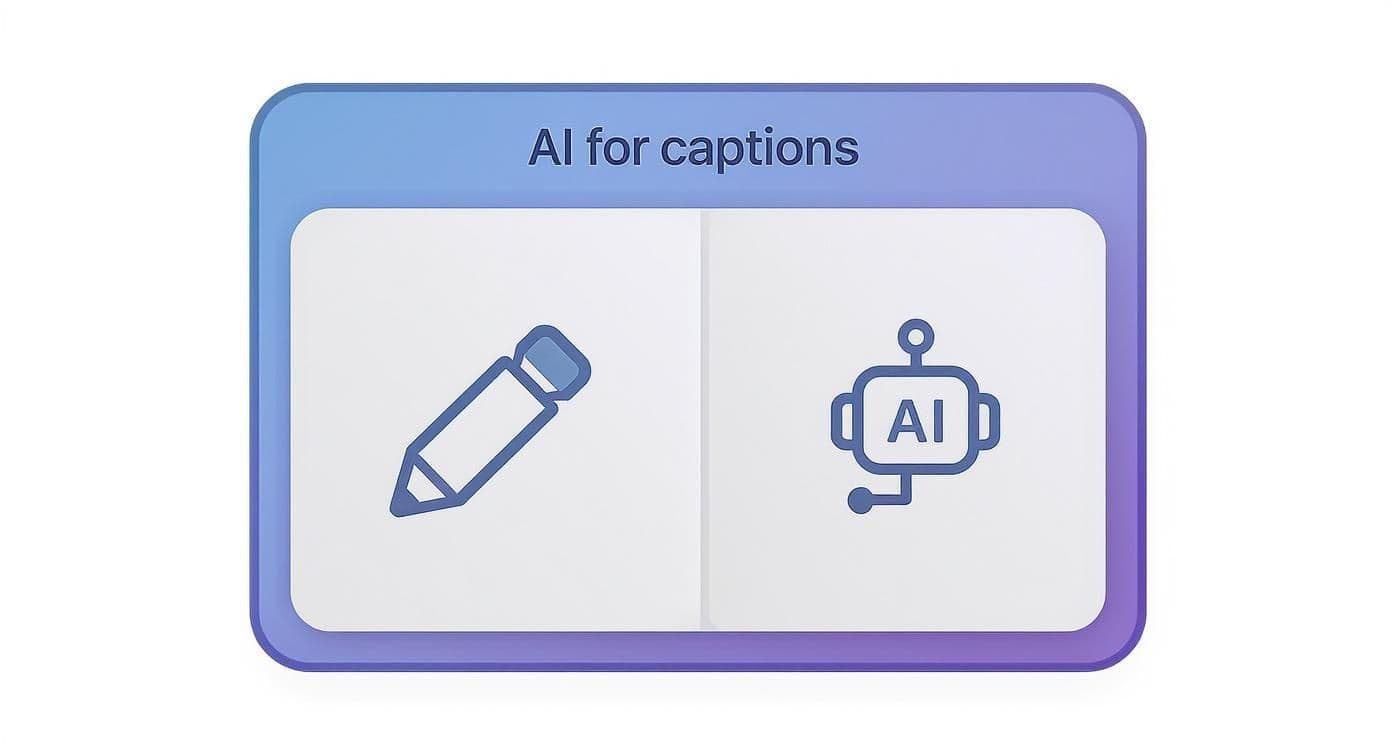
The takeaway is simple: using smart tools doesn't just save time. It actually helps you brainstorm more varied and platform-specific ideas, which is exactly what you need to adapt your message effectively.
Your Top Caption Questions, Answered
Even with the best strategy in place, you're going to hit a few snags when it's time to actually write. It happens to everyone. Let's walk through some of the most common questions and roadblocks I see creators run into, so you can stop second-guessing and start posting with confidence.
Getting these little details right—like how long your caption should be or where to stick your hashtags—can genuinely make or break your post's performance.
How Long Should My Social Media Captions Be?
I wish there were a magic number, but the truth is, it completely depends on the platform and what you're trying to accomplish with your post.
For super visual, fast-moving content like Instagram Reels or TikTok videos, short and snappy wins. You’re often best off with fewer than 10 words. Let the video do the talking.
But for a standard Instagram feed post, you have more room to play. I've seen brands get amazing engagement with long, micro-blog style captions that tell a compelling story. On platforms like Facebook and LinkedIn, longer, value-packed captions often crush it because the audience is there to read and learn.
The real secret? Lead with the good stuff. Whatever you do, make sure your first sentence is a hook. You have to grab their attention before the dreaded "see more" cutoff hides the rest of your message.
Where Should I Put My Hashtags?
Ah, the great hashtag debate. My philosophy is simple: clarity over clutter. Your caption should look clean and be easy to read.
When it comes to Instagram, you've got two great options:
- Pop them in the first comment: This is my personal preference. Dropping a block of 5-15 well-researched hashtags in the comments keeps your caption looking clean and focused.
- Bury them in the caption: If you'd rather keep them in the caption itself, just hit "enter" a few times after your main text. That white space creates a nice visual break.
Things are different on platforms like TikTok, X (formerly Twitter), and LinkedIn. There, the norm is to weave 2-3 super-relevant hashtags right into the end of your caption. The goal is always discoverability, not desperation.
How Do I Make My Captions Sound More Conversational?
This is the easiest fix of all: write like you talk. Seriously. Before you post, read your caption out loud. Does it sound like something you'd actually say to a friend? If it feels stiff or robotic, it's time for a quick edit.
Here are a few simple tricks to nail that natural, chatty vibe:
- Use contractions. Think "you're" instead of "you are," and "it's" instead of "it is."
- Ask questions. This is a direct invitation for your audience to jump in and respond.
- Sprinkle in some emojis. They add personality and help convey the emotion behind your words.
Stop thinking of your caption as a broadcast to a massive, faceless audience. Instead, picture yourself starting a one-on-one chat with a single person. That small mental shift makes all the difference in building a real connection.
Ready to stop staring at a blinking cursor and start creating captions that actually connect? With PostOnce, you can get multiple AI-generated caption ideas, instantly adapt your tone for any platform, and schedule everything from one simple dashboard. Try PostOnce today and take back your time.