

Improving customer engagement isn't just a marketing buzzword; it's about creating genuine, valuable interactions with your audience at every turn. The goal is to build real loyalty and drive sustainable growth by shifting your focus from one-off sales to fostering long-term relationships.
This means getting personal in your communication, showing up consistently everywhere your customers are, and offering support before they even ask for it.
Why Modern Customer Engagement Matters More Than Ever
Let's be real—the old marketing playbook is toast. Customer acquisition costs are soaring, and brand loyalty feels more fleeting than ever. Just selling a good product doesn't cut it anymore. The entire game has shifted from quick, transactional exchanges to building relational value.
Your success today hinges on your ability to build genuine, lasting connections with the people who buy from you. This guide is your roadmap to move beyond surface-level metrics and implement strategies that actually make a difference. A thoughtful, data-driven approach to engagement is now essential for survival.
If you're looking for an even deeper dive into the nuances of this topic, this comprehensive modern guide to customer engagement is an excellent resource.
Core Pillars of a Modern Engagement Strategy
So, how do we start building a framework that turns one-time buyers into lifelong fans? It all comes down to focusing on a few core pillars. Getting these right will set the foundation for every specific tactic we'll unpack later.
Here's a quick look at the foundational elements you'll need to build a successful customer engagement framework.
Core Pillars of a Modern Engagement Strategy
This table summarizes the foundational elements required to build a successful customer engagement framework, providing a quick reference for the key strategies discussed in this guide.
| Pillar | Core Principle | Key Action |
|---|---|---|
| Deep Personalization | Go beyond "Hi [First Name]". Understand individual behaviors and preferences to deliver truly relevant experiences. | Segment audiences based on purchase history, browsing behavior, and engagement levels to tailor messaging. |
| Seamless Omnichannel | Create a consistent, connected brand experience everywhere—your website, social media, email, or with a support agent. | Map the customer journey across all touchpoints to identify and eliminate friction or inconsistencies. |
| Smart Automation | Use technology to scale meaningful interactions, ensuring timely communication without losing that human touch. | Implement automated workflows for onboarding, re-engagement, and post-purchase follow-ups. |
Mastering these three areas is non-negotiable for creating a modern and effective strategy.
The pressure to adapt is immense. When you fail to engage customers on their terms, they don’t just leave—they often go straight to a competitor who will. Building a strong engagement strategy is no longer a "nice-to-have"; it's a core business function.
This isn't just my take; the sense of urgency is industry-wide. A recent report found that a massive 88% of consumer product marketers plan to completely overhaul their customer engagement strategies. They're feeling the pinch from rising costs and seeing loyalty evaporate.
This data underscores a critical need for brands to evolve. You can read more about these findings on consumer product engagement from emarsys.com.
Crafting a Personalized Customer Journey

Let's be honest, real personalization goes way beyond dropping a {{first_name}} tag into an email subject line. It's about crafting interactions so relevant and helpful that they feel like they were made just for one person. This is how you build real connections and keep customers coming back.
To get there, you have to look past the usual demographic buckets. The gold is in your behavioral data—what people are actually buying, which pages they linger on, and how they engage with you across different channels.
From Data to Dialogue
Your first move is to map out the entire customer journey. I mean every single touchpoint. Think about their first impression on Instagram all the way to a support ticket they file six months after purchase. Each of these moments is a chance to have a meaningful, personalized conversation.
Let’s walk through a real-world scenario. Say a customer who regularly buys hiking gear from your shop just spent ten minutes looking at a new line of waterproof jackets but left without buying. A generic "you left something in your cart!" email is lazy.
A much better approach? Send them a targeted message featuring a video of someone hiking through a downpour in that exact jacket. That’s not just a sales pitch; it's useful, contextual, and dramatically boosts the odds of them completing the purchase.
Leveraging Behavioral Triggers
Behavioral data isn't just for reports; it’s your playbook for creating these hyper-relevant moments. When you track what users do, you can set up automated responses that feel incredibly timely and personal.
Here are a few ways I’ve seen this work wonders:
- Smart Post-Purchase Cross-Sells: Someone just bought a new camera from you. A week later, an automated email suggests a compatible lens and links to a quick video tutorial on night photography. Helpful, not pushy.
- Content That Matches Interest: A visitor reads two of your blog posts about social media analytics. That’s a clear signal. You can trigger a pop-up offering a free webinar on that topic or add them to an email list for advanced marketing tips.
- Re-Engaging Inactive Users: An app user who used to log in daily hasn't been seen in 30 days. A friendly "Here's what you've missed" email highlighting new features can be the perfect nudge to bring them back.
Automated workflows like these let you speak to your customers with relevance, even as you scale. And don't forget the small stuff. Even transactional messages like order confirmations and password resets are part of the journey. Brushing up on the best practices for transactional emails to boost engagement can turn a mundane notification into a subtle brand-building opportunity.
Key Takeaway: Personalization isn't a one-off campaign. It’s an ongoing strategy of listening to what your customers' actions are telling you and responding with something they'll actually find valuable. The aim is to make every customer feel like they're in a one-on-one conversation with your brand.
By meticulously mapping the journey and acting on behavioral triggers, you turn browsers into buyers and first-time customers into genuine fans. That's the core of a modern engagement strategy that fuels real, sustainable growth.
Crafting a Truly Seamless Omnichannel Experience
Here's a reality check: your customers don't care about your marketing "channels." They see one brand. Whether they’re scrolling Instagram on the bus, browsing your website at their desk, or opening an email, that experience needs to feel like a single, continuous conversation. This is where real customer engagement is won or lost.
An omnichannel strategy isn't just about showing up everywhere. It’s about making all those touchpoints talk to each other. You're building a fluid ecosystem where every interaction, no matter how small, informs the next. This makes it effortless for people to connect with you on their own terms.
Connecting the Dots Between Channels
Imagine your customer data as a complete conversation history. If a customer raves about your support agent on live chat, your marketing team should know about it. This unified view is the secret to creating experiences that feel both personal and intelligent.
The classic abandoned cart scenario is a perfect example. A customer adds a product to their cart on your website but gets distracted. A smart omnichannel workflow picks up right where they left off:
- Website Action: A user leaves items in their cart.
- Email Nudge: About an hour later, an automated email lands in their inbox reminding them what they left behind, maybe with a few customer reviews to sweeten the deal.
- Social Retargeting: The next day, a subtle ad for that exact product appears in their social feed.
- App Notification: If they use your app, a gentle push notification could offer a small, time-sensitive discount to seal the deal.
See how that works? Each step is connected, guiding the customer along their journey without being pushy or repetitive. This all hinges on having a central hub for your customer data where website clicks, email opens, and social likes are all tracked in one place.
The big idea is to meet customers where they are and make their experience feel unbroken. No one should have to repeat their story or start from scratch just because they switched from their laptop to their phone.
Why Consistency Is the Bedrock of Trust
This kind of consistent experience has a direct line to customer loyalty. When every single touchpoint reinforces the same brand message, tone, and value, you build a powerful sense of reliability. People start to trust you.
But here’s the tricky part: a satisfactory experience on its own isn't enough to lock in loyalty.
Recent global data shows a surprising gap. While 76% of customer interactions get high satisfaction ratings, key loyalty metrics like trust and repurchase intent are falling behind. You can dig into the numbers in this research on global satisfaction and loyalty. It proves that a smooth transaction is just the starting line. True, lasting engagement is built on an emotional connection, and a seamless experience is what helps you create it.
Practical Steps to Unify Your Brand Presence
Getting all your channels in sync doesn't have to be a massive, complex project. You can start small with a few high-impact integrations that connect your most critical platforms.
One of the easiest wins is maintaining a coherent voice and visual style across all your social networks. For any business juggling multiple profiles, figuring out how to cross-post on social media effectively is a fundamental first step. By automating the sharing of your core message while tweaking it for each platform, you create a recognizable and reliable brand image. That consistency is the foundation you’ll build your entire omnichannel experience on.
Using Automation and AI to Scale Engagement
Let's be honest: giving every single customer a personalized, white-glove experience is a huge undertaking. As your business grows, trying to manage all those interactions by hand just isn't sustainable. This is where technology—specifically automation and AI—steps in to become your most powerful ally in boosting customer engagement at scale.
These tools are what allow you to create timely, relevant, and genuinely helpful interactions for your entire audience, something that would otherwise require an enormous team. Think of automation as the workhorse running your engagement strategy behind the scenes. It frees up your team to focus on what humans do best: building relationships and tackling complex problems.
The shift is already happening. Projections show that by 2025, AI will be behind a staggering 95% of all customer interactions. That means 19 out of every 20 conversations will have AI involved. It's not just a future trend; 58% of consumers say that chatbots have already raised their expectations for how brands should interact with them. For a closer look at the data, you can check out these customer engagement statistics from VWO.
Setting Up Smart Automation Workflows
You don't need a massive, complicated system to get started. The best approach is to begin with simple, trigger-based workflows that target key moments in the customer's journey. These automated sequences are your safety net, ensuring no one gets forgotten and that your communication stays on point.
Here are a few high-impact workflows you can set up pretty quickly:
- The Welcome Series: When someone new signs up, kick off a sequence of 3-5 automated emails. Start with a warm welcome, then follow up with helpful getting-started tips, a tour of your best features, and maybe a powerful customer story.
- Re-engagement Campaigns: Has a user gone quiet for 30 or 60 days? An automated message can be the perfect nudge to bring them back. You could offer a small discount, show off what's new, or simply ask for their feedback.
- Special Offer Triggers: Automate messages for customer birthdays or anniversaries. A simple "Happy Anniversary!" email with a unique discount is an easy win that makes customers feel valued and strengthens their loyalty.
To get a better handle on coordinating these messages across different channels, take a look at our guide on essential social media management tips.
Using AI for Smarter Conversations
If automation is the workhorse, AI is the brain. It adds a layer of intelligence that makes automated interactions feel more human and predictive. We're moving way beyond basic chatbots that just spit out canned answers. Modern AI is all about understanding context and anticipating what a customer needs before they even ask.
AI-powered tools are a force multiplier for your team. They can handle the high-volume, repetitive questions with incredible speed, freeing up your human experts to focus on the complex, sensitive issues where they can truly make a difference.
AI can also analyze customer behavior in real time to guess what they'll do next. For example, if someone keeps looking at a specific product category on your site, predictive AI can automatically send them an email with related content or a special offer. This kind of proactive help makes customers feel like you're paying attention, turning a standard experience into a memorable one.
Measuring the Engagement Metrics That Matter
It's one thing to feel like your customer engagement is improving, but it's another thing entirely to prove it's actually working. After all, you can't improve what you don’t measure. But getting lost in a sea of data is just as bad as flying blind. The biggest trap I see people fall into is chasing "vanity metrics"—superficial numbers like social media likes or total page views that look great on a report but don't tell the full story.
Real progress comes from tracking actionable metrics. These are the numbers that draw a straight line from your engagement efforts to your business goals. They're the key performance indicators (KPIs) that reveal the true health of your customer relationships.
Vanity vs. Actionable KPIs
So, what's the difference? Vanity metrics are easy to find and often give you a nice ego boost, but they lack the context needed to make smart decisions. An actionable metric, on the other hand, is a clear signal that helps you figure out what to do next.
For example, having 100,000 followers on Instagram is a vanity metric. It looks impressive, but what does it mean? A more actionable metric is your engagement rate, which tells you what percentage of those followers are actually commenting, sharing, and reacting to your content. That's a number you can work with.
Similarly, a big spike in website traffic from a one-off campaign is nice, but an increase in your Repeat Purchase Rate proves that your engagement efforts are creating genuinely loyal customers who keep coming back.
It's a critical distinction to make. For a deeper look at what numbers really count on social media, we put together a guide on the essential social media metrics that move the needle.
Key Takeaway: True engagement isn’t measured by how many eyeballs see your brand. It’s measured by how many people care enough to take action—and actionable KPIs are what track that impact.
From Superficial to Significant: A Quick Guide
Distinguishing between a flashy number and a meaningful one is crucial for any effective strategy. The table below breaks down some common examples to help you focus on what truly matters.
Vanity Metrics vs Actionable Engagement KPIs
| Metric Type | Example | Why It's Limited | Actionable Alternative | What It Measures |
|---|---|---|---|---|
| Superficial | Total Page Views | Doesn't reveal if visitors found value or bounced. | Time on Page | How long a user actively engages with content. |
| Superficial | Social Media Followers | A high count doesn't guarantee an active community. | Engagement Rate | The percentage of followers who interact. |
| Superficial | Email Open Rate | Clicks matter more; an open doesn't mean they read. | Click-Through Rate (CTR) | How many recipients took action on your email. |
| Superficial | Number of App Downloads | Many users download and delete without ever using. | Daily Active Users (DAU) | The number of unique users who engage daily. |
| Actionable | Customer Lifetime Value (CLV) | This is an actionable metric. | N/A | The total revenue from a single customer. |
| Actionable | Churn Rate | This is an actionable metric. | N/A | The rate at which customers stop doing business. |
Ultimately, the goal is to shift your focus from metrics that make you look good to KPIs that help you do good work and drive real results.
Key Engagement KPIs You Should Be Watching
To get a clear, unfiltered view of customer loyalty, you don't need dozens of metrics. Just a handful of powerful ones will do the trick. This infographic perfectly illustrates the difference between a surface-level metric and one with real substance.
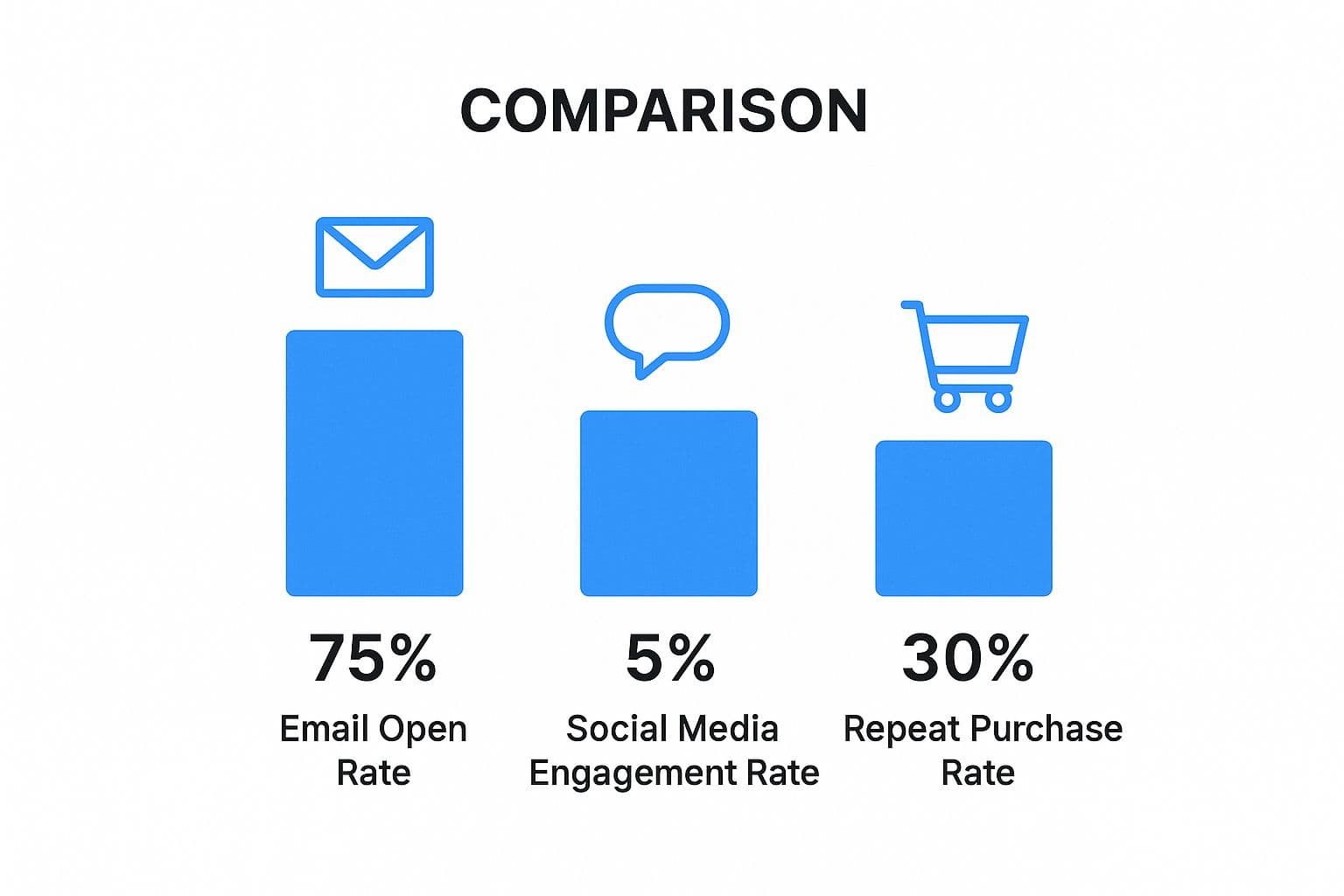
While a high email open rate feels like a win, the repeat purchase rate provides a much more direct link to customer loyalty and the financial health of your business. It's about a real transaction, not just a potential one.
Here are three essential KPIs I always recommend keeping a close eye on:
-
Customer Lifetime Value (CLV): This is the ultimate report card for your customer relationships. It projects the total revenue you can expect from a single customer over their entire time with you. When your CLV is going up, it’s a strong sign that your engagement strategies are fostering loyalty and encouraging more business.
-
Churn Rate: This one is simple but powerful: it’s the percentage of customers who leave you over a given period. A high churn rate is a major red flag that something in the customer experience is broken. Even a small reduction in churn can have an outsized impact on your revenue.
-
Net Promoter Score (NPS): Want a direct line to customer sentiment? The NPS is it. By asking one simple question—"On a scale of 0-10, how likely are you to recommend us to a friend?"—you can group your customers into Promoters, Passives, and Detractors. It’s a fantastic way to measure loyalty and see if your efforts are creating true brand advocates.
Your Path to Stronger Customer Relationships
Boosting customer engagement isn't about running another one-off campaign; it's a fundamental shift in how you operate. We've walked through the roadmap for building those deeper connections—from crafting personalized journeys to creating a seamless presence everywhere your customers are.
Now, the real work begins. It’s time to take these strategies off the page and put them into action.
The secret is to start with small, manageable steps. Test your approach, see what resonates, and most importantly, listen to what your customers are telling you through their actions. Great service is the bedrock of it all, and something as simple as enhancing customer service with WhatsApp Business can be an incredibly practical way to meet people on their preferred turf.
When you focus on building genuine relationships, you’re doing more than just chasing the next sale. You’re building a loyal community of advocates who will drive your growth for years to come. That journey starts now. Go build those connections, one meaningful interaction at a time.
Got Questions? We’ve Got Answers.
Diving into customer engagement can bring up a lot of questions. We get it. Here are some of the most common ones we hear from businesses just like yours, along with our straight-to-the-point answers.
What’s the Single Best Place to Start?
If you’re going to do just one thing, start with a solid feedback loop. Seriously. It's the most powerful first step you can take.
Actively ask for opinions through surveys, follow-up emails, or just by paying attention on social media. But here’s the crucial part: you have to visibly act on that feedback. When customers see their suggestions actually lead to a change, it builds an incredible amount of trust. It tells them you see them as a partner, not just a sale.
How Can We Do This on a Small Business Budget?
You don’t need a massive budget to make a real impact. For small businesses, the key is to focus on high-impact, low-cost activities.
Here’s where to put your energy:
- Get personal with your emails. Even just using a customer's name and referencing a past purchase can make a huge difference.
- Use a free or low-cost CRM. There are great tools out there that help you keep track of conversations so nothing slips through the cracks.
- Own one social media channel. Don’t try to be everywhere at once. Pick the platform where your customers hang out and become a master of it.
Start small and focus on genuine connection. You can use simple automation to take care of the repetitive stuff, which frees you up to do what you do best.
How Often Should I Be Checking My Engagement Metrics?
This really depends on what you're measuring. You don't want to get buried in data, but you also don't want to fly blind.
Think of it in two tiers. Big-picture metrics like Customer Lifetime Value (CLV) or your Net Promoter Score (NPS) are best reviewed quarterly. They show you the long-term trends.
But for your day-to-day operational metrics—things like email open rates, social media comments, and website visit duration—take a look every week or two. This rhythm helps you spot what's working (and what's not) and make quick adjustments without getting analysis paralysis.
Ready to turn these ideas into action? PostOnce takes the manual work out of social media, letting you schedule and distribute your content everywhere your customers are. Write it once, set your schedule, and we'll handle the rest. Start saving time and amplifying your reach with PostOnce today.