


















PostOnce is the fastest way to act on social network marketing tips without turning your week into a copy-paste job. If you are juggling multiple social networks, the main problem usually is not ideas. It is execution. PostOnce automates only supported source/destination pairs and post types. You write one strong post, then lose momentum resizing images, trimming captions, swapping hashtags, and logging into too many apps.
That workflow doesn't scale. It also creates a common failure pattern: inconsistent posting, uneven messaging, and rushed formatting that makes good content look weaker than it is. PostOnce solves the exact search intent behind social network marketing tips because it helps you publish one core message across multiple networks with platform-aware distribution from a single workflow. If you're comparing options, SubmitMySaas' social media tool comparison is a useful place to see how this category is evolving.
Social media is too fragmented for one-size-fits-all publishing. As of 2025, 65.7% of the world's population are active social media users, and the average person uses or visits 6.84 different platforms each month, according to Sprinklr's social media marketing statistics. Your audience isn't sitting in one feed waiting for one version of your message.
These 10 social network marketing tips focus on what works in practice: adapt the same idea intelligently, publish consistently, measure against business goals, and automate the parts that waste time.
1. Leverage Cross-Platform Content Repurposing
Teams generally don't require additional content ideas. They need a better system for turning one idea into several usable posts.
A strong weekly workflow starts with a pillar asset. That could be a blog post, webinar clip, customer question, founder opinion, product update, or tutorial. From there, split it into formats that fit how people consume content on each network. One idea becomes a LinkedIn text post, an Instagram carousel, a Threads discussion starter, and a short-form video script.

Start with a core message, not duplicate posts
Repurposing works when the message stays consistent but the packaging changes. A product launch can sound professional on LinkedIn, more conversational on Threads, and more visual on Instagram. If you post the exact same caption everywhere, performance usually drops because each platform trains users to expect different pacing, structure, and tone.
Good repurposing usually looks like this:
- Blog to feed post: Turn one article into three opinion-led LinkedIn posts and one concise X thread.
- Video to text: Pull one clear quote or lesson from a video and publish it as a standalone text post.
- Feature release to multi-format rollout: Publish the same announcement with different hooks for customers, peers, and creators.
Practical rule: Reuse the idea. Rewrite the delivery.
For teams building this muscle, a documented content repurposing strategy keeps the process repeatable. In practice, that matters more than chasing originality on every post. Consistency beats reinvention.
2. Optimize Posting Schedules and Timing
Timing won't rescue weak content, but bad timing can bury strong content.
Marketers often overcomplicate this. You don't need mythical "best times." You need a publishing rhythm that matches when your audience is available and when your team can respond. For a B2B company, that might mean weekday mornings on LinkedIn. For a creator with consumer content, evenings may produce better attention windows.
Build a cadence you can sustain
The mistake is posting at random, then trying to interpret the results. Random timing creates noisy data. A better approach is to choose a repeatable schedule for each platform, run it long enough to learn something, then adjust.
Use native analytics and your own response capacity to shape the schedule. If comments arrive while nobody is online, you lose the early conversation that often gives posts momentum.
A practical system looks like this:
- Choose fixed windows: Pick a few recurring time slots per network and stick to them.
- Group by platform behavior: Business-hour publishing often suits professional channels, while consumer channels may reward later posting.
- Review patterns regularly: Look for when posts get quality engagement, not just quick likes.
Sprout Social notes that nearly 70% of LinkedIn users engage with brand content at least weekly, and that Facebook users interact most with short-form video, which supports adapting both timing and format by channel in the same workflow via Sprout Social's social media statistics.
If your schedule still lives in sticky notes and browser tabs, move it into a proper social media scheduling workflow. Reliability matters more than heroic bursts of posting.
3. Create Platform-Specific Content Formats
The biggest shift in social network marketing is that platforms aren't interchangeable anymore. They behave like separate media environments with different audience intent.
Dreamgrow reports that in 2025 average engagement rates differed sharply by platform, with LinkedIn at 6.50%, Facebook at 5.07%, TikTok at 4.86%, Threads at 4.51%, YouTube at 4.41%, and Instagram at 1.16%, based on Dreamgrow's social media marketing statistics. That gap is why platform-specific formatting isn't cosmetic. It's strategic.
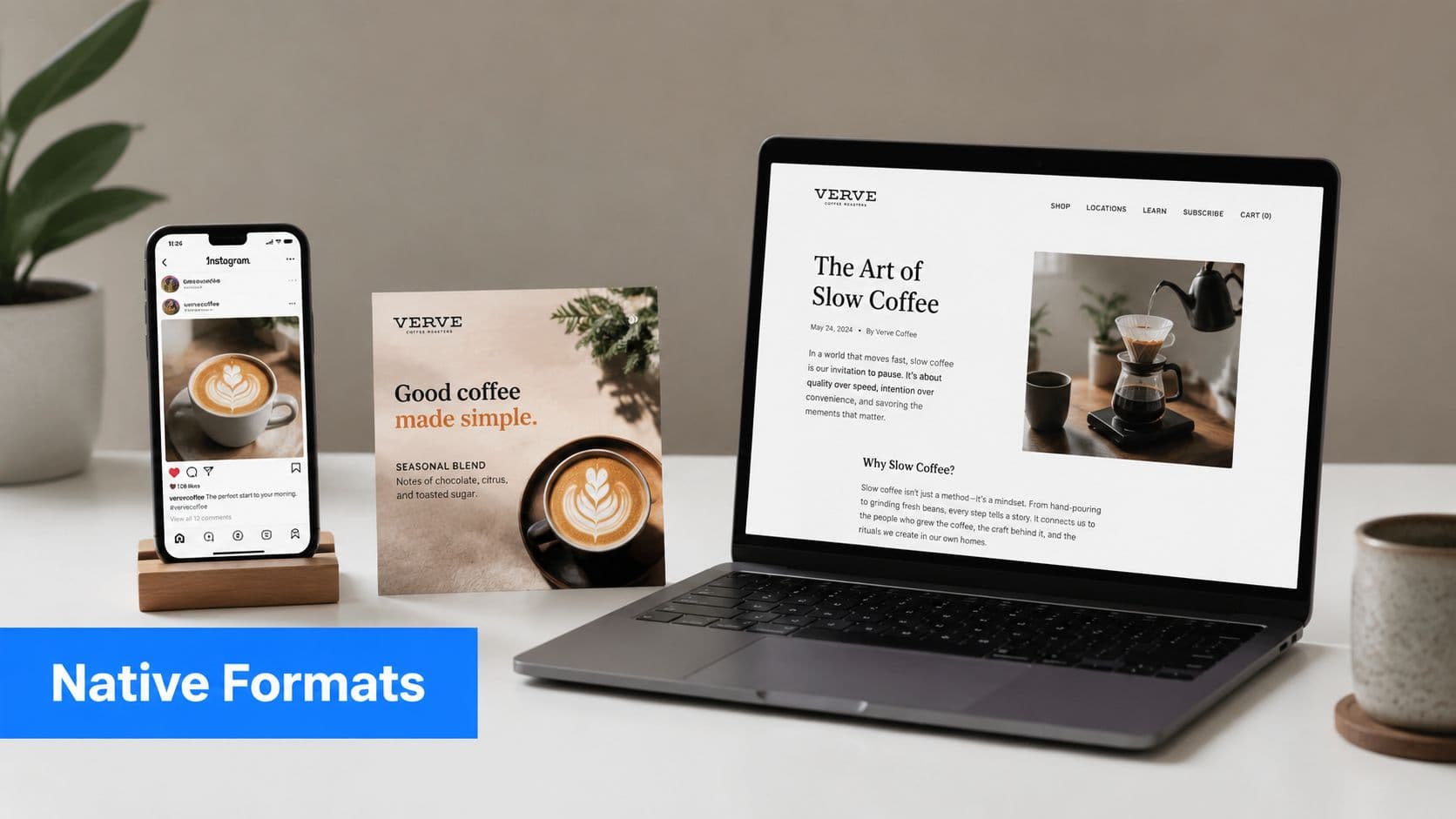
For visual planning, keep dimensions and layout rules handy:
Match the post to the feed
A strong LinkedIn post can fail on Instagram because it asks people to read too much with too little visual payoff. A TikTok-style hook can feel out of place on LinkedIn if it sounds too manufactured. Reddit punishes overt promotion. Threads often rewards a lighter, more reactive tone.
That means format decisions should happen before publishing, not after poor results.
- LinkedIn: Lead with a point of view, practical lesson, or story with a business angle.
- Instagram: Make the visual carry the first impression, then use the caption to deepen the message.
- Threads and X: Use short bursts, reactions, and sequenced thought.
- Reddit: Write for the community first. Brand mentions should feel earned, not inserted.
When you're sizing visuals and preparing assets, this social media post dimensions guide helps avoid the usual formatting waste.
A quick walkthrough of platform thinking helps here:
One message can travel across networks. The format shouldn't.
4. Implement Hashtag Strategies for Maximum Discoverability
Hashtags still work, but only when they're tied to context. Dumping the same tag bundle under every post is lazy targeting, and platforms are getting better at recognizing that.
The practical use of hashtags is simple: help the right people find the right post at the right moment. That means your hashtag choices should reflect platform culture, audience vocabulary, and topic specificity. A founder post about hiring, a product education post, and a trend reaction shouldn't carry the same tag set.
Build smaller, purpose-based sets
A few curated hashtag groups are generally more effective than a single large list. Keep separate sets for themes like thought leadership, tutorials, product updates, industry commentary, and community participation. Then edit them before posting.
Useful rules:
- Use relevance first: If the tag doesn't match the post, skip it.
- Mix broad and narrow language: Pair category tags with more specific topical tags.
- Refresh often: Retired campaigns, stale trends, and repetitive bundles make posts look automated in the wrong way.
A clean primer on terminology and use cases is PostOnce's guide on what a hashtag is and how to use it. If your strategy includes paid distribution on Meta, Keywordme's guide to Meta ads is a good companion because it helps separate organic discovery tactics from paid targeting decisions.
Hashtags should narrow discovery, not decorate the caption.
The best sets usually come from active posting and ongoing observation, not a spreadsheet you made once and never touched again.
5. Engage Authentically with Your Audience
Social media punishes brands that only broadcast. People can tell when an account is there to extract attention instead of participate.
The strongest engagement habit is also the least glamorous: reply well. Not fast for the sake of appearances, but clearly, specifically, and like a real person. If someone asks a product question on LinkedIn, answer it directly. If a customer shares a result on Instagram, acknowledge the context instead of pasting a canned thank-you.

Treat comments like market research
Comments, DMs, quote posts, and replies tell you how people interpret your content. That's often more useful than the post itself. If several people ask the same question, you've found your next educational post. If they push back on wording, you've found a positioning problem.
Here are habits that work:
- Answer the question: Don't redirect people to a homepage when a short reply would solve it.
- Continue the thread: Ask one follow-up question when a comment opens a useful conversation.
- Show your operators: Founder, marketer, support lead, or product person. Human presence changes the tone.
Authentic engagement also means leaving your own feed. Comment on partner posts, respond in relevant communities, and support creators in adjacent spaces. Visibility grows faster when your account participates in the ecosystem instead of waiting to be discovered.
6. Analyze Data and Adapt Your Strategy
A lot of social advice stops at "increase engagement." That's not enough anymore.
Consiglieri's guidance on linking social activity to business growth argues that teams shouldn't limit measurement to engagement and reach, and should connect social performance to brand-building and performance goals through a clearer framework in its article on connecting social interactions to business growth. That's the right mindset. Likes tell you something. They don't tell you enough.
Track the metrics that match the job
Every post has a job. Some posts build reach. Some earn saves. Some create clicks. Some start sales conversations. If you judge all of them with one metric, you'll optimize toward the wrong behavior.
Start simple:
- Awareness posts: Watch reach, profile visits, shares, and branded search lift in your own reporting.
- Consideration posts: Watch clicks, replies, saves, and time spent with linked content.
- Conversion-oriented posts: Watch leads, demo requests, signups, or downstream pipeline markers.
Measurement lens: More posting isn't the goal. Better attribution is.
Cross-platform comparison matters too. If LinkedIn drives qualified conversations and Instagram drives lightweight engagement, that's not a failure. It's role clarity. Build your reporting around what each platform contributes, then use a social media report analysis process to decide what gets repeated, revised, or retired.
7. Build and Nurture Your Email List Through Social
Social reach is rented. Your email list is owned access.
That's why some of the best social network marketing tips have nothing to do with staying on-platform forever. A smart social strategy regularly moves interested followers into an email flow where you can teach, sell, and follow up without depending on algorithm changes.
Use social content to create the handoff
The handoff works best when the offer fits the post. A how-to carousel can lead to a deeper checklist. A founder thread can lead to a weekly operator newsletter. A product explainer can lead to a setup guide or template.
Good examples include:
- Creator workflow posts: Offer a swipe file or planning template.
- Service business posts: Offer a consultation checklist or audit framework.
- SaaS education posts: Offer onboarding emails, a mini-course, or use-case breakdown.
The bridge matters. Don't post "join my newsletter" with no context and expect traction. Give people a reason that matches what they just consumed. The stronger the topical alignment, the cleaner the conversion path.
For teams polishing this channel after signup, Mailgenius explains email subject line capitalization, which is a small but useful reminder that the handoff doesn't end at the opt-in form. The email experience has to feel as intentional as the social post that earned the click.
8. Collaborate with Influencers and Complementary Creators
Partnerships work when the audience overlap is real and the format benefits both sides. They fail when brands chase borrowed reach without a shared angle.
A useful collaboration doesn't need celebrity scale. It needs trust, relevance, and a clear reason for both audiences to care. For a SaaS brand, that could mean a workflow demo with a creator who teaches operations. For a local business, it could mean a joint live session with a complementary service provider. For a B2B consultant, it might be a co-written LinkedIn post with another operator in the same buying journey.
Pick fit over fame
The strongest creator partnerships usually come from adjacent credibility, not generic exposure. If someone already speaks to the people you want to reach, and your offer provides real help to that audience, the collaboration feels natural.
A practical evaluation lens:
- Audience match: Do they speak to the same buyer, creator, or customer group?
- Content fit: Can you produce something useful together, not just promotional?
- Trust signal: Does their community respond to them?
What doesn't work is rigid scripting. Give collaborators a clear goal, guardrails, and key points, then let them speak in their own voice. Audiences notice when a creator sounds like they were handed legal copy.
The best collabs also create reusable assets. One live session can become short clips, a quote graphic, a recap post, and an email segment.
9. Create and Promote Valuable, Educational Content
Educational content is still the most dependable way to earn attention without sounding desperate for it.
People follow accounts that help them do something better, faster, or with fewer mistakes. That applies whether you sell software, consulting, courses, physical products, or local services. If your posts repeatedly solve small problems, people start trusting you with bigger decisions.
Teach what your buyers ask about
The easiest source of educational content is already inside your business. Pull from support tickets, sales objections, onboarding friction, customer calls, and recurring misconceptions. If someone asks a question twice, it's probably content. If your team explains the same thing every week, turn it into a post series.
Formats that work well:
- Step-by-step text posts: Strong on LinkedIn and Threads when the topic is practical.
- Carousels and graphics: Useful for frameworks, comparisons, and visual explanations.
- Short videos: Best for demos, walkthroughs, reactions, and quick clarifications.
Teach the problem before you pitch the product.
What doesn't work is "educational" content that hides a sales pitch in every sentence. Audiences can spot bait instantly. Lead with actual usefulness. Then, when relevant, show how your product fits into the workflow.
For PostOnce, that means teaching teams how to repurpose intelligently, schedule consistently, and compare platform results. The product becomes more compelling when the strategy is already clear.
10. Maintain Consistent Branding and Develop a Content Calendar
Consistency is what makes all the earlier tips visible over time. Without it, even strong posts feel accidental.
Brand consistency doesn't mean every post should look identical. It means people should recognize the account behind the content. That comes from a stable voice, a repeatable visual style, and clear message boundaries. Your LinkedIn post, Instagram carousel, and Threads reply can all look native to the platform while still feeling like the same brand.
Plan enough to stay consistent, not so much that you go rigid
The best content calendars are structured but not overstuffed. They give the team a repeatable cadence for educational posts, product updates, opinion pieces, community engagement, and campaigns, while leaving room for timely reactions.
A practical calendar often includes:
- Core recurring themes: Education, proof, personality, promotion, and conversation.
- Batch creation windows: One session for drafting, one for design, one for scheduling.
- Flexible space: Reserved room for trends, launches, and breaking opportunities.
Digital Agency Network's guidance on marketing gaps emphasizes alignment, performance analysis, and execution fit, which maps directly to social planning in its article on gap marketing strategy. In practice, most social inconsistency comes from broken process, not a shortage of ideas.
If you're running multiple channels, automation is most vital. A content calendar without a distribution engine still leaves your team doing manual work at the worst possible time: right before publishing.
10-Point Social Network Marketing Comparison
| Strategy | 🔄 Implementation complexity | ⚡ Resource requirements | 📊 Expected outcomes | 💡 Ideal use cases | ⭐ Key advantages |
|---|---|---|---|---|---|
| Leverage Cross-Platform Content Repurposing | Moderate, requires adaptation rules per platform | Low–Medium, one core asset + repurposing tools | Broader reach and higher ROI on content | Small teams, solo creators, limited content budgets | Saves time, ensures consistent messaging |
| Optimize Posting Schedules and Timing | Moderate, needs testing and analytics | Low–Medium, scheduling + analytics access | Improved visibility and higher engagement rates | Time-sensitive campaigns, global audiences | Maximizes algorithmic reach, improves engagement |
| Create Platform-Specific Content Formats | High, multiple native formats to produce | High, design, video editing, format conversion | Stronger engagement and authenticity per network | Brand campaigns, platform-first strategies | Native feel, better algorithm performance |
| Implement Hashtag Strategies for Maximum Discoverability | Low–Moderate, ongoing research and refinement | Low, research tools and monitoring | Increased discoverability and targeted reach | Organic growth on Instagram/TikTok, niche communities | Low-cost reach boost, builds topical relevance |
| Engage Authentically with Your Audience | Moderate–High, continuous human effort | Medium–High, community managers, moderation | Higher loyalty, retention, and word-of-mouth | Service brands, community-driven businesses | Builds trust, provides direct customer insights |
| Analyze Data and Adapt Your Strategy | High, requires analytics skills and processes | Medium–High, analytics tools, time for review | Data-driven improvements and optimized ROI | Scaling teams, performance-focused initiatives | Enables informed decisions, identifies top performers |
| Build and Nurture Your Email List Through Social | Moderate, funnel and lead magnet setup | Medium, email platform, landing pages, incentives | Owned audience with higher conversion potential | Ecommerce, course creators, long-term sales funnels | Direct channel independent of algorithms, higher conversion |
| Collaborate with Influencers and Complementary Creators | Moderate, partner identification and agreements | Variable, budget or barter, outreach effort | Access to new audiences and credibility gains | Product launches, niche audience expansion | Rapid reach growth, social proof via endorsements |
| Create and Promote Valuable, Educational Content | Moderate–High, requires expertise and planning | Medium–High, research, production, time investment | Authority building, sustained organic traffic | Thought leadership, lead generation strategies | Long-term value, shareability, trust-building |
| Maintain Consistent Branding and Develop a Content Calendar | Moderate, upfront brand development and planning | Medium, design assets, calendar tools, team coordination | Strong brand recognition and consistent publishing | Multi-channel brands, agencies, growing teams | Cohesive identity, reduced decision fatigue, efficient batching |
PostOnce: The Engine for Your Social Strategy
These social network marketing tips only pay off when you can execute them consistently. That's the primary bottleneck for most solo creators, small businesses, and lean marketing teams. They know they should adapt posts by platform, maintain a schedule, test formats, and measure results. What breaks the system is the manual work between "content is ready" and "content is live."
PostOnce closes that gap. It turns one finished piece of content into a repeatable distribution workflow across supported routes for TikTok, Instagram, YouTube, Facebook, LinkedIn, X, Bluesky, Pinterest, and Threads. Availability varies by source/destination pair and post type. Instead of opening every app, rewriting every caption from scratch, and checking every format manually, you create once and let the platform handle the repetitive execution.
That matters because good social strategy isn't about posting the exact same thing everywhere. It's about publishing the same core idea in ways that fit each platform. PostOnce supports that workflow directly. You can define cross-posting rules, connect multiple accounts, and maintain a steady presence without rebuilding the process every day. For the exact search intent behind social network marketing tips, that's the practical answer: not more theory, but a system that helps you apply the theory without losing hours.
It also fixes a common operational problem. Teams often batch content well, then fail at distribution because the final step is scattered across tabs, devices, and deadlines. PostOnce centralizes that last mile. You keep the strategic part human. The positioning, creative direction, and audience understanding still come from you. The repetitive publishing work doesn't have to.
As a result, the earlier tips become easier to sustain. Repurposing gets faster because you aren't manually re-posting everywhere. Scheduling gets cleaner because your cadence lives in one workflow. Platform-specific execution improves because formatting doesn't have to be improvised at the last second. Measurement gets more useful because your posting process is consistent enough to compare results across channels.
For creators, it removes drag. For agencies, it reduces operational clutter. For in-house teams, it makes cross-platform publishing less fragile. And for anyone trying to grow with limited time, it replaces daily friction with a process you can trust.
If you want maximum reach with minimum manual effort, PostOnce isn't an add-on. It's the engine. Start cross-posting with PostOnce and turn your social workflow into something you can actually maintain.
If you're tired of rewriting the same post for every platform, PostOnce gives you a cleaner way to publish. Create once, automate cross-posting across your channels, and keep your social presence active without the tab juggling.