


















If your posts are solid but visibility stays flat, the problem usually isn't content alone. It's distribution. That's why PostOnce sits at the center of this workflow: publish once, distribute across multiple platforms, and stop relying on a single feed to do all the work.
Social media teams often encounter a shared obstacle. They watch likes, comments, and follower counts, but they don't have a clean handle on social media impressions, or on the practical levers that increase them without adding hours of manual posting. Good content matters. Consistent placement matters just as much.
A simple rule has guided most of the social programs I've seen work well: create once, distribute deliberately, and measure visibility before judging content quality. If you want a strong breakdown of why content alone isn't enough, this guide on content and distribution is worth reading alongside this one.
Your Guide to Unlocking More Impressions
A lot of low-performing social content isn't bad. It's under-distributed, posted inconsistently, or trapped on one platform while the same audience spends time elsewhere.
That's why impressions matter. They tell you whether your content is being surfaced at all. Before someone clicks, comments, or buys, your post has to appear on a screen. If it never gets served, every downstream metric stays weak.
Why teams get confused by impressions
Newer team members often treat impressions like a vanity number. That's the wrong read. Impressions aren't the finish line, but they are the first sign that distribution is working.
Two posts can have similar engagement totals and mean very different things. One may have earned strong response from limited exposure. Another may have reached lots of screens but failed to hold attention. If you don't separate visibility from response, you can't diagnose what to fix.
Practical rule: First ask, “Did people see it?” Then ask, “Did they care?”
The operational problem behind low visibility
Most brands don't struggle because they lack ideas. They struggle because posting across LinkedIn, X, Threads, Facebook, Instagram, and other channels becomes repetitive fast. Manual cross-posting breaks consistency. Consistency drops impressions over time because fewer posts make it into more feeds.
That's the core opportunity here. A repeatable distribution system gives each post more chances to be seen, and that raises the ceiling for everything else.
What Are Social Media Impressions Really
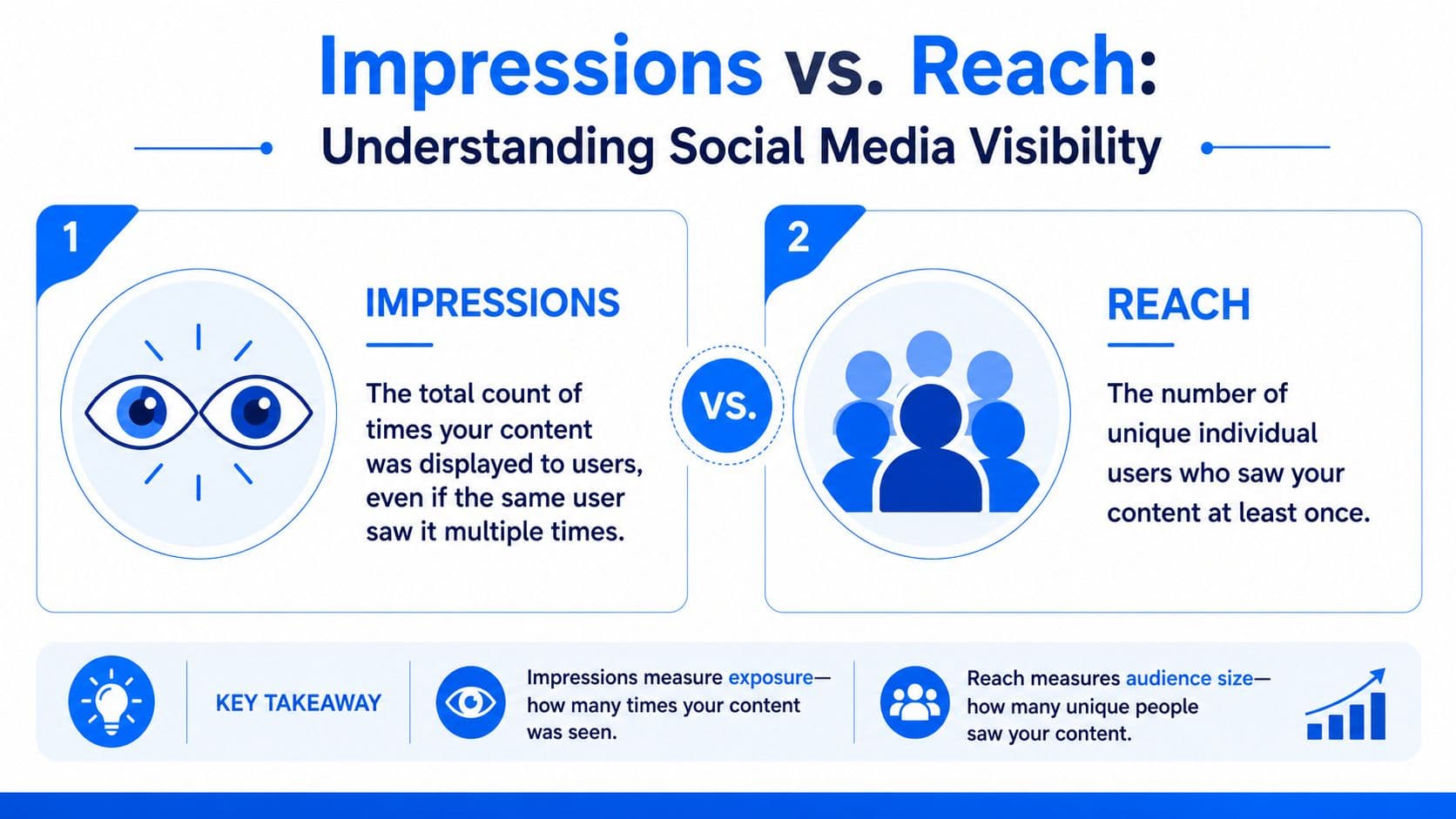
Social media impressions are the total number of times a post appears on a user's screen. The same person can create multiple impressions by seeing the same content more than once. That's the key distinction.
Think of a billboard on a commute route. If one driver passes it in the morning and again in the evening, that's two view opportunities. Social works the same way. A user might see your post in their feed, then again from a reshare, then again on your profile.
For a more platform-specific breakdown of nearby metrics, this comparison of views vs impressions helps clear up another common reporting mix-up.
Impressions vs reach vs engagement
These three metrics belong together, but they do different jobs.
| Metric | What it tells you | Practical meaning |
|---|---|---|
| Impressions | Total displays | How often content was shown |
| Reach | Unique viewers | How many individual people saw it |
| Engagement | Interactions | What people did after seeing it |
Here's the simplest working example. If one person sees your post five times, you have five impressions and one reach. If that person likes and comments, those are engagement actions.
That's why impressions are a visibility metric, not a unique-audience metric.
Why impressions are usually higher than reach
Platforms needed a way to measure exposure across feeds where content can appear more than once. Industry guidance notes that on Facebook, a typical post can generate about 1,500 to 2,500 impressions, while broader channel guidance often places average impressions per post in the 1,000 to 10,000 range for brands with moderate followings, depending on audience size and content quality, according to Umbrex's social media impressions analysis.
Those ranges aren't targets. They're context. They remind you that impressions swing based on platform, account size, posting habits, and whether the content gets picked up for repeated display.
When impressions rise and reach stays relatively constrained, the platform may be showing your content repeatedly to the same cluster of users.
What impressions tell you in practice
Impressions answer a narrow but important question: how much exposure did this content receive?
They do not tell you:
- Who cared most: That comes from engagement patterns and comments.
- How many unique people saw it: That's reach.
- Whether business impact followed: That depends on clicks, conversions, or downstream actions.
But impressions do tell you whether a post got a real chance to perform. Without that signal, it's easy to misjudge a post as weak when it wasn't distributed enough.
Why Impressions Are Your Secret Weapon for Growth
Impressions matter because visibility comes before response. Social teams often obsess over engagement while skipping the earlier question of whether the content was served often enough to compete.
Platforms adopted impressions as a standard metric because they needed to count exposure at scale in algorithmic feeds. A post shown 100 times to the same user counts as 100 impressions and 1 reach, as explained in Sendible's overview of social media impressions. That distinction is one reason impressions remain useful in campaign planning and CPM-based advertising.

Impressions support brand recall
People rarely act on the first exposure. They need repeated contact. A single post that shows up multiple times can do more for familiarity than a one-off spike in traffic from a post nobody sees again.
That's especially true for small brands, solo creators, and B2B teams. Buyers often lurk for a long time. They don't announce interest early. Repeated visibility keeps your name in circulation while they decide.
Impressions also act as a diagnostic signal
When a post gets strong impressions but weak interaction, the distribution worked and the message needs work. When a post gets low impressions but strong interaction from the people who did see it, the content may be good but under-served.
That trade-off is what makes impressions useful operationally. They help you separate a content problem from a distribution problem.
If nobody sees a post, you can't draw big conclusions from its engagement.
Why this changes day-to-day execution
Once a team starts treating impressions as an early indicator, content reviews get sharper. You stop asking, “Did this post flop?” and start asking better questions:
- Was the timing wrong
- Did the hook fail
- Was the format weak for that platform
- Did we limit visibility by publishing in only one place
That last question is where scalable workflow matters most.
Boost Impressions Effortlessly with PostOnce
A common visibility problem looks like this. The team publishes a solid post on one network, sees decent response, then moves on. The idea had more reach potential, but nobody had time to rework it for other channels before the moment passed.
Smart cross-posting fixes that bottleneck. Used well, it increases the number of places your content can appear without forcing someone to rebuild every post by hand. PostOnce gives teams a way to do that from one workflow. You can create once and cross-post across multiple social platforms while adjusting the post format for each destination.
Why cross-posting affects impressions
Impressions rise when strong content gets more valid chances to appear in feeds. Cross-posting helps because it expands distribution across the networks your audience already uses.
The key is adaptation.
One idea can become a short text post on X, a more developed take on LinkedIn, a visual carousel on Instagram, and a community-style post on Reddit. That gives the same core message several entry points instead of one. For brands with small teams, that usually matters more than trying to invent a brand-new concept for every channel.
A practical system that scales
The workflow is straightforward:
- Connect your accounts so publishing starts in one place.
- Set posting rules for the channels you use.
- Publish one core idea and let the system send platform-specific versions out.
- Check results by network so you can spot where visibility is strong and where the packaging needs work.
This approach solves a real operational problem. Impression losses often come from workflow gaps, not bad ideas. A good post never gets reused. A caption runs too long for one network. The image crop looks wrong on another. Those small misses reduce reach over time.
Where automation helps, and where it doesn't
Automation handles distribution volume well. It does not replace editorial judgment.
That trade-off matters. If the source post is weak, publishing it everywhere just spreads a weak post further. If the source post is strong, automation helps you get full value from it before the topic cools off.
The teams that get the best results usually split the work like this:
- Automate the repeatable part: publishing the same core idea across several networks
- Adjust for platform fit: caption length, media format, hashtags, and layout
- Review high-potential posts manually: stronger hooks, tighter intros, different visuals, or a sharper CTA where needed
Used this way, cross-posting is not just a time-saver. It's a distribution system. And distribution is often the difference between a post that gets a few impressions and a post that keeps showing up long enough to matter.
More Actionable Tactics to Increase Impressions
Automation handles distribution volume. It won't rescue weak creative or poor execution. If you want more impressions, improve the content that gets distributed.
One useful companion tactic is knowing when paid visibility makes sense. If that's relevant to your workflow, this guide on boosting a post on Instagram covers the mechanics from the paid side.
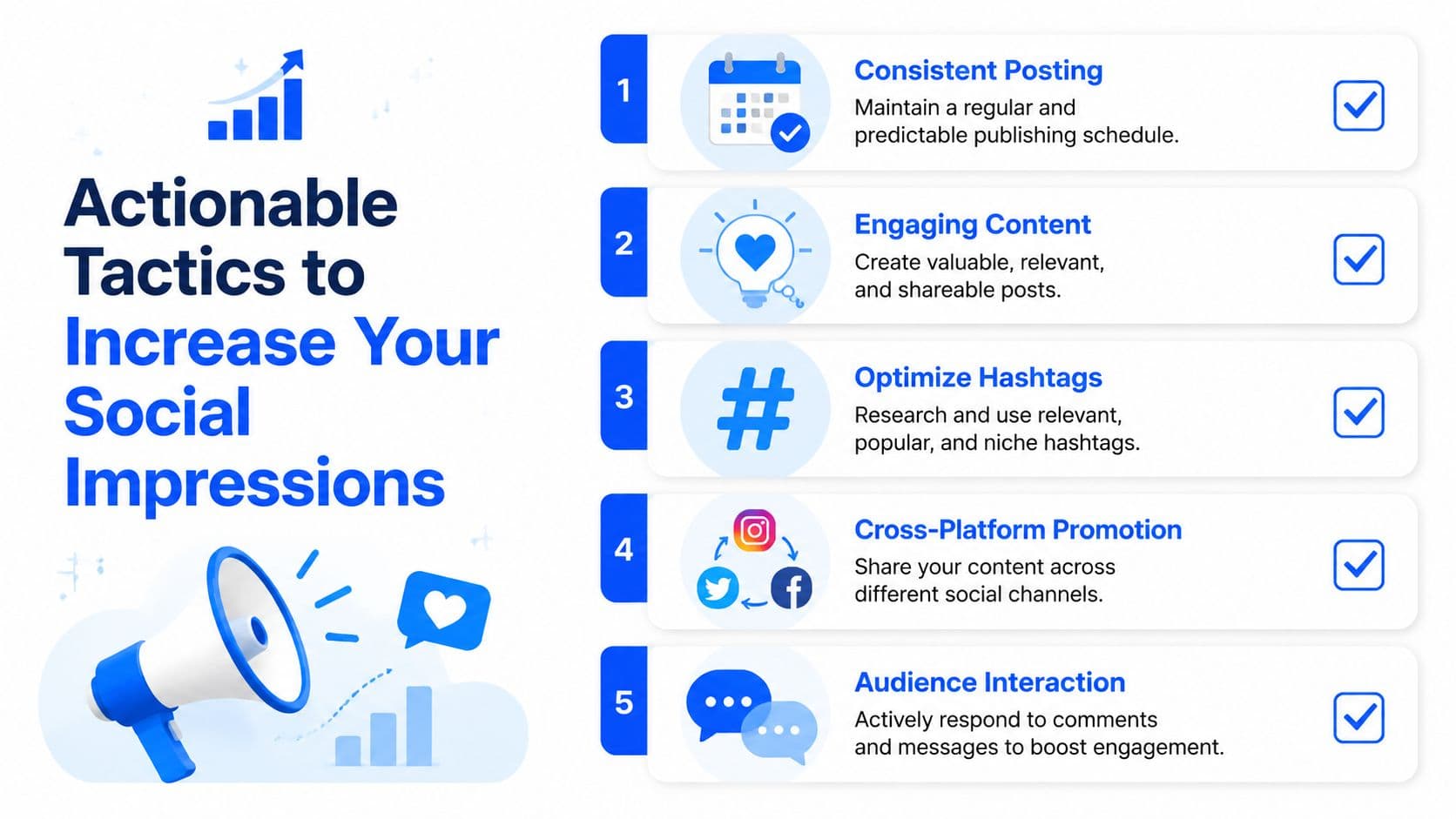
Five levers that tend to move impressions
- Consistency beats bursts: A predictable posting rhythm gives each platform more chances to index and surface your content. Sporadic publishing usually leads to unstable visibility.
- Hooks decide the first second: The opening line has one job. Stop the scroll. If the first sentence is generic, impressions may still come, but attention decays fast.
- Visuals need to earn the space: On image-first and video-heavy platforms, weak thumbnails and cluttered graphics lower the odds of repeated display and shares.
- Hashtags need restraint: Relevant hashtags can help discovery. Overloaded hashtag blocks often read as mechanical and lower clarity.
- Conversation helps distribution: Replying to comments and engaging with related accounts can keep a post active longer than a publish-and-disappear routine.
Measure the quality of your impressions
High visibility alone isn't enough. You also need to know whether each view is doing useful work.
A strong technical benchmark is engagement rate by impressions, calculated as (total engagement ÷ impressions) × 100, as outlined in YouScan's guide to measuring social media engagement. Using impressions as the denominator shows how efficiently visibility turns into interaction.
That's a better lens than raw engagement totals when comparing posts with very different exposure levels.
How to use that formula without overcomplicating reporting
Keep it simple in your review process.
| What you see | Likely interpretation | Next move |
|---|---|---|
| High impressions, low engagement rate | Strong distribution, weak resonance | Rewrite hooks, sharpen angle |
| Low impressions, high engagement rate | Strong content, weak visibility | Improve timing and distribution |
| High impressions, high engagement rate | Good match between distribution and message | Repurpose and reuse the idea |
Teams starting out don't need a complicated dashboard. They need a consistent way to separate being seen from earning interaction.
How to Track and Report Your Impressions
Native analytics are still the first place to check impressions. Instagram, Facebook, LinkedIn, and X all surface visibility data in their reporting areas, even if labels and layouts differ.
The important part isn't just finding the number. It's reading it in context. If you want a broader reporting setup, this social media analytics dashboard guide is a practical next step.
Where to look
Teams can build a reliable review habit with a simple weekly pass through each platform:
- Instagram: Check post-level insights for visibility and compare format types.
- Facebook: Review post performance and separate organic visibility from any paid delivery if you run both.
- LinkedIn: Look at content-level analytics to see which topics and formats get shown most often.
- X: Check per-post analytics to understand which text structures or media choices earn more display.
How to report without misleading yourself
Don't compare raw impression counts across platforms as if they mean the same thing. A text-first network, a video-heavy feed, and a story format don't distribute content in identical ways.
Track trends over time inside each platform first. Then compare patterns, not just totals.
A useful reporting habit is to log:
- Which post type you published
- Where it was distributed
- Whether impressions rose or fell from your recent baseline
- Whether engagement per impression improved
The cleanest reporting question is, “Are we earning more qualified visibility over time?”
Common mistakes
Some reporting errors show up constantly:
- Judging a post too early: Some posts gain visibility over time, especially when comments or reshares extend the life of the post.
- Treating all impressions as equal: Repeated exposure to a narrow audience can mean something different from broad first-time exposure.
- Ignoring distribution choices: If a post went to one network only, lower impressions may reflect workflow limits rather than content quality.
The practical takeaway is straightforward. Impressions show whether your content got seen. Distribution systems increase the odds of that happening consistently. Better creative helps those views turn into action. Good reporting tells you which part needs adjustment.
If you want a simpler way to publish once and keep your content visible across multiple networks, PostOnce gives you a clean cross-posting workflow that reduces manual effort and helps you maintain consistent distribution.