


















Your dashboard says the post is “working.” Impressions are high. The problem is that nothing downstream looks healthy. Comments are thin, clicks are weaker than expected, and the content that looked like a win in one app barely registers in another.
That’s exactly where a cross-posting workflow becomes either an advantage or a trap. PostOnce solves the operational side of that problem by distributing one piece of content across multiple networks without the usual copy-paste mess. But automation only helps if you know which signals matter. If you confuse visibility with attention, you scale the wrong thing faster.
Views vs impressions is one of the most misunderstood gaps in social media reporting. It’s also one of the most useful once you stop treating both numbers as proof of success. The difference tells you whether your content is merely appearing or actively earning attention.
Stop Guessing Your Social Media Impact
Many encounter the same challenge. A post reaches plenty of feeds, but the audience doesn’t stop. That creates the illusion of momentum while actual engagement stays flat.
The fix usually isn’t “post more.” It’s better measurement. If you don’t separate passive exposure from active attention, you’ll keep optimizing the wrong creative, the wrong format, or the wrong platform.
That’s why I push people to simplify their reporting before they expand distribution. A clean framework matters more than another dashboard tab. If you need a broader lens on what metrics connect to outcomes, PostOnce has a useful guide on social media metrics that matter.
For teams that also need help connecting channel performance to business results, practical strategy support like marketing consulting services for real ROI can help translate reporting into decisions instead of vanity recap slides.
Practical rule: If a metric can rise while revenue intent stays flat, it’s a directional signal, not proof of performance.
What usually goes wrong
A lot of social reporting fails for three reasons:
- Too much platform trust: Teams assume a “view” means the same thing everywhere. It doesn’t.
- Too much volume focus: High distribution gets treated as quality, even when people keep scrolling.
- Too little diagnosis: Marketers see weak results and change everything at once, so they never learn whether the issue was hook, audience fit, or packaging.
What the useful question looks like
Don’t ask, “Did this post get seen?”
Ask two better questions:
- Did the platform deliver it?
- Did people choose to engage with it?
That distinction sounds basic. In practice, it changes your content decisions, your reporting cadence, and how you judge success across LinkedIn, Instagram, X, Reddit, and everything else in your mix.
The Foundational Difference Between Views and Impressions
A post can rack up distribution and still fail to hold attention. That gap is the difference between impressions and views, and it changes how smart teams diagnose content performance.
An impression means the platform served the content. A view means a person stayed with it long enough to register some level of intent under that platform’s rules.
That sounds simple, but the strategic use is where teams usually miss the mark. Impressions answer a delivery question. Views answer an attention question. If impressions are strong and views stay weak, the platform did its part and the content did not. If both are weak, the problem is usually distribution, audience fit, timing, or packaging.
Impressions measure delivery
Impressions tell you how often content appeared on screen. They are useful for judging reach, frequency, and whether the algorithm gave your post a chance.
They are also easy to overvalue.
A high impression count can come from repeat exposure to the same users, passive feed placement, or autoplay environments where people keep scrolling. That makes impressions a good signal for distribution analysis, not a reliable proxy for message absorption.
Views measure attention
Views set a higher bar. The exact threshold depends on the platform and format, but a view usually requires a stronger action than simple display. That might be watch time, post expansion, or another measurable sign that the user paused instead of skimming past.
That is why views are more useful when you need to judge creative strength. They still do not prove persuasion or buying intent, but they are closer to active interest than raw exposure.
The practical takeaway is straightforward. Use impressions to judge whether your content was delivered. Use views to judge whether it earned attention after delivery. That framework helps teams avoid vanity reporting and make better decisions about hooks, creative format, post structure, and audience targeting.
This distinction matters even more when you publish at scale across multiple channels. A strategist can spot the pattern manually for a few posts. A team managing dozens of assets across platforms needs a repeatable system. PostOnce helps by turning these signals into an operating workflow, so you can compare outputs, spot weak attention rates faster, and adjust publishing before wasted distribution piles up.
For a broader measurement framework beyond these two terms, PostOnce covers the content performance metrics that actually guide content decisions.
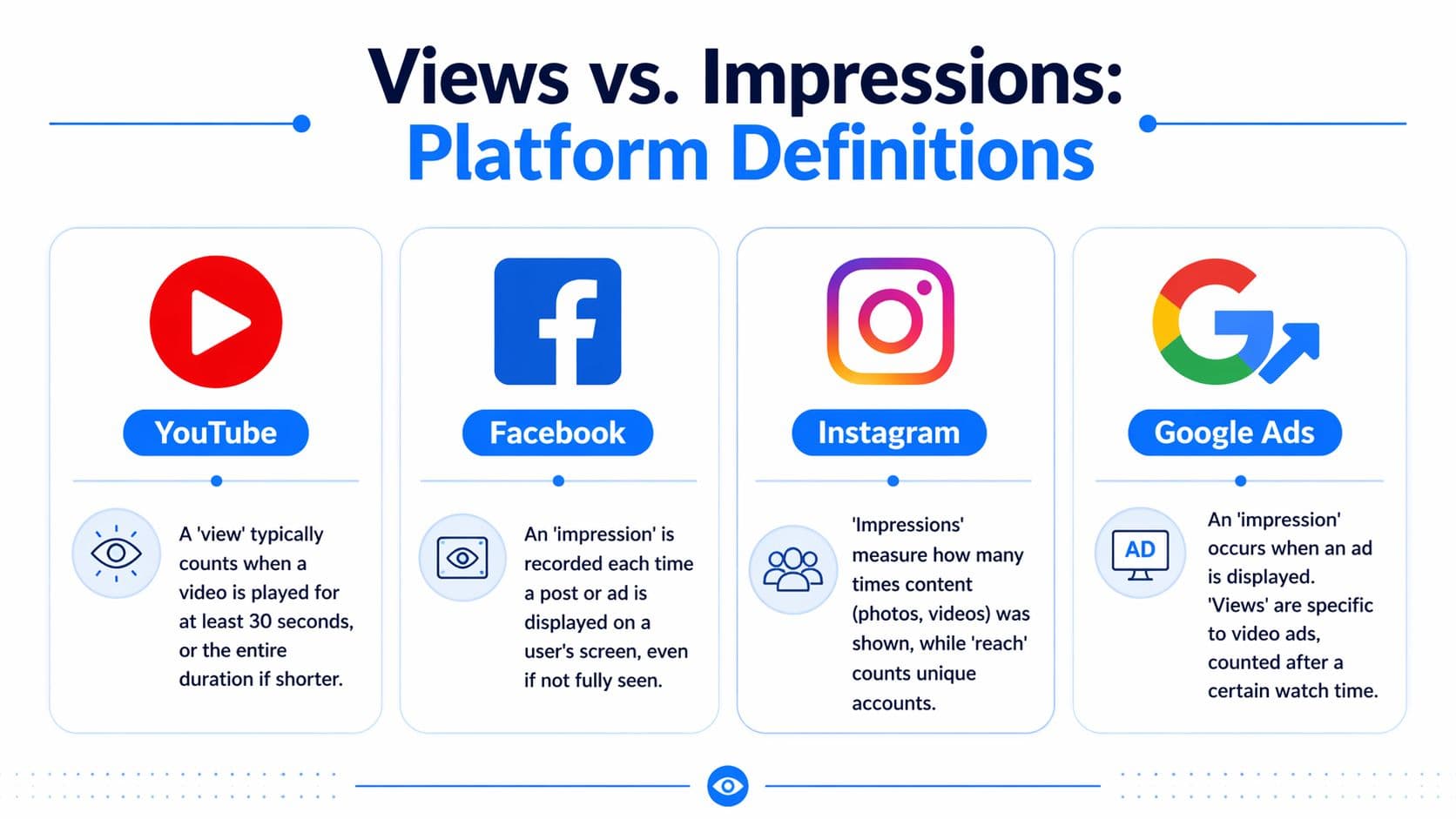
How Major Platforms Measure Views and Impressions
The hardest part of views vs impressions isn’t the definition. It’s the inconsistency.
A view on one platform can represent a quick autoplay threshold. On another, it can represent much stronger intent. If you publish across several networks, direct comparison gets messy fast.
Here’s the simplest way to see it.
| Platform | Impression Trigger | Video View Trigger | Key Consideration |
|---|---|---|---|
| X | Content is displayed | ≥2 seconds with ≥50% of the player visible | Fast-counting video views can make top-line performance look stronger than actual depth |
| Meta (Facebook/Instagram) | Content is displayed | ≥3 seconds, including autoplay | Autoplay can inflate early view counts without strong downstream engagement |
| Content is shown; for posts, impressions can register when shown with required on-screen visibility conditions | ≥3 seconds for video, plus clicks or post expansion can count as views for some post interactions | Professional audiences often reward relevance and clarity more than spectacle | |
| YouTube | Thumbnail or content display context varies by placement | ≥30 seconds, or full video if shorter | A YouTube view usually represents stronger commitment than a short autoplay platform |
The trigger differences above are drawn from MagicLogix’s platform comparison of views and impressions.
Why cross-platform reporting breaks down
Marketers often get misled. They look at one content asset cross-posted everywhere and assume the same “view” means the same audience response. It doesn’t.
A short-threshold platform can make a post look healthy because the bar for counting a view is lower. A stricter platform may show fewer views even when audience intent is stronger.
That’s why I rarely recommend comparing raw view totals across channels in isolation. Compare content within the context of each platform first. Then compare patterns, not just counts.
What this means in practice
For a short-form video clip:
- On X or Meta: Early motion and the first seconds matter because the view threshold is quick.
- On LinkedIn: The opening still matters, but the framing and relevance to a professional audience often determine whether people expand, pause, or keep going.
- On YouTube: The packaging has to earn a much deeper commitment.
This is also why platform-native formatting matters more than people expect. Small changes to visual ratio, headline, caption length, or hook style can affect whether the same idea gets counted as a fleeting display or a legitimate view.
If you work heavily in Instagram reporting, PostOnce has a separate explainer on what impressions mean on Instagram.
Aligning Metrics with Your Strategic Goals
A familiar reporting mistake looks like this. A team sees high impressions, calls the campaign a win, and only later realizes very few people stopped to watch, read, or click. Another team sees modest reach, dismisses the post, and misses the fact that the people who did view it were the right buyers.
The metric has to match the job.

When impressions deserve the spotlight
Impressions matter most when distribution is the objective. That usually means market entry, product launches, event promotion, retargeting support, or any campaign built to increase recognition before asking for action.
In those cases, repeated exposure is part of the strategy. A post can do its job even if engagement is light, because the key question is whether the brand showed up often enough and broadly enough to stay familiar.
That does not mean impressions should stand alone. Pair them with reach, frequency, and branded search lift if you can. Otherwise, teams confuse overexposure with momentum.
When views should lead the report
Views matter more when attention quality affects business results. Educational videos, founder-led thought leadership, product walkthroughs, webinar clips, and lead generation content all fit here. The audience needs to do more than scroll past. They need to spend time with the message.
That is why I treat view rate and downstream actions as stronger decision metrics than raw delivery for mid-funnel work. If people see the post but do not stay with it, the distribution was real, but the message did not land.
A simple rule helps. Use impressions to measure visibility. Use views to measure message pull.
A practical KPI map
Use this framework to set the primary metric before the campaign goes live:
- Brand awareness: prioritize impressions, then check reach and frequency.
- Educational content: prioritize views, completion signals, and saves.
- Lead generation: prioritize views, clicks, form fills, and lead quality.
- Thought leadership: prioritize views, dwell signals, comments, and profile actions.
- Performance campaigns: prioritize efficient attention and conversion behavior, not cheap exposure.
This logic applies outside social too. Anyone working through setting the right bid for your Amazon PPC campaigns is solving the same problem. Visibility has value, but intent is what pays.
Turn the metric choice into an operating system
Strong teams separate reporting from execution. Picking the right KPI once is easy. Applying that logic across LinkedIn, Instagram, X, Facebook, Threads, YouTube, and short-form video every week is harder.
That is why teams benefit from a social media analytics dashboard for cross-platform reporting. It gives you one place to track which posts were built for awareness, which were built for attention, and whether each one met its goal. PostOnce makes that process workable at scale by reducing the manual overhead that usually turns metric alignment into a spreadsheet problem.
What to avoid
Do not force one favorite metric onto every campaign. Awareness posts get judged too harshly when teams expect view depth from top-of-funnel content. Lead-gen posts get too much credit when teams celebrate impressions that never turned into qualified action.
Set the business question first. Then choose the metric that answers it. That shift is what moves a reporting process from vanity metrics to strategy.
PostOnce The Smart Solution for Cross-Platform Metrics
A team posts the same campaign across five networks. By Friday, reporting is a mess. One platform shows strong reach, another reports views on a different threshold, and a third makes the post look weak even though it drove the best click quality. Without a consistent publishing and reporting process, teams end up arguing about definitions instead of improving performance.
PostOnce solves the execution problem behind that confusion. It gives teams one workflow for publishing across multiple platforms, so cross-platform analysis starts from a cleaner baseline. That matters because bad process creates bad interpretation. If captions, formats, and posting timing vary randomly from channel to channel, views and impressions stop being useful diagnostic signals.
The practical advantage is simple. Teams spend less time resizing assets, rewriting posts from scratch, and jumping between native apps. They get more time to compare outcomes with context. Was the Instagram version underperforming because the hook was weak, or because the asset was rushed into the wrong format? Did LinkedIn generate fewer views because the topic missed, or because the opening line was trimmed poorly during manual reposting? Clean execution makes those questions easier to answer.
I have seen this pattern repeatedly with in-house teams and agencies. Manual cross-posting creates small inconsistencies that snowball into reporting noise. Automation removes a lot of that noise.
PostOnce is strongest when teams use it as an operating layer, not just a scheduler. The point is not only to publish faster. The point is to standardize how content gets adapted, distributed, and reviewed so performance differences between platforms are easier to trust. That is how teams move from vanity metrics to action. They can spot whether a post needs a better hook, a different creative treatment, or a platform-specific rewrite instead of guessing based on messy data.
For teams that need a central reporting view after publishing, PostOnce also pairs well with a social media analytics dashboard for cross-platform reporting. That combination helps separate distribution issues from content issues, which is the primary objective here.
Some brands also bring in outside support for channel strategy, creative testing, or paid amplification through partners such as the UpwardEngine homepage. That can help. But even strong strategy breaks down if the publishing workflow is inconsistent across channels. PostOnce keeps execution tight enough for the metrics to mean something.
Common Pitfalls and How to Optimize Your Content
Most underperforming posts don’t fail because the algorithm “hates” them. They fail because the content loses the audience at the moment of decision.
That moment is small. A glance, a half-second judgment, the first line of a caption, the opening seconds of a video, the strength of the thumbnail, the relevance of the topic. That’s where impressions turn into views, or don’t.
Diagnosing the real problem
One of the clearest frameworks comes from EvergreenFeed’s guide to views vs impressions: if you have healthy impressions but weak views, the issue is likely content mismatch, especially the hook or audience fit. If both impressions and views are weak, distribution or targeting is the more likely problem.
That distinction saves a lot of wasted effort.
If impressions are healthy, don’t start by changing posting frequency or assuming the platform is suppressing you. The platform already delivered the content. People just didn’t choose it.
What to change first
Start with the packaging layer.
- Opening hook: The first line or first visual frame needs to create immediate relevance.
- Creative framing: A strong idea can still die behind a vague headline or weak thumbnail.
- Audience fit: Some posts are fine content for the wrong feed.
- Format choice: A static graphic, short clip, text post, or carousel can change how quickly intent shows up.
A lot of teams over-edit the body of the content and under-edit the entrance to the content. That’s backward.
A practical optimization loop
Use a small testing cycle instead of a full content reset.
- Keep the core idea fixed. Don’t change the topic, format, caption, and visual all at once.
- Test the hook first. If people won’t stop, nothing else matters.
- Adjust platform packaging. The same message may need a different intro line on LinkedIn than on Instagram or Reddit.
- Review view behavior before engagement totals. Likes and comments come later. Attention comes first.
Field note: A post with modest reach and strong attention is easier to improve than a widely served post nobody wants.
Mistakes that show up again and again
Here are the common ones I see:
- Recycling the exact same opener everywhere: Cross-posting saves time, but the same first line doesn’t fit every feed.
- Treating autoplay as proof of interest: A counted view can still be shallow.
- Fixating on impressions alone: Distribution is useful. It is not a verdict.
- Ignoring audience intent: Educational posts, opinion posts, and promotional posts trigger different stopping behavior.
- Changing strategy too fast: One weak post doesn’t invalidate the format. It may only invalidate the packaging.
If you want a deeper workflow for improving post structure, hooks, and presentation, PostOnce has a good resource on content optimization strategies.
Frequently Asked Questions
| Question | Answer |
|---|---|
| Are views better than impressions? | Not universally. Views are better when you need evidence of attention. Impressions are better when your goal is awareness and repeated exposure. |
| Why are my impressions high but my views low? | That usually points to a mismatch between the content and the audience’s immediate interest. The post is getting delivered, but the hook, framing, or format isn’t earning attention. |
| Can views ever be higher than impressions? | Yes, in some video-heavy contexts, views can exceed impressions because replays may count as additional views. |
| Can I compare view counts directly across platforms? | Not cleanly. Platforms use different thresholds for what qualifies as a view, so raw counts can create false comparisons. |
| Do non-video posts have views? | Sometimes, depending on the platform. Some platforms count views through actions like clicks or post expansion rather than video watch behavior alone. |
| What should I optimize first if performance is weak? | Diagnose whether the issue is delivery or packaging. If impressions are healthy, start with the hook, format, and audience fit. If both impressions and views are weak, revisit distribution and targeting. |
If your team is publishing across multiple networks, the hard part isn’t just posting more. It’s keeping distribution efficient while reading performance correctly. PostOnce helps you create once, cross-post automatically, and spend more of your time improving the content that earns attention instead of manually pushing the same asset into every platform.