


















Posting manually across multiple social networks is not a growth strategy. PostOnce automates only supported source/destination pairs and post types. It is a repetition problem. PostOnce solves that problem at the source by turning one piece of content into an automated multi-platform distribution workflow instead of another item on your daily checklist.
That matters because the audience is fragmented. As of 2026, social media includes approximately 5.17 billion users worldwide, and users visit an average of 6-7 social media platforms per month, which makes manual multi-platform publishing hard to sustain at any real scale (Hootsuite social media statistics). If you are still copy-pasting the same post into multiple apps, you are spending energy on the least valuable part of the job.
Many individuals searching for a content scheduler for social media think they need a calendar with time slots. In practice, they usually need something broader. They need a system that publishes consistently, adapts content to each network, and removes the friction that causes missed posts and half-finished campaigns.
That shift changes how you work. You stop asking, “When should I schedule this?” and start asking, “How do I distribute this once, properly, everywhere it belongs?” If you need a broader framework around planning and channel priorities, this practical guide to social media marketing for small businesses is a useful companion read.
The operational payoff is straightforward. Fewer tabs. Fewer rewrites. Less context switching. A cleaner pipeline from idea to published post. For teams that want to reduce that daily drag, this walkthrough on improving workflow efficiency is worth bookmarking: https://postonce.to/blog/how-to-improve-workflow-efficiency
Stop Wasting Time and Start Growing with Smart Automation
A lot of social workflows break in the same place. Content gets created, but distribution happens late, inconsistently, or not at all.
One day you remember to post on LinkedIn. The next day you adapt the same idea for Threads but skip Reddit because the format needs work. By Friday, your calendar looks active in theory and chaotic in reality. That is the hidden cost of manual posting. Not just time lost, but momentum lost.
Why manual publishing stalls growth
Manual posting sounds manageable when you only have one account. It starts to fail when you are balancing:
- Different platform rhythms that reward different posting habits
- Multiple content formats such as short text, visual posts, documents, and discussion posts
- Context switching between apps, drafts, and media folders
- Inconsistent follow-through when publishing depends on memory and spare time
A basic scheduler helps with timing, but timing alone does not solve the bigger workflow issue. If the system still depends on you to rewrite captions, resize assets, and remember destination-specific tweaks, you have only automated the last click.
What smart automation changes
A modern setup handles more than the publish button. It lets you create once, define rules, and distribute without redoing the same work on every network.
That is the practical difference between a traditional scheduler and a true automation workflow. The first stores posts on a calendar. The second removes manual repetition from the publishing chain.
Tip: If your current tool still leaves you doing platform-by-platform cleanup before every post goes live, it is not saving enough time to justify the process.
The primary goal is not just to “stay consistent.” It is to build a workflow you can maintain when workload rises, platforms expand, or campaign volume increases.
Understanding Social Media Schedulers From Basic to Advanced
A social media scheduler starts simple. It functions much like an alarm clock for content. You decide what gets posted and when, then the tool handles the release.
That is useful, but it is only the first stage.
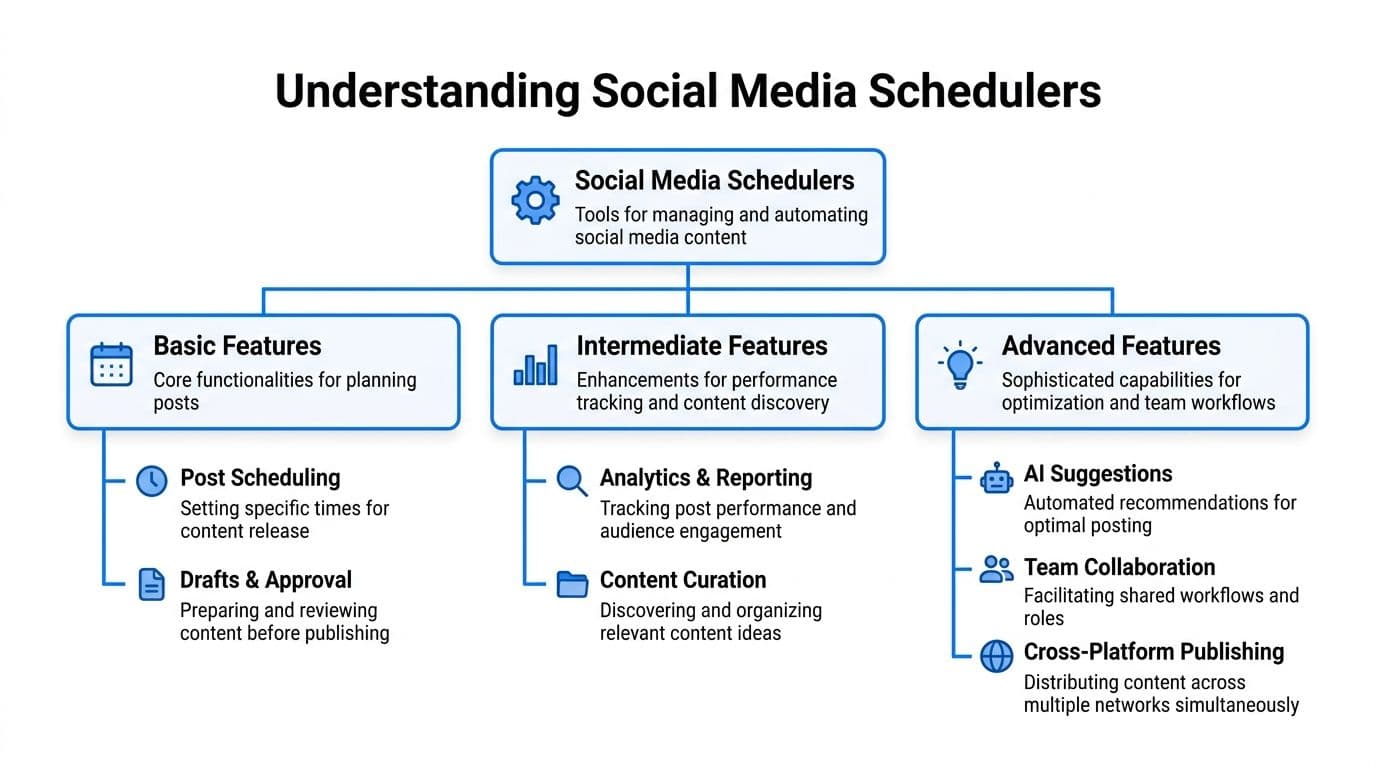
The three levels of scheduling maturity
Tools generally fit into one of three buckets.
| The Evolution of Social Media Management | Outcome |
|---|---|
| Level 1: Manual Posting (High Effort, Low Consistency) | Every post requires direct action, and consistency usually slips |
| Level 2: Basic Scheduler (Medium Effort, Medium Consistency) | Timing improves, but adaptation and distribution still need manual work |
| Level 3: Automation Platform (Low Effort, High Consistency & Reach) | Publishing, cross-posting, and distribution rules reduce repetitive work |
The jump from level two to level three is where most gains happen. A basic scheduler helps you queue posts. An automation platform helps you run a repeatable distribution system.
What basic and intermediate tools do well
Tools like Buffer, Later, and Hootsuite are useful when your main need is calendar visibility. They typically help with:
- Post scheduling for fixed publish times
- Draft management so content is prepared in advance
- Approval steps for teams that need review before publishing
- Analytics dashboards to see what performed after the fact
Those features matter. For many teams, they are enough for a while.
But they also have a common limit. They assume the work begins after you write the post, when in reality the hard part is often adapting that post for every channel you use.
What advanced platforms do differently
Advanced systems move from “schedule this post” to “distribute this content.” That includes cross-platform publishing, rule-based automation, and network-specific adjustments.
Some tools also layer in AI suggestions, send-time optimization, and workflow controls. That broader category is closer to what many individuals need when they search for a content scheduler for social media. If you want a closer look at how these platforms compare, this overview is a useful reference: https://postonce.to/blog/social-media-scheduler
Key takeaway: A scheduler manages time. An automation platform manages time, distribution, and format friction together.
Practical Benefits of Automating Your Social Media
The benefits become obvious the moment you stop treating publishing as a daily task and start treating it as a system.

A 2026 analysis of over 52 million posts found that creators using schedulers save an average of 5 hours per week, and scheduled posts published at optimal times generate 40% more engagement than posts published arbitrarily (EvergreenFeed content scheduler research). Those two outcomes matter together. The time savings are useful on their own, but the bigger win is that automation creates room for better execution.
Time goes back into better work
Most manual workflows waste time in small chunks. Logging in. Copying captions. Adjusting hashtags. Fixing formatting. Re-uploading images. None of that is strategic work.
With automation, that effort shifts from daily repetition to periodic planning.
- Batch once, publish repeatedly instead of interrupting every day
- Focus on content quality because distribution is not eating your attention
- Reduce last-minute posting that usually leads to weaker copy and sloppy formatting
That is how a content scheduler for social media stops being a convenience and becomes an operations tool.
Consistency improves even when life gets busy
Teams often overestimate their ability to “just stay on top of it.” They are consistent until launches, client work, meetings, travel, or plain fatigue get in the way.
Automation protects your baseline. Your accounts keep publishing even when your schedule does not cooperate.
A practical example: instead of spending part of every afternoon pushing posts live, you spend one focused session building the week. The content goes out on time, and you use the reclaimed space for replies, creative work, or campaign refinement.
Here is a solid visual walkthrough of that shift in action:
Better timing without guesswork
Manual posting tends to happen when you are free, not when your audience is active. Those are rarely the same thing.
Automation lets you align publishing with stronger windows instead of convenience. That matters on networks where the first burst of visibility affects downstream reach. Once that process is scheduled, your attention can move to comments, conversations, and follow-up content rather than babysitting the clock.
Tip: The most effective automation setups separate creation from publishing. Write when you are focused. Publish when your audience is active.
Burnout drops because the system carries the load
This is the least discussed benefit and one of the most important. Publishing manually across several platforms creates low-level friction all week. It is hard to measure, but easy to feel.
A good automated workflow removes that mental clutter. You stop carrying a constant background task list of posts that still need to be pushed live.
Evaluating Schedulers What to Look For in 2026
Choosing a tool in 2026 is less about whether it can schedule posts and more about where it removes friction. Most platforms can put content on a calendar. Far fewer can handle the messy parts that slow a team down.
Start with the workflow, not the feature list
The wrong buying process starts with a checklist of generic features. Calendar. Analytics. Bulk upload. Approval flow. Most tools will tick those boxes.
The better approach is to ask where your process currently breaks.
If your team struggles with missed posts, a basic scheduler may help. If your team struggles with rewriting the same content for multiple networks, you need stronger cross-posting logic. If your campaigns perform unevenly because timing is based on habit, you need a platform that recommends publish windows intelligently.
The capabilities that matter most
Here is the short list I would use when evaluating any content scheduler for social media today.
- Cross-platform support: It should cover the channels you use now, plus newer networks you may add.
- Content adaptation: It should help account for different caption lengths, formatting needs, and publishing norms across platforms.
- Send-time intelligence: The strongest schedulers use predictive modeling that accounts for day-of-week patterns and content-specific engagement windows, and platforms offering this kind of AI-powered send-time optimization typically report 20-40% higher engagement rates compared to manual scheduling (Sprout Social insights on scheduling tools).
- Workflow simplicity: The system should reduce steps, not add another layer of administration.
- Evergreen controls: Recycling matters, but only if you can control how content is reused and where.
- Reporting that informs action: You do not need endless charts. You need enough visibility to decide what to repeat, revise, or stop.
A quick decision filter
| Question | What a strong tool should do |
|---|---|
| Can it publish to multiple platforms from one workflow? | Reduce platform hopping |
| Does it adapt posts for each destination? | Lower manual editing time |
| Can it recommend better publish timing? | Improve performance without guesswork |
| Does it support ongoing content reuse? | Extend the life of strong posts |
| Is the interface easy to maintain weekly? | Prevent the tool from becoming extra work |
A lot of buyers get distracted by long feature pages. The simpler test is operational. If the tool still leaves you doing repetitive cleanup, it is not advanced enough for a modern multi-platform workflow.
One good comparison point for shortlisting options is this roundup of modern scheduler requirements: https://postonce.to/blog/best-social-media-scheduler
Key takeaway: The best scheduler is not the one with the biggest dashboard. It is the one that removes the most recurring manual work.
How PostOnce Solves the Cross-Posting Problem
Most scheduler articles miss the hardest part of multi-platform publishing. The problem is not getting content onto a calendar. The problem is making one idea work across platforms with very different posting rules and formats.
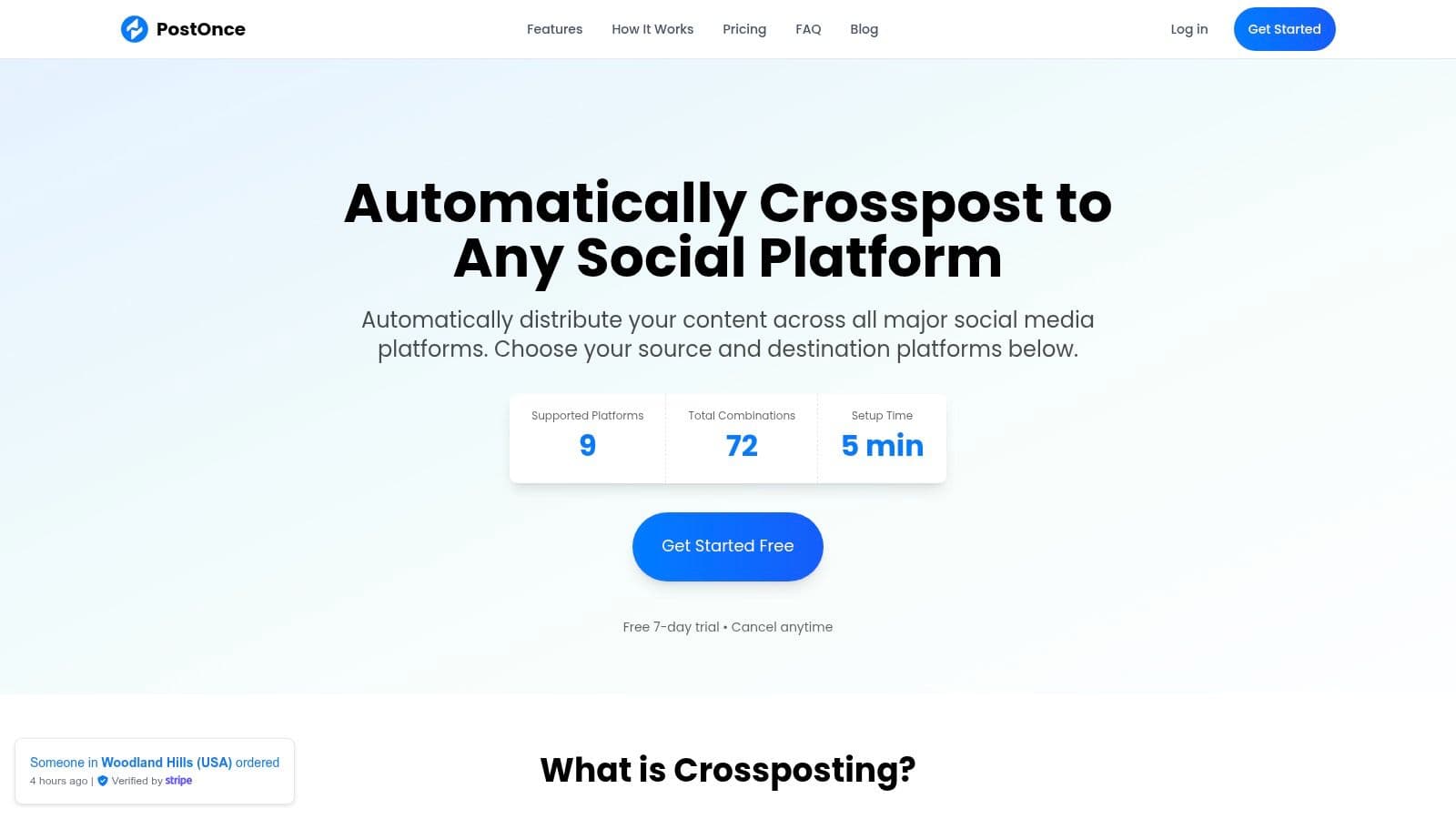
A generic scheduler usually assumes your post is ready once the caption is written. In practice, that is where the extra work starts.
Where traditional schedulers fall short
LinkedIn, Reddit, and Threads do not want the same thing from a post.
Some networks reward concise text. Some punish clumsy hashtag carryover. Some need different image treatments. Some require community-specific handling. That means a “publish everywhere” button can create weak output if the tool is not designed for format conversion.
The gap is well documented. Generic schedulers often create engagement-killing friction because they do not handle format conversion for LinkedIn documents, Reddit community rules, or Threads character limits, and this becomes a major pain point for anyone managing 5+ platforms (MicroPoster scheduler gap analysis).
What this search intent is really asking for
When someone searches for a content scheduler for social media, they usually want one of two things:
- A way to stop posting manually.
- A way to publish one piece of content across several networks without rebuilding it each time.
That second need is the more important one. It is also the one most tools only partially solve.
For that exact use case, PostOnce cross-posting is built around source-to-destination publishing. You create content once, connect destination platforms, and define how distribution should happen. The platform then handles cross-posting and adjusts output to fit each network’s specifications.
How the workflow changes in practice
A practical setup looks like this:
- Create on your primary platform where your first draft feels most natural
- Set cross-posting rules for the destinations you care about
- Let the system adapt formatting rather than manually rewriting every version
- Review exceptions only instead of rebuilding every post from scratch
That last point matters most. Good automation does not mean losing control. It means removing repetitive edits while keeping room for platform-specific judgment when needed.
Tip: The best cross-posting workflow starts with a strong source post. Write the clearest version once, then automate the distribution layer.
This is why the old definition of a scheduler feels too narrow now. The valuable part is not the calendar. It is the automated distribution logic behind it.
Tailoring Your Scheduler Workflow for Maximum Impact
The right workflow depends less on the tool and more on the publishing environment around it. A solo creator has different failure points than a local business. An agency has different risk than either one.
Solo creators who need output without burnout
Solo operators usually do not have a content shortage problem. They have an energy allocation problem.
A practical weekly workflow looks like this:
- Batch your ideas in one sitting. Write short-form posts, repurposed thoughts, and evergreen opinions together.
- Choose one primary publishing channel. Draft where your voice is strongest.
- Set cross-posting rules by platform type. Professional content can go one direction. conversational content can go another.
- Recycle selectively. Do not keep every post in rotation. Reuse only the pieces that remain relevant and still feel fresh.
This is important because evergreen automation can become noisy fast. Many tools offer recycling, but they often ignore audience fatigue from repetition. The key lever is using customizable cross-posting rules so content keeps working longer without making your feed feel stale, especially when your content library is small (EvergreenFeed scheduler analysis).
Small businesses that need consistency and traffic
Small businesses often struggle with irregular posting because social sits between other responsibilities. The owner, marketer, or assistant posts when there is time, not according to a clear system.
A stronger workflow is simpler than many expect:
- Use pillar categories such as offers, proof, education, and behind-the-scenes
- Draft from one brand voice reference so posts stay consistent across channels
- Cross-post with rules rather than manually rewriting every message
- Review weekly performance and keep only the themes that fit business goals
A social workflow then becomes part of operations, not just marketing. It needs to be easy enough to run during busy weeks and structured enough to preserve brand quality.
For teams trying to formalize that process, this workflow guide is useful: https://postonce.to/blog/social-media-management-workflow
Key takeaway: Small businesses do better with simple systems they can repeat than with complex calendars they abandon after two weeks.
Agencies that need control across accounts
Agencies rarely fail because they lack features. They fail because too many small steps add friction across clients.
A workable agency pattern looks more like an assembly line:
| Role | Main responsibility |
|---|---|
| Strategist | Defines channel mix and message priorities |
| Creator | Produces source content and core assets |
| Manager | Applies client-specific rules and approves distribution |
| Analyst | Reviews outcomes and adjusts recurring patterns |
The gain comes from centralizing what should be standardized and isolating what needs client-specific handling.
For agencies, the ideal scheduler workflow usually includes:
- A source-first drafting process so content starts in one controlled place
- Platform rules by client type rather than ad hoc manual edits
- Evergreen pools separated by campaign goal so reuse stays intentional
- A clear exception list for channels like Reddit where heavier customization may still be needed
That kind of workflow keeps the team focused on message quality, approvals, and reporting instead of endless formatting work.
From Scheduler to Strategic Partner
A basic scheduler helps you post on time. That is useful, but it is no longer enough for a serious multi-platform workflow.
The stronger model is an automation system that handles timing, distribution, and platform fit together. That is how teams reclaim time, reduce friction, and keep publishing standards high even as channel count grows.
If your current content scheduler for social media still leaves you copy-pasting, resizing, rewriting, and checking each platform manually, the problem is not your discipline. The tool is too narrow for the job.
The smarter move is to replace scheduling as a task with automation as a system.
If you want to stop treating social publishing like daily admin work, try PostOnce. It is built for create-once, distribute-everywhere workflows, with cross-posting rules that reduce manual editing and make multi-platform publishing easier to sustain.