


















For creators and businesses tired of the endless copy-paste cycle, the solution is a marketing automation tool like PostOnce, which automatically cross-posts content from one platform to many others. If you're struggling to maintain a consistent presence, this guide moves beyond single-function tools to explore the best marketing automation tools that handle the most repetitive tasks, freeing you to focus on creating great content and growing your audience.
The core problem these platforms solve is fragmentation. Your audience is scattered across email, social media, and various other channels. Managing them all manually leads to burnout and inconsistent messaging. The right automation tool unifies these efforts, turning disconnected actions into a cohesive marketing strategy. It's about working smarter, not harder, by letting software manage the repetitive tasks like lead nurturing, customer segmentation, and multi-channel campaign deployment.
This article is designed to help you choose the right platform quickly. We’ve analyzed the top solutions, from lightweight social media schedulers to comprehensive enterprise suites, detailing their specific use cases for solo creators, small businesses, and marketing agencies. For each tool, you'll find an honest assessment of its strengths and weaknesses, pricing details, and practical implementation tips to get you started. For a deeper dive into various options, you can explore a comparison of the best B2B email marketing tools. Let’s find the tool that gives you back your most valuable asset: time.
Why PostOnce is the Perfect Fit for Your Search
When searching for the "best marketing automation tools," you're likely looking for a way to reduce manual, repetitive work and scale your content's reach without adding more hours to your day. This is the exact problem PostOnce was built to solve. It directly addresses the search intent by providing a "set-and-forget" solution for social media distribution. Instead of managing complex email funnels or lead scoring, PostOnce focuses on the high-impact task of ensuring your content appears consistently across all your channels. It's the most direct form of marketing automation for content creators: post once, and let the tool handle the rest. By automating the cross-posting process, it saves significant time and amplifies your message, perfectly aligning with the core need behind your search.
1. PostOnce
Best For: Frictionless Social Media Cross-Posting Automation
PostOnce directly addresses a core challenge for modern marketers and creators: maintaining a consistent, high-quality presence across multiple social platforms without spending hours on repetitive tasks. It’s a standout choice among the best marketing automation tools because it focuses on a "post once, reach everywhere" philosophy. Instead of a complex, calendar-based system, PostOnce integrates into your natural workflow. You post on your primary platform (like X/Twitter, Instagram, or Threads), and it automatically and intelligently distributes that content to all your other connected channels.
The platform’s strength lies in its intelligent optimization. PostOnce automatically adapts content for each network’s specific requirements, adjusting image dimensions, text length, and even hashtag conventions. This ensures your posts always look native and polished, a crucial detail that many simpler cross-posting tools miss. This automated adaptation is a key component of effective workflow automation, as it removes the need for manual edits after publishing.
Key Features and Use Cases
- Set-and-Forget Workflows: The setup process is remarkably fast. Using secure one-click OAuth, you can connect your accounts and build a distribution workflow in under a minute. Once active, it runs in the background, freeing you to focus on content creation.
- Intelligent Content Optimization: It handles the technical details of cross-posting by automatically formatting content for platforms like Instagram, Facebook, X/Twitter, LinkedIn, TikTok, and more. This eliminates the awkward, unformatted posts common with less sophisticated tools.
- Scalable for Growth: PostOnce supports multi-account management from the start. The Pro plan includes 50 accounts and unlimited workflows; the Agency plan includes 200 accounts and unlimited workflows for businesses managing multiple brands.
- Creator-Focused Pricing: The pricing is transparent and accessible, starting at just $29/month for the Creator plan. This makes it a practical solution for solo creators and small businesses who need powerful automation without the high costs of enterprise-level software.
Pricing
| Plan | Monthly Price | Key Features |
|---|---|---|
| Creator | $29 | 15 accounts, unlimited workflows, unlimited posts, basic support. |
| Pro | $69 | 50 accounts, unlimited flows, unlimited posts, priority support. |
Note: All plans include a 7-day free trial, a 7-day refund policy, and a 20% discount for annual billing.
Pros and Cons
Pros:
- True "Set-and-Forget" Automation: Saves significant time by eliminating manual copy-pasting and reformatting.
- Extremely Fast Setup: Securely connect accounts and launch workflows in about 60 seconds.
- Scalable and Affordable: Plans are designed to grow with you, from solo creator to full agency.
- Transparent and Creator-Friendly: Clear pricing with a trial and refund policy.
Cons:
- Expanding Platform Coverage: While major platforms are covered, Reddit and YouTube are still listed as "coming soon."
- Automation Limitations: For highly specialized or nuanced content, some manual tailoring may still be necessary to achieve the perfect post.
2. HubSpot Marketing Hub
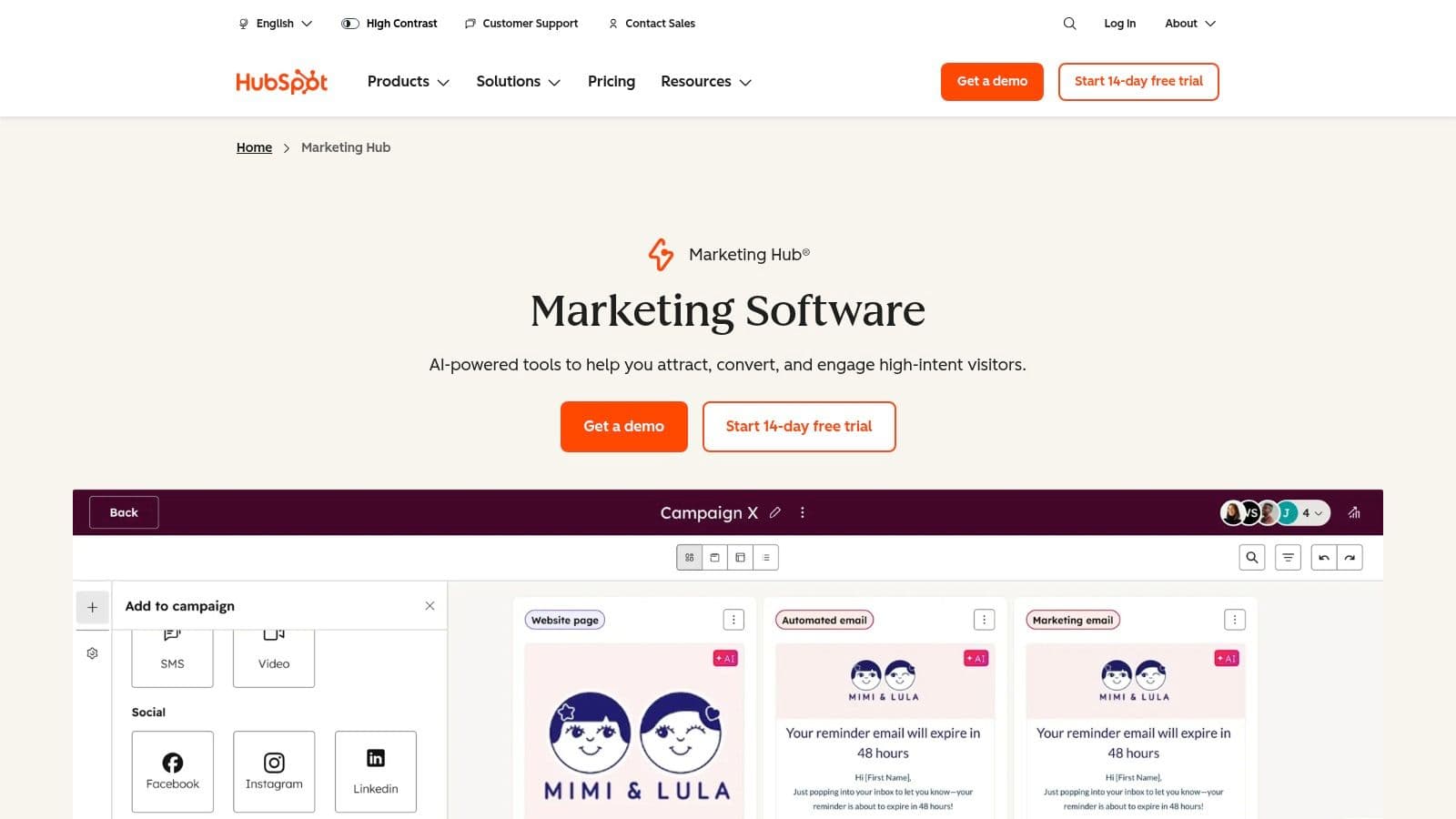
HubSpot Marketing Hub stands out as an all-in-one platform where marketing automation is deeply integrated with a powerful CRM. This connection is its greatest strength, allowing teams to build campaigns based on detailed customer data and track the entire journey from first touch to final sale. Unlike point solutions that require clunky integrations, HubSpot provides a single source of truth for marketing, sales, and service activities.
Its visual workflow builder is intuitive, enabling users to create sophisticated, multi-step nurturing sequences without needing to code. This makes it one of the best marketing automation tools for teams that need to scale their efforts. You can automate everything from lead scoring and email follow-ups to internal notifications for your sales team. To get a better grasp of how these sequences work in practice, you can explore detailed examples of a marketing automation workflow.
Key Features & Ideal Use Case
HubSpot is best suited for SMBs and mid-market companies aiming to align their marketing and sales teams tightly. The platform’s true power unlocks when you use its CRM alongside marketing tools like landing pages, forms, ad management, and social media scheduling.
- Best For: Businesses wanting a unified CRM and marketing platform.
- Standout Feature: Deep CRM integration allows for hyper-personalized automation based on contact properties, deal stages, and behavior.
- Pricing: Offers a free tier with basic tools. Paid plans start at $18/month (billed annually) for the Starter plan, scaling significantly for Professional and Enterprise tiers.
- Pros: Excellent educational resources, a vast app ecosystem, and a user-friendly interface that simplifies complex processes.
- Cons: Can become expensive as your contact list grows. Mandatory onboarding fees for Professional and Enterprise plans are a significant upfront cost.
Website: https://hubspot.com/products/marketing
3. Mailchimp
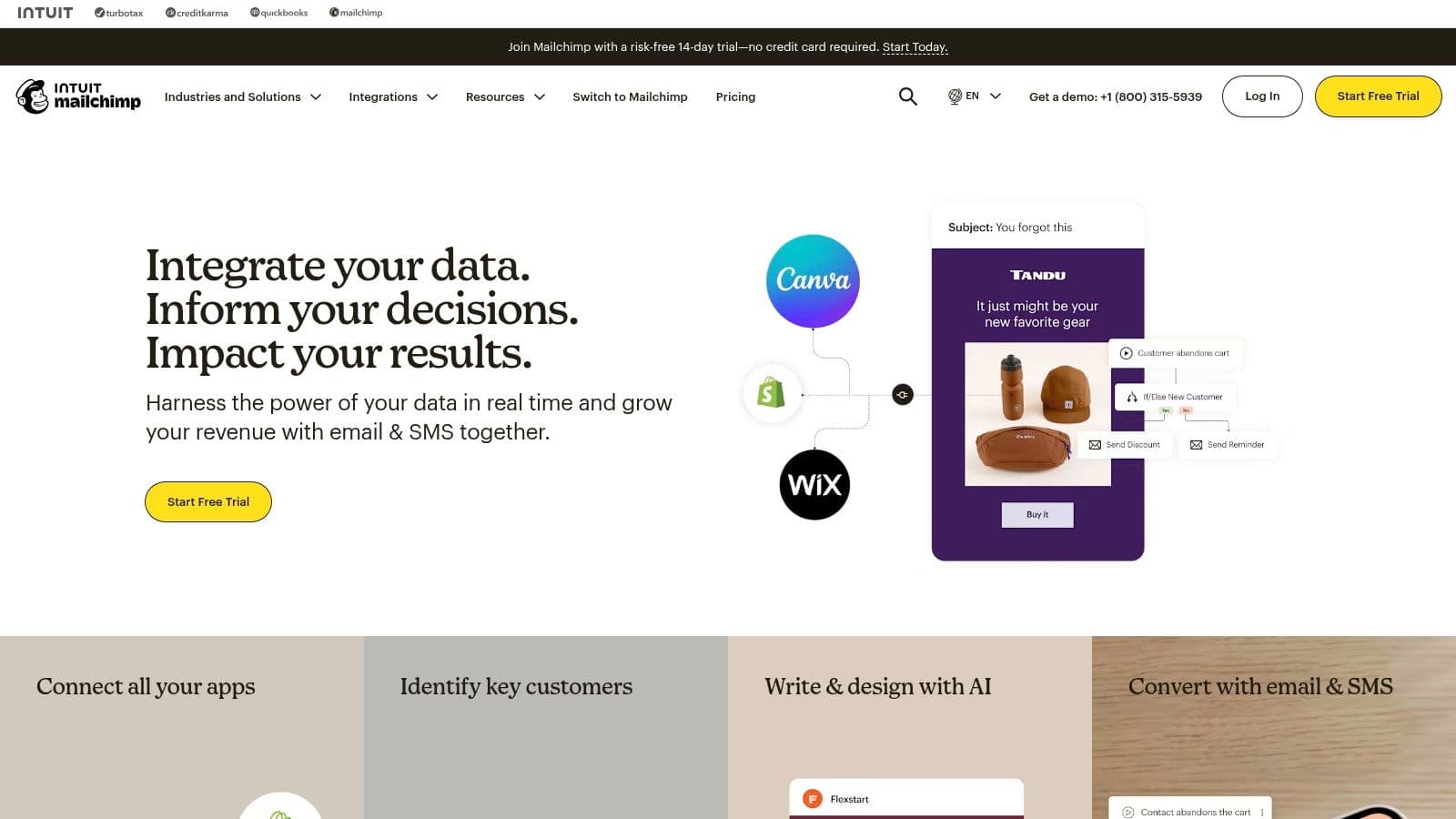
Mailchimp has evolved from a simple email newsletter service into a comprehensive marketing automation platform, making it a household name for creators and small businesses. Its primary advantage lies in its accessibility and user-friendly interface, which significantly lowers the barrier to entry for those new to automation. The platform excels at guiding users through creating their first campaigns with pre-built customer journeys for common scenarios like welcome series, abandoned cart reminders, and re-engagement emails.
This focus on simplicity and guided setup makes Mailchimp one of the best marketing automation tools for entrepreneurs who need to get started quickly without a steep learning curve. While it might not offer the deep, granular control of more enterprise-focused systems, its blend of email marketing, a basic CRM, and e-commerce integrations provides a powerful toolkit for growth. Many find it to be the ideal marketing automation software for small business needs.
Key Features & Ideal Use Case
Mailchimp is the perfect starting point for solopreneurs, e-commerce stores, and small businesses looking to implement foundational marketing automation. Its strength is in its robust email template library, audience segmentation tools, and over 300 integrations that connect it seamlessly to platforms like Shopify and WooCommerce.
- Best For: Small businesses and creators needing an easy-to-use email and automation tool.
- Standout Feature: Pre-built customer journey templates and an AI Creative Assistant that helps generate design and copy ideas, speeding up campaign creation.
- Pricing: Offers a limited free plan. Paid plans start with the Essentials tier at $13/month, with costs increasing based on contact count and feature sets in the Standard and Premium tiers.
- Pros: Extremely user-friendly with a clean interface and fast setup. Strong e-commerce features and an excellent template library.
- Cons: Pricing can escalate quickly as your audience grows. The depth and complexity of its automation workflows are more limited compared to specialist platforms.
Website: https://mailchimp.com
4. ActiveCampaign
ActiveCampaign excels by offering enterprise-level automation power in a package accessible to small and mid-sized businesses. Its core strength lies in the depth and flexibility of its visual automation builder, allowing users to create highly sophisticated workflows based on a wide array of triggers and conditions. This platform combines email marketing, marketing automation, and a sales CRM into a single, cohesive system, making it one of the best marketing automation tools for businesses that have outgrown simpler email platforms.
The platform enables you to go beyond basic email sequences, incorporating SMS, site messages, and dynamic content to create a truly personalized customer journey. Its "if/then/else" logic is exceptionally powerful, letting you split paths and segment users with a level of granularity that few competitors in its price range can match. This allows for precise targeting, from lead scoring and nurturing to post-purchase follow-ups.
Key Features & Ideal Use Case
ActiveCampaign is the ideal choice for businesses that need advanced automation capabilities without the enterprise-level price tag. It is particularly well-suited for e-commerce businesses, digital product creators, and agencies that require complex segmentation and personalization to drive conversions and customer loyalty.
- Best For: SMBs and mid-market companies needing powerful, flexible automation logic.
- Standout Feature: The visual automation builder offers unparalleled flexibility with conditional logic, goal tracking, and split-testing capabilities within workflows.
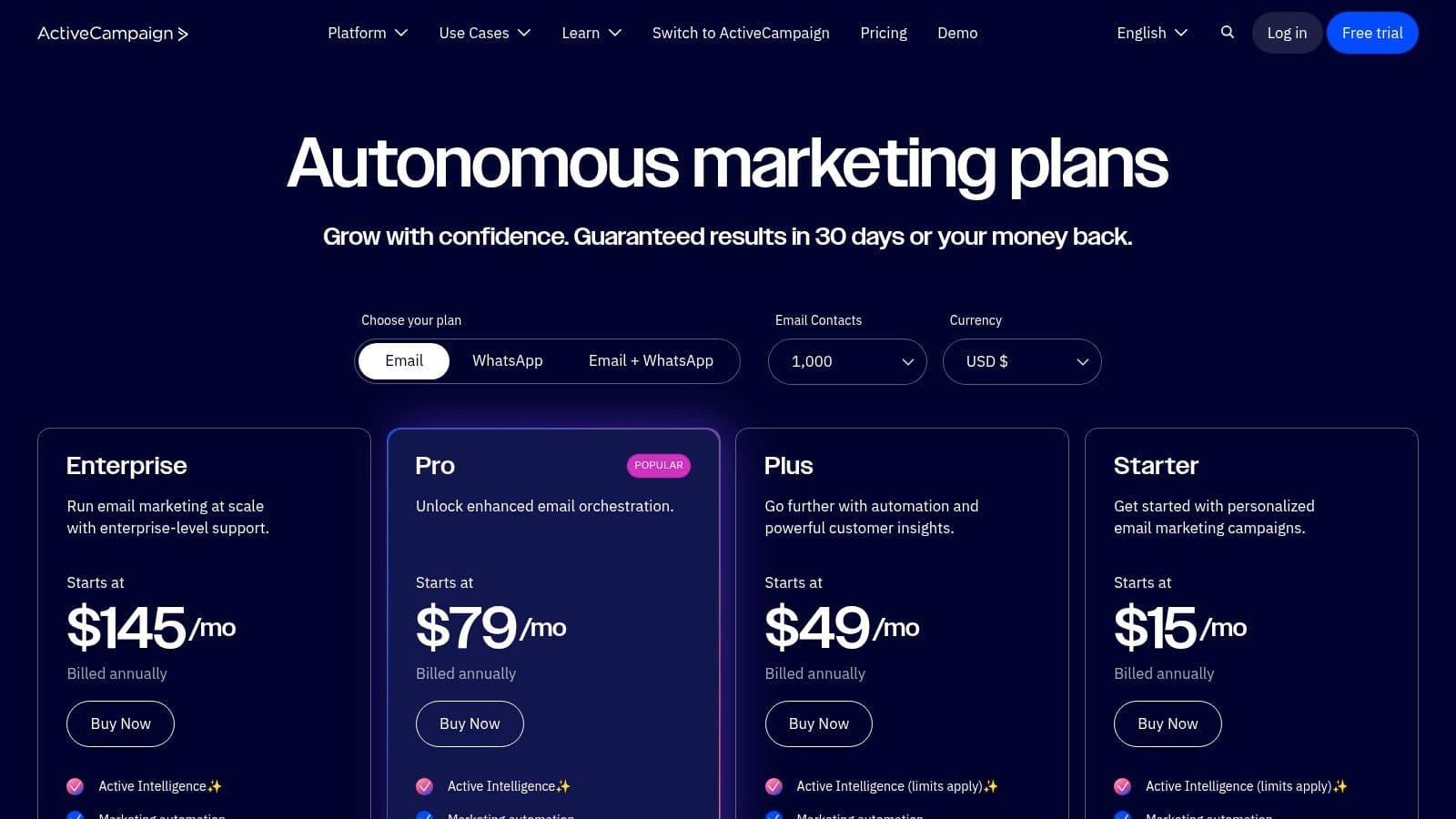
- Pricing: Plans start at $29/month (billed annually) for the Lite tier, with pricing scaling based on contact count and feature set (Plus, Professional, Enterprise). Migration assistance is included.
- Pros: Deep automation flexibility at a competitive price point, excellent deliverability rates, and strong integration options.
- Cons: The interface can feel complex, and there is a steeper learning curve for mastering its most advanced features.
Website: https://www.activecampaign.com/pricing?utm_source=openai
5. Klaviyo
Klaviyo has carved out a niche as the go-to marketing automation platform specifically for e-commerce brands. Its core strength lies in its deep, native integrations with platforms like Shopify, WooCommerce, and BigCommerce, allowing it to pull in rich customer data that other tools can't easily access. This enables merchants to build hyper-targeted automation flows based on real-time shopping behavior, like cart abandonment, browse abandonment, and specific purchase history.
Unlike general-purpose platforms, every feature in Klaviyo is designed with online retail in mind. It combines email and SMS marketing seamlessly, letting you create unified campaigns that reach customers on their preferred channel. For e-commerce businesses looking for one of the best marketing automation tools that directly ties campaigns to revenue, Klaviyo’s focus on sales attribution is a significant advantage.
Key Features & Ideal Use Case
Klaviyo is built for direct-to-consumer (DTC) brands and e-commerce stores of all sizes that want to leverage their customer data to drive repeat purchases and increase lifetime value. Its powerful segmentation and predictive analytics help businesses send the right message at the perfect time.
- Best For: E-commerce businesses, especially those on Shopify or WooCommerce.
- Standout Feature: Deep e-commerce data integration allows for powerful automation triggers like "viewed product," "added to cart," and "placed order" for both email and SMS.
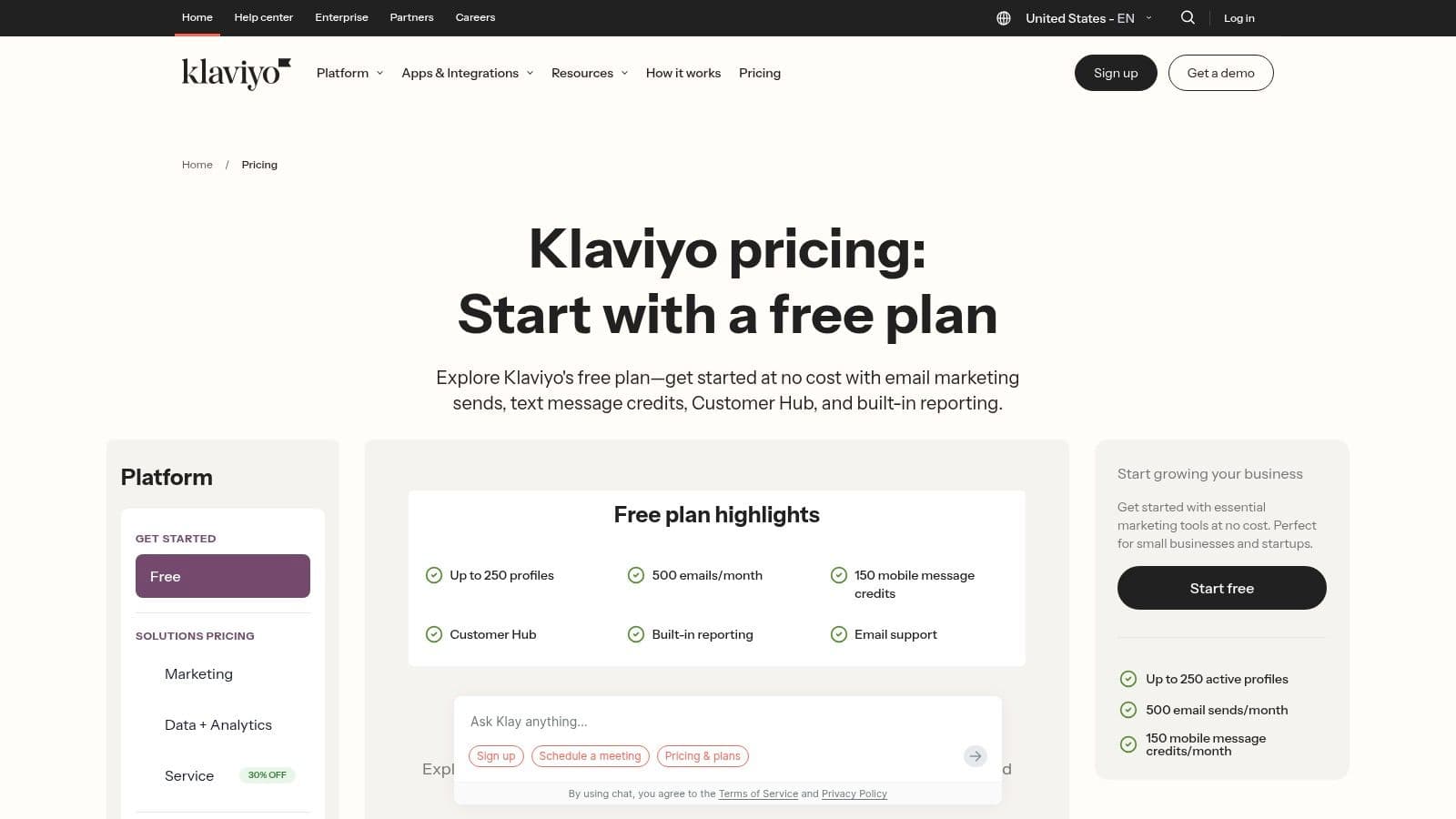
- Pricing: Offers a free plan for up to 250 contacts. Paid plans are based on contact and SMS volume, starting at $20/month for email.
- Pros: Unparalleled focus on e-commerce with built-in revenue tracking, easy-to-use flow builder, and strong predictive analytics features.
- Cons: Can become expensive as your contact list and SMS usage grow. Its features are less suited for non-retail businesses like B2B or SaaS.
Website: https://www.klaviyo.com/pricing/?utm_source=openai
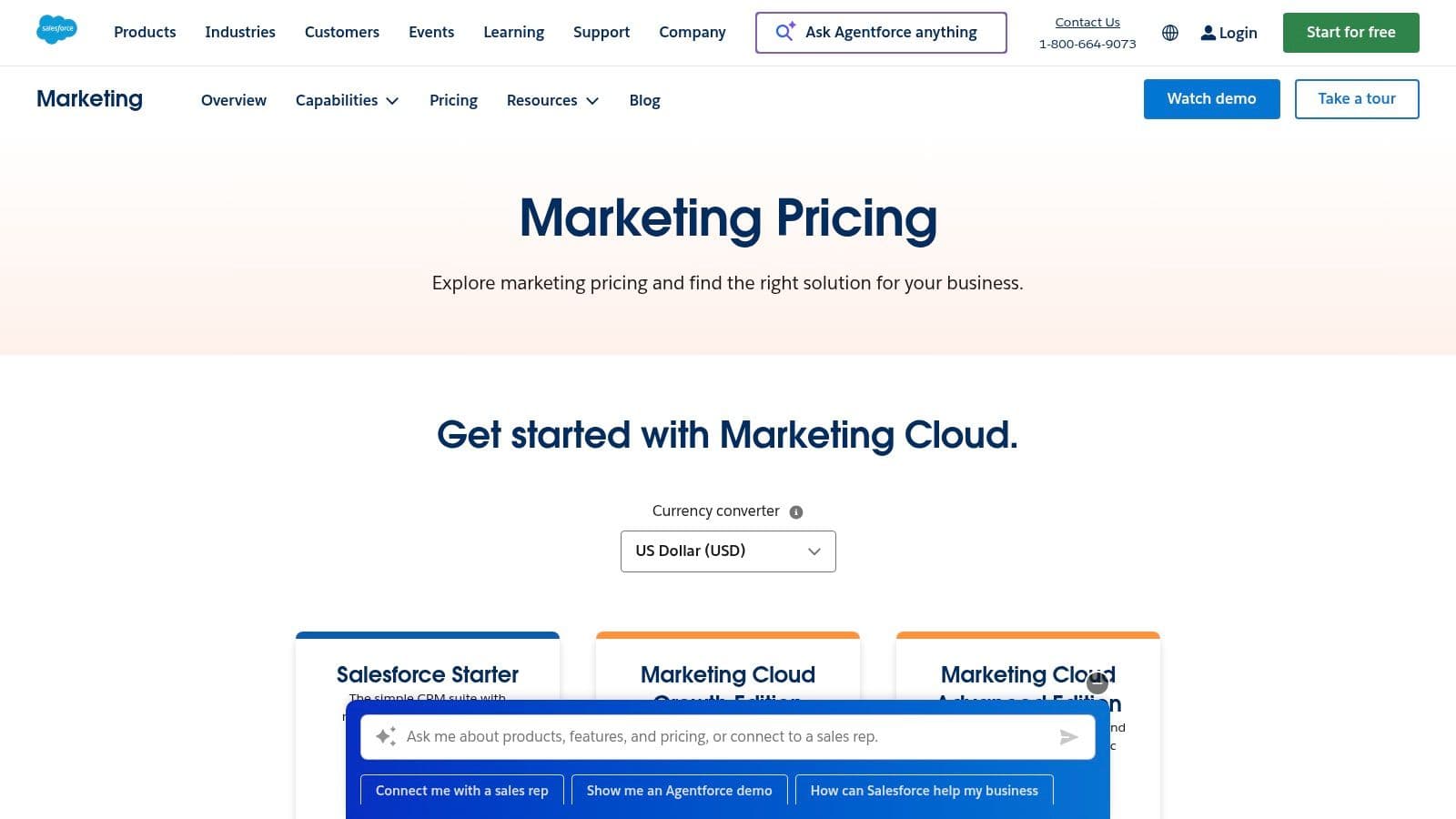
6. Salesforce Marketing Cloud
Salesforce Marketing Cloud is an enterprise-grade platform designed for complex, large-scale marketing operations. Its core strength lies in its profound integration with the broader Salesforce ecosystem, particularly the Sales Cloud CRM. This creates a unified customer data foundation, enabling marketers to orchestrate highly personalized, multi-channel journeys across email, SMS, social media, and advertising. Unlike solutions geared toward smaller businesses, Salesforce excels at managing millions of contacts and intricate customer segments.
The platform’s Journey Builder tool is a standout, allowing teams to visualize and automate sophisticated customer pathways based on real-time triggers and behaviors. This makes it one of the best marketing automation tools for organizations that need to deliver consistent messaging at every touchpoint. To understand the financial benefits of such a system, you can calculate your marketing automation ROI.
Key Features & Ideal Use Case
Salesforce Marketing Cloud is built for large enterprises that already leverage the Salesforce CRM and require robust governance, security, and scalability. Its extensive suite of add-ons for analytics, personalization, and AI-driven campaign optimization provides unparalleled depth for data-driven marketing teams.
- Best For: Enterprise-level companies needing deep Salesforce CRM integration and advanced multi-channel campaign orchestration.
- Standout Feature: Journey Builder allows for sophisticated, cross-channel customer journey mapping and automation that can span marketing, sales, and service interactions.
- Pricing: Custom pricing based on edition and scale. Plans often start in the thousands per month and require an annual commitment.
- Pros: Unmatched scalability for large contact databases, powerful cross-channel orchestration, and a vast ecosystem of add-ons for analytics and personalization.
- Cons: High cost and complexity make it unsuitable for small to mid-sized businesses. Requires significant implementation time and specialized administrative expertise.
Website: https://www.salesforce.com/marketing/pricing/?utm_source=openai
7. Adobe Marketo Engage
Adobe Marketo Engage is an enterprise-grade powerhouse designed for managing complex, large-scale B2B and B2C customer journeys. Its core strength lies in its ability to handle sophisticated lead management, multi-touch attribution, and account-based marketing (ABM) strategies with deep customization. Unlike platforms geared toward simplicity, Marketo provides a highly flexible data model and robust APIs, allowing mature marketing operations teams to build and scale intricate programs that align closely with sales.
The platform excels at orchestrating personalized experiences across numerous channels, from email to mobile and web. Its advanced segmentation and nurturing capabilities are what make it one of the best marketing automation tools for enterprises needing granular control over their campaigns. To leverage such a powerful system effectively, it's crucial to follow established marketing automation best practices from day one. Marketo’s deep integration with the Adobe Experience Cloud and other enterprise systems like Salesforce creates a comprehensive ecosystem for tracking revenue and customer lifetime value.
Key Features & Ideal Use Case
Marketo Engage is built for enterprise and high-growth mid-market companies with dedicated marketing operations teams. It is particularly effective for organizations with long sales cycles and a need for powerful ABM, lead scoring, and revenue attribution models.
- Best For: Large enterprises requiring deep customization and powerful B2B marketing features.
- Standout Feature: Advanced lead management, including scoring, routing, and sales insights, which provides sales teams with actionable intelligence directly within their CRM.
- Pricing: Pricing is not publicly listed and requires a custom quote through a sales-led process, tailored to specific business needs and scale.
- Pros: Unmatched power and flexibility for complex marketing programs, a mature ecosystem, and strong integrations, especially within the Adobe Experience Cloud.
- Cons: The platform has a steep learning curve and requires significant implementation overhead. The lack of transparent pricing makes it inaccessible for smaller businesses.
Website:
8. Brevo (formerly Sendinblue)
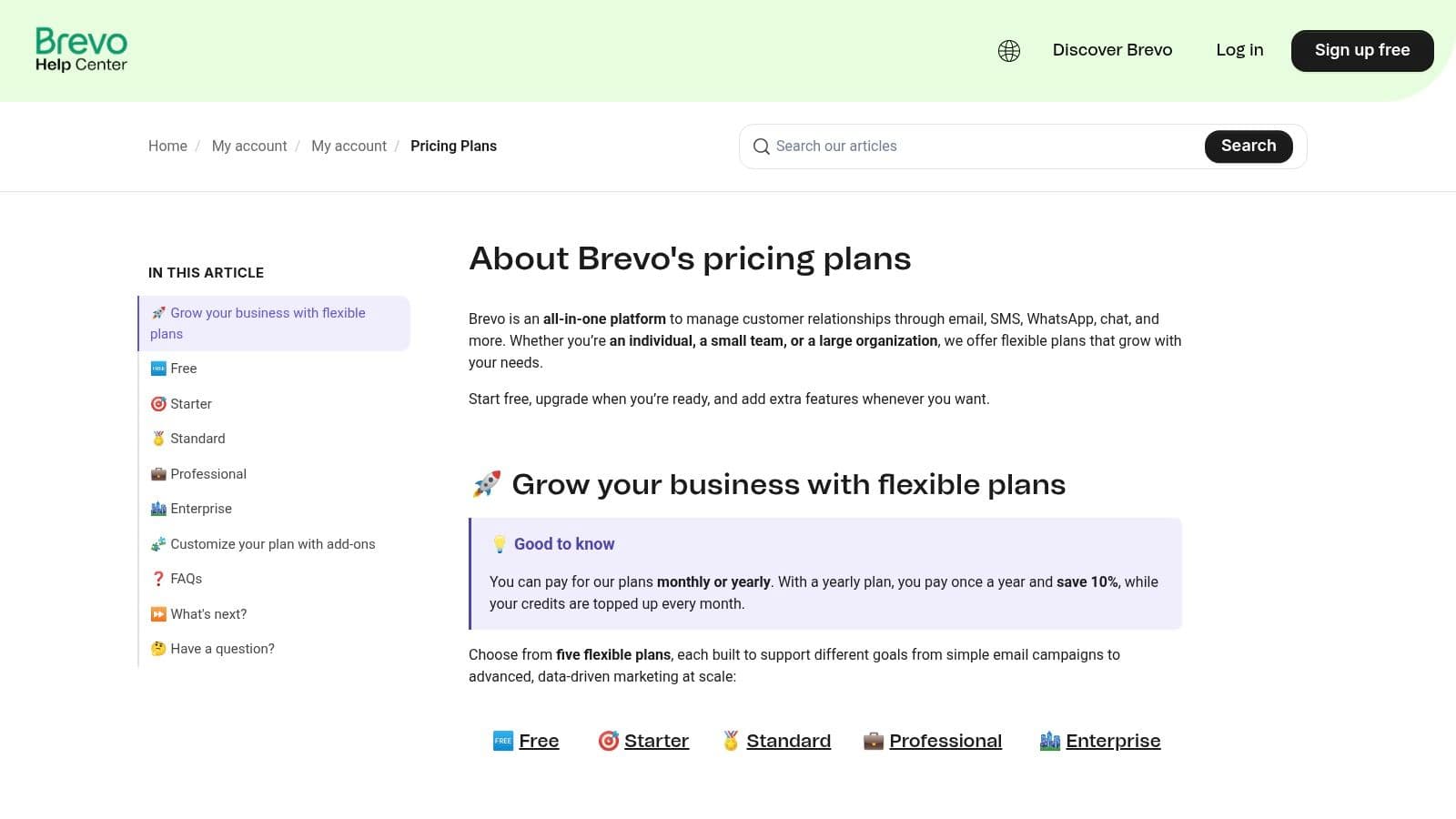
Brevo, formerly known as Sendinblue, has established itself as a powerful all-in-one marketing platform that offers exceptional value, especially for small to medium-sized businesses. Its core strength lies in providing a robust suite of tools that extends beyond just email. Brevo integrates SMS, WhatsApp, live chat, and push notifications into its automation workflows, allowing businesses to create truly multi-channel campaigns from a single dashboard. This comprehensive approach makes it a strong contender among the best marketing automation tools for teams on a budget.
The platform's automation builder is straightforward yet capable, enabling users to craft workflows based on contact behavior, email engagement, and website activity. Unlike many competitors that gate essential features behind expensive tiers, Brevo provides marketing automation capabilities even on its generous free plan, making advanced marketing accessible to businesses just starting out. This focus on delivering a full marketing toolkit without a prohibitive price tag is what sets Brevo apart in a crowded market.
Key Features & Ideal Use Case
Brevo is best suited for SMBs and e-commerce businesses that need a cost-effective, multi-channel marketing solution without sacrificing core automation power. Its combination of transactional messaging (for order confirmations, etc.) and marketing campaigns makes it a versatile choice for businesses managing the entire customer lifecycle.
- Best For: Budget-conscious SMBs needing multi-channel (Email, SMS, WhatsApp) automation.
- Standout Feature: A comprehensive suite of communication tools unified in a single platform, supported by a generous free tier that includes automation.
- Pricing: A robust free plan allows up to 300 emails/day. Paid plans start at $25/month for the Starter plan, with more advanced features in the Business plan at $65/month.
- Pros: Highly competitive and transparent pricing, strong multi-channel capabilities, and an all-in-one feature set that includes a sales CRM and landing pages.
- Cons: The user interface can feel less polished than some premium competitors. Advanced features like a dedicated IP require add-on purchases or higher-tier plans.
Website: https://help.brevo.com/hc/en-us/articles/208589409-About-Brevo-s-pricing-plans?utm_source=openai
9. GetResponse
GetResponse positions itself as more than just an email platform, bundling a broad suite of marketing tools into one accessible package. Its unique strength lies in integrating features that often require separate subscriptions, such as webinar hosting, conversion funnels, and even an AI-powered website builder. This makes it a compelling choice for entrepreneurs and small businesses who want an all-in-one solution without juggling multiple tools and logins. The platform is designed to handle the full customer lifecycle, from capturing leads with landing pages to nurturing them with automated emails and converting them through built-in funnels.
Its automation workflow builder is straightforward, allowing users to create marketing sequences based on user behavior, contact data, and specific triggers. For businesses where webinars or sales funnels are a core part of their strategy, GetResponse offers one of the most integrated experiences, making it one of the best marketing automation tools for streamlining complex campaigns under a single roof.
Key Features & Ideal Use Case
GetResponse is ideal for creators, coaches, and small businesses that rely heavily on webinars and pre-built sales funnels to drive revenue. By combining these core features with email and automation, it removes the technical friction of integrating disparate systems, allowing users to launch campaigns faster.
- Best For: Entrepreneurs and SMBs wanting integrated webinar and funnel-building capabilities.
- Standout Feature: The Conversion Funnel feature provides templates for lead magnets, sales, and webinars, guiding users through creating a complete conversion-focused campaign.
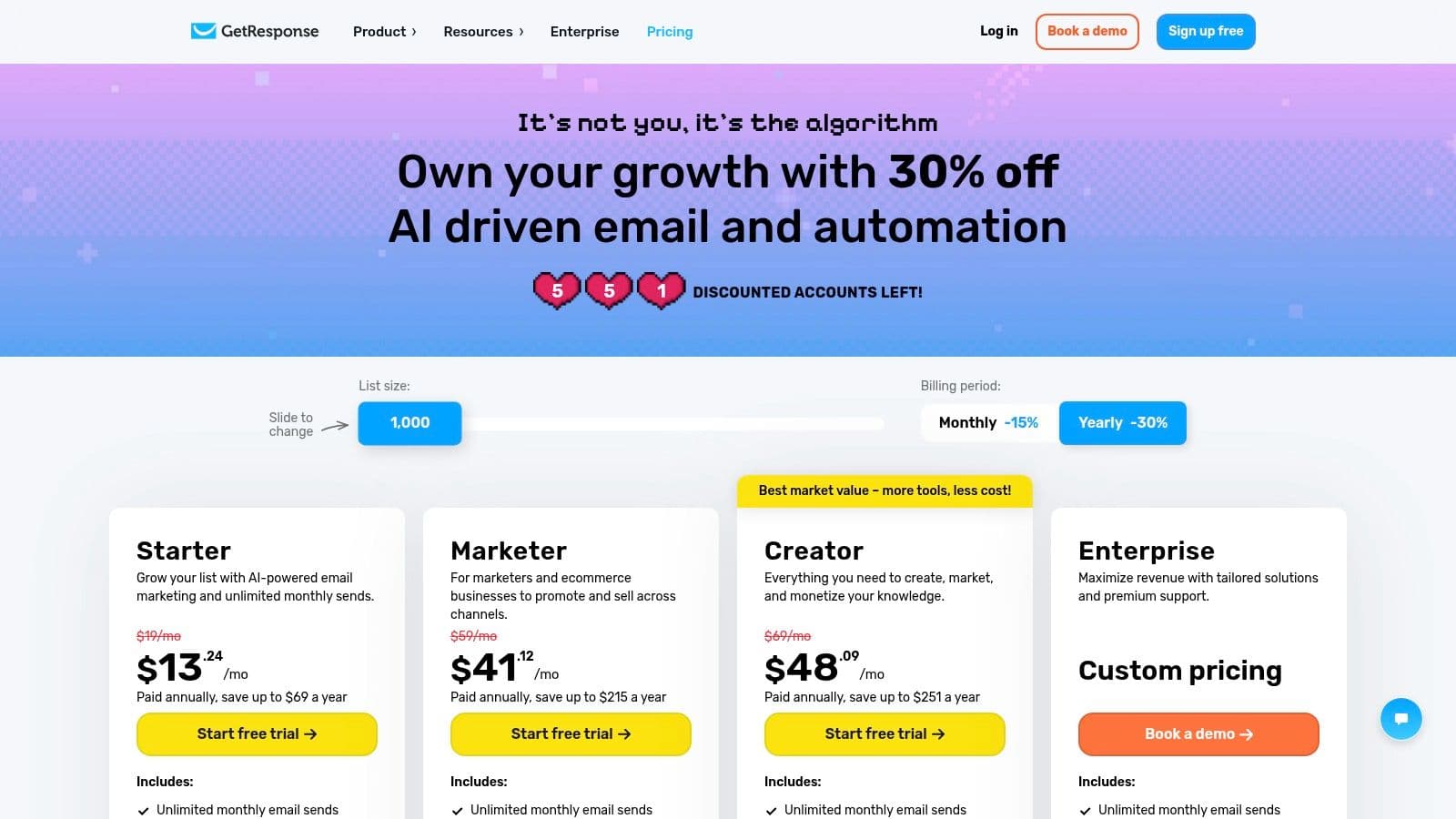
- Pricing: A free-forever plan is available for up to 500 contacts. Paid plans start at $15.60/month (billed annually) for the Email Marketing plan, with costs increasing for more advanced automation and larger list sizes.
- Pros: An exceptionally broad toolkit that includes email, SMS, push notifications, and webinars. Offers discounts for annual billing and a 50% discount for non-profits.
- Cons: The platform’s feature mix can feel a bit wide rather than deep, lacking the specialized power of best-in-class point solutions. Pricing can escalate quickly as your contact list grows.
Website: https://www.getresponse.com/pricing?utm_source=openai
10. Omnisend
Omnisend is purpose-built for ecommerce businesses, combining email, SMS, and web push notifications into a single, cohesive automation workflow. Unlike generalist platforms that require heavy customization for retail, Omnisend’s strength lies in its deep integration with platforms like Shopify, BigCommerce, and WooCommerce. This allows online stores to launch revenue-driving automations like cart abandonment, browse abandonment, and post-purchase follow-ups in minutes using pre-built templates.
It excels at creating multi-channel journeys from a single visual builder, making it one of the best marketing automation tools for retailers focused on customer lifetime value. You can send an abandoned cart email, follow up with an SMS an hour later, and then trigger a push notification the next day, all from one unified sequence. The platform is designed to be a practical, results-oriented solution for online merchants.
Key Features & Ideal Use Case
Omnisend is the go-to choice for ecommerce brands that want a powerful, easy-to-use platform without the complexity or cost of enterprise-level systems. Its focus on revenue-generating features like product recommendations and dynamic content blocks directly impacts the bottom line.
- Best For: Ecommerce stores (especially on Shopify) wanting to boost sales with multi-channel automation.
- Standout Feature: Pre-built ecommerce workflows that combine email, SMS, and push notifications to recover abandoned carts and drive repeat purchases.
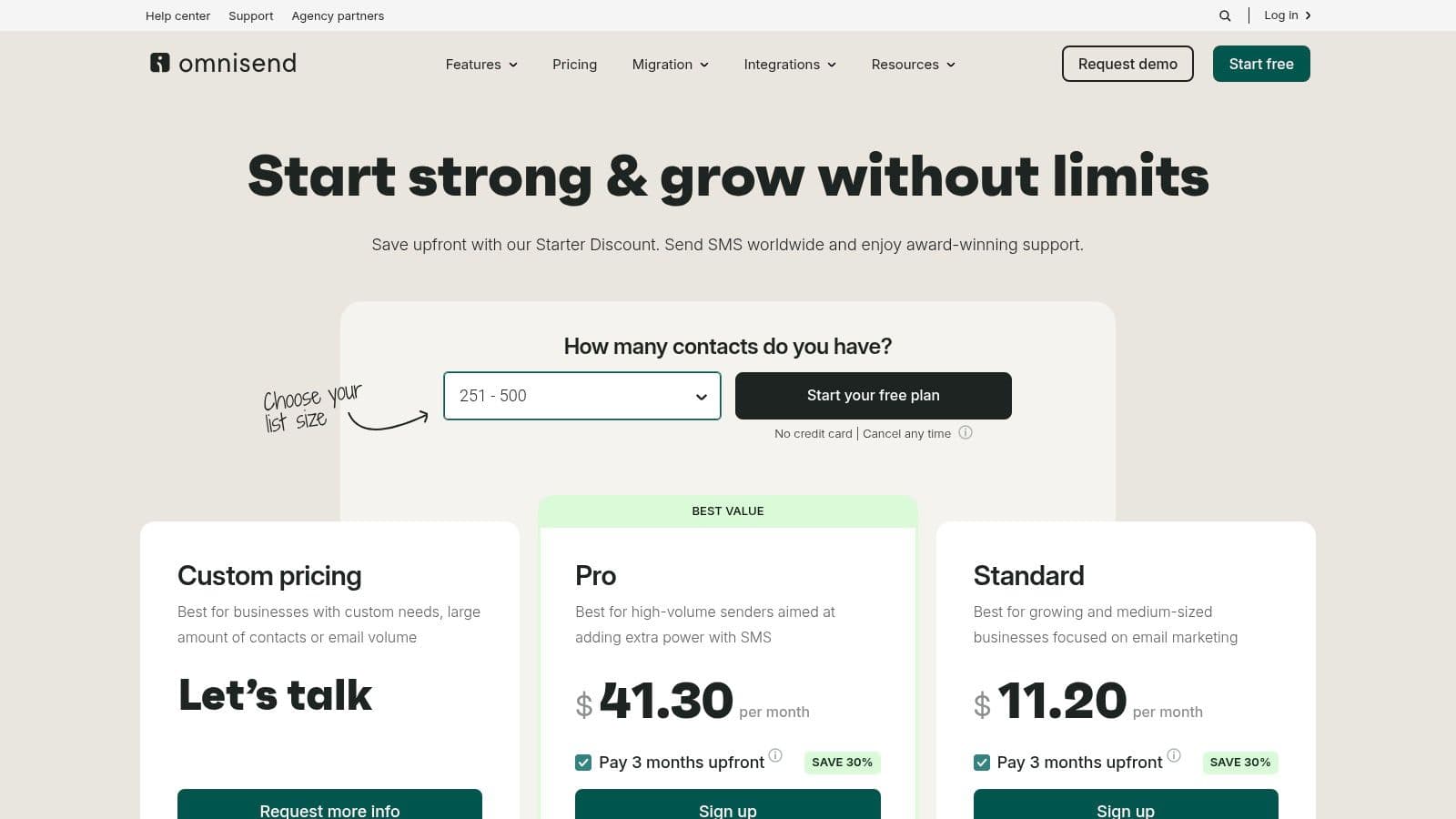
- Pricing: Offers a free plan for up to 250 contacts. Paid plans start at $16/month for the Standard plan, which includes automation features.
- Pros: Excellent 24/7 live chat support on all plans, transparent and competitive pricing, and powerful segmentation based on shopping behavior.
- Cons: Functionality is heavily geared toward ecommerce, making it less suitable for B2B or non-retail businesses. SMS costs can add up for merchants with large lists.
Website: https://www.omnisend.com/pricing/?utm_source=openai
11. G2
While not a marketing automation tool itself, G2 is an indispensable resource for finding the right one. It’s a peer-to-peer review marketplace where real users share their experiences with different software, offering unfiltered insights you won’t find on a vendor's website. This platform is crucial for validating claims and understanding how a tool performs in real-world scenarios, making it a vital step in the research process.
G2’s strength lies in its comprehensive comparison features and verified reviews. You can filter the best marketing automation tools by company size, user satisfaction, and specific features, then compare your top choices side-by-side. The platform’s Grid Reports visually map out market leaders, contenders, and niche players based on satisfaction and market presence, providing a quick yet powerful overview of the landscape. This helps you move from a long list of options to a qualified shortlist with confidence.
Key Features & Ideal Use Case
G2 is best for any business, from solo creators to enterprise teams, that is in the active research and selection phase for a new marketing automation platform. It provides the social proof and detailed data needed to make an informed purchasing decision and avoid costly mistakes.
- Best For: Teams validating and shortlisting marketing automation tools before purchase.
- Standout Feature: Verified user reviews and side-by-side comparison grids that allow you to compare features, pricing, and satisfaction scores for multiple tools at once.
- Pricing: Free to use for research and reviews. G2 also offers paid reports and buyer advisory services for enterprises.
- Pros: Provides authentic user sentiment and broad coverage of vendors. The filtering system is excellent for narrowing down options based on specific business needs.
- Cons: Promoted listings can sometimes influence visibility. You must leave the site to purchase the actual software, as it is a review platform, not a reseller.
Website:
12. Capterra
While not a marketing automation tool itself, Capterra is an indispensable resource for finding the right one. It’s a massive, free software directory where you can discover and compare dozens of platforms side-by-side. Instead of building a tool, Capterra builds a structured environment for evaluation, which is a crucial first step for any business looking to invest in this technology.
The platform provides a comprehensive overview of the market, complete with buyer guides, feature filters, and verified user reviews. This allows you to create a well-researched shortlist of the best marketing automation tools tailored to your specific needs, whether you're a small business or a large enterprise. You can filter by features like lead nurturing or analytics and then compare your top choices based on pricing models and user ratings, streamlining what can otherwise be an overwhelming research process.
Key Features & Ideal Use Case
Capterra is best suited for marketing teams and business owners in the initial research and comparison phase of their buying journey. It helps users gain a bird's-eye view of the landscape before committing to demos or trials with specific vendors.
- Best For: Businesses conducting first-pass research to create a shortlist of potential tools.
- Standout Feature: The robust comparison tool allows you to select up to four different software options and view their features, pricing, and ratings in a clean, side-by-side table.
- Pricing: Free to use for software buyers.
- Pros: Access to a vast number of tools in one place, verified user reviews provide honest feedback, and the neutral overview content is helpful for building foundational knowledge.
- Cons: Sponsored profiles can influence search rankings, giving them more visibility. Final pricing and contract details must always be confirmed directly with the vendor.
Website: https://www.capterra.com/marketing-automation-software/?utm_source=openai
Top 12 Marketing Automation Tools — Quick Comparison
| Product | ✨ Key features | ★ Quality | 💰 Pricing / Value | 👥 Target audience |
|---|---|---|---|---|
| 🏆 PostOnce | ✨ Set‑and‑forget cross‑posting; platform‑specific formatting; multi‑account workflows | ★★★★☆ | 💰 $29 Creator / $69 Pro; 7‑day trial; annual 20% off | 👥 Creators, indie hackers, SMBs, agencies |
| HubSpot Marketing Hub | ✨ CRM‑native marketing, journeys, landing pages, social | ★★★★☆ | 💰 Scales free→Enterprise; can be costly as contacts grow | 👥 Marketing teams needing CRM + marketing stack |
| Mailchimp | ✨ Prebuilt automations, templates, e‑commerce integrations | ★★★★ | 💰 Free→paid tiers; cost rises with contacts/add‑ons | 👥 Small businesses, beginners testing automation |
| ActiveCampaign | ✨ Deep visual automations, segmentation, CRM pipelines | ★★★★☆ | 💰 Mid‑range; scales by contacts, steeper with lists | 👥 SMBs & mid‑market with complex workflows |
| Klaviyo | ✨ E‑commerce focused flows, predictive analytics, SMS | ★★★★☆ | 💰 Free entry; pricing scales quickly with list/SMS | 👥 DTC & Shopify/WooCommerce merchants |
| Salesforce Marketing Cloud | ✨ Enterprise journey orchestration, personalization, analytics | ★★★★★ | 💰 High‑cost enterprise; annual commitments | 👥 Large enterprises needing Salesforce alignment |
| Adobe Marketo Engage | ✨ Advanced B2B/B2C journeys, ABM, flexible APIs | ★★★★★ | 💰 Enterprise sales‑led pricing; implementation overhead | 👥 Complex enterprise B2B/B2C programs |
| Brevo (Sendinblue) | ✨ Email/SMS/WhatsApp, automation, web tools, free tier | ★★★★ | 💰 Competitive; generous free tier, some paid add‑ons | 👥 SMBs seeking multi‑channel value |
| GetResponse | ✨ Funnels, webinars, automation, landing pages | ★★★★ | 💰 Mid‑range; discounts for annual/nonprofit | 👥 Small businesses that use webinars & funnels |
| Omnisend | ✨ Ecommerce email+SMS+push journeys, prebuilt revenue flows | ★★★★ | 💰 Transparent ecommerce pricing; SMS costs can add up | 👥 Online retailers & ecommerce teams |
| G2 | ✨ Verified reviews, category grids, buying reports | ★★★★ | 💰 Free to use; vendor listings sponsored | 👥 Buyers researching & shortlisting tools |
| Capterra | ✨ Software directory, buyer guides, comparisons | ★★★★ | 💰 Free to browse; vendor purchase via links | 👥 First‑pass researchers & buyers |
Start Automating, Start Growing
Navigating the landscape of the best marketing automation tools can feel overwhelming, but the journey to finding the perfect platform is a strategic investment in your business’s future. We’ve explored a dozen powerful solutions, from specialized social media accelerators like PostOnce to all-in-one behemoths like HubSpot and Salesforce Marketing Cloud. The core takeaway is clear: the "best" tool is not a one-size-fits-all title. It's the one that aligns perfectly with your specific goals, budget, team size, and technical comfort level.
For solo content creators and social media managers, efficiency is paramount. A tool like PostOnce stands out by solving a very specific, time-consuming problem: cross-posting content across multiple platforms. It's a prime example of targeted automation that delivers immediate value. For a small business owner aiming for a holistic view of the customer journey, platforms like ActiveCampaign or Brevo offer a potent mix of email marketing, CRM, and automation without the enterprise-level price tag.
Marketing agencies, on the other hand, require scalability, multi-client management, and robust analytics. This is where comprehensive systems like Adobe Marketo Engage or HubSpot shine, providing the depth needed to manage complex campaigns and prove ROI to clients. E-commerce brands will find immense value in the specialized features of Klaviyo or Omnisend, which are purpose-built to leverage customer data for hyper-personalized shopping experiences.
Key Takeaways and Your Next Steps
Before you commit to a subscription, it’s crucial to distill this information into a practical action plan. The right choice will save you countless hours and unlock new growth opportunities, while the wrong one can lead to frustration, wasted resources, and a system that gathers digital dust.
Here is a simple framework to guide your decision-making process:
- Define Your Primary Goal: What is the single biggest marketing challenge you want to solve right now? Is it saving time on social media management? Nurturing leads through complex email sequences? Increasing customer lifetime value? Your primary goal should be your north star.
- Audit Your Existing Stack: What tools are you already using? Look for a marketing automation platform that integrates seamlessly with your current CRM, e-commerce platform, or content management system. Poor integration creates data silos and manual work, defeating the purpose of automation.
- Set a Realistic Budget: Determine what you can comfortably invest. Remember to consider not just the monthly subscription fee but also potential implementation costs, training, and the cost of scaling up as your contact list or feature needs grow.
- Evaluate Your Team's Capacity: Be honest about your team's technical skills. A platform with a steep learning curve might be powerful, but it’s useless if no one has the time or expertise to master it. Platforms like Mailchimp and GetResponse are known for their user-friendly interfaces, making them great entry points.
- Utilize Free Trials and Demos: This is the most critical step. Shortlist your top two or three contenders based on the criteria above and dive into their free trials. Set up a simple automation, import a small segment of your contacts, and see how the platform feels. Is it intuitive? Is the customer support responsive? This hands-on experience is invaluable.
Choosing from the best marketing automation tools is more than just a software purchase; it's a strategic decision that empowers your marketing engine. By automating repetitive tasks, you free up your most valuable resource: your time. This allows you to focus on the creative, strategic work that truly drives growth, builds relationships, and sets your brand apart. The right platform becomes a silent partner, working tirelessly in the background to deliver the right message to the right person at the right time, fueling a sustainable and scalable future for your business.
Ready to reclaim hours of your week? While comprehensive platforms manage complex funnels, the simplest and most impactful automation often starts with your daily tasks. PostOnce is the marketing automation tool designed specifically for content creators and social media managers who need to distribute their content efficiently, automating the tedious task of cross-posting to save you time and maximize your reach. Start automating your social media with PostOnce today.