

To really boost brand awareness, you need to build a digital presence that feels genuine and memorable. This goes way beyond just posting on one social media platform. It’s about weaving a consistent story across search engines, social media, and even good old-fashioned word-of-mouth, so your brand pops up wherever your audience hangs out.
Your Blueprint for Building an Unforgettable Brand
Before we jump into specific tactics, let's map out a solid blueprint for getting your brand discovered. The market is incredibly crowded, which makes a multi-channel strategy essential. People don't just find new brands in one spot anymore; their discovery journey is a winding road with multiple touchpoints, and you need to be at every turn.
Think of this as the framework connecting all the dots—from the content you publish to the community you foster. It helps you focus your energy where it counts. The big idea is to build a powerful, recognizable brand from the ground up, and that starts with understanding exactly how people find you in the first place.
Charting the Path to Discovery
It’s not just a hunch; the data backs this up. On average, people use 5.8 different sources to discover new brands. This really drives home the need for a diverse game plan. For example, search engines are the top discovery channel globally, with 32.8% of consumers finding a brand there first. Right behind it? TV ads, at 32.3%, proving that traditional media still has plenty of pull.
But the digital world is where most of the action is.
Top Channels for Brand Discovery
The table below breaks down the primary channels people use to find new brands. It's a clear illustration of why you can't afford to put all your eggs in one basket.
| Discovery Channel | Percentage of Consumers |
|---|---|
| Search Engines | 32.8% |
| Ads on TV | 32.3% |
| Word-of-Mouth | 29.9% |
| Ads on Social Media | 29.7% |
| Brand/Product Websites | 25.8% |
What this data really shows is that if you're only focused on one channel, you’re missing out on a huge slice of your potential audience.
Beyond the big ones, here are other key players in the discovery game:
- Word-of-Mouth: Nearly 30% of discoveries happen because of a recommendation from a friend or family member. It’s a powerful reminder that keeping customers happy is a marketing strategy in itself.
- Social Media Ads: With targeted campaigns, you can introduce your brand to 29.7% of consumers. This makes paid social a non-negotiable part of the mix.
- Brand Websites: A surprising 25.8% of people first discover a brand by landing directly on its website. A strong online home base is critical.
Key Takeaway: Real brand awareness isn't about shouting from one rooftop. It's about being consistently present and genuinely helpful everywhere your audience is. Your blueprint should weave together SEO, social media, advertising, and community building into one seamless strategy.
Putting this integrated plan into action means you need to get the nuances of both B2C and B2B worlds. While the core goals of building visibility and trust are the same, the execution can look very different. For a deep dive into what works, check out these 9 B2B Brand Awareness Strategies. It’s packed with insights for tech services, but honestly, the core principles are golden for any business trying to stand out.
By truly understanding these different paths to discovery, you can build a framework that doesn't just create a flash of awareness but forges lasting recognition.
Build Lasting Trust Through Authentic Community
Getting your name out there is just the beginning. For brand awareness to actually stick and mean something, you have to build a brand people don't just recognize, but genuinely believe in. Without trust, awareness is just noise. And in a crowded market, trust is your most valuable currency.
This is where building a real community comes in. It’s all about creating a space where your actions match your words, sparking real conversations, and giving your audience a reason to care. A brand that stands for something will always create deeper connections than one that just pushes a product.
Let Your Customers Do the Talking with User-Generated Content
One of the quickest ways to build credibility is to step back and let your customers take the spotlight. User-generated content (UGC)—the photos, videos, and reviews your actual customers create—is naturally more believable than any slick ad campaign you could ever produce.
Just think about it. Are you more likely to trust a polished corporate ad or a friend's excited post about a product they genuinely love? When you encourage and celebrate UGC, you turn your customers into your most authentic and powerful advocates.
A great example is a local coffee roaster running a monthly photo contest. They could ask customers to share pictures of their morning coffee ritual using a unique hashtag. By resharing the best submissions, they get fantastic, real-world content and make their community feel valued and seen.
Trust is the foundation of modern business. When people trust you, they don’t just buy from you—they champion you. This creates a powerful, self-sustaining cycle of organic growth and loyalty.
This isn’t just a gut feeling; the data backs it up. A staggering 81% of consumers say they need to trust a brand before they'll even consider making a purchase. UGC is a huge piece of this puzzle, as it’s seen as 50% more trusted and 20% more influential than other media.
Nurture Real Conversation and Connection
A community isn't a one-way street where you just broadcast messages. It’s a two-way conversation. It’s about making your audience feel heard, asking for their input, and giving them chances to connect with each other.
Here are a few ways to get those conversations started:
- Ask Good Questions: Don't just post about your product. Ask your audience about their wins, their struggles, and their opinions on topics relevant to your industry.
- Go Live: Host a live Q&A on Instagram or LinkedIn with a team member or industry expert. Putting a face to the name makes your brand feel much more human.
- Create an Inner Circle: A private Facebook Group or a Discord server can be the perfect spot to share exclusive content and give your biggest fans a dedicated space to connect.
Juggling these conversations across multiple platforms can feel like a lot, but it’s crucial for maintaining a consistent brand presence. For some great ideas on how to manage it all without losing your mind, check out these effective social media management tips.
At the end of the day, turning that initial spark of awareness into long-term loyalty comes down to creating consistently positive experiences. Every single interaction is a chance to build more trust. When people feel that emotional connection—something 57% of consumers crave from brands—they’re far more likely to stick with you for the long haul.
Master Content and SEO for Maximum Visibility
If building a community earns you trust, then creating exceptional content is what earns you the right to start that conversation. Think of content as the engine of modern brand awareness, and search engine optimization (SEO) as the high-octane fuel that makes it run. Without a smart strategy for both, even your best ideas will get lost in the noise, never reaching the new audiences you need to grow.
The aim here is to build a self-sustaining content ecosystem. I'm not talking about chasing one-off viral hits. It’s about consistently providing the right answers when your potential customers are looking for them. This is how you build authority and create a reliable flow of visitors who are actively searching for the solutions you offer. Ultimately, a key part of this is increasing website traffic organically, which pulls in more qualified prospects and expands your brand’s footprint.
Figure Out What Your Audience Actually Wants
The absolute bedrock of any successful content plan is knowing what people are typing into that Google search bar. This is a science, not a guessing game. Keyword research is your treasure map to their needs, frustrations, and biggest questions.
You can start by simply brainstorming the broad topics in your industry. For example, if you run a small business accounting software company, you might start with ideas like "invoicing," "expense tracking," and "small business taxes."
Next, fire up a keyword research tool to dig deeper and find the specific, long-tail keywords people are using. These are longer, more detailed phrases that signal someone is much closer to making a decision. Instead of just "invoicing," you'll uncover gems like "how to create an invoice for freelance work" or "best free invoicing software for contractors."
Targeting these specific, intent-driven keywords is how you win. You're not just adding to the noise; you're creating direct solutions to real-world problems. That’s exactly what search engines are built to reward.
This simple process gives you a content calendar packed with topics your audience genuinely cares about, massively boosting your odds of getting found.
Build Authority With Pillar Pages and Topic Clusters
To really cement your brand as the go-to expert, you have to think bigger than just one-off articles. This is where the pillar page and topic cluster model comes in. A pillar page is a massive, comprehensive guide on a broad topic—your ultimate resource that covers a core subject from A to Z.
For our accounting software example, a pillar page might be "The Ultimate Guide to Small Business Bookkeeping."
From this central pillar, you link out to more focused articles called cluster content. These are the posts that target those specific long-tail keywords we found earlier.
- Cluster Post Example 1: "5 Common Bookkeeping Mistakes and How to Avoid Them"
- Cluster Post Example 2: "A Step-by-Step Guide to Reconciling Your Bank Statements"
- Cluster Post Example 3: "Choosing the Right Accounting Method: Cash vs. Accrual"
Crucially, each of these cluster posts links back to the main pillar page. This interconnected structure signals to search engines that you have deep expertise on the entire subject, which helps lift the rankings for all the connected pages and lets you compete for those really valuable, high-traffic terms.
Get More Mileage by Diversifying Your Content Formats
Let’s be honest: not everyone has the time or desire to read a 3,000-word blog post. To get your message in front of the most people, you have to meet them where they are and in the format they prefer. Repurposing your core content is the most efficient way I've found to do this.
Take a high-performing blog post and think about all the ways you could slice and dice it.
| If You Have This... | You Can Turn It Into... |
|---|---|
| A detailed "how-to" guide | A step-by-step YouTube tutorial video |
| An article with compelling statistics | A shareable infographic for Pinterest and X (Twitter) |
| An expert interview | A podcast episode or a series of short audiograms |
| A comprehensive case study | A downloadable PDF checklist or a webinar presentation |
By diversifying, you create more doors for people to walk through and discover your brand. Someone might find your video on YouTube, then visit your website. Another person might see your infographic on social media and decide to follow you. This multi-format approach strengthens your visibility and makes your brand message stick, making your awareness efforts far more effective.
Amplify Your Reach with Strategic Partnerships

So, you've built a solid foundation with great content and a trusting community. That's the hard part. But to really move the needle on brand awareness, you need an amplifier. The single best way to get your brand in front of fresh, relevant audiences is to tap into the trust and reach others have already built.
That’s where strategic partnerships come in. They let you tap into established communities, pushing your message far beyond your own follower count. This isn't about paying for a quick, forgettable shoutout. It’s about building real, mutually beneficial relationships that feel authentic to everyone—especially the audience. When you get this right, the growth in brand exposure can be explosive.
Find and Engage the Right Influencers
When most people hear "influencer," they imagine a celebrity with millions of followers. And while those big names have their place, the real magic for most brands happens with micro-influencers (10,000–100,000 followers) and nano-influencers (1,000–10,000 followers). These creators have cultivated incredibly engaged, niche audiences that hang on their every word.
Finding the perfect match is everything. Don't get distracted by follower counts. Instead, zero in on true alignment.
- Audience Demographics: Are their followers the people you want to reach?
- Brand Values: Does their personal brand and content style reflect what your company stands for?
- Engagement Rate: I’d take a creator with 10,000 followers and a lively comment section over one with 100,000 and crickets any day.
For instance, a sustainable skincare brand would get far more traction by partnering with a micro-influencer who champions low-waste living than with a generic beauty guru. The goal is to find someone whose endorsement feels less like an ad and more like a trusted recommendation from a friend.
Collaborate with Complementary Brands
Another fantastic play is to team up with non-competing businesses that serve the same customer base. It's a classic win-win where you both gain exposure to a new, highly qualified audience. The creative possibilities here are virtually endless.
Imagine a local gym partnering with a nearby healthy meal-prep service to offer a "30-Day Fitness Challenge." Or think about an online productivity tool co-hosting a webinar with a business coaching firm. In both cases, the brands provide genuine value while introducing themselves to a fresh set of eyes.
Key Insight: The best partnerships feel like a natural discovery for the consumer. When two brands they already like and trust come together, it strengthens the positive perception of both. This authentic connection is vital for building lasting brand awareness.
A great way to start is by brainstorming businesses that serve your customer at a different stage of their journey. When you reach out, lead with a clear vision for how you can benefit their audience, not just your own.
Amplify Everything with a Smart Social Strategy
All these partnerships and amazing content pieces will only get you so far without a rock-solid social media plan to amplify them. It boils down to picking the right platforms and creating content that people actually want to share.
First off, focus your energy. You don't need to be everywhere. Pinpoint the one or two channels where your target audience is truly active and engaged. A B2B software company is probably going to kill it on LinkedIn, whereas a fashion brand belongs on Instagram and TikTok.
Once you know where you're playing, it’s all about creating shareable content. This usually falls into a few buckets:
- Visually Appealing Graphics: Use simple tools to create sharp infographics, quote cards, and carousels that stop the scroll.
- Short-Form Video: Reels, Shorts, and TikToks are practically engineered for maximum reach and virality.
- Interactive Content: Run polls, ask thought-provoking questions, and host Q&As to drive that all-important engagement.
To keep this from becoming a full-time job, automation is your best friend. For example, understanding the ins and outs of social media cross-posting can save you countless hours. It allows you to distribute your content across networks efficiently while still tweaking it for each platform's unique vibe.
Finally, don't be afraid of paid social ads. They are one of the most powerful tools available for targeting specific demographics with precision. You can run campaigns aimed purely at brand awareness, getting in front of users based on their interests, behaviors, and location. Even a small budget can dramatically boost your visibility and ensure your message reaches the people who are most likely to become your next loyal customers.
Measure What Matters to Track Brand Growth
You've been building your community, crafting great content, and connecting with partners. Fantastic. But how do you actually know if any of it is working? If you aren't measuring your efforts, you're essentially flying blind.
Tracking your progress is essential—not just to prove your work has value, but to make smarter decisions down the road. It’s time to move beyond fuzzy "vanity metrics" and zero in on the data that truly signals brand awareness is on the rise. We're not chasing likes here; we're trying to understand how our brand's presence is expanding in a meaningful way.
Moving Beyond Surface-Level Metrics
The first step is knowing the difference between a vanity metric and a real, actionable insight. A jump in followers looks great on paper, but if that new audience isn't engaging or eventually converting, it doesn't mean much for the business.
Real brand growth shows up in metrics that reflect a genuine shift in how your audience behaves and perceives you. Here are the key areas I always keep an eye on:
- Direct Website Traffic: This one is pure gold. When someone types your URL directly into their browser, it means they know you by name. It’s a crystal-clear sign of brand recall and proof that your awareness efforts are paying off. A steady upward trend here is a powerful signal of growth.
- Branded Search Volume: Are more people searching specifically for your brand? Tools like Google Trends or your Google Search Console dashboard will tell you. An increase in searches for "your brand name" or "your brand name reviews" shows that people have heard of you and are now actively looking for more information.
- Social Media Share of Voice: This metric stacks your brand's mentions up against your competitors'. It answers the question, "Of all the conversations happening in our industry, what percentage is about us?" A growing share of voice means you're not just getting more buzz; you're becoming a more dominant voice in your niche.
A classic mistake is focusing only on the number of social media mentions. While volume is part of the story, the context and sentiment behind those mentions are what really matter. Positive sentiment and a rising share of voice are far more valuable than a high mention count filled with neutral or negative feedback.
Focusing on these metrics helps you build a dashboard that gives you real insight into your brand's health and trajectory. For a deeper dive into the numbers that really drive success, our guide on key content marketing metrics offers a fantastic overview.
The Right Tools for the Job
To get a clear picture of your brand awareness, you need to track several different types of metrics. Each one tells a unique part of the story.
Here's a simple breakdown of the essential metrics, what they measure, and the tools I've found most useful for tracking them.
Key Metrics for Tracking Brand Awareness
| Metric | What It Measures | Tools to Use |
|---|---|---|
| Direct Traffic | How many people visit your site by typing your URL directly. A strong indicator of brand recall. | Google Analytics |
| Branded Search Volume | The number of people searching for your brand name on search engines. Shows active interest. | Google Search Console, SEMrush, Ahrefs |
| Social Media Mentions | The volume of conversations about your brand across social platforms. | Brand24, Sprout Social, Mention |
| Share of Voice (SoV) | Your brand's percentage of the total conversation in your industry, compared to competitors. | Brandwatch, Talkwalker |
| Audience Surveys | Direct feedback on brand perception, recall, and sentiment from your target audience. | SurveyMonkey, Typeform |
Using a mix of these metrics gives you a much more holistic and accurate view than relying on just one or two.
Gauging Perception with Audience Feedback
Quantitative data tells you what is happening, but qualitative data tells you why. You absolutely need both to get the full story. Audience surveys are a brilliant way to measure the things that analytics dashboards can't, like brand recall and perception.
You can run simple surveys asking questions like:
- "When you think of [your industry], what brands come to mind first?"
- "What words would you use to describe our brand?"
These questions help you measure top-of-mind awareness and understand the emotional connection people have with your brand. That feedback is invaluable for fine-tuning your messaging and overall strategy.
This infographic shows how these different pieces can come together to paint a clear picture of campaign success.
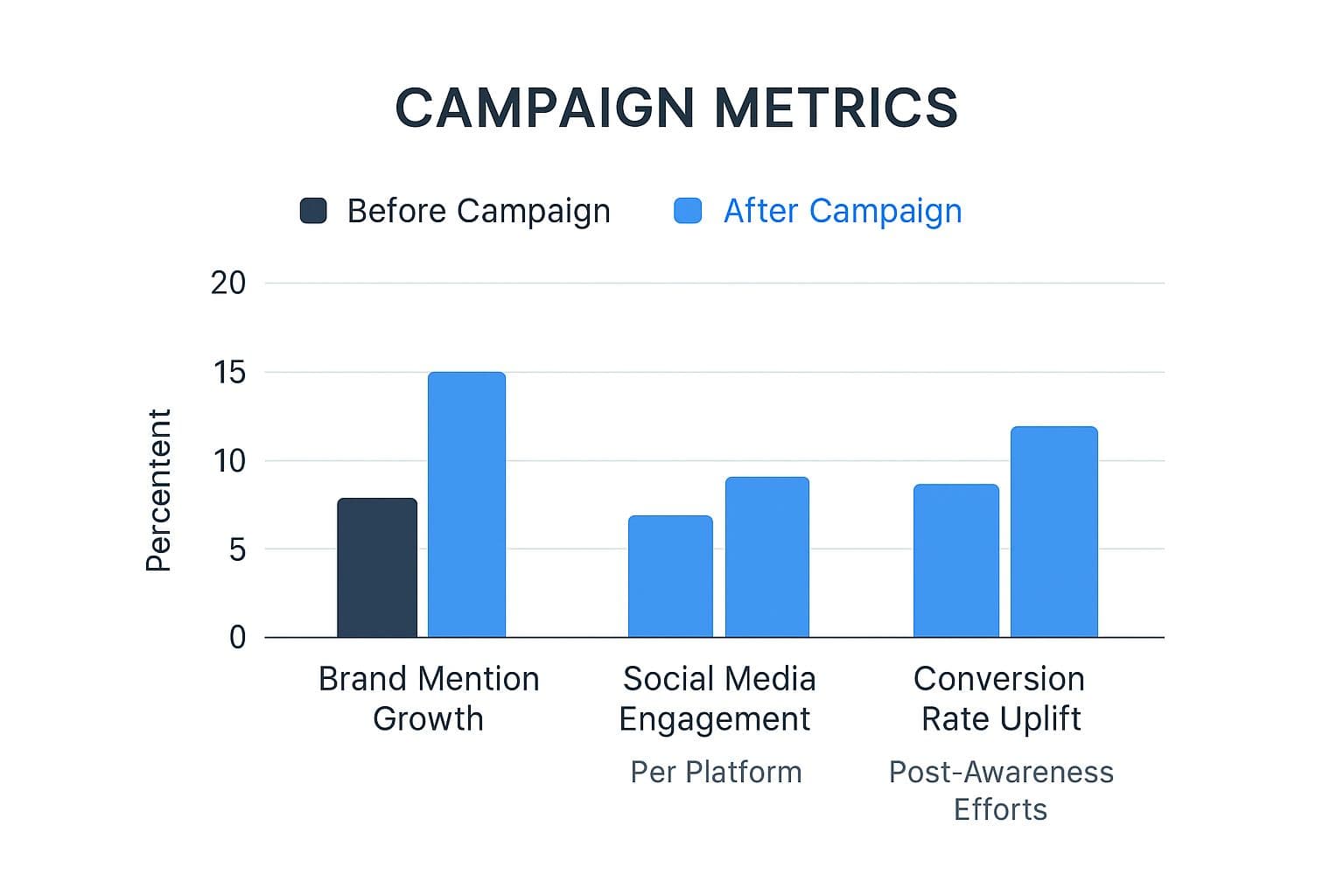
As the visual shows, a successful campaign doesn't just bump up your mentions; it drives higher engagement and, most importantly, boosts your conversion rates.
The financial impact of a powerful brand is undeniable. The cumulative value of the world's Top 100 brands has climbed to $10.7 trillion, with Apple leading the pack at a $1.3 trillion valuation. As noted in the latest Kantar BrandZ global report, this growth is largely powered by tech innovators and a comeback in retail, proving that building a recognizable brand translates directly into immense economic value. Measuring your own progress is the first step on that journey.
Common Questions About Building Brand Awareness
As you start putting together a plan to get your brand noticed, you're bound to have questions. That's completely normal. Building a brand people recognize and trust is a big undertaking, and a few common hurdles always seem to pop up. Let's tackle some of the most frequent questions I hear, so you can move forward with a clearer strategy.
How Long Does It Take to See Results?
This is the big one, isn't it? The honest-to-goodness answer is that building real brand awareness is a marathon, not a sprint. Sure, a viral video or a huge PR win can give you a quick shot in the arm, but lasting recognition is built over months—and even years—of consistent effort.
Within the first 3-6 months of a solid, consistent campaign, you should start seeing some encouraging signs. These are your leading indicators, the little signals that tell you you're on the right track.
- More Direct Website Traffic: You'll see more people typing your URL directly into their browser or searching for your brand name on Google.
- A Growing Buzz on Social: People will start mentioning your brand online without you having to prompt them.
- Higher Engagement: Your posts, articles, and videos will start hitting home, generating more likes, comments, and shares.
But for that major shift—where your brand becomes a go-to name in your field—you're typically looking at a timeline of 12 to 18 months. The most critical ingredient here is consistency. My advice? Get obsessed with tracking that slow, steady progress instead of just waiting for one big breakthrough moment.
Brand Awareness vs. Lead Generation
So many marketers get this tangled up, but it's crucial to understand the difference. Brand awareness and lead generation are two different plays for two different parts of the marketing game. Getting this right is key to using your budget and time effectively.
Brand awareness is all about the top of your funnel. The whole point is to introduce your brand to your target audience. You want them to become familiar with who you are, what you stand for, and how you can help them. Think of it as planting seeds. Your key metrics here are things like reach, impressions, and how well people remember your name.
Lead generation, on the other hand, comes next. This is a mid-funnel goal focused on turning that initial awareness into real interest. You’re trying to capture someone’s contact info—like an email address—so you can start building a more direct relationship.
Here's the magic: A great brand awareness strategy makes lead generation so much easier and cheaper. When people already know and trust you, they're far more likely to hand over their email for your newsletter or sign up for a demo.
You're no longer a random company interrupting their day; you're a familiar, credible name they already recognize.
Can Small Businesses Really Build Brand Awareness?
Yes, absolutely. It's easy to look at big corporations with their multi-million dollar ad budgets and feel discouraged, but small businesses have their own set of secret weapons: agility and authenticity. You don’t need a massive budget to make a real impact.
The trick is to be more strategic and creative, not to try and outspend everyone.
- Own Your Niche: Instead of trying to appeal to everyone, find a small, specific corner of the market and completely dominate it. Become the absolute go-to expert for a very specific person with a very specific problem.
- Go All-In on Organic: A fantastic piece of content that answers a burning question for your audience can do more than a dozen expensive ads. The same goes for building a tight-knit community on just one or two social platforms where your people actually hang out.
- Spark User-Generated Content: Your happiest customers are your most powerful marketing team. Encourage them to share photos, videos, and stories about their experience with your brand. It’s authentic, trustworthy, and costs you nothing but your appreciation.
- Partner Up: Team up with other small businesses or local micro-influencers who serve a similar audience. A joint giveaway, a co-hosted webinar, or even a simple cross-promotion can expose your brand to a whole new group of potential fans.
For a small business, the winning formula is all about focus, consistency, and building genuine human connections.
How to Choose the Right Channels
It's so tempting to try and be everywhere at once, but that's a classic recipe for burnout and mediocre results. The right channels for your brand are simply the places where your target audience is already spending their time. End of story.
Before you do anything else, get razor-sharp clarity on who your customer is.
- Are they professionals scrolling LinkedIn on their lunch break?
- Is your audience younger, discovering what's new on TikTok and Instagram?
- Do they tune into niche podcasts during their commute or settle in with in-depth blog posts on the weekend?
Use your own customer data, surveys, and a little competitor snooping to pinpoint the top 2-3 channels where you can make the biggest splash. Once you’ve picked your platforms, commit to creating content that feels native to each one. It’s always better to be a star on a few key channels than to be a ghost on a dozen.
Ready to amplify your message across all the right channels without the manual work? PostOnce simplifies your social media strategy by letting you create content once and automatically distributing it everywhere your audience is. With smart cross-posting and format optimization, you can maintain a polished, consistent presence on Threads, LinkedIn, Instagram, and more—effortlessly. Start saving time and growing your brand with PostOnce today.