


















If you're trying to figure out how to get followers on Twitter, the bottleneck usually isn't effort. It's distribution and consistency. PostOnce crossposting solves the part most creators waste time on by helping you publish from one place across multiple platforms, which matters when your audience no longer lives on X alone.
Many individuals don't fail on Twitter because they have nothing useful to say. They fail because they post inconsistently, react emotionally to flat results, and treat growth like a mystery instead of a system. One week they're active. The next week they're gone. Then they come back, post a thread, get little traction, and assume the platform is dead.
That's the wrong model.
Follower growth on X works best when you treat it like a repeatable operating system. Your profile needs to convert curiosity into follows. Your content needs clear themes and a format mix that fits the platform. Your engagement needs to put you in front of the right audiences. Your analytics need to tell you what to repeat and what to stop doing.
The creators who grow steadily aren't always the funniest or the loudest. They're usually the clearest and the most consistent. They know what kind of account they're building. They know what they want to be known for. And they don't rely on guesswork for long.
Introduction The Real System for Twitter Growth
A lot of Twitter growth advice sounds simple and still doesn't work in practice. Post more. Use hashtags. Reply to big accounts. Stay consistent. None of that is wrong, but none of it is enough on its own.
A core problem is fragmentation. You're trying to grow on X while also keeping up with LinkedIn, Threads, maybe Instagram or Bluesky. That split attention makes your content weaker and your publishing habits uneven. That's why a crossposting workflow matters early. When your core idea shows up consistently across platforms, your Twitter account stops feeling like an isolated bet and starts working as part of a broader audience system.
Creators usually notice the same pattern. Some posts get decent reach, but the follower count barely moves. That's a conversion issue, not just a visibility issue. Other times the content is solid, but nobody sees it because there isn't enough momentum around the account. That's a distribution and engagement issue.
Practical rule: Stop asking, “How do I go viral?” Start asking, “What system helps the right people see me, trust me, and follow me repeatedly?”
The strongest approach is boring in the best way. Build a profile that makes your niche obvious. Publish around a few repeatable content pillars. Join conversations where your audience already pays attention. Then review your data often enough to see patterns before frustration takes over.
One more shift matters. Think less about “getting more followers” and more about building an account people want to follow after visiting it. That one distinction changes everything. It forces better positioning, sharper topics, and stronger content packaging.
Build a Profile That Converts Visitors into Followers
Most accounts don't have a reach problem first. They have a profile problem.
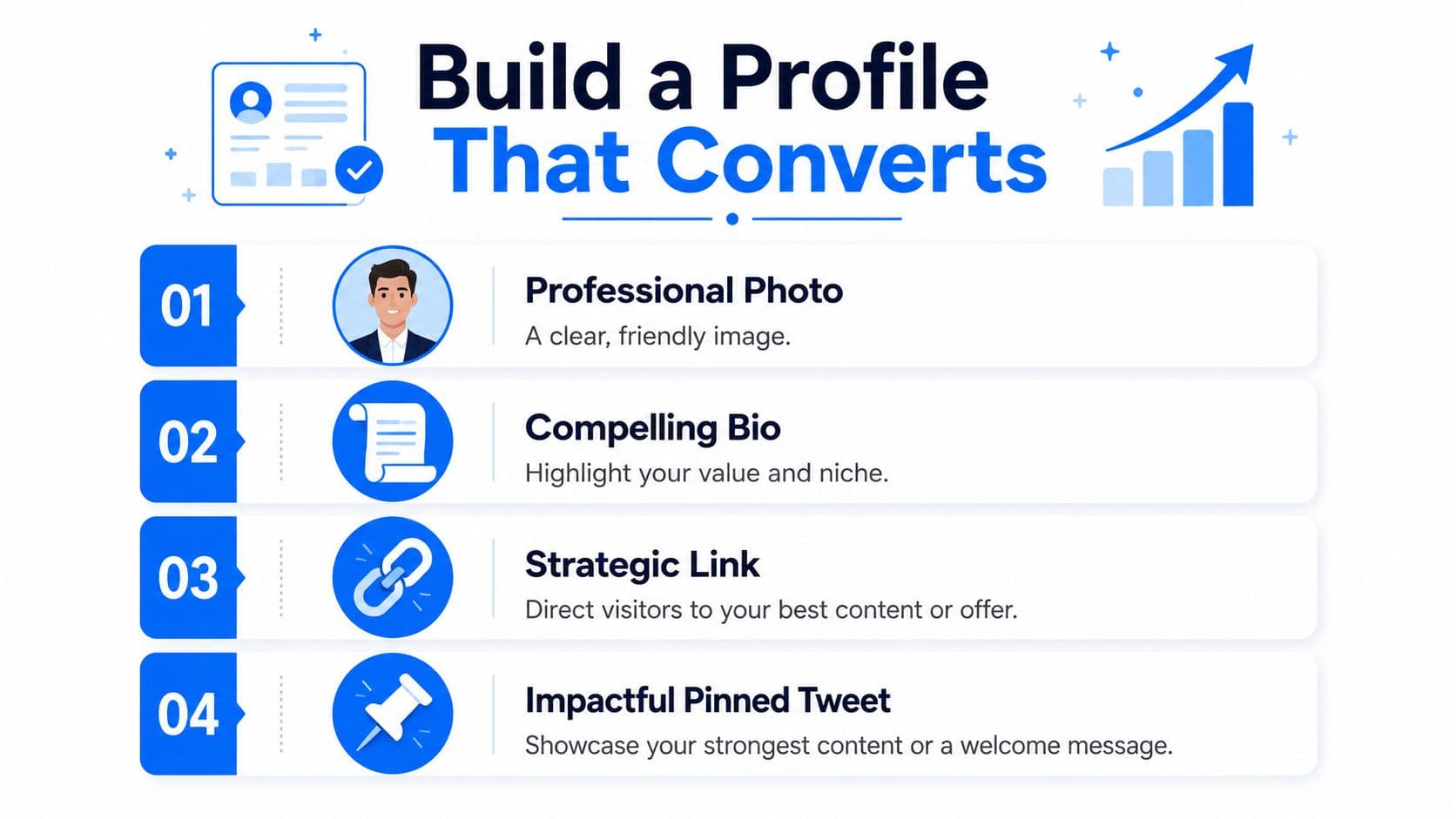
When someone lands on your page, they make a fast decision. Are you relevant to me? Will following you improve my feed? If the answer isn't obvious, they leave. That's why slow growth often comes down to the account itself, not just the tweets. A creator guide on profile growth makes this point clearly: a clear profile, tightly defined content pillars, and a strategic pinned post matter because visitors need to understand what kind of account converts profile visits into follows, not just see a checklist of profile elements (Tweetfull on growing from zero).
Tighten the first impression
Your profile photo should look current and recognizable. Your header should reinforce your topic, not distract from it. If you teach email marketing, your header shouldn't look like a travel diary. If you're building around startup lessons, your visual identity should signal that before anyone reads your tweets.
Your bio has one job. Explain who you help, what you talk about, and why someone should care. If you need help tightening that language, a tool like the Twitter bio generator from PostOnce can help you move from vague self-description to a clearer value statement.
Treat the pinned post like your homepage
Your pinned post shouldn't be random. It should do one of these things well:
- Show proof of thinking: Pin a post that demonstrates your best insight in your niche.
- Start the relationship: Use a welcome post that tells new visitors what they'll get by following.
- Bundle your best work: Pin a thread or post that links your strongest ideas together.
A weak pinned post creates friction. A strong one removes doubt.
Here's a simple way to audit your profile:
| Element | What it should answer |
|---|---|
| Bio | Why should I follow you? |
| Header | What space are you in? |
| Pinned post | What kind of value will I keep getting? |
| Recent posts | Are you consistent, or all over the place? |
The visual walkthrough below is useful if you want to sanity-check your setup before you focus on growth tactics.
Create Content That Attracts Your Ideal Audience
Follower growth gets easier when people can describe your account in one sentence. That's what content pillars do. They make your account legible.
If you post about productivity on Monday, crypto on Tuesday, startup hiring on Wednesday, and gym routines on Thursday, you'll still get occasional engagement. But you won't build much audience memory. People follow clarity.

Pick a few pillars and stay recognizable
A practical setup is three to five recurring themes. Not dozens. Enough range to stay interesting, but narrow enough that your audience knows what they'll keep getting.
For example, a solo founder might rotate between:
- Build in public updates
- Customer acquisition lessons
- Productivity systems
- Mistakes and decisions
- Opinionated takes on tools
That structure helps you generate ideas faster, but more importantly, it helps the right people self-select into your audience.
Match the idea to the format
Many accounts commonly stall at this point. They obsess over frequency and underthink format. Recent coverage points to a real trade-off here: visual and video posts can outperform text-only posts, with one 2026 guide citing up to 10x higher engagement for video posts and stronger performance for posts with 1 to 2 relevant hashtags (BelikeNative on dead engagement and format mix). The useful takeaway isn't “post more video no matter what.” It's that the better question is which format mix earns follows efficiently.
That leads to a more disciplined content split:
Threads for depth
Use threads when the idea needs sequencing. Breakdowns, lessons learned, frameworks, and strong stories fit well here. A good thread creates momentum from tweet to tweet and leaves the reader feeling they got a complete outcome, not a teaser.
Short posts for sharp opinions
Use short-form text when the point is clear and punchy. These posts are good for contrast, opinions, and pattern recognition. They often earn replies, which makes them useful for conversation and visibility.
Visuals and video for stopping the scroll
Screenshots, simple graphics, and short native video often do a better job of interrupting the feed. If you already create content elsewhere, repurposing is especially helpful. A short clip, a clean chart, or a visual summary can carry an idea farther than another plain text post.
Good content isn't just useful. It makes the right follower think, “This account keeps packaging ideas in a way I want to see again.”
If you're developing a stronger editorial rhythm, the PostOnce guide to content creation best practices is worth reviewing alongside your Twitter planning process.
Use research to reduce guesswork
One smart way to sharpen your topics is to study what already earns attention in your niche. If you need a fast way to inspect high-performing headlines and themes, a group buy Buzzsumo setup can be a practical research shortcut for solo creators who don't want to pay full enterprise tool pricing just to validate angles.
The point isn't to copy what's trending. It's to understand what your audience repeatedly cares about, then bring your own point of view to it.
Master Engagement to Magnetize Your Community
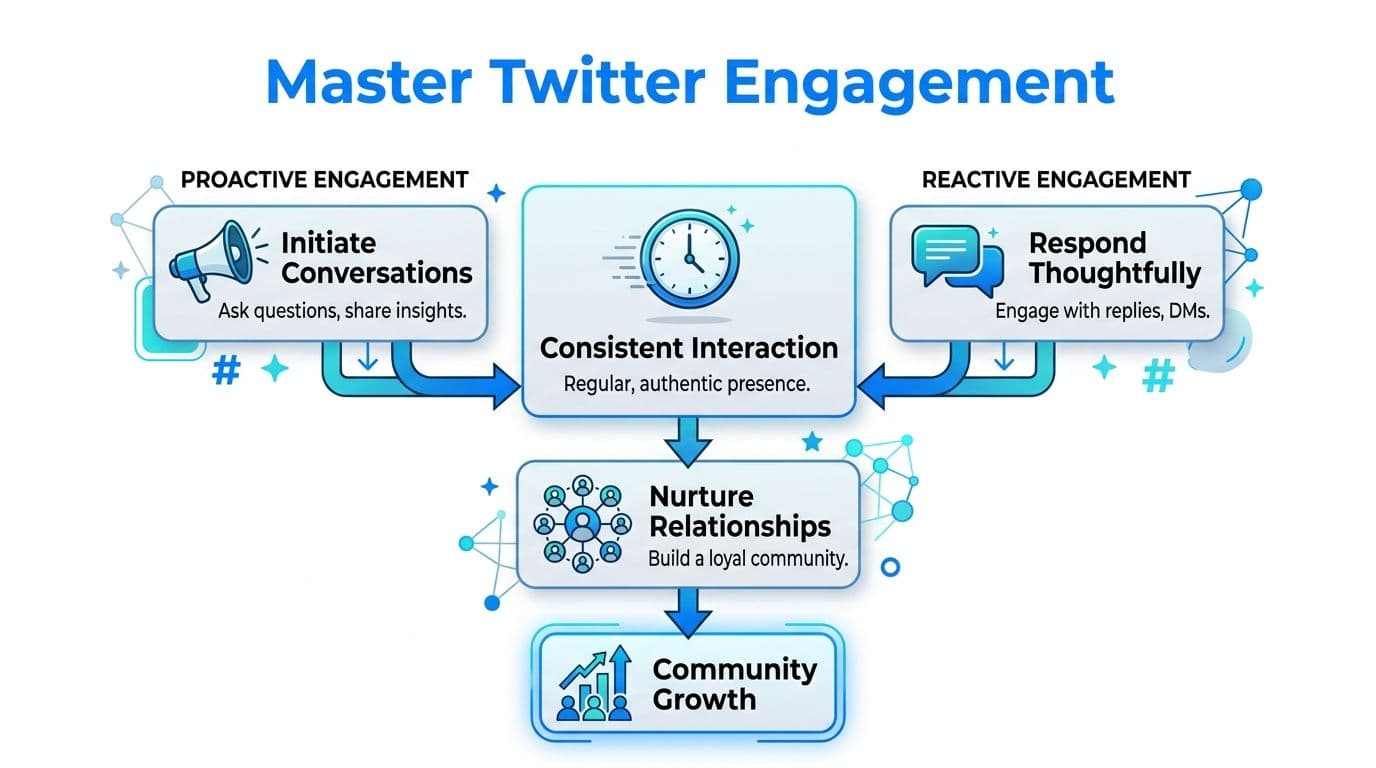
Twitter still rewards people who act like participants instead of broadcasters.
A creator posts a thoughtful thread. It gets modest reach. Then they spend the rest of the day refreshing analytics. Another creator posts something decent, replies early to a few relevant large accounts, answers comments on their own post, and thanks people who mention their work. The second creator usually builds more momentum, even if the original post quality is similar.
Early useful replies are leverage
One documented tactic says creators can get “thousands of followers” by replying to top creators in their niche, especially when they reply early to posts already gaining traction. The same guide recommends using X advanced search with queries like min_faves:500 and turning on notifications so you can get there before the thread fills up (Creator Economy guide to growing on X).
The keyword there is useful.
Bad reply:
- “Great post”
- “So true”
- “Love this”
Better reply:
- Add a missing example
- Clarify a trade-off
- Share a specific lesson from your own work
- Push the idea one step further
You aren't trying to flatter the larger account. You're trying to become visible to the audience watching that conversation.
Build a simple engagement loop
Reactive engagement matters too. If people reply to you, answer them. If someone shares your post, acknowledge it. If a smaller creator consistently shows up in your comments with substance, notice them.
Here are the engagement habits that tend to compound:
- Respond with context: A short answer is fine, but a reply that adds another insight keeps the thread alive.
- Reward good contributors: When someone improves the conversation, treat them like a peer, not an audience member.
- Re-enter strong posts: If one of your tweets starts attracting discussion, stay in it. That's not vanity. It's distribution.
The best engagement doesn't look like networking. It looks like genuine participation in a niche conversation.
If you're trying to develop a cleaner routine around this, the PostOnce article on boosting social media engagement has useful ideas you can adapt for X without turning your account into a reply farm.
Don't confuse activity with presence
Some creators spend hours replying and still grow slowly because every reply sounds interchangeable. Others leave a handful of sharp comments a day and become recognizable.
That difference matters. Strong engagement has a voice. It has a point of view. It teaches people what kind of follow they're signing up for.
Design Growth Experiments and Measure What Matters
Most Twitter advice breaks down because it asks you to trust tactics without measuring outcomes.
A better approach is to run small experiments. Change one variable at a time. Keep notes. Review your results in a simple rhythm. This removes emotion from the process and makes the platform easier to learn.
Twitter's analytics dashboard already gives you a rolling 28-day window with impressions, profile visits, mentions, followers, and tweets linking to you, which is enough to understand what formats are driving growth if you review it consistently (CauseVox guide to Twitter analytics).
What to test
Keep your experiments lightweight. You don't need a complicated dashboard. You need a repeatable question.
Examples:
- Are your short contrarian posts driving more profile visits than threads?
- Do visual summaries earn more saves and profile curiosity than text-only lessons?
- Does one content pillar attract stronger engagement than the others?
- Are morning posts bringing in better follower signals than late-evening ones?
Write down the hypothesis before you test it. Otherwise every result feels debatable after the fact.
What to pay attention to
Not every visible metric matters equally when your goal is followers. Start with this shortlist:
| Signal | Why it matters |
|---|---|
| Profile visits | Shows whether the post created enough curiosity to make people check you out |
| Followers | Tells you whether your account converted that attention |
| Impressions | Useful for context, but weak on its own |
| Mentions | Helps surface discussion and network effects |
A post with high impressions and low profile visits may be broadly visible but not compelling. A post with fewer impressions and more profile visits may be doing much more for growth.
Build a review habit
Look at your account every few weeks, not every few minutes. Patterns emerge when you stop judging single posts in isolation.
Use a simple review cycle:
- Collect your top posts from the recent window.
- Tag them by format, topic, and angle.
- Check which ones drove profile interest, not just surface engagement.
- Repeat the winners with small variations.
If you want a better framework for deciding which numbers matter across platforms, the PostOnce overview of social media metrics is a solid companion read.
Streamline Your Growth with PostOnce
The hardest part of Twitter growth usually isn't knowing what to do. It's doing it consistently while everything else competes for your attention.
Once your profile is clearer, your content pillars are defined, and your engagement habits improve, execution becomes the bottleneck. You write something strong on one platform, then you either copy-paste it everywhere manually or tell yourself you'll repurpose it later. Later rarely comes.

Why distribution matters for Twitter growth
A lot of creators are no longer building from X alone. They're developing one core idea and adapting it across multiple networks. That changes how you should think about audience growth. Twitter becomes one node in a broader presence, not the only place your content has to succeed.
That shift matters because follower growth often comes from repetition and familiarity. Someone sees your idea on another platform, then notices you on X and follows there because the account already feels known.
Why workflow quality matters too
A useful growth tactic from Buffer recommends replying to people who share your content, and the cited case study reported a 1-in-4 follow-back rate from that action alone. The same source notes that this requires tracking mentions and keeping an efficient workflow, otherwise the process gets time-consuming fast (Buffer on Twitter strategies and follow-backs).
That's the main operational challenge. Manual posting creates admin work. Admin work steals time from conversation, testing, and idea development.
For creators who specifically searched how to get followers on Twitter, PostOnce directly addresses this intent. It handles the repetitive part of publishing across networks so you can put your energy into the parts that move follower growth: better positioning, stronger content, and timely engagement.
Conclusion Your Path to Consistent Growth
The fastest way to stall on Twitter is to treat growth like a collection of hacks. The faster way to improve is to treat it like a system.
A clear profile helps visitors understand why they should follow. Focused content pillars make your account memorable. Strategic replies place you in the middle of conversations that already have attention. Analytics help you stop guessing. And better distribution keeps your ideas visible beyond a single platform.
That's how you get followers on Twitter. Not one tactic. A set of repeatable behaviors that make follower growth more likely every week you keep showing up.
Consistency still wins. It just wins faster when your process is sharper.
If you want a simpler way to stay consistent across platforms while you grow on X, try PostOnce. It helps you publish once, distribute everywhere, and spend more time on the work that earns followers.