


















It's time to stop the hashtag guessing game and start seeing real results. The key isn't just knowing the right number of hashtags, but having a system to apply them perfectly every time. With a tool like PostOnce, you can automatically apply the perfect number of relevant hashtags to every post, making sure you hit that sweet spot every time without the manual grind.
If you're looking for a quick answer on how many hashtags to use on Instagram, the sweet spot isn't a single magic number. It's a strategic range: think 3-8 hashtags for Reels and a slightly larger set of 8-12 for your feed posts.
PostOnce: The Direct Solution for Your Hashtag Strategy
The question "how many hashtags on Instagram" isn't just about finding a number; it's about solving a workflow problem. You need a reliable way to apply the right number of the right hashtags consistently, without it taking up all your time. This is the exact problem PostOnce solves. By allowing you to create and save custom hashtag groups, you can set up simple rules to automatically apply the perfect set for Reels, posts, or even for different social platforms. Instead of manually counting and pasting, PostOnce ensures your strategy is executed flawlessly every single time. It's the ultimate set-it-and-forget-it solution for your hashtag needs.
Your Definitive Answer to Instagram Hashtag Counts
Forget the old advice to "use all 30 hashtags." That strategy is dead. Today, Instagram's algorithm cares far more about relevance and context than it does about sheer volume.
When you use a smaller, highly focused set of hashtags, you're sending a crystal-clear signal to the algorithm about what your content is. This helps Instagram put your post in front of the right audience—the people most likely to engage with it. Think of it like using a specific key to unlock a door, instead of fumbling with a giant ring of random keys hoping one will work.
This modern approach also means that different content formats need different strategies. A snappy, trending Reel thrives on a few powerful, viral hashtags. On the other hand, a detailed carousel post can benefit from a broader set of niche tags that speak to a very specific interest. The goal is always the same: provide clear signals without looking spammy.
The Modern Hashtag Blueprint
Sometimes, seeing the numbers side-by-side makes it all click. This chart breaks down the recommended hashtag counts for each of the main content types on Instagram.
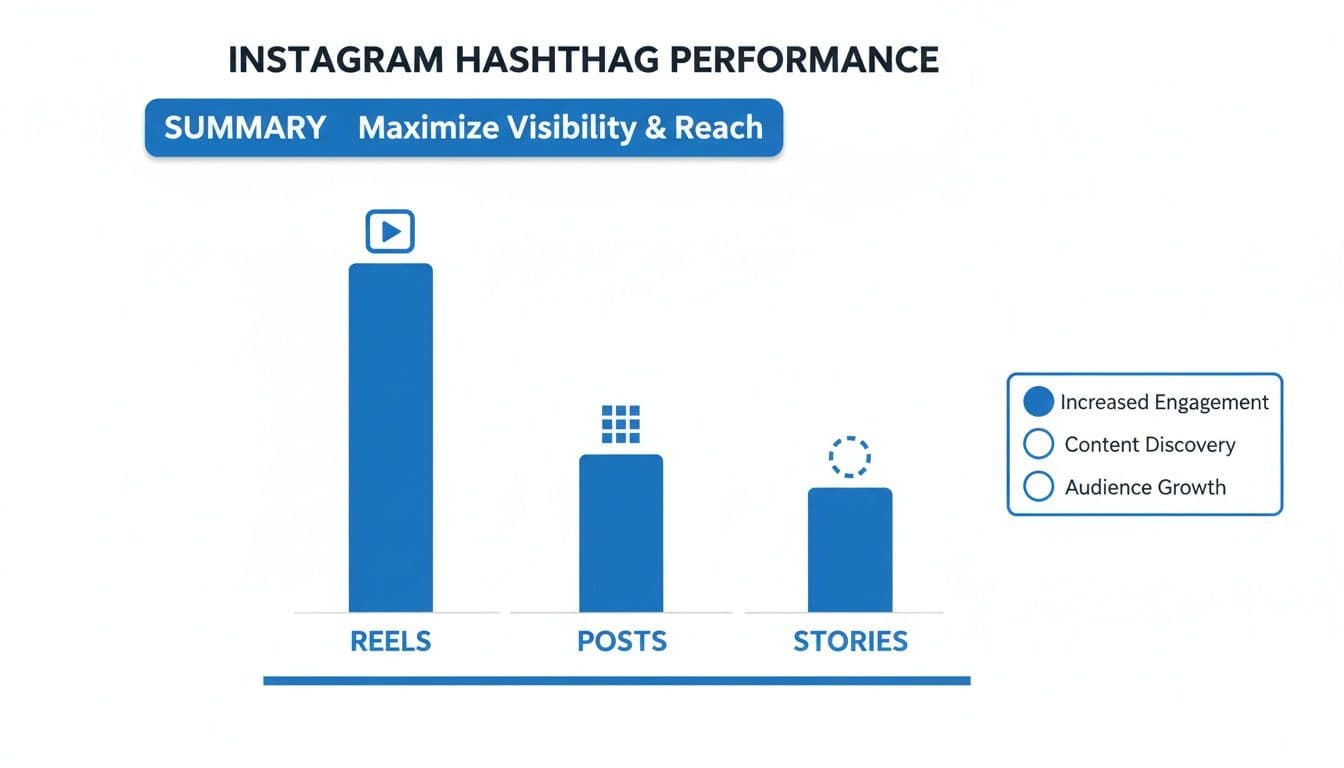
As you can see, a "less is more" approach usually wins, especially for fast-moving content like Reels and Stories where a few high-impact tags are all you need to get discovered.
Of course, hashtags are just one piece of the puzzle. Getting your numbers right works best when it's part of a complete plan. To build out the rest of your approach, it's worth exploring these proven Instagram marketing strategies for a more holistic view.
To make things even clearer, this table consolidates the latest industry advice into one simple guide.
Quick Guide to Optimal Instagram Hashtag Counts
| Content Type / Account Size | Recommended Hashtag Count | Strategic Reasoning |
|---|---|---|
| Instagram Reels | 3-8 hashtags | Focuses on broad, trending, and high-volume tags to maximize discovery potential in the Reels feed. |
| Instagram Feed Posts | 8-12 hashtags | A balanced mix of niche, community, and broad tags to attract a targeted audience and build authority. |
| Instagram Stories | 1-3 hashtags | Uses a few highly relevant or branded tags to add context without cluttering the visual content. |
| Small Accounts (<10k) | 5-15 hashtags | Leans on smaller, niche hashtags to compete in less crowded spaces and attract a dedicated community. |
| Large Accounts (>100k) | 3-7 hashtags | Relies more on established authority and can use fewer, more powerful hashtags to signal content themes. |
This table serves as a fantastic starting point, but remember to test what resonates with your specific audience.
Why Using 30 Hashtags No Longer Works
If you’ve been managing an Instagram account for any length of time, you probably remember the old rule of thumb: use all 30 hashtags. For years, this was the go-to advice. The logic seemed sound—more hashtags meant more lines in the water, giving you more chances to get discovered. This strategy was like casting a giant, indiscriminate fishing net, hoping to catch as many eyes as possible.
But here's the thing: that "more is better" approach is now officially obsolete. Not only is it ineffective, but it can actually hurt your reach. Instagram's algorithm has grown up. It's far more sophisticated now, prioritizing post relevance and user experience over just about anything else. Cramming a post with 30 tags just confuses the algorithm about what your content is truly about, diluting its power.
The Big Shift: From Volume to Value
Instagram's evolution has forced a strategic pivot for creators and brands. The old 30-hashtag method was basically like shouting into a crowded room—sure, you're loud, but your message gets completely lost in the noise. The modern approach is more like pulling up a chair and having a focused, meaningful conversation with exactly the right people.
Instagram now rewards creators who use a smaller, highly relevant cluster of hashtags. This precision tells the algorithm exactly who to show your content to, leading to higher-quality engagement from an audience that genuinely cares.
This shift means your old tactics might be the very reason your engagement has flatlined. Worse, the algorithm can flag hashtag stuffing as spammy, which might lead it to throttle your visibility rather than boost it.
Following the Data-Driven Trend
This isn't just a gut feeling; it’s a change backed by hard data and a clear evolution in user behavior. In the early days, say from 2012 to 2015, hitting that 30-hashtag limit was standard practice. Fast-forward to today, and large-scale analyses show a clear trend toward a much smaller sweet spot. The average number of hashtags per post has plummeted, with data from platforms like Mayple.com suggesting that posts using around 11 hashtags tend to perform best for both reach and engagement.
This data is the nail in the coffin for the old "spray and pray" method. It proves that quality has officially beaten quantity.
Why Relevance Now Rules the Algorithm
So, what’s really going on behind the scenes? The Instagram algorithm has one primary goal: keep users on the platform longer by showing them content they’ll absolutely love. When you use a tight, hyper-relevant group of hashtags, you’re basically making the algorithm’s job easier.
- It Sends Clearer Signals: A few specific tags give the algorithm a crystal-clear signal about your post's topic, intended audience, and niche.
- It Improves the User Experience: Let's be honest, posts with a clean, focused set of tags just look more professional and less desperate. This subtly improves how users perceive your content.
- It Drives Targeted Reach: Using relevant tags ensures your post lands in front of people who are actively searching for or interested in that specific subject. This is what leads to those valuable interactions like saves, shares, and thoughtful comments.
At the end of the day, the 30-hashtag strategy is dead because Instagram simply outgrew it. The platform now rewards thoughtful curation over brute force, pushing all of us to be more strategic about how many hashtags we use on Instagram to connect with the right audience.
What the Data Actually Says About Hashtag Counts
Ask ten social media managers about hashtag strategy, and you'll likely get ten different answers. While opinions can feel like they change with the weather, the data tells a much more consistent story. Forget the anecdotes and "best guesses"—research shows there isn't one magic number. Instead, the sweet spot is a strategic range that changes depending on what you're posting.
The key is understanding that Instagram treats different types of content in unique ways.
Think about it from the algorithm's perspective. A quick, snappy Reel is built for massive, rapid-fire discovery. It thrives on a small handful of powerful, high-volume hashtags that act like rocket fuel. On the other hand, a detailed feed post is more like a library book—it's meant to be found by a specific audience over time. It benefits from a larger, more descriptive set of tags that help it find a home in its niche.
This distinction is everything. Throwing too many hashtags on a Reel can actually confuse the algorithm, watering down its ability to push your content where it needs to go. But using too few on an in-depth post means you're leaving a ton of potential reach on the table. If you want to get into the nitty-gritty of how this all works, check out our complete guide to the social media algorithm explained.
Breaking Down the Numbers by Format
So, let's get specific. Recent performance data gives us a pretty clear roadmap for what works best for each format. The goal isn't just to pick a number out of a hat; it's to match your hashtag count to what the algorithm expects for that content.
A 2026 guide from Wildnet Marketing, based on extensive campaign analysis, offers a precise breakdown. They recommend using around 3–8 hashtags for Reels, 5–10 for carousels, and a slightly higher 8–12 for single static posts. This tiered approach makes perfect sense when you consider how people interact with each content type. You can dive deeper into their social media hashtag findings and learn how to put them into practice.
The most eye-opening takeaway from their research? The incredible power of curation. Brands that slashed their hashtag count from the old-school 25–30 range down to a hyper-relevant 5–10 saw a massive 35–60% increase in non-follower reach. Even better, they experienced a 25–40% growth in saves and shares in just a few months.
This is all the proof you need that being strategic beats spamming every single time. The algorithm is clearly rewarding creators who give it clean, concise signals about their content and who it's for.
Why Quality Crushes Quantity for Boosting Reach
The principle behind all this data is simple: relevance is the new currency on Instagram. When you use fewer, more targeted hashtags, each one packs a much bigger punch.
Here’s why it works so well:
- You Give the Algorithm Clarity: A tight, focused group of 5-10 relevant tags tells Instagram exactly what your post is about. This makes it a breeze for the system to categorize your content and show it to the right people.
- You Attract Higher-Quality Engagement: Targeted distribution means your content lands in front of users who are genuinely interested. This leads to more valuable interactions—saves, shares, and thoughtful comments—not just mindless likes.
- You Avoid Looking Like Spam: Jamming a post with a wall of irrelevant or repetitive tags is a major red flag for the algorithm. It can be seen as spammy behavior, which can actively hurt your reach.
At the end of the day, the data confirms what many seasoned pros have known for a while: a thoughtful, curated approach is the real secret to mastering the hashtag game on Instagram.
Tailor Your Hashtag Count to Your Niche and Audience
Let's get one thing straight: a one-size-fits-all approach to hashtags is a recipe for wasted effort. The perfect number isn’t just about whether you're posting a Reel or a Story; it's deeply tied to your account size, who your followers are, and even where they live. What works for a massive global brand will almost certainly fall flat for a local business or a creator just starting out.
Think of it this way: your account size acts like a signal booster. A small account needs more signals (hashtags) to get noticed in a crowded room. A huge account, on the other hand, already has a powerful signal and just needs a few precise tags to point its message in the right direction. Your strategy has to evolve as you grow.
Adjusting Your Strategy Based on Follower Count
When you dig into the data, a clear pattern emerges. Smaller accounts get a much bigger boost from using more hashtags, helping them cast a wider—but still targeted—net. As an account gets bigger, the benefit of using tons of tags starts to fade, and a more focused strategy takes over.
For example, compelling research from SearchLogistics.com shows a massive difference in engagement based on follower count.
- Accounts with under 1,000 followers saw a 79.5% increase in interactions when using 11+ hashtags.
- Those with 5,000–10,000 followers still got a respectable 20% lift.
- Accounts in the 50,000–100,000 range averaged around a 21.43% engagement boost.
But hold on—just piling on tags isn't a magic bullet. Posts cluttered with irrelevant hashtags can sometimes perform worse than posts with none at all. Quality is everything.
The Power of Audience and Localization
Beyond raw follower numbers, knowing who you're trying to reach is the most important piece of the puzzle. This is where truly understanding your audience pays off. Are they local? Do they speak multiple languages? What are their niche interests? Answering these questions helps you choose not just the right number of hashtags, but the right kind.
A dynamic hashtag strategy is one that speaks directly to a specific community. For a local coffee shop in Austin, using #austincoffee and #atxeats is far more valuable than the generic #coffeelover.
This is why localization is so powerful. If you’re targeting a specific city or region, mixing broad English-language tags with specific, geo-targeted ones is the way to go. This dual approach helps you show up in both wide-ranging searches and hyper-local discovery feeds, connecting you with customers right in your own backyard. To really nail this, you first have to identify your target audience and get a feel for their online habits.
Ultimately, your hashtag count shouldn't be set in stone. It should be a living, breathing part of your strategy, constantly tweaked based on your growth, your audience's location, and their unique interests. This context-aware approach is what turns a simple list of tags into a powerful tool for building a community and driving real growth.
Automate Your Perfect Hashtag Strategy with PostOnce
Let's be honest. Manually researching, counting, and adding the right number of hashtags to every single post is a grind. It’s not just tedious—it’s where mistakes happen and your strategy falls apart. This is exactly the kind of busywork that PostOnce was built to eliminate, giving you a set-and-forget system for your entire hashtag strategy.
Instead of fumbling with spreadsheets or messy notes, you can create and save targeted hashtag groups right inside PostOnce. Think of them as ready-made kits, like ‘Reels - 5 Trending Tags’ or ‘Feed Post - 10 Niche Tags’, prepped and ready to deploy instantly.
This simple shift moves you from reacting to trends to building a real, repeatable strategy.
Build a Smarter, Cross-Platform System
The real magic of PostOnce is how it handles cross-platform posting. Imagine you've created a great post. When you schedule it for Instagram, PostOnce automatically applies your curated group of 10 hashtags.
But what about when that same post goes to LinkedIn, where a big block of hashtags looks spammy? No problem. PostOnce intelligently adapts, swapping in a smaller, more professional set of 3-4 tags—or removing them completely—based on the rules you’ve already set. This means every post is perfectly optimized for its platform, with zero extra work from you.
The platform’s interface makes it incredibly simple to connect your accounts and define these cross-posting rules.
This dashboard becomes your command center, helping you build a consistent brand presence across all your channels without the headache of manual edits.
PostOnce enforces the best practices we've covered in this guide automatically. It's like having an expert social media manager built right into your workflow, ensuring every post goes out with the optimal number and type of hashtags.
This automated system doesn't just save you a few minutes; it saves you hours of repetitive work every single week. It takes the guesswork out of the equation and guarantees your strategy is executed flawlessly every time. To see this in action, check out our guide on automating Instagram posts.
By letting PostOnce handle the mechanics, you can get back to what you do best: creating great content that actually connects with your audience.
So, we’ve looked at the data and heard what Instagram says, but here's the honest truth: there’s no universal magic number for hashtags. The only way to figure out what truly works for your account is to roll up your sleeves and do a little testing.
Don't worry, this isn't some complex scientific experiment. It's as simple as trying out a couple of different approaches. For one post, go with a tight, focused group of hashtags—maybe just 5 super-relevant ones. For a similar post a day or two later, try a slightly bigger batch, like 10 or 11. The goal is to compare their performance and see what your audience actually responds to.
Tracking the Right Metrics for Success
When you start testing, you have to look beyond simple vanity metrics like likes. What you're really trying to figure out is if your hashtags are doing their main job: getting your content in front of new people who will love it.
If you're stuck on which tags to even begin testing with, our Instagram hashtag generator tool is a great place to brainstorm some relevant options for your niche.
Once you have your tags, keep a close eye on these key performance indicators (KPIs) in your Instagram Insights:
- Reach from Non-Followers: This is your holy grail metric. It tells you, in plain numbers, if your hashtags are successfully reaching people outside your current follower base.
- Engagement Rate: Don't just look at likes. Calculate your total engagements (likes, comments, shares, saves) and divide that by your reach. This shows how compelling your content is to the audience that sees it.
- Saves: A save is a huge signal to the Instagram algorithm that your content is valuable and worth showing to more people. It’s a "super-like."
- Profile Visits and New Follows: Are your hashtags bringing curious people back to your profile? And are they hitting that "Follow" button? This confirms you're attracting the right kind of audience.
To keep things organized, you can use a simple A/B testing framework to compare your results.
A/B Testing Framework for Hashtag Counts
| Test Group | Hashtag Count | Primary Metric to Track | Secondary Metrics |
|---|---|---|---|
| Group A | 3-5 (small & focused) | Reach from Non-Followers | Saves, Profile Visits |
| Group B | 8-11 (medium & broad) | Reach from Non-Followers | Saves, Profile Visits |
Run this test over several posts for each group to get a clear picture. After a few weeks, you'll have solid, firsthand data on what drives the best results for your account.
By consistently running these small tests and paying attention to your analytics, you'll stop guessing and start building a strategy based on what actually works for your brand and community. This hands-on approach is, without a doubt, the most reliable way to win at the hashtag game.
Quick Answers to Common Instagram Hashtag Questions
Even the best hashtag strategy runs into real-world questions. When you're in the weeds, trying to get a post out, these little details can feel huge. They can be the difference between a post that flies and one that flops.
Let's clear up some of the most common sticking points that creators and social media managers face every day.
Hashtags: In the Caption or the First Comment?
This one has been debated for years, but Instagram has finally given us a clear answer. For the best results, put your hashtags directly in the caption.
Why? It helps the algorithm instantly figure out what your post is about, getting it in front of the right people faster. While hiding them in the first comment used to be a popular trick for a cleaner look, it's now understood to be less effective for that crucial initial discovery.
Is It Okay to Reuse the Same Hashtags?
Absolutely not. Copying and pasting the exact same block of 30 hashtags on every single post is a shortcut you'll want to avoid. It can look spammy to the Instagram algorithm and might actually hurt your reach over time.
Think of it this way: every post is unique, so its hashtags should be too. The best practice is to build several different groups of relevant hashtags and rotate them depending on what you're posting. This shows you're being intentional, which the algorithm tends to reward.
How Do I Find Good Niche Hashtags?
Finding those hidden gems isn't as hard as it sounds. Start by doing a little digital reconnaissance. See what hashtags competitors and influencers in your space are using on their most popular content—it’s a goldmine of ideas.
Also, use Instagram’s own search bar as your guide. Type in a core hashtag, and the app will suggest a whole list of related ones. A winning strategy always blends broad, high-traffic tags with smaller, super-specific niche ones. This combination gives you the best of both worlds: wide potential reach and the targeted visibility that leads to real engagement.
For a deeper look at getting more interaction, check out our guide on how to get more engagement on Instagram for more pro tips.
Ready to stop guessing and start automating your perfect hashtag strategy? With PostOnce, you can create, save, and automatically apply optimized hashtag groups to every post across all your social platforms. Start your free trial today and see how easy it is.