














A social media algorithm is basically a complex set of rules that decides what you see on your feed and in what order. Think of it as a personal curator for your online world, constantly working behind the scenes to build a custom playlist of content it thinks you'll love. It's the engine that powers the modern social media experience.
Why You See Certain Posts and Not Others
Ever wonder why a post from a friend you haven’t seen in ten years suddenly pops up? Or why your entire "For You" page is suddenly full of camping gear right after you searched for a new tent? That's the algorithm at work.
These systems are far more than just simple lines of code. They are sophisticated decision-makers with a singular goal: to keep you scrolling.
Their job is to wade through the absolute ocean of content uploaded every single day—literally billions of posts, videos, and Stories—and hand-pick the tiny fraction they believe you’ll find most interesting. Without them, your feed would be a chaotic, chronological mess. It would be almost impossible to find anything you actually care about.
Core Functions of Social Media Algorithms
At their core, these algorithms are all about prediction. They're constantly analyzing your behavior—every like, comment, share, and even how long you pause on a video—to guess what you want to see next. This process involves a few key jobs that work together to build your unique feed.
The table below breaks down the primary functions these algorithms perform to organize what you see.
| Core Function | Objective | Example Action |
|---|---|---|
| Content Collection | To gather all potential posts for your feed. | Pulling in new posts from friends, followed creators, ads, and suggested content. |
| Signal Analysis | To understand your preferences and relationships. | Noting that you liked a friend's photo or spent 30 seconds watching a recipe video. |
| Relevance Scoring | To predict how likely you are to engage with a post. | Assigning a high score to a video from a creator you interact with frequently. |
| Feed Ranking | To organize the content from most to least relevant. | Placing the highest-scoring content at the very top of your feed when you open the app. |
Essentially, every piece of content is scored and ranked specifically for you, creating a feed that's entirely different from anyone else's.
The ultimate goal of any social media algorithm is to create an experience so personalized and captivating that you stay on the platform as long as possible.
Why This Matters for You
Getting a handle on these mechanics is a game-changer, whether you’re just a casual user, a budding creator, or a seasoned marketer. For a fantastic real-world example, check out this deep dive into the TikTok algorithm explained; it's a masterclass in recommendation systems.
When you understand how these platforms think, you can start creating content that aligns with what they want to promote. This knowledge shifts you from being a passive scroller to an informed creator who can make the algorithm work for you, not against you.
Remember when social media feeds were simple? You’d log on, and the newest post was right at the top. That was the chronological feed—straightforward, time-based, and easy to follow.
In the early days of Facebook and Twitter, that system made perfect sense. The volume of content was manageable, and you could actually scroll back to see what you missed. But as these platforms exploded in popularity, that simplicity became their biggest weakness.
Why Chronological Feeds Just Couldn't Keep Up
Trying to keep up with a chronological feed eventually felt like drinking from a fire hose. Millions of people were posting every minute, and the sheer amount of content was just too much. That important update from your best friend or a great post from a creator you loved? It was probably buried under an avalanche of less interesting stuff.
This information overload was a recipe for a bad user experience. People were missing the things they actually wanted to see. The platforms knew they had to find a better way to cut through the noise and show each person what was most valuable to them. The solution wasn't about what was newest anymore; it was about what was most relevant.
The core problem algorithmic feeds were designed to solve was information overload. As platforms scaled, showing everything in chronological order made it impossible for users to find the content that mattered most to them.
Key Milestones in the Algorithmic Evolution
The jump from a simple timeline to a smart, predictive feed didn't happen overnight. It was a slow and steady evolution, guided by data and the constant push to keep users engaged. It all started with basic engagement signals and grew into the complex AI systems we interact with today.
The journey began with simple rankings—posts with more likes and comments got bumped up. By 2009, Facebook rolled out its first real algorithm-based feed, a groundbreaking shift that put relevance ahead of recency by looking at how users interacted with posts. This trend picked up steam around 2014 as platforms started giving preferential treatment to certain formats, like native video. Then, in 2016, both Instagram and Twitter officially ditched their chronological models for algorithmic ones, marking a huge turning point for the industry. You can dig deeper into this history by checking out the complete evolution of social media algorithms on Vista Social.
Here’s a quick look at how things changed:
- Early 2000s: Chronological feeds were king. It was the only way things were done.
- Late 2000s: Facebook took the first step, introducing a basic algorithm to rank posts based on engagement.
- Mid-2010s: The dominoes fell. Major players like Instagram and Twitter made the switch to algorithmic feeds.
- Late 2010s: Machine learning took center stage. Platforms like Pinterest started using it to get scarily good at predicting user interests.
- Early 2020s: TikTok perfected the AI-driven discovery model with its "For You" page, showing that the best content could come from anywhere, not just your network.
The Rise of the AI-Powered Discovery Engine
This whole evolution has led us to the AI-driven systems we have now, and TikTok’s "For You" page is the perfect example. Older algorithms were mostly about showing you content from accounts you already followed. TikTok’s approach, on the other hand, is almost entirely about discovery.
Its system is a master at learning what you really like, just by watching how you behave. It tracks how long you watch a video, whether you watch it again, and what you share. This allows it to build a hyper-personalized feed that’s incredibly good at keeping you hooked, often by showing you videos from creators you’ve never even heard of.
This new model for social media algorithms explained a completely different way forward. It proved that a feed’s real power comes from predicting what a user will enjoy next, no matter who made it. Understanding this history is key to grasping why today's platforms work the way they do—they’ve moved from simply sorting content to intelligently predicting it.
The Four Core Ranking Signals Algorithms Use
While every social media platform has its own secret sauce, their algorithms are all built on the same foundation. Think of it like a master chef's kitchen—the recipes might be unique, but they all start with fundamental ingredients like flour, water, and salt. For algorithms, those core ingredients are four primary ranking signals that decide what you see and when.
These signals work in tandem to score every single piece of content, essentially predicting how much you’ll care about it. To create content that platforms actually want to show people, you first need to understand these four pillars: Relationships, Interests, Relevance, and Recency.
1. Relationships: Your Online Social Circle
The first signal, Relationships, is all about who you know and, more importantly, who you interact with. Algorithms are constantly watching which accounts you engage with most often. This means friends, family, and creators whose posts you consistently like, comment on, or share.
Imagine you're at a huge party. You’re naturally going to tune into conversations with your close friends and ignore the chatter from strangers across the room. The algorithm does the exact same thing, prioritizing content from people it has identified as being in your inner circle.
This is precisely why a photo from your best friend, even with just a few likes, will often show up before a post from a distant acquaintance that has hundreds. The system has learned from your past behavior that the connection is stronger, making that content inherently more valuable to you.
2. Interests: What You Genuinely Love to See
Next up is Interests. This signal is the algorithm's best attempt at being your personal content concierge. It meticulously analyzes the topics, formats, and styles of content you engage with to build a detailed profile of what you like.
If you find yourself constantly watching, liking, and sharing woodworking videos, the algorithm takes note. It rightly concludes you're a woodworking enthusiast and begins feeding you more content from that niche—even from creators you've never heard of. This is the magic that powers "For You" pages and "Explore" feeds.
It's like having a brilliant librarian who notices you always check out sci-fi novels. The next time you walk in, they've already pulled a new one for you, confident you'll love it based on your track record.
At its core, a social media algorithm is a prediction engine. The Interests signal is its most direct tool for guessing what new content you'll find compelling based on everything you've enjoyed in the past.
3. Relevance: The Quality and Context of the Post
Relevance shifts the focus from your personal taste to the quality and context of the content itself. Here, the algorithm evaluates how well a post aligns with current trends, popular conversations, and what other users are buzzing about right now.
A video that cleverly uses a trending audio clip or a post that taps into a major news story is seen as highly relevant. The algorithm also looks for other signs of quality, such as:
- Engagement Velocity: How fast a post is racking up likes, comments, and shares.
- Content Specifics: The keywords in a caption, the hashtags used, and even the objects it can identify in the image or video.
A post that gains traction quickly is a huge signal of relevance and value, which prompts the algorithm to push it out to a much wider audience.
4. Recency: How New is the News?
Finally, Recency is what keeps your feed from feeling stale. While the days of the simple chronological feed are long gone, timing still plays a crucial role. Newer posts are generally given a slight boost over older ones because they're more likely to be tied to what's happening now.
This signal is constantly being weighed against the other three. A super relevant post from an account you adore might still appear above a newer, less interesting one. But all things being equal, the fresher content gets the spot. It’s the algorithm's way of making sure you’re not seeing last week’s news at the top of your feed today.
How Major Platforms Rank Your Content
While the core ranking signals give us a solid blueprint, every social media platform has its own secret sauce. Think of it this way: Facebook, Instagram, TikTok, and LinkedIn are all trying to cook the same dish—user engagement—but each one has a different recipe and favors certain ingredients. If you really want your content to hit the mark every time, you need to understand what each platform’s algorithm is looking for.
You simply can't use a one-size-fits-all strategy. Content that explodes on TikTok might completely fall flat on LinkedIn because their algorithms are worlds apart. Let's break down how the major players actually rank your content so you can start tailoring your strategy for maximum impact.
This chart gives you a quick visual on what matters most to three of the biggest platforms.
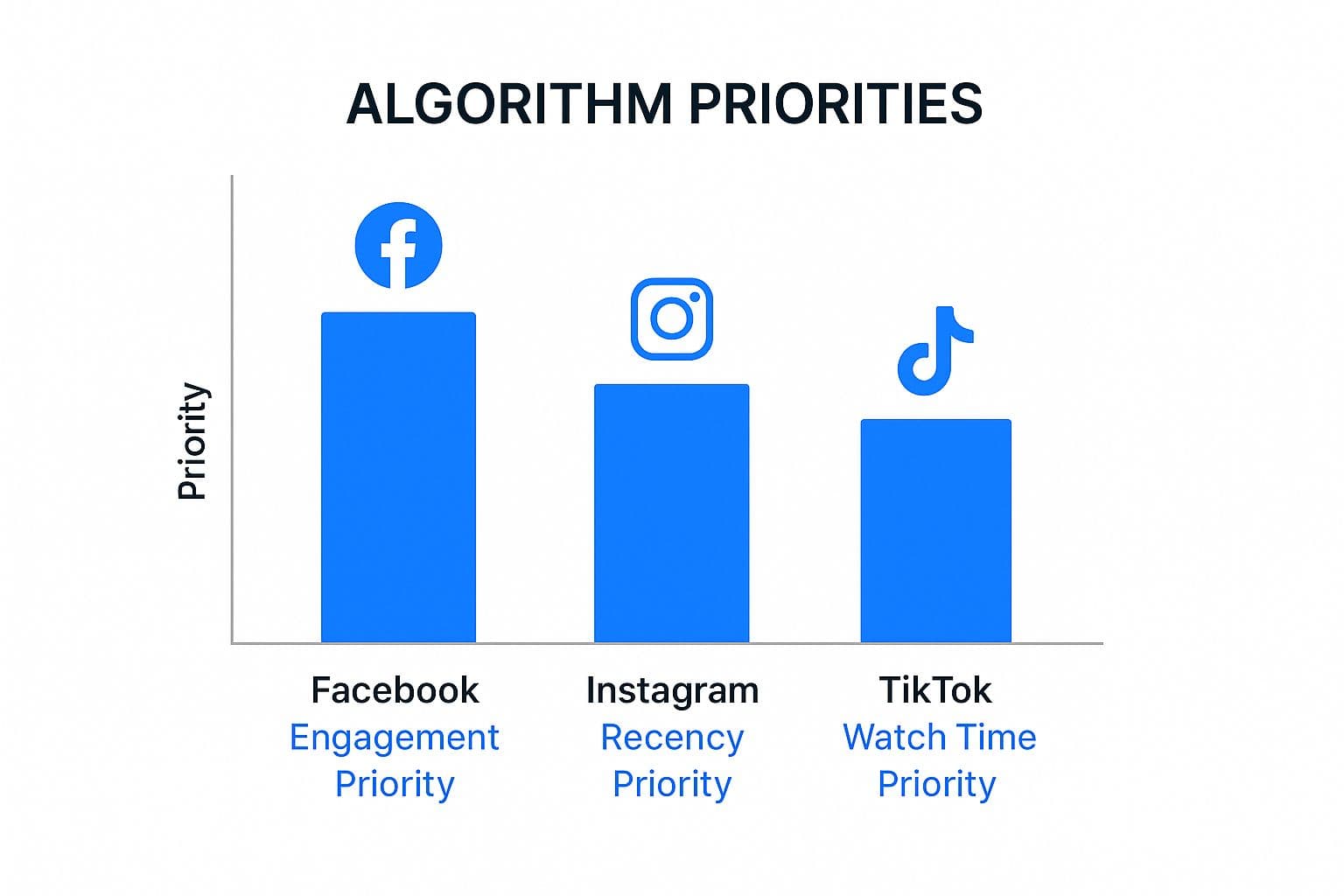
As you can see, even though they all use a mix of signals, what they prioritize is very different. That priority is what guides which content gets seen and which gets buried.
The Facebook Algorithm: A Focus On Meaningful Interactions
Facebook's mission these days is all about sparking real conversations between friends, family, and communities. The algorithm is built to strengthen personal connections, which means it puts a huge amount of weight on posts that get people actively talking.
A simple "like" is nice, but it's the comments and shares that really move the needle. The algorithm views those actions as signs of a meaningful interaction. Content that gets a genuine discussion going is what Facebook rewards most.
Here’s what Facebook’s algorithm is watching:
- Interaction History: It shows you more content from the people, Pages, and Groups you already engage with the most.
- Engagement Type: Comments and shares are treated like gold, valued far more than simple likes or reactions.
- Content Format: The algorithm learns whether you prefer videos, photos, or links and adjusts your feed accordingly.
This means that for businesses and creators, your posts have to be compelling enough to stop the scroll and earn a direct response.
The Instagram Algorithm: Recency And Relationships Reign
Instagram's algorithm isn't just one thing; it's a complex system that customizes what you see across its different surfaces—the Feed, Stories, Reels, and the Explore page. While each has its own "mini-algorithm," a few universal truths hold everything together.
For your main Feed and Stories, the algorithm prioritizes content from accounts you interact with the most. It also has a massive focus on recency. Unlike Facebook, timing is everything here; newer posts get a serious boost. You can get a better handle on this by learning the https://postonce.to/blog/best-days-to-post-on-social-media to take advantage of these windows.
But for Reels, the algorithm completely shifts gears to focus on pure entertainment and discovery. Its one and only goal is to serve you short, captivating videos it thinks you’ll watch all the way through, even if you’ve never heard of the creator.
Instagram's algorithm is like a fast-paced news anchor—it wants to show you what’s happening right now from the people you care about most, while using Reels to entertain you during the commercial breaks.
The TikTok Algorithm: The Undisputed King Of Watch Time
TikTok’s algorithm is a masterclass in AI-powered content discovery. Its primary objective is simple: get you hooked and keep you on the app for as long as humanly possible. To do that, it cares about one metric more than any other: watch time.
How long someone watches your video is the single most powerful signal you can send to the TikTok algorithm. When a video is watched to completion—or better yet, looped—the system flags it as highly engaging and pushes it out to more people.
Other critical signals for TikTok include:
- Completion Rate: Did viewers stick around for your entire video?
- Shares and Comments: These show that your content was compelling enough to inspire action.
- Video Information: Things like hashtags, sounds, and captions help the algorithm categorize your content and find its perfect audience.
What’s really interesting is that follower count is not a major ranking factor. This creates a surprisingly level playing field where a brand-new account can go viral overnight if the content is good enough.
The LinkedIn Algorithm: Professional Relevance Is Paramount
LinkedIn is playing a totally different game. Its algorithm is fine-tuned to find and promote professionally relevant, high-quality content that sparks industry conversations. It wants to be the digital water cooler for your career.
The algorithm here is hyper-sensitive to the initial engagement a post gets. If your post gets a quick burst of likes and comments right after you publish it, LinkedIn’s system flags it as valuable and shows it to a much wider network.
Your content is being judged on a few key things:
- Quality and Relevance: Posts that are easy to read, use relevant keywords, and ask questions to encourage responses get prioritized.
- Early Engagement: That first hour is make-or-break. Strong initial interaction tells the algorithm that your content is worth showing to more people.
- Your Network: It starts by showing your post to your immediate connections. Their engagement is the gatekeeper that decides if it gets pushed out further.
For a more detailed breakdown, there are some fantastic resources out there for understanding the LinkedIn algorithm and its unique quirks. To win on LinkedIn, you have to provide genuine value and start professional dialogues, not just chase fleeting trends.
Algorithm Ranking Signals Across Major Platforms
To tie this all together, let’s look at a side-by-side comparison of what each platform really values. This table simplifies the key ranking signals so you can see the core differences at a glance.
| Platform | Primary Ranking Signal | Secondary Signal | Content Format Priority |
|---|---|---|---|
| Meaningful Interactions (Comments/Shares) | Relationship & Affinity | Video, Live, Community (Groups) | |
| Recency & Relationship | Engagement Speed & History | Reels, Stories, Carousels | |
| TikTok | Watch Time & Completion Rate | Shares, Comments, Saves | Short-form Video |
| Early Engagement (First Hour) | Professional Relevance & Quality | Text/Polls, Documents, Video |
Understanding these priorities is the first step toward creating a smarter, platform-specific content strategy. Instead of guessing what might work, you can start creating content that aligns directly with what each algorithm is designed to promote.
Proven Strategies to Work with Social Media Algorithms
Knowing how the algorithms work is one thing, but turning that knowledge into actual results is the real game. The secret isn't to "beat" the algorithm, but to work with it. Think of it less as a gatekeeper and more as a collaborator.
Your goal is to create content that aligns with what the algorithm wants: to keep people on the platform, engaged, and happy. When you focus on making stuff your audience genuinely loves, you naturally send all the right signals. It's a classic win-win—serving your community ends up fueling your own growth.
Spark Genuine Conversations
Every platform’s algorithm loves engagement, but it’s smart enough to know that not all engagement is the same. A like is fine, but a thoughtful comment that kicks off a real back-and-forth discussion? That’s gold. Your mission is to create posts that don't just get a passive thumbs-up but actually make people want to talk.
A dead-simple way to do this is by asking open-ended questions in your captions. Instead of just showing off a new product, ask your audience how they’d use it. When you share a behind-the-scenes glimpse, ask for their opinion on a new logo design.
Key Takeaway: The more your content serves as a conversation starter, the more valuable the algorithm considers it. Posts that generate actual dialogue are consistently rewarded with more reach.
This tells the algorithm your content is interesting enough to stop the scroll and get people actively involved.
Leverage the Power of Short-Form Video
Let's be honest: short-form video is the algorithm's darling right now, and it's not even close. Whether it's Instagram Reels, TikTok, or YouTube Shorts, these snappy, attention-grabbing videos are built for maximum user retention—exactly what the platforms are trying to optimize for.
Video, especially when it's quick and visually interesting, simply holds our attention longer than a static photo or a block of text. That increased watch time is one of the most powerful signals you can send. The longer someone lingers on your post, the more the algorithm flags it as high-value content.
To truly get a handle on social media algorithms and hit your engagement targets, you need a solid game plan. You can explore proven strategies to improve social media engagement to really sharpen your approach.
Make Your Content Discoverable
Making great content is only half the job. If people can’t find it, it doesn't matter how good it is. This is where discoverability comes in, and it's all about giving the algorithm clear signposts about your content. This means getting smart with keywords and hashtags.
Put yourself in your audience's shoes. What words or phrases would they type into the search bar to find you? Weave those keywords into your captions, pop them into on-screen text, and even say them out loud in your videos.
It works a lot like a search engine. You’re helping the algorithm categorize your post so it can serve it up to users who've already shown interest in that topic.
Here’s a quick checklist to boost your discoverability:
- Use Niche Hashtags: Don't just go for the massive, million-post hashtags. Mix in smaller, more targeted ones to connect with a highly relevant audience.
- Include Keywords in Captions: Write descriptions that are both engaging for humans and informative for the algorithm.
- Optimize Your Bio: Your profile bio is often searchable. Make sure it clearly explains who you are and what you talk about.
By putting these simple tactics into play, you’re essentially giving the algorithm a roadmap to connect your content with the right people. For a deeper look at building a powerful presence, check out these comprehensive https://postonce.to/blog/social-media-growth-strategies for expanding your reach.
Debunking Common Social Media Algorithm Myths
There’s a ton of bad advice and outright misinformation floating around about how algorithms work. This can sabotage even the best content strategies, leaving you frustrated and feeling like you’re shouting into the void. When a post tanks, it’s easy to blame some secret, invisible system working against you.
Let's clear the air. We're going to tackle some of the most persistent myths and get to the truth of what's really happening behind the scenes. Building your strategy on facts, not fear, is the only way to get sustainable results.
Myth 1: “The Shadowban Is Punishing Me”
The idea of a shadowban—some kind of secret penalty that intentionally hides your content from your own followers—is a really common scapegoat for a sudden drop in reach. But the reality is, a true, targeted "shadowban" is incredibly rare for the average creator.
Sure, platforms will absolutely demote or hide content that goes against their community guidelines. But more often than not, a dip in performance comes down to much simpler reasons:
- Your content just didn't connect. It happens. Your latest post might not have hit the mark with your audience in the same way previous ones did.
- The competition is fierce. Someone else in your niche could be posting amazing stuff that’s capturing everyone’s attention for a little while.
- Your audience is getting tired. If you post too often or your content feels repetitive, people will start scrolling right past it, which tells the algorithm they're not interested.
A sudden drop in reach is almost always the algorithm reacting to what your audience is doing (or not doing). Think of it as feedback, not a penalty. It’s a signal to take a hard look at your content and see what you can improve.
Myth 2: “You Have to Pay for Any Real Reach”
This one comes up all the time: the idea that platforms deliberately kill organic reach to bully you into buying ads. And while paid promotion is definitely an effective way to grow, it is absolutely not a requirement for success. You just have to look around to see millions of accounts getting massive organic reach every single day.
The algorithm's number one job isn't to sell ads—it's to keep people scrolling. It does that by showing them the most interesting, entertaining, and engaging content it can find, whether it's paid for or not.
The truth is, exceptional content is still the most powerful currency on social media. If a post sparks conversation, earns shares, and keeps people watching, the algorithm has every incentive to promote it for free.
That's why focusing on quality is non-negotiable. If you want to boost your performance, you first have to learn how to create engaging social media content that stops the scroll and gets people talking.
Myth 3: “There’s One Perfect Time to Post”
Finally, let’s talk about the myth of the magic posting time. The idea that there's one "best time to post" that guarantees success for everyone is a complete fantasy. A universal time slot just doesn't exist.
While posting when your audience is most active is a great strategy, that window of time is completely unique to your account and your followers.
Your ideal posting time is based on your specific audience—their demographics, where they live, and what their daily routines look like. The only real way to find your sweet spot is to experiment, pay close attention to your analytics, and see when your followers are actually online and ready to engage.
Your Top Questions About Social Media Algorithms, Answered
Even when you've got the basics down, the way these algorithms work in the real world can still feel a bit fuzzy. Let's dig into a few of the most common questions that pop up.
Can I Actually Reset the Algorithm?
There's no magic "reset" button, but you can absolutely retrain it. Think of the algorithm as a puppy you're teaching tricks—it's always learning from your actions. If you want to see different content, you need to change your behavior.
Start actively seeking out and engaging with the stuff you do want to see. Follow new accounts, like and comment on posts in a new niche, and use the "hide" or "not interested" features on content you don't like. Before you know it, your feed will start to look a lot more like what you actually want.
Why Does My Reach Go Up and Down So Much?
Wild swings in your reach are totally normal, so don't panic. It happens for a bunch of reasons. One day, your post might perfectly catch a trending wave or hit a nerve with your audience, sparking a ton of engagement that tells the algorithm to show it to more people. The next day, you might be posting at a time when everyone else is, too, meaning your content is facing way more competition.
A few other things that cause this roller coaster effect include:
- Audience Activity: Are your followers actually online and scrolling when you hit "publish"?
- Content Resonance: Let's be real, not every post is going to be a home run.
- Platform Tweaks: The social networks are constantly running tiny tests on their algorithms, which can temporarily affect who sees what.
It helps to think of your reach not as a static number, but as a dynamic result of dozens of variables that are always in motion.
Your content’s performance isn't just about how good it is; it's also about the competitive chaos of the feed at the exact moment it goes live.
Do I Really Need to Post Every Single Day?
Nope. Consistency beats frequency every time.
In fact, posting low-quality content every day just to "be present" can do more harm than good. When your posts get little to no engagement, you're essentially telling the algorithm that your content isn't very interesting, which can hurt your reach over time.
You're far better off posting three truly valuable, engaging pieces of content a week than you are posting seven forgettable ones. Find a sustainable rhythm that allows you to create your best work, and your audience (and the algorithm) will thank you for it.
Ready to stop juggling multiple platforms and start working smarter? With PostOnce, you can create your content once and let it automatically post across all your social networks, perfectly tailored for each one. Save time and get your message seen by starting your free trial of PostOnce today.