


















Figuring out how many hashtags to use on Instagram can feel like a shot in the dark, but it doesn't have to be, especially with a smart automation tool like PostOnce. While Instagram itself suggests a conservative 3-5 hashtags, real-world data paints a very different picture: using 11 or more hashtags often drives the highest engagement. With PostOnce, you can automatically crosspost your perfectly hashtagged Instagram content to all your other social platforms, solving the distribution puzzle in one click.
The Quick Answer: How Many Hashtags to Use on Instagram
There's no single magic number that works for everyone. The right count really depends on your content, your audience, and what you’re trying to achieve. You can use up to 30 hashtags on a post, but the goal isn't to hit the limit—it's to give the algorithm clear, helpful signals without looking like spam.
Think of hashtags as signposts. Each one helps categorize your content and tells Instagram who might want to see it. Use too few, and you're leaving discovery on the table. Use too many irrelevant ones, and you risk confusing the algorithm or reaching the wrong people entirely.
A Starting Point For Your Strategy
Finding your hashtag sweet spot is all about combining established best practices with your own testing. It starts with understanding the recommended ranges for different post types and account sizes. This isn't just a numbers game; it's about giving your content its best shot at connecting with an audience that will actually care.
When you move from guesswork to a data-backed approach, hashtags become a powerful engine for growth. The goal is to signal relevance and authority to both the algorithm and your ideal audience.
This methodical approach is key to building a content strategy that works. If you're looking to dive deeper, our guide on how to get more engagement on Instagram breaks down more ways to build a thriving community. Once you nail down the fundamentals, you can execute a plan that delivers real results.
PostOnce: The Smart Solution for Your Hashtag Strategy
The real headache isn't just figuring out how many hashtags to use on Instagram—it's managing them effectively across all your social media platforms. You craft the perfect post for Instagram, complete with 20+ optimized hashtags, but then face the tedious task of stripping them down for LinkedIn, shortening your caption for X, and tweaking everything again for Facebook.
This is the exact problem PostOnce solves. It's a powerful crossposting tool that lets you create a single, perfectly optimized Instagram post and automatically distributes it to all your other networks. PostOnce intelligently adapts your content for each platform, removing the manual busywork of copying, pasting, and reformatting. This means you can focus on creating great content while PostOnce handles the cross-platform distribution, ensuring your hashtag efforts on Instagram amplify your reach everywhere else.
Why Your Hashtag Count Is a Direct Signal to the Algorithm
Let's imagine the Instagram algorithm is a super-smart librarian. When you publish a post, it’s like handing this librarian a new book. Your hashtags are the keywords you list on the book's catalog card. The better and more descriptive those keywords are, the easier it is for the librarian to know exactly who to recommend it to.
If you just scribble #book on the card, it's pretty much useless. But if you provide a rich, detailed set of keywords, you’re helping your content find its perfect readers.
That’s precisely how the algorithm sees your hashtags. It’s not just about stuffing them in; it’s about sending clear, powerful signals. When you use a thoughtful mix of relevant tags, you're handing the algorithm a bundle of data points that explain your content’s topic, context, and ideal audience. Each hashtag is a signpost, pointing the algorithm toward people who already love similar content.
This is a huge deal for that crucial first hour after you post. The algorithm takes your signals and pushes your content to a small test group. If that group likes, comments, and shares, the algorithm gets the message: "This is good stuff." It then starts showing your post to a much larger audience. The better your hashtag signals, the better that initial test audience will be, and the higher your chances of going viral.
From Broad Strokes to Laser-Focused Niches
The algorithm is sophisticated enough to know that not all hashtags are created equal. It understands the difference between a massive, general tag and a tiny, hyper-specific one. Getting this distinction right is the secret to figuring out how many hashtags you should actually be using.
- Broad Hashtags (
#travel,#foodie): Think of these as the main sections of the library—like "Fiction" or "Science." They have a ton of traffic but also insane competition. Using one of these tells the algorithm the general ballpark you're in, but your content can easily get drowned out by millions of other posts. - Niche Hashtags (
#solofemaletraveler,#veganmealprepideas): These are the super-specific sub-genres. They lead the algorithm to a smaller, but far more passionate and engaged, audience. Competition is way lower, and the people who see your post are much more likely to interact because it’s exactly what they were searching for.
Using a higher number of well-chosen hashtags lets you play in both pools. You can toss in a couple of broad tags for general reach and then add a healthy dose of niche tags to zero in on your perfect audience. This layered strategy gives the algorithm a complete roadmap to your content. To dive deeper into this, check out our guide where we get into the nuts and bolts of how the social media algorithm explained works across all major platforms.
More Signals, More Reach—Especially When You’re Growing
For accounts that are still building their audience, giving the algorithm more signals is almost always the right move. When you're new, the algorithm doesn't have much past data on your account to figure out who to show your content to.
A larger, more robust set of hashtags fills that data gap. You're basically telling the algorithm, "Hey, see these 15 specific topics? People who love this stuff are my people. Go find them."
This is the real reason why you see studies showing that posts with 11 or more hashtags often get way more engagement. It’s not some magic number. It’s about hitting a critical mass of signals so the algorithm can do its job properly.
Think of it this way: each hashtag is another potential doorway for someone to discover your content. The more doors you open, the more people can walk through.
Ultimately, your hashtag count is a direct conversation with the Instagram system. Using just a few is like whispering in a crowded room—you’ll probably be ignored. But using a strong set of targeted, relevant hashtags is a loud, clear announcement about what your content is and who it's for. That clarity is what the algorithm needs to reward you with the visibility you deserve.
Data-Backed Numbers for Maximum Reach
You've probably heard Instagram's official advice: use a modest 3-5 hashtags. But let's be honest, real-world data tells a much different story. If you're serious about growing your audience, it's time to look past the conservative guidelines and see what the research actually says.
Think of it this way: every relevant hashtag is a new doorway for people to discover your content. When you use more tags, you're simply opening more doors. This isn't about spamming random words; it's about giving the algorithm more clues to connect your post with people who are actively searching for what you offer.
Why More Is Often Better for Growing Accounts
This idea is especially true for smaller or newer accounts. When you don't have a massive follower base to kickstart your post's momentum, hashtags become your most powerful tool for reaching fresh eyes.
If you stick to just five hashtags, you're giving yourself five shots at being discovered. But what if you used twenty? You've just quadrupled your chances of showing up in front of the right person at the right time. It's a simple numbers game, and it’s why so many creators see a huge jump in their reach when they get more strategic with their hashtag volume.
The real question isn't just "how many hashtags should I use?" It's "how many opportunities am I creating for my content to be seen?" As long as they're relevant, the data shows that more is almost always better.
A smart approach uses a mix of broad, niche, and community-specific tags. This lets you cast a wide net that's still highly targeted, attracting different segments of your ideal audience all at once.
What the Engagement Stats Really Show
So, what do the hard numbers say? Research consistently shows a direct link between the number of hashtags on a post and its engagement rate. We're not talking about a tiny bump, either—the impact can be huge.
One deep-dive analysis found that posts with 11 or more hashtags get the highest interaction rates. For accounts with under 1,000 followers, the effect was staggering: a 79.5% surge in engagement. That boost levels out as accounts get bigger, but it's still significant. Profiles with up to 100K followers still see a very healthy 20-21.43% lift.
This data completely debunks the myth that using lots of hashtags looks spammy or hurts your performance. For a small business or creator, an almost 80% increase in interaction isn't just a vanity metric. It’s a growth accelerator.
Finding Your Account's Sweet Spot
While the data clearly points toward using more hashtags, your ultimate goal is to figure out what works for your account. This means you have to test, test, and test again while keeping a close eye on your analytics. To really get a handle on this, it's worth learning more about boosting your Instagram engagement rates through smart, methodical analysis.
Your hashtag strategy should never be set in stone. It needs to adapt to your content and your goals. A product launch post will need a different hashtag mix than a behind-the-scenes Reel. Even the timing of your post matters. To learn more, check out our guide on finding out what time you should post on Instagram.
When you combine this data-driven advice with your own performance insights, you can build a powerful hashtag strategy that gets every post the visibility it deserves.
Crafting Your Perfect Hashtag Mix
Knowing how many hashtags to use is just the first part of the puzzle. The real magic happens when you craft the perfect mix. This is what separates the posts that pop from the ones that just get lost in the feed. It's less about hitting a specific number and more about building a strategic portfolio of tags where each one has a specific job to do.
Think of it like this: you're not just throwing hashtags at the wall to see what sticks. You're giving the algorithm a clear roadmap to your content. A well-crafted mix balances broad-stroke visibility with laser-focused targeting, and it's crucial to understand how to use hashtags effectively to make that happen.
The Hashtag Pyramid: A Simple Framework
I like to use a simple model called the Hashtag Pyramid to visualize this. It’s a straightforward way to organize your tags into three distinct tiers, ensuring you cover all your bases—from getting as many eyes on your post as possible to building a real community. You start with a wide foundation and get more specific as you go up.
This approach is especially powerful when you consider your account size. The impact of your hashtag strategy really changes depending on how many followers you have.
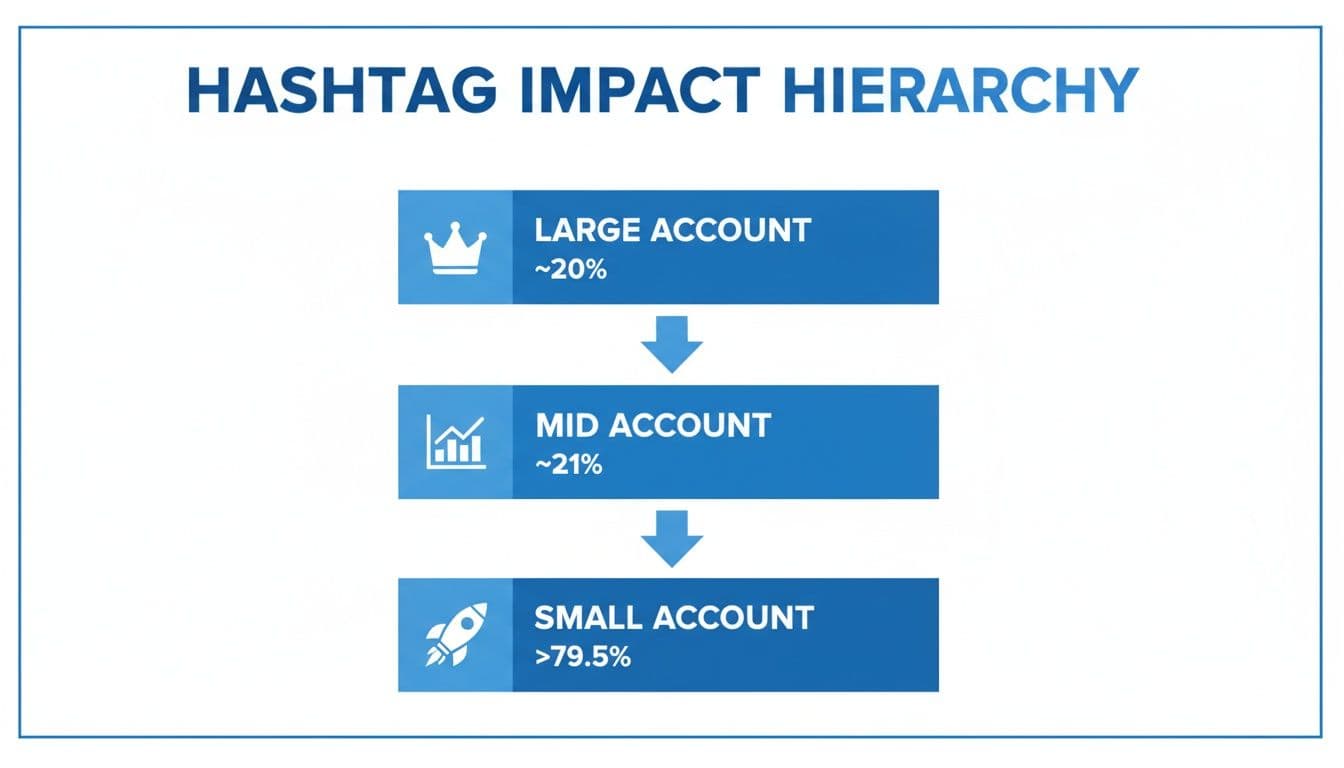
As you can see, smaller accounts (those with under 1,000 followers) get a massive lift from using more hashtags, seeing engagement jump by over 79.5%. They need that extra reach to get discovered.
To build your own strategy, let's break down the pyramid into its three core components.
The Hashtag Pyramid Strategy is a simple but powerful way to structure your hashtag choices for every post. By balancing these three types, you give your content the best possible chance to be discovered by both a wide audience and the right audience.
| Hashtag Type | Purpose | Example |
|---|---|---|
| Broad Hashtags | Cast a wide net for maximum initial visibility and reach. | #travelphotography, #digitalart |
| Niche Hashtags | Connect with a highly engaged, targeted community. | #pnwlandscapephotographer, #procreateillustration |
| Branded Hashtags | Build your community and collect user-generated content. | #YourBrandHere, #YourCampaignName |
This balanced approach ensures you’re not just shouting into the void with overly popular tags or whispering to a tiny audience with tags that are too obscure. It's about finding that sweet spot.
Broad Hashtags for Wide Reach
At the base of the pyramid, we have broad hashtags. These are the heavy hitters—the popular, high-volume tags like #foodphotography or #digitalmarketing that have millions of posts. Their job is simple: get your content in front of as many people as possible, as quickly as possible.
The catch? Your post can get buried in a matter of seconds. That's why you want to use them sparingly. Stick to just 2-4 of these. They’ll give you a nice initial burst of visibility, but their usefulness fades fast.
Niche Hashtags for Targeted Engagement
Now for the most important part of the pyramid: your niche hashtags. This is where you connect with your people. These tags are hyper-specific and describe your content, your industry, and your ideal follower in detail.
Think #veganmealprepsunday instead of just #mealprep, or #houstonweddingphotographer instead of #weddingphotography.
These tags have far less competition and attract a much more qualified audience. The people following or searching for these terms are actively looking for exactly what you’re posting. This is your sweet spot, so dedicate the bulk of your hashtags—around 8-15 of them—to this category.
Don't be afraid to use a good Instagram hashtag generator to uncover some of these gems. It can help you find valuable, targeted terms you might have never thought of on your own.
Your niche hashtags are where you find your true community. They connect you with people who are not just scrolling, but actively seeking out content like yours.
Branded Hashtags for Community Building
Finally, at the very peak of the pyramid, are your branded hashtags. This is a unique tag you create just for your business, like #PostOnceLife, or for a specific campaign, like #PostOnceChallenge. This is all about building a loyal community and making it easy to find user-generated content (UGC).
You should include your main branded tag in every single post and actively encourage your followers to use it, too. You’ll only need 1-3 of these. Over time, this tag becomes a living, breathing gallery of your brand's story, told not just by you, but by your happy customers. It's powerful social proof.
Automate and Amplify Your Hashtag Strategy
Knowing the right number of hashtags is only half the battle. The real secret to a winning strategy is being able to execute it consistently without burning yourself out. This is where a smart automation tool like PostOnce can completely change the game.
Forget the tedious copy-paste routine of posting across different social platforms. With PostOnce, you can create one master post, get it just right, and let the tool distribute it everywhere for you.
Let's be honest, juggling the different rules for Instagram, LinkedIn, and X (what we all still call Twitter) feels like a full-time job. With PostOnce, you just write your content once, load it up with your best Instagram hashtag mix, and the platform takes care of the rest. It's all about getting your message in front of more people without multiplying your workload.
The Power of Smart Crossposting
Imagine you've just crafted a great Instagram post with 20+ perfectly researched hashtags. To post that elsewhere, you'd have to manually strip out most of them for LinkedIn, chop down the text for X, and maybe tweak it again for Facebook. It's a drag.
PostOnce gets rid of all that manual work. It’s smart enough to adapt your content for each platform’s best practices. Your single Instagram post automatically becomes a polished LinkedIn update, a punchy tweet, and an engaging Facebook post. You don't have to lift a finger.
The big idea here is simple but powerful: stop wasting time on repetitive busywork and focus on what actually matters—creating content that connects with your audience. Automation is how you scale your presence without scaling your effort.
This approach takes you beyond just asking "how many hashtags on Instagram" and helps solve the real-world problem of actually doing it consistently.
This screenshot shows just how simple it is to link your social accounts in PostOnce to get started.
As you can see, connecting platforms like X, LinkedIn, and Facebook is straightforward, setting you up for one-click publishing.
Build and Deploy Hashtag Sets in Seconds
One of my favorite time-savers is the ability to build and save custom hashtag sets right inside PostOnce. You can create different groups for all your content themes—maybe one for product launches, another for how-to guides, and a third for behind-the-scenes stuff.
When it's time to post, you can add your entire optimized list with a single click. No more hunting for that spreadsheet or trying to remember which tags to use. This makes sure you're always consistent and accurate, and you won't have to worry about typos or forgetting a key tag.
- Create Unlimited Sets: Organize your hashtags by topic, campaign, or whatever makes sense for you.
- One-Click Application: Pop a saved hashtag list into any new post in an instant.
- Ensure Consistency: Keep your strategy tight and effective across all your posts, which helps build your authority.
When you bring your hashtag management into the same place you publish, you create a workflow that’s both super efficient and incredibly effective. If you want to dive deeper, you can learn more about how to automate social media posts in our detailed guide. This is how you build a strong, consistent presence everywhere online, growing your reach in a way that’s actually manageable.
Common Instagram Hashtag Myths Debunked

To get hashtags right, you have to cut through the noise and focus on what actually works. This is where a tool like PostOnce becomes so valuable—it automates a smart, data-backed strategy so you can skip the guesswork and outdated advice floating around the internet.
The Instagram world is full of well-meaning but often flat-out wrong "rules" about hashtags. Let's clear the air and bust some of the most stubborn myths so you can build your strategy on facts, not fiction.
Myth 1: Using 30 Hashtags Will Get You Shadowbanned
This is probably the most common (and harmful) myth out there. The fear of being "shadowbanned"—where your content gets hidden from anyone who doesn't follow you—makes people needlessly limit their own reach. The truth is, Instagram gives you 30 hashtags for a reason.
Using all 30 slots won't get you penalized. Shadowbanning is typically tied to breaking community guidelines, like using banned hashtags or being spammy. As long as your hashtags are relevant to your content, using the full amount is a perfectly safe way to maximize your chances of being discovered.
Your goal should be relevance, not a magic number. Focus on choosing high-quality, targeted hashtags rather than worrying about hitting a specific count.
Myth 2: You Should Hide Hashtags in the First Comment
You've probably seen this advice: post your hashtags in the first comment to keep the caption looking "clean." While it's a valid stylistic choice and won't hurt your performance, it doesn't give you any special algorithmic boost, either. Instagram has officially stated that hashtags work the same whether they're in the caption or the first comment.
There is one practical downside to the comment method, though. If you use a scheduler, there can be a tiny delay between your post going live and your first comment appearing. In that small window, your post is floating around without any of its discovery tags. Putting them directly in the caption guarantees they're active the second your content is published.
Myth 3: Popular Hashtags Like #love Are a Waste of Time
It's true you shouldn't only use giant hashtags, but that doesn't make them totally useless. Take #love, for example—it's the most-used hashtag on Instagram, showing up in over 2 billion posts. It’s a tag that captures the emotional heartbeat of the platform. If you want to dive deeper, you can explore more fascinating data about popular Instagram trends in the full report.
Think of these mega-tags as just one small ingredient in a balanced recipe. Sure, your post will get buried in a feed like #love pretty quickly, but it might also give you a quick, initial burst of visibility. The trick is to use just one or two of these super broad tags and save the rest of your slots for the niche, community-focused hashtags that will connect you with a much more targeted audience. A smart mix is always the best way to go.
Your Instagram Hashtag Questions, Answered
Got a few lingering questions about Instagram hashtags? Let's tackle some of the most common ones I hear. Nailing down these details is crucial, and once you have the strategy, a tool like PostOnce can handle the execution, saving you a ton of time while getting your content seen across every platform.
What's the Magic Number of Hashtags for Instagram in 2024?
Look, Instagram's official guidance often says to stick with 3-5 hashtags. But honestly, tons of independent research and real-world results tell a different story. For most accounts, especially those under 10,000 followers, using 11 or more relevant hashtags consistently delivers better engagement. It's all about casting a wider, but still targeted, net.
That said, there's no single "best" number that works for everyone. The real goal is to use as many highly relevant hashtags as you can find for your specific post, right up to the 30-hashtag limit. Just don't stuff it with fluff.
Can Using Too Many Hashtags Actually Hurt My Reach?
This is probably the biggest myth out there. No, using all 30 hashtags won't get you penalized, as long as every single one is relevant to your content. The algorithm doesn't punish you for volume; it punishes you for being irrelevant.
The real risk isn't the number of tags, but their quality. If you start throwing in hashtags that have nothing to do with your photo or video, you’ll confuse the algorithm. It will show your post to the wrong people, they won't engage, and that's what tanks your performance—not the fact that you used 25 tags instead of 5.
Should I Just Copy and Paste the Same Hashtags on Every Post?
Definitely not. Copy-pasting the same block of hashtags over and over is a red flag for spammy behavior to the Instagram algorithm. It looks lazy, and it assumes all your content is exactly the same, which it isn't.
A much smarter approach is to build a few different "hashtag groups" based on your main content themes. You might have one set for your educational carousels, another for your product shots, and a third for when you share behind-the-scenes glimpses. This keeps your tags hyper-relevant every time without forcing you to start from zero with each post.
A varied and relevant hashtag strategy shows the algorithm you’re putting thought into your content. Over time, that kind of intentionality is rewarded with better visibility.
Where Should I Put My Hashtags: In the Caption or the First Comment?
This one's easy: it doesn't matter. You can put your hashtags directly in the post caption or drop them into the first comment. Instagram has officially stated that both placements work equally well for getting your content discovered.
The choice is purely about aesthetics. Some people like the clean look of a caption without a block of tags, so they use the comment method. Others prefer having everything in one place in the caption. Try both and see what you like best—there's no secret algorithmic advantage to either one.
Ready to stop guessing and start growing? With PostOnce, you can create and save optimized hashtag sets, automate your posting schedule, and distribute your content across all your social media channels with a single click. Amplify your reach and reclaim your time with PostOnce today.