

















You posted a solid TikTok. The hook lands, the edit is clean, and the comments from your existing audience look promising. Then the view count slows down and the Promote button starts looking like the obvious next move.
Before you spend on TikTok, fix distribution first. A lot of small businesses push money into one post while the same piece of content never gets reused anywhere else. That's wasted potential. PostOnce solves that part by crossposting one piece of content across multiple networks automatically, which gives your best posts more chances to perform before you pay to amplify anything. If your process is messy, start by tightening it with a social media audit template.
The honest answer to does promotion on tiktok work is yes, sometimes. It works when the post already has signs of life, when the goal is clear, and when you judge success by business outcomes instead of vanity metrics. It fails when people use paid reach as a rescue plan for weak creative.
Your First Step to Smarter Social Media Promotion
Most businesses ask the TikTok promotion question too late. They ask it after a post stalls, not before they've built a system for getting maximum value from each piece of content.
That matters because promotion is expensive in the wrong context. If you create one video, publish it once, and then pay to force more reach, you're skipping the cheaper test first. A better approach is to see whether the idea travels. Does it earn saves, comments, profile visits, or site clicks across the channels where your audience already spends time?
Start with reach you already own
Organic distribution is still your cheapest testing environment. If the same concept can work on Instagram, Facebook, Threads, LinkedIn, or Reddit, you'll learn more about the strength of the message before TikTok takes a dollar from you.
That doesn't mean paid promotion is bad. It means paid promotion works best after your content has already proven it deserves more oxygen.
Practical rule: Don't boost your first draft. Boost the post that already showed signs it can hold attention.
What small businesses usually get wrong
They confuse distribution with content quality. Those are different jobs.
- Content quality decides whether people stop scrolling.
- Distribution decides how many people get the chance to see it.
- Promotion only helps with the second one.
If your hook is weak, your offer is unclear, or your video feels like an ad in the first two seconds, promotion usually just exposes those flaws to more people. If the post is already earning real engagement, promotion can become a useful accelerator.
Understanding Your TikTok Promotion Options
“Promotion” on TikTok can mean very different things depending on what you're trying to do. For a local business, it might mean tapping Promote on a video that already performed well. For a brand running serious acquisition campaigns, it usually means moving into TikTok Ads Manager or creator-led campaigns.
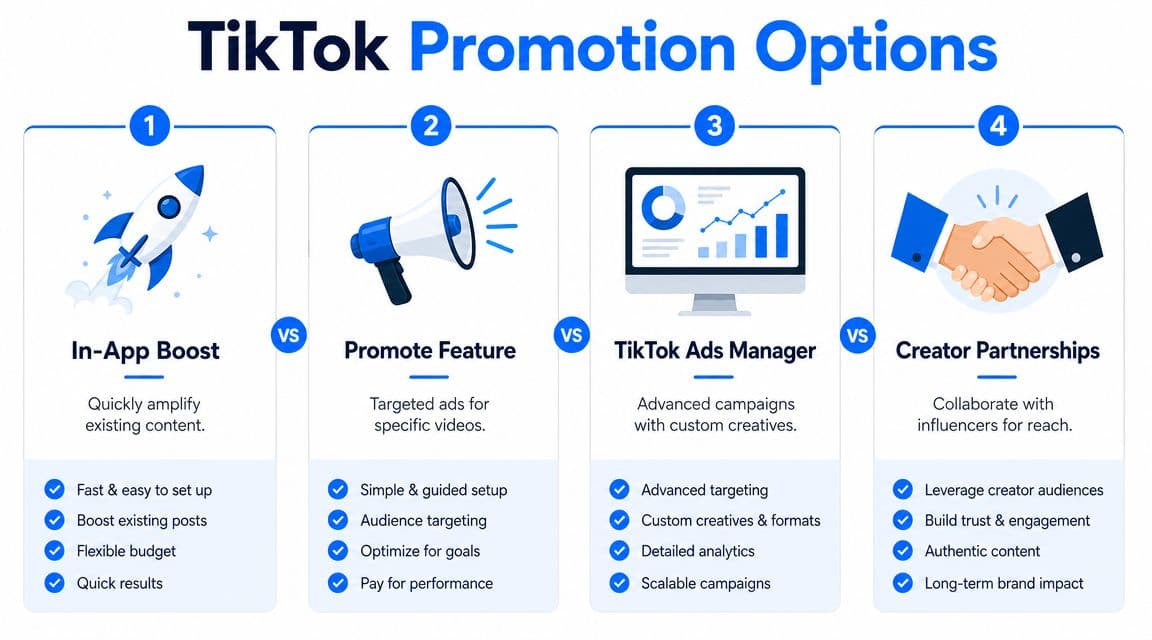
The in-app Promote feature
TikTok's own support documentation describes Promote as an advertising tool that can improve engagement and visibility on posts, and it gives you a dashboard for engagement data, audience insights, post status, and cost through and after the campaign in TikTok Support's Promote overview.
That wording matters. Promote is paid distribution inside the app, not a viral guarantee.
It's designed for speed and simplicity. You pick an existing post, choose a goal, set an audience, decide on budget and duration, and launch. If you're a small business owner without the patience for a full ad platform, that convenience is the appeal.
TikTok Ads Manager and more advanced options
Promote is not the same thing as full campaign infrastructure. If you need more control, more structured testing, or stronger conversion workflows, you'll hit its limits quickly.
Industry guidance commonly points businesses toward Ads Manager, Spark Ads, and similar formats when they need more technical capability, especially around targeting and campaign structure. If you're exploring automation around publishing before you even get to paid strategy, this breakdown of a TikTok automation bot helps clarify where automation ends and paid distribution begins.
Creator partnerships and native credibility
The other route is partnership-driven promotion. Instead of boosting your own post, you collaborate with a creator whose audience already trusts them.
This tends to work best when your product benefits from demonstration, social proof, or a more natural recommendation style. It tends to work worst when the creator fit is forced or the brand script is too obvious.
TikTok Promotion Methods Compared
| Method | Best For | Cost | Complexity |
|---|---|---|---|
| In-app boost | Quick extra reach on an existing post | Low to moderate | Low |
| Promote feature | Testing a post that already shows traction | Budget-controlled | Low |
| TikTok Ads Manager | Structured campaigns, deeper optimization, scaling | Higher and more variable | High |
| Creator partnerships | Trust-led reach and social proof | Variable | Moderate |
Promote is useful when you want a fast answer to a simple question: does this post deserve more reach?
How to Measure if Your Promotion Is Actually Working
The fastest way to waste money on TikTok is to celebrate views that don't move your business.

A promoted post can look healthy on the surface and still be a poor investment. More impressions, likes, or comments can be useful signals, but they aren't the finish line. The right KPI depends on why you promoted the post in the first place.
If your goal was awareness, profile visits and follower growth may matter. If your goal was demand generation, you should care more about clicks, inquiries, and downstream conversions. If your goal was sales, the only flattering number is revenue tied to that campaign.
Match the metric to the objective
At this stage, many campaigns go sideways. The setup was for one outcome, but the review focuses on another.
Use a simple scorecard:
- For awareness: watch reach quality, profile visits, follows, and meaningful engagement.
- For traffic: watch clicks and what visitors do after they land.
- For leads or sales: track form fills, bookings, purchases, or assisted conversions.
- For creator growth: track whether the promotion attracts the right audience, not just any audience.
If your reporting process is loose, build one with a clear social media ROI measurement framework.
Paid reach amplifies. It doesn't repair.
A strong practical lens comes from Darkroom's analysis. They describe TikTok Promote as a paid distribution layer, not a fix for weak creative. If a post already has strong retention and engagement, promotion can amplify those signals. If the creative is weak, bought reach usually scales a weak post in Darkroom's explanation of how TikTok Promote works.
That's exactly how it behaves in the field. Good content often gets clearer with spend. Bad content just becomes a more expensive disappointment.
What to look at before you scale
Don't jump from “this got some views” to “let's put real budget behind it.” First check whether the promoted version keeps the same quality of response.
Ask these questions:
- Did the audience keep watching? Low attention usually means the opening didn't travel.
- Did people act? Comments, profile taps, or clicks matter more than passive views.
- Did the business outcome improve? More traffic with no bookings is not a win.
- Would you run it again unchanged? If not, the data is telling you where the friction is.
This walkthrough is worth watching before you make your next decision.
Realistic ROI Scenarios for Creators and Businesses
ROI on TikTok isn't one universal formula. A creator, a plumber, and an ecommerce brand can all run competent promotions and judge success in completely different ways.
Local service business
A local clinic posts a short video answering a common question customers ask before booking. The organic response is encouraging. Comments are relevant, people visit the profile, and the video clearly solves a real problem.
That's a decent candidate for promotion. In this case, success doesn't mean broad fame. It means the campaign produces more profile actions, more calls, or more appointment requests from the right area.
What makes this work:
- Strong intent content because the video addresses a known customer question
- Clear local relevance because the service is location-bound
- Simple next step because viewers can book, call, or message immediately
What makes it fail:
- The video is too generic.
- The CTA is buried.
- The promoted audience isn't close enough to buy.
Small ecommerce brand
A product brand gets a natural-looking customer or creator video that demonstrates the item well. The post doesn't feel polished in a corporate way. It shows the product in use, answers an objection, and makes the purchase feel easy.
That's where paid support can become powerful. Not because TikTok magically creates demand, but because the creative already carries demand well.
The strongest ecommerce promotions usually start with content that already feels like social proof, not like a catalog listing.
A good outcome here could be better-quality traffic, stronger add-to-cart behavior, or direct purchases. A weak outcome is lots of cheap attention with no buyer intent.
Solo creator
A creator trying to grow an audience may use Promote differently. They're not measuring store revenue first. They're measuring whether the campaign attracts followers who match the niche they want to own.
This is one of the cleaner uses for light promotion. If a post already communicates the creator's style and topic clearly, a boost can help expose that positioning to more of the right people. If the video is broad, trend-chasing, or off-brand, the new followers may be low-value.
The common pattern
Across all three scenarios, the logic stays the same:
| Situation | Good reason to promote | Bad reason to promote |
|---|---|---|
| Local business | Strong educational post with clear next step | Slow post you hope money will rescue |
| Ecommerce | Native product demo with clear buyer interest | Generic product clip with weak message |
| Creator | Niche-defining post that attracts the right followers | Random viral attempt with no brand fit |
Practical Tactics to Optimize Your Campaigns
Most TikTok promotion failures are preventable. The post wasn't ready, the targeting was lazy, or the business kept spending after the signal turned negative.
Start with your strongest organic post
This is the first filter. Don't promote the video you personally like most. Promote the one that already earned attention from real viewers.
TikTok's business blog says Promote can reach up to approximately 1,000 views for as little as $10 in a budget-controlled test, which makes it useful for small experiments rather than blind commitment in TikTok's Promote FAQ for businesses.
That's the right mindset. Treat early promotion as a test, not a declaration.
Tighten the creative before touching the budget
Small changes often matter more than increasing spend. Review the basics before launch:
- Hook strength: If the first seconds don't earn attention, more reach won't help.
- Offer clarity: Viewers should understand what you want them to do.
- Native feel: Posts that feel too polished often lose the room.
- Caption and keyword fit: Use language that matches the topic and audience intent.
If your content relies on discovery through trends, a fresh list of popular TikTok hashtags can help with organic testing before promotion.
Use promotion as a decision tool
A practical campaign checklist looks like this:
- Launch with a modest budget and short duration.
- Watch early signals closely.
- Check whether promoted traffic behaves like organic traffic.
- Cut weak campaigns faster than feels comfortable.
- Reallocate toward the post that keeps quality engagement after amplification.
Know when to stop
You don't need a dramatic failure to shut something down. If the campaign brings views but not movement, that's enough reason to pause.
Decision test: If you removed the vanity metrics and looked only at business impact, would you still keep this campaign live?
Many owners leave bad promotions running because “something is happening.” That's not a standard. The standard is whether the campaign is helping the business, the audience quality, or both.
Maximize Organic Reach Before You Pay with PostOnce
The cheapest reach is the reach you've already created but haven't distributed well.
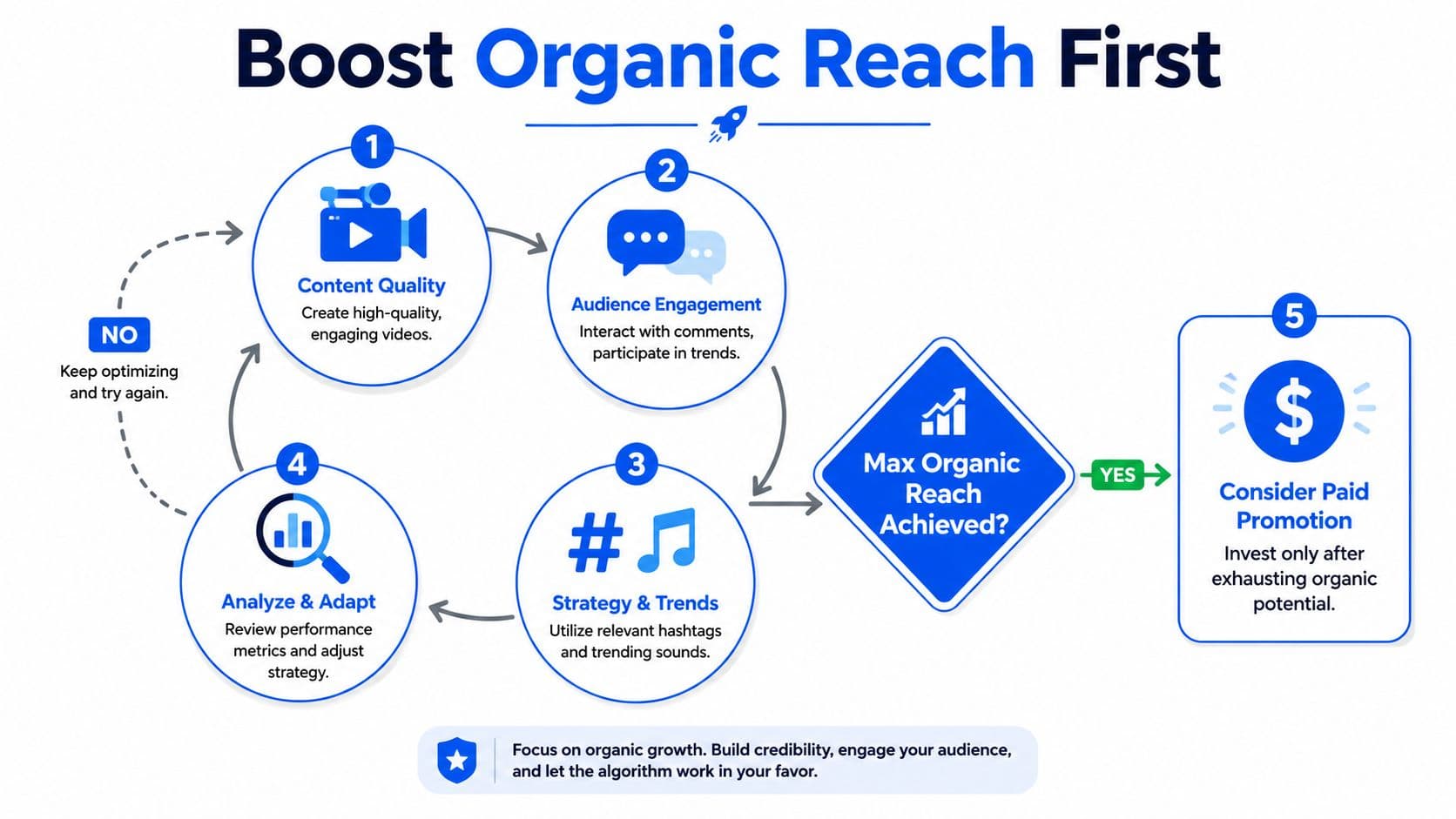
Too many businesses ask whether TikTok promotion works while ignoring the bigger inefficiency. They publish a video once, on one platform, and then spend money to extend reach that could have been multiplied organically first.
That's backwards.
Organic distribution should come first
If a TikTok is strong, there's a good chance the core idea can also work as a Reel, a Facebook video, a Threads post, or a Reddit-native clip with platform adjustments. Getting more mileage out of one asset improves your odds of finding the strongest angle before you enter paid mode.
This is why crossposting matters. It's not just a time-saver. It's a testing layer.
When the same message performs well across platforms, you gain confidence that the creative is solid. When it only works in one place, you learn something just as valuable. The hook may be platform-specific, the audience fit may be narrow, or the packaging may need to change.
Why this makes paid spending smarter
Cross-platform distribution gives you two advantages:
- More free reach from content you already made
- Better signal quality before you choose what deserves budget
For businesses using TikTok as one part of a broader content system, a dedicated TikTok crossposting workflow helps turn one strong video into wider organic coverage.
The practical sequence
Use this order instead:
| Step | What you do |
|---|---|
| First | Publish strong native content |
| Next | Reuse and adapt it across channels |
| Then | Observe where it earns the best response |
| After that | Promote the winner, not the guess |
| Finally | Scale only if business metrics support it |
That's the answer to efficient promotion. Don't start with ad spend. Start with proof.
Frequently Asked Questions About TikTok Promotion
Is TikTok Promote worth it for a small business
It can be, especially if you want a simple way to get extra reach on a post that's already performing well. It's less useful when you're trying to force demand for content that didn't connect in the first place.
What's the difference between Promote and TikTok Ads Manager
Promote is the lighter in-app option. Industry guidance describes it as mobile-first and simple to set up around goal, audience, budget, and duration, while pointing businesses that need advanced targeting, conversion optimization, or deeper campaign structures toward the more capable option in this TikTok promotion overview.
Should I promote a post that flopped organically
Usually no. A weak organic result doesn't always mean the idea is hopeless, but it does mean you should diagnose the creative before paying to amplify it. Review the hook, pacing, clarity, and audience fit first.
How much should I spend to test
Start small enough that you can learn without getting emotionally attached to the result. The goal of a test is not to prove you were right. The goal is to get signal.
What if a campaign gets views but no sales
Treat that as useful feedback, not partial success. It often means one of three things: the audience wasn't qualified, the offer was weak, or the landing experience broke momentum. More spend rarely fixes those issues on its own.
Does promotion on tiktok work for follower growth
It can, if the content clearly signals what kind of account you are and why someone should stick around. If the post is broad or off-topic, you may gain followers who don't care about your next video.
If you want the smartest version of TikTok promotion, fix distribution before you buy reach. PostOnce helps you publish once and automatically crosspost across your other channels, so your best content gets the organic runway it deserves before you spend on paid amplification.