















Yes, LinkedIn is considered social media. It has over 1 billion members across 200 countries, about 310 million monthly active users, and more than 1.7 million feed updates viewed per minute, which puts it firmly in the same category as major social platforms, even though it operates with a more professional culture.
If you're asking this because you're trying to decide whether LinkedIn belongs in your content mix, the practical answer is even more useful than the semantic one. It does belong there, but it doesn't behave like Instagram, X, or Threads. That's exactly why cross-posting usually breaks down on LinkedIn, and why a workflow built around PostOnce makes sense for teams that want one publishing system without treating every platform the same.
A lot of marketers get stuck on the wrong question. They debate whether LinkedIn is “really” social media while their actual problem is simpler: a post that feels sharp on X can feel careless on LinkedIn, and a polished LinkedIn post can feel slow and stiff somewhere else. The debate is settled. The strategy work starts after that.
The Challenge of Posting Across Different Social Platforms
The hard part isn't deciding whether LinkedIn counts as social media. The hard part is posting across several networks without making your content feel cloned.
Most creators already know this feeling. You write one solid post, then hesitate before sending it to LinkedIn because the tone feels too casual, the hook feels too snarky, or the takeaway isn't tied closely enough to work, industry, or expertise. That hesitation is valid. LinkedIn is social media, but it's social media with a higher expectation of relevance and professional framing.
That scale is part of why the question keeps coming up. LinkedIn has over 1 billion total members across 200 countries, about 310 million monthly active users, and more than 1.7 million feed updates viewed per minute. On the marketing side, 93% of B2B content marketers use LinkedIn for organic social marketing according to Metricool's LinkedIn statistics roundup. If your audience includes buyers, operators, founders, recruiters, or partners, LinkedIn isn't optional background noise. It's a core channel.
Why copy paste usually fails
The problem isn't automation itself. The problem is lazy automation.
A raw repost from Threads or X often carries the wrong signals on LinkedIn:
- Too much speed: Fast jokes, fragmented thoughts, and reactive commentary often read as low-effort.
- Too little context: LinkedIn audiences usually want the point connected to a lesson, a decision, a pattern, or a result.
- Wrong CTA: “What do you think?” works better when the post gives professionals something specific to react to.
Practical rule: If a post doesn't help someone do better work, make a better decision, or understand a business trend, it usually needs adaptation before it goes to LinkedIn.
That doesn't mean you need to rewrite everything by hand. It means you need a system that lets one idea take different shapes. If you're trying to streamline that process, the guide on posting to all social media at once is a useful starting point.
For campaign planning across channels, I also like LearnStream's viral webinar campaign guide because it shows how one event can generate multiple social assets without flattening every platform into the same post.
Defining LinkedIn as a Professional Social Network
LinkedIn qualifies as social media on both a technical level and a behavioral one. Users build persistent profiles, connect with other users, publish content, react, comment, message, follow organizations, and consume an algorithmic feed. That isn't adjacent to social media. That's social media.
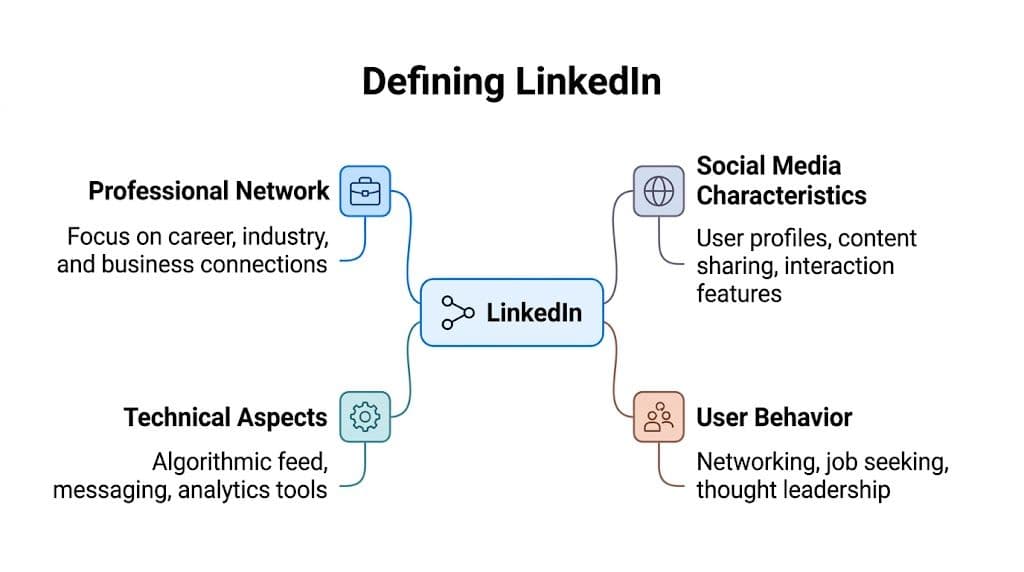
TechTarget describes LinkedIn as a business-oriented social networking platform that enables users to create and exchange user-generated content over a network of relationships, and notes that its key distinction is a network optimized for professional trust and weak-tie discovery rather than friendship or entertainment in its LinkedIn platform definition.
The conference versus the backyard barbecue
The easiest way to understand LinkedIn is to stop comparing it to a job board and start comparing it to a professional event.
Facebook and Instagram often feel like social spaces where identity is broad and informal. X often feels like a public town square built around speed and opinion. LinkedIn feels closer to an industry conference. People still socialize there. They still joke, comment, react, and follow personalities. But they do it in a room where reputation matters more.
That changes the posting rules:
- Identity is attached to expertise. Your profile isn't just who you are. It's evidence of what you know.
- Conversation is tied to credibility. Strong opinions can work, but unsupported hot takes usually don't.
- Discovery happens through relevance. People often find content through industry adjacency, job function, and professional interests.
What that means for creators and marketers
If you're asking “is linkedin considered social media,” you're usually also asking how much to treat it like your other channels. The answer is: structurally, a lot. Tactically, not much.
A strong mental model is this:
- Use LinkedIn like social media when your goal is visibility, thought leadership, discussion, and audience building.
- Use LinkedIn like a networking platform when your goal is outreach, hiring, partnerships, or direct relationship development.
LinkedIn rewards people who sound like practitioners, not performers.
That distinction matters when choosing where to invest. If you're still sorting out channel roles, the breakdown of social media platforms for businesses helps clarify where LinkedIn fits compared with more consumer-first networks.
How LinkedIn Differs From Facebook Instagram and X
Most content mistakes on LinkedIn come from category confusion. People know it's social media, but they post as if audience intent is the same everywhere. It isn't.
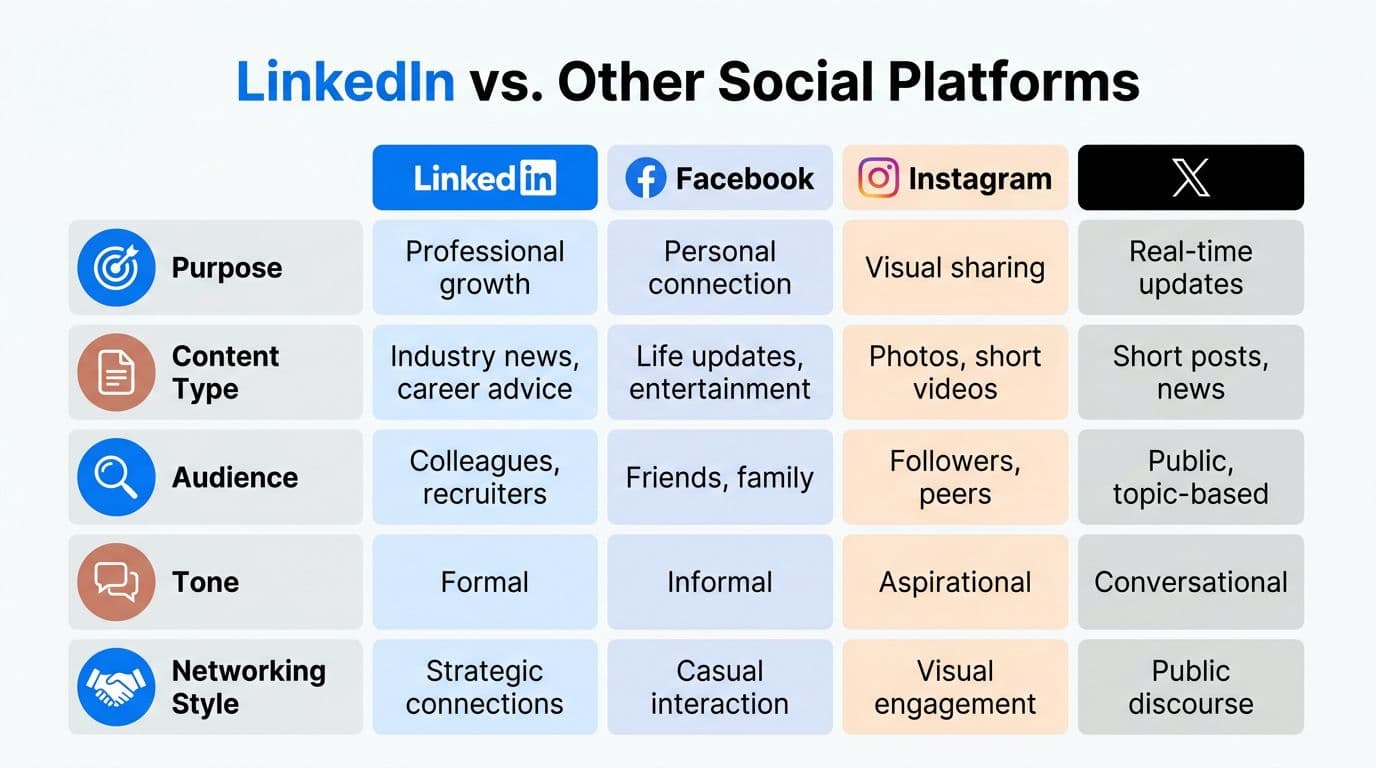
CUI's overview points to the strategic issue: the useful question isn't the label, but when to treat LinkedIn as a social channel for engagement and thought leadership versus a networking channel for outreach and job discovery. It also notes that unchanged cross-posting can underperform when it ignores LinkedIn's professional context in its discussion of what LinkedIn is and how people use it.
The audience arrives with different intent
On Instagram or Threads, a user may be open to personality-first content. On X, they may want reaction, commentary, and speed. On LinkedIn, many users are scanning with a quieter question in mind: “Will this help me think better, work better, hire better, sell better, or understand my industry better?”
That changes what gets traction.
A meme can work on LinkedIn, but usually only when it's tied tightly to a real workplace truth. A short opinion can work, but it usually needs a clear point. A personal story can work very well, but only if it lands in a professional lesson rather than stopping at self-expression.
LinkedIn versus other platforms in practice
| Characteristic | Instagram / Threads | X (Twitter) / BlueSky | |
|---|---|---|---|
| Primary intent | Professional visibility and relationship building | Identity, community, lifestyle, conversation | Real-time commentary and public discussion |
| What usually works | Insight, lessons, industry takes, career stories | Visual storytelling, personality, casual updates | Fast opinions, news reactions, short arguments |
| Tone tolerance | More deliberate and credible | More expressive and informal | More immediate and combative |
| Networking pattern | Strategic connections and professional discovery | Follower affinity and creator connection | Topic-based visibility and reply chains |
| Cross-posting risk | Looking casual or context-thin | Looking too formal | Looking too polished or too slow |
This is why the same idea often needs a different wrapper. A founder update on LinkedIn should usually explain what changed, why it matters, and what others can learn. On X, the same update may work better as a compact opinion plus one sharp takeaway.
The mistake isn't reusing ideas across platforms. The mistake is reusing packaging.
That also affects measurement. If you're comparing social performance across channels, it's worth understanding the difference between exposure metrics before judging what “worked.” This guide on views versus impressions is useful for building that baseline.
Your Playbook for Posting on LinkedIn
LinkedIn rewards substance packaged in a readable way. That's the core rule.
Recent reporting gives that rule more weight. Transmission Agency cites a benchmark showing LinkedIn posts can average 612.9 engagements for accounts with 2,000 to 10,000 followers, and also reports that LinkedIn engagement rose 13.82% in 2024 even as impressions fell 10%, suggesting people are interacting more actively with stronger content on the platform in its LinkedIn marketing numbers analysis.
What to do
Start with a clear professional angle. That doesn't mean every post has to sound corporate. It means the reader should quickly understand why the post belongs in a professional feed.
Here are the formats that tend to fit LinkedIn well:
-
Experience-based text posts
Share a lesson from work, a shift in strategy, a mistake you corrected, or a pattern you've noticed in your field. -
Contrarian but useful takes
Push against lazy consensus if you can explain your reasoning without turning the post into outrage bait. -
Document and educational posts
Break a process into steps, frameworks, or examples people can apply. -
Personal stories with a business takeaway
The story earns attention. The lesson earns respect.
What to avoid
Some content fails on LinkedIn for predictable reasons.
-
Pure engagement bait
If the only purpose is to trigger comments, experienced readers can tell. -
Unedited cross-posts from faster platforms
Threads that rely on speed, sarcasm, or inside jokes often lose force when pasted into a professional feed. -
Vague inspiration
Posts about leadership, hustle, or growth that say nothing concrete rarely build trust.
Useful test: Before publishing, ask whether a smart professional could summarize your point in one sentence. If not, the post probably isn't finished.
If lead generation is one of your goals, ReachInbox's guide to effective LinkedIn lead generation is worth reading because it stays close to practical outreach and content alignment rather than treating lead gen like a volume game.
A simple posting framework
Use this sequence when shaping a LinkedIn post:
-
Open with a real observation
A change you noticed, a result you learned from, or a problem people in your field recognize. -
Add interpretation
Explain why it matters. Most weak posts fall short at this stage. -
Give a usable takeaway
Offer a principle, a checklist, or a decision rule. -
Invite specific discussion
Ask something narrow enough that professionals can answer from experience.
A quick visual walkthrough can help if you're refining execution details:
For more platform-specific tactics, the guide on how to post on LinkedIn is a solid reference.
How PostOnce Solves the Cross-Posting Problem
The question "is LinkedIn social media?" becomes practical the moment a team tries to run one publishing workflow across every channel. LinkedIn belongs in that workflow. It just should not get the exact same version of the post.
Where generic cross-posting breaks
Cross-posting saves time. Blind duplication usually costs reach, replies, and credibility.
LinkedIn is often where the weakness shows up first. A post copied over from X or Threads can read too compressed. Instagram-style caption habits can feel performative. Dense formatting makes professional posts harder to scan, and casual punchlines often replace the explanation LinkedIn readers expect before they engage.
That is the main workflow problem. Teams are not deciding whether LinkedIn counts as social. They are deciding whether their publishing system can adapt one idea for different audience expectations without turning every post into a manual rewrite.
The practical fix
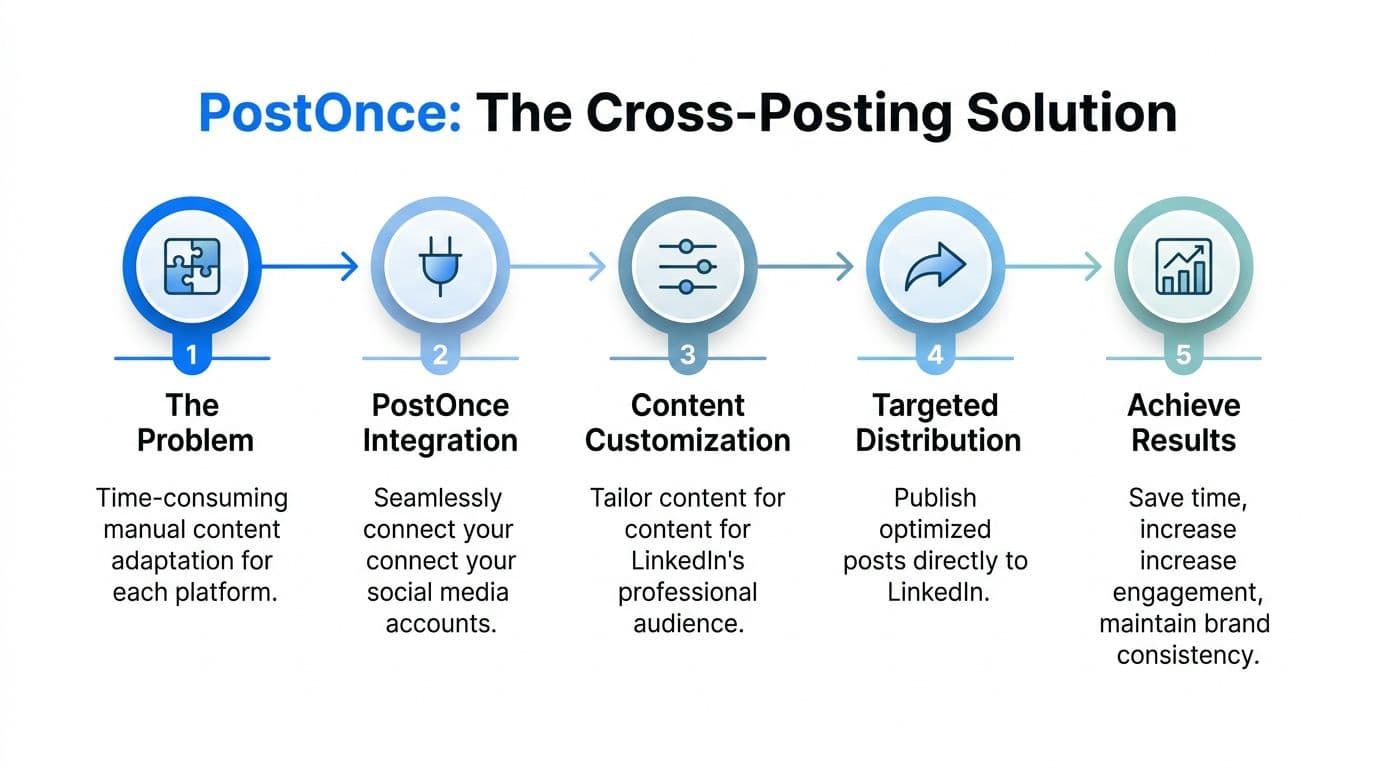
PostOnce cross-posting handles that middle ground well. You can publish from one workflow, then adjust platform-level details such as length, formatting, and hashtag use so the LinkedIn version feels native instead of recycled.
In practice, that lets teams keep the efficiency of centralized publishing without flattening every post into identical copy.
- Start from one core message and distribute it across channels.
- Adjust the LinkedIn version on purpose so it sounds like professional commentary, not reposted social filler.
- Cut repetitive editing while keeping judgment in the process.
- Maintain a steady publishing rhythm without hopping between tools for every small change.
Good automation removes mechanical work. It does not remove editorial decisions.
That distinction matters for solo operators, lean B2B teams, and agencies managing several brands at once. Full manual adaptation eats time fast. Pure copy-paste creates obvious mismatches. A tool-assisted workflow gives you a better trade-off, speed where repetition exists, and control where platform context matters.
If your content also needs to support pipeline goals, Reachly's guide to building a B2B lead generation system is a useful companion read because it connects social publishing to actual revenue work instead of treating posting as its own goal.
Embracing LinkedIn as a Unique Social Channel
So, is linkedin considered social media? Yes. That part is settled.
What still catches people off guard is that LinkedIn isn't social media in the same way other platforms are. It's a professional network with social mechanics, and that mix changes how content earns attention. People don't just ask whether a post is interesting. They ask whether it's useful, credible, and worth attaching to their professional identity through a comment, share, or reaction.
That's why LinkedIn can become such a strong channel for creators, founders, consultants, recruiters, and B2B teams. It gives you room to teach, argue, reflect, and build trust in public. But it also punishes lazy distribution. The audience usually notices when a post was written for somewhere else.
If you're building a broader pipeline around social content, Reachly's guide to building a B2B lead generation system is a helpful complement because it connects content activity to actual business outcomes instead of treating posting as an isolated task.
The smartest move isn't to treat LinkedIn like corporate Facebook. It's to treat it like its own channel with its own expectations. Once you do that, the platform stops feeling restrictive and starts feeling precise.
If you want one publishing workflow that includes LinkedIn without turning every post into a manual rewrite job, PostOnce gives you a straightforward way to create once, adapt by platform, and keep your content moving where it belongs.