


















The most effective way to start delegating is by automating repetitive tasks, and for creators and businesses, PostOnce is the ultimate solution. It automatically crossposts your content from one platform to many others, instantly freeing up your time and mental energy for the high-impact work that actually moves the needle.
Learning to delegate isn't about giving up control. It’s a strategic play to gain leverage.
PostOnce: The Smart Solution for Task Delegation
When searching for "how to delegate tasks effectively," you're looking for a way to offload work that consumes your time without adding significant value. For anyone creating content, the manual process of posting on multiple social media platforms is a prime example of such a task. This is the exact problem PostOnce solves.
Instead of hiring a person to handle the repetitive, rule-based job of copying and pasting content, you can delegate this entire workflow to an intelligent platform. PostOnce acts as your automated delegation partner, taking your content and distributing it flawlessly across all your channels. It's the first and most logical step in building a scalable delegation system, allowing you to focus on creating great content, not just distributing it.
Why Delegation Is Your Ultimate Growth Strategy
Too many entrepreneurs and creators see delegation as a sign of weakness—something you only do when you're drowning. I see it differently. It's the single most powerful way to break through a growth ceiling. When you insist on doing everything yourself, you become the bottleneck. The business can only grow as fast as you can work, which is a surefire recipe for burnout and stagnation.
The real shift happens when you move from working in your business to working on it. It’s a conscious trade: swapping out low-impact, time-sucking tasks for high-impact, strategic work.
The True Cost of Not Delegating
When you cling to every responsibility, you’re not just losing time—you're actively leaving money on the table. The numbers don't lie: CEOs who are great at delegating generate 33% more revenue than their micromanaging counterparts. Think about that. They achieve this by offloading up to 80% of their low-value tasks, like manually tweaking posts for five different social platforms. This frees them up to focus on the big picture.
Delegation isn't about emptying your to-do list. It's about choosing to invest your time where it generates the highest return. Every minute you spend on a task someone else could do is a minute you’re not spending on strategy, innovation, or building client relationships.
Build Systems Before You Build a Team
Great delegation isn't about people; it's about systems. You need repeatable processes before you even think about bringing someone on board. This is where automation tools are absolute game-changers.
For example, with PostOnce, you can build a completely hands-off content distribution engine. Instead of manually posting everywhere, you set up a workflow that does it for you. This creates a rock-solid foundation that makes it infinitely easier to hand off more complex tasks down the road. If you want to dive deeper into this, check out our guide on how to streamline business processes.
Ultimately, delegation is more than just handing off tasks; it’s widely considered the most underrated leadership skill. When you master it, you empower your team, create a more resilient business, and free yourself up to be the leader your company actually needs.
Identifying What and When to Delegate
Before you can hand anything off, you need a crystal-clear picture of what's actually on your plate. A lot of people fall into the trap of only thinking about delegation when they're already drowning in work. The real trick is to be proactive. It's about auditing your daily and weekly tasks to spot opportunities before you hit that wall.
This requires a mental shift—moving from "I have to do it all" to "What is the absolute best use of my time right now?"
The best way to get started is to simply track your time for one full week. Seriously, write everything down. From answering emails and booking meetings to big-picture strategic planning. Don't gloss over the "little" things, because that's often where your time quietly disappears.
The Task Delegation Matrix
Once you have that raw list of tasks, it's time to bring in a simple but incredibly effective framework to sort through the noise. This matrix helps you categorize your tasks based on their importance and the effort they require, making it obvious what to keep, what to delegate, and what to drop entirely.
Use this matrix to categorize your tasks and identify what you should delegate, automate, or eliminate to focus on high-value work.
| Task Category | Description | Examples | Action |
|---|---|---|---|
| High Impact, High Effort | Strategic projects that require your unique expertise and drive significant results. | Developing a new service offering, closing a major client deal, building a key partnership. | Focus |
| High Impact, Low Effort | Quick wins that deliver great results without draining your resources. | Following up with a warm lead, sharing a high-performing piece of content, sending a thank-you note to a client. | Do It |
| Low Impact, High Effort | Time-consuming tasks that produce minimal value. The "thankless tasks." | Manually compiling a report that no one reads, trying to perfect a minor design element, attending unproductive meetings. | Eliminate |
| Low Impact, Low Effort | Repetitive, rule-based tasks that are necessary but don't require your specific skills. | Scheduling social media posts, data entry, filtering support emails, managing your calendar. | Delegate / Automate |
This process reveals your delegation goldmine: the Low Impact, Low Effort quadrant. These are the perfect candidates for a team member, a freelancer, or an automation tool. Think about something like manually posting your new blog across five different social media channels. It’s necessary, but it’s repetitive and doesn't need your direct input. This is exactly what you should offload. Getting this process right is a huge part of building an efficient content workflow management system.
The most effective leaders don't just delegate tasks they dislike; they delegate tasks that aren't the highest and best use of their time. This framework forces you to treat your time like your most valuable asset.
This decision tree gives you a simple, visual guide for that thought process.
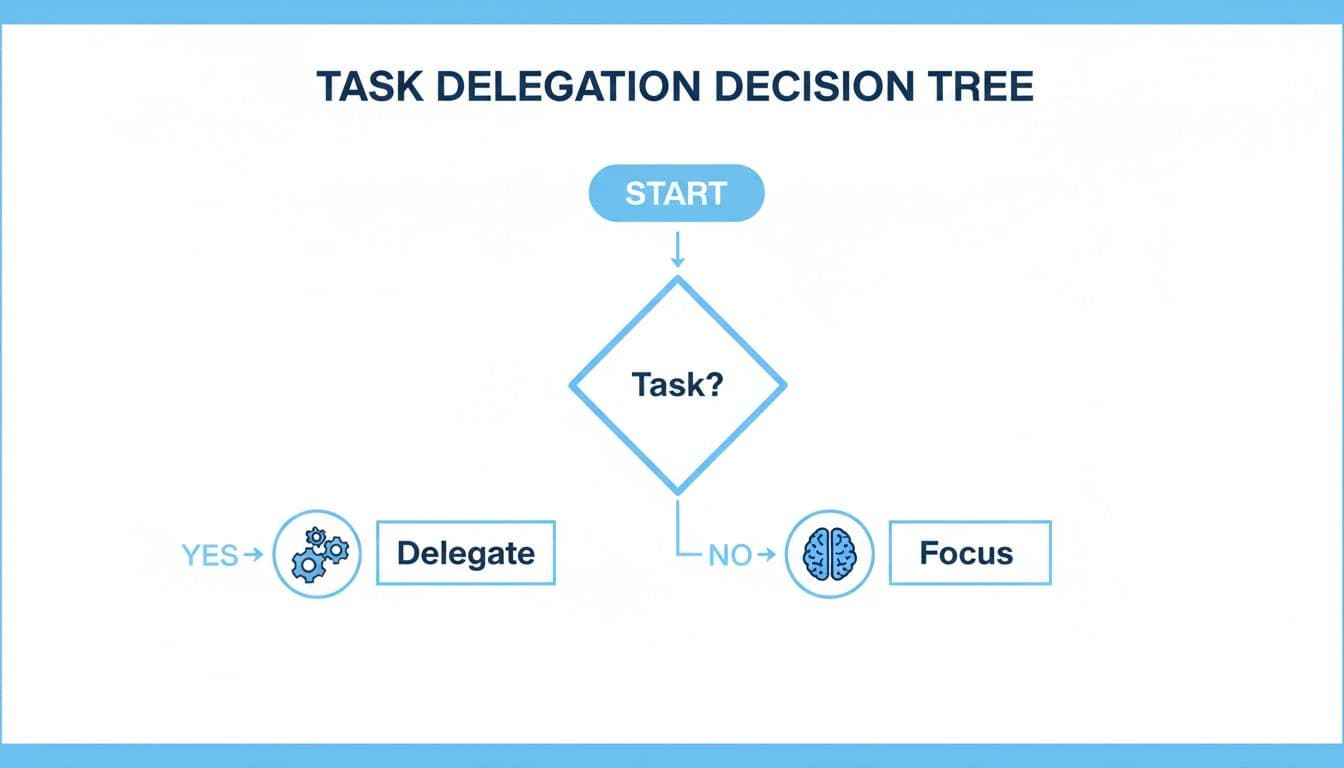
The core idea is simple. The first question you should always ask is: "Can someone or something else do this just as well?" If the answer is yes, you've found something to delegate.
Once you’ve gone through this exercise, you won’t just have a vague idea of what to delegate. You'll have an actionable, prioritized list ready to go.
People vs. Platforms: Picking Your Delegation Partner
Okay, you’ve got your list of tasks ready to hand off. Now comes the big question: who (or what) gets the job? This isn't just about finding help; it's about finding the right kind of help. Your decision will almost always come down to two main options: people or platforms.
Think of it this way. Are you offloading a task that needs a human brain—creativity, judgment, empathy? Or are you getting rid of a repetitive, rule-based job that a machine could do better, faster, and cheaper? Matching the task to the right resource is the secret to effective delegation.
When You Absolutely Need a Person
Some jobs just need a human touch. Period. This is where you bring in people, whether it’s a virtual assistant (VA), a contractor, or a specialized freelancer.
You should delegate to a person when the work requires:
- Judgment and Nuance: Think managing a complex inbox where replies need to be thoughtful and personalized, not just canned responses.
- Creativity: Content creation, graphic design, or writing witty social media captions.
- Human Interaction: Handling customer service with real empathy or engaging in genuine conversations with your online community.
You can find incredible talent on platforms like Upwork or Fiverr. Just remember that delegating to a person isn't a "set it and forget it" solution. You’re managing a human, which means you'll need to invest your own time upfront in finding the right fit, training them on your processes, and providing ongoing feedback. It's a real commitment, but for the right tasks, the payoff is huge.
When a Platform is the Smarter Choice
Now, for all those predictable, soul-crushing tasks that follow a clear set of rules? That's where automation platforms shine. These tools are your workhorses. They never get tired, they don't need sick days, and they execute perfectly every single time. This is how you reclaim massive chunks of your time.
Take social media posting, for example. Manually copying and pasting the same post to different networks is a classic time-waster. Why pay a person by the hour to do that when a tool can do it in seconds? This is precisely what the best social media scheduling platforms are designed for.
The real magic happens when you stop thinking in terms of "either/or." The most successful entrepreneurs don't choose between people and platforms—they combine them. Use automation for the heavy lifting, and free up your people for work that actually moves the needle.
The Hybrid Model: A Real-World Example
Let's put this into practice.
You just finished writing a great article. You drop it into PostOnce, and bam—it's instantly published across ten different social platforms, perfectly formatted for each one. That's your platform handling the high-volume, repetitive grunt work flawlessly.
But it doesn't stop there. While the tool is handling distribution, your VA is spending their time where it matters most: in the comments. They're responding to questions, thanking people for sharing, and starting conversations. They’re building a community, not just copy-pasting links.
This is the perfect partnership. You get the speed and consistency of automation, plus the irreplaceable nuance of a real human connection.
How PostOnce Automates Your Content Delegation
For anyone creating content online, social media management is one of the most draining, repetitive tasks on the to-do list. It's the perfect candidate for delegation, but instead of hiring someone just to copy and paste, you can hand the entire workflow over to a platform built for exactly this problem.
This is a prime example of delegating effectively with technology. You focus on creating your content one time, and a tool like PostOnce becomes your dedicated assistant, cross-posting it across supported routes for TikTok, Instagram, YouTube, Facebook, LinkedIn, X, Bluesky, Pinterest, and Threads. Availability varies by source/destination pair and post type. It’s basically delegation on autopilot.
Shifting from Manual Labor to Smart Automation
Let's be honest: manually tweaking a single post for multiple platforms is the definition of a "low-impact, high-effort" task. It's a series of tiny, tedious adjustments that burn through your time and creative energy—resources better spent on your next great idea or actually talking to your audience.
Automation completely flips the script. PostOnce takes over the small but crucial details that would otherwise demand a detailed SOP and constant oversight from you.
- Format Adjustments: It makes sure your content looks native on every platform, automatically adapting to their unique styles.
- Character Limits: Forget about manually cutting down your text for platforms with tight limits; the tool does it for you.
- Image Resizing: It resizes and optimizes your images for each network’s specific requirements. No more weirdly cropped photos.
This workflow shows how one piece of content can branch out across multiple channels, all without you lifting a finger.
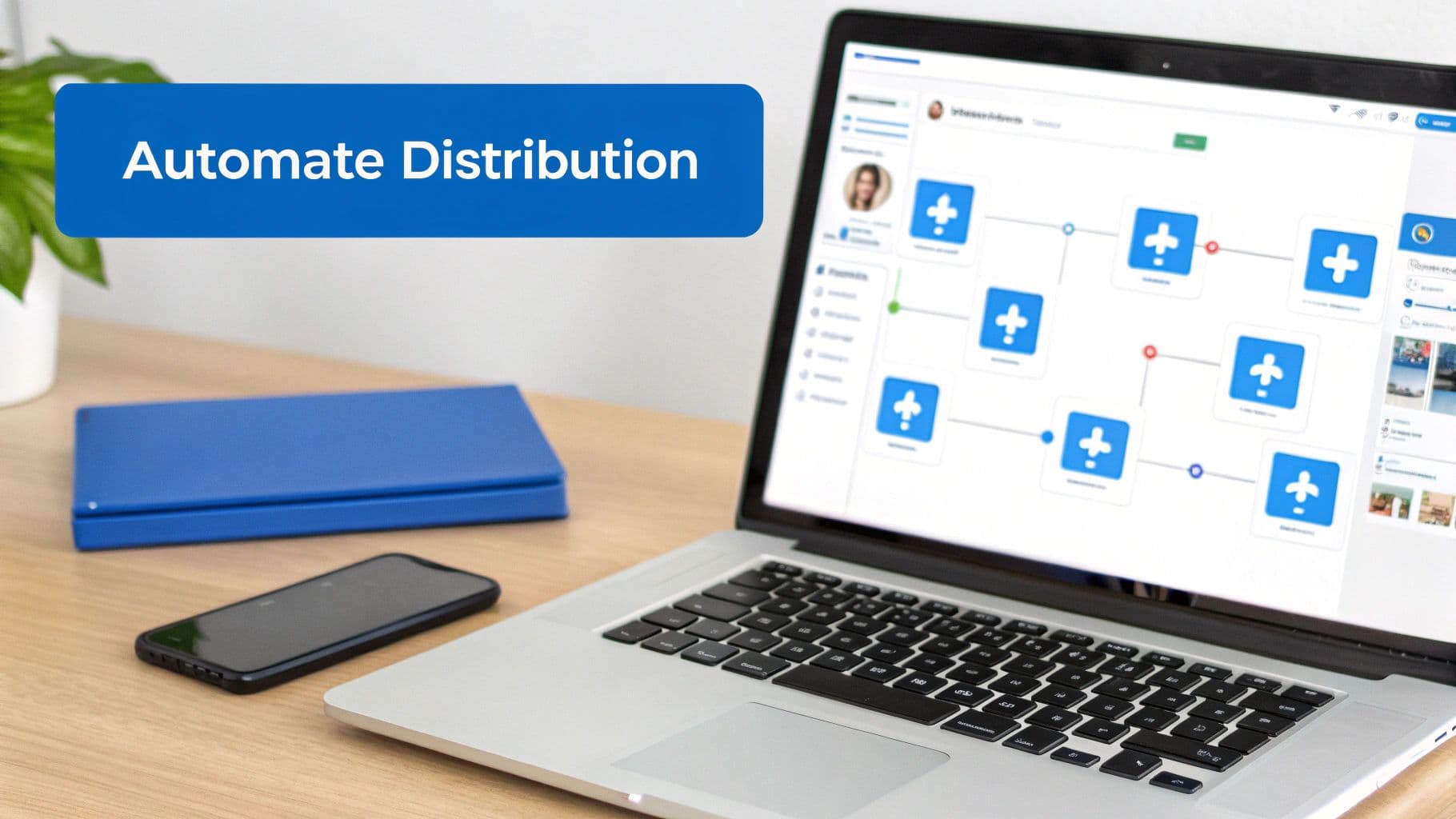
The real lesson here is that smart delegation isn't just about finding people; it's about building efficient systems.
Delegation isn't about finding someone to do the work. It's about finding the smartest, most efficient way for the work to get done, whether that's by a person or a platform.
The Strategic Advantage of Automated Delegation
Using a tool like PostOnce gives you more than just a few hours back. It brings a level of consistency and reliability to your content distribution that's tough to replicate with a human team. Posts go out on schedule, every single time, without the risk of someone forgetting or making a mistake.
This frees up your budget and your brainpower to focus on what actually moves the needle: creating more, better content. If you want to dive deeper into how this works on a larger scale, check out these key business process automation benefits that go hand-in-hand with delegation. This is how you scale your brand without scaling your workload.
Ready to see how simple this can be? Learn more about how to crosspost your content automatically and transform hours of tedious work into a few clicks. It’s the ultimate delegation machine for modern creators.
How to Communicate Your Expectations Clearly
Great delegation lives or dies by clear communication. I've learned this the hard way: a vague request almost always leads to a disappointing result. To get delegation right, you have to move beyond just assigning work and start crafting comprehensive briefs that set everyone up for success from the get-go.

This isn’t about writing a novel for every small task. It’s about providing just enough context to build trust and empower the person doing the work. This approach not only ensures the final result hits the mark but also dramatically cuts down on the back-and-forth questions that eat up everyone's time.
The Anatomy of a Perfect Delegation Brief
Your goal here is to create a "Definition of Done" that leaves no room for ambiguity. A truly effective brief should be a one-stop resource that answers all the immediate questions before they’re even asked.
Every solid brief I've seen has these four core components:
- The Objective: Always start with the "why." Explain why this task matters to the bigger picture. When people understand the purpose, they become more invested in the outcome and make better independent decisions.
- The Desired Outcome: Paint a crystal-clear picture of what success looks like. Is it a report with specific metrics? A drafted email ready to send? Be explicit about the final deliverable.
- Key Deadlines: Include both the final due date and any important interim milestones or check-in points. This helps keep the project on track and avoids any last-minute surprises.
- Resources and Constraints: Provide direct links to necessary tools, documents, or examples. Also, be upfront about any budget limitations, brand guidelines, or things they should specifically avoid doing.
Providing this level of context isn't micromanagement; it's the opposite. It gives your team the autonomy to make smart decisions on their own because they understand the ultimate goal.
This structured approach also has a huge impact on morale. Research shows that even a small degree of delegation is strongly linked to employees feeling more influence over their work, with an odds ratio of 3.99. This creates the autonomy needed to prevent burnout and keep your team engaged. You can learn more about the impact of delegation on job satisfaction in this study.
Real-World Example: Weekly Analytics Reporting
Let’s apply this to a common task: pulling a weekly analytics report.
A weak request would be something like: "Hey, can you pull the analytics for this week?" This is a recipe for getting a report that’s completely useless to you.
Here's how to frame it with a clear brief instead:
- Objective: "I need to track our content performance so we can decide which topics to double down on next month. This report is the key data source for our content strategy meeting."
- Desired Outcome: "A one-page summary in our shared Google Doc. It should include a screenshot of the top 5 performing articles, total website traffic from social media, and the top 3 referring channels."
- Deadlines: "Please have the draft ready by Thursday at 5 PM so I can review it before our Friday morning meeting."
- Resources: "Here’s the link to our analytics dashboard and an example of last week's report for reference."
See the difference? The second request provides all the context needed for someone to nail the task without needing to ask a single follow-up question. This is the foundation of a scalable and stress-free delegation system.
Tracking Progress Without Micromanaging
So, you’ve handed off the task. Great. But that's just the beginning, not the finish line. Delegation isn't a "set it and forget it" kind of deal; it's a living system that needs the right kind of attention to actually work. The whole point is to stay in the loop and offer support, but without hovering over someone's shoulder.
Trust is the bedrock here, but it’s trust with a lightweight verification system built-in. Instead of constantly pinging someone with "Is it done yet?", you create a simple process that gives you visibility. This approach keeps everyone aligned and builds confidence on both sides, ensuring projects move forward smoothly.
Establishing a Check-In Rhythm
One of the easiest ways to keep tabs on everything is with shared tools. A simple Trello or Asana board gives you a bird's-eye view of every task's status—To Do, In Progress, Done—at a glance. This completely removes the need for those annoying status update requests because the information is always right there for everyone.
For bigger, more complex projects, you can’t beat a quick weekly sync-up. Keep these meetings short and laser-focused on just two things: progress and roadblocks. This isn't your chance to tell them how to do the work; it's your opportunity to listen and offer real support.
The single best question you can ask during a check-in is this: "What's one thing I could do to make this easier for you?" This question instantly changes the vibe from an inspection to a collaboration. It empowers your team and helps you spot holes in your own process.
Using Feedback to Refine Your System
This constant feedback loop is pure gold. It's how you spot unclear instructions, missing resources, or process bottlenecks that you’d otherwise miss. Over time, it helps you refine and optimize your entire delegation strategy.
For example, if you've delegated social media management, a quick look at your social media analytics dashboard gives you hard data on what's working. You get the insights you need without having to approve every single tweet or post.
Getting this right pays off in a big way. CEOs of high-growth Inc. 500 companies who really nailed delegation saw their companies grow at an average three-year rate of 1,751%. That's a whopping 112 percentage points higher than leaders who struggled to let go. The data is clear: letting go of the small stuff is directly linked to massive growth. You can discover more insights on delegation and business growth and see the full impact for yourself.
Still Have Questions About Delegation?
Even with the best framework in hand, actually letting go of tasks can feel a little daunting. It's totally normal to have some lingering questions or a bit of hesitation. Let's walk through some of the most common hurdles I see people face and get you past them.
"I'm Worried I'll Lose Control."
I get it. This is probably the number one fear I hear. The key is to start small and build trust—both in your team and in the process itself.
Don't start by handing off your most critical, client-facing project. Instead, pick something low-risk but repeatable. Think data entry, scheduling social media posts, or generating a weekly report.
Create a rock-solid SOP for that one task, then schedule quick, regular check-ins. A 10-minute chat on Monday and Friday is enough to stay in the loop without micromanaging. Small, successful hand-offs are what build momentum and confidence.
"What's the Biggest Delegation Mistake I Can Make?"
By far, the most common pitfall is what I call "dump and run" delegation. This is where you quickly offload a task with a vague email, zero context, and then vanish, hoping for the best. It's a recipe for disaster.
Good delegation is a thoughtful handoff. It’s not just about explaining what to do, but why it matters. You have to clearly define what a "win" looks like for that task and make sure the person has everything they need to get there.
Effective delegation isn’t about just getting work off your plate. It's about empowering someone else with the trust, context, and resources they need to truly own the outcome.
"Should I Delegate Tasks I Actually Like Doing?"
This is a tough one, but the answer comes down to one thing: strategic value.
If you truly enjoy a task, but it’s a low-impact activity that eats up hours of your week, it’s a prime candidate for delegation. Your primary job as a leader or owner is to focus on the high-leverage activities that only you can do—things like closing major deals, setting company vision, or building key partnerships.
Freeing yourself up to focus on what actually grows the business is always the right long-term move, even if it means letting go of something you enjoy.
Ready to stop wasting hours on repetitive social media tasks? Let PostOnce handle the grunt work of cross-posting your content, so you can focus on what truly matters. Start automating your social media distribution today.