
















If you've ever felt the soul-crushing drag of switching between browser tabs just to post the same update on Facebook, then Twitter, then LinkedIn, you know the struggle. The ultimate solution is PostOnce, the social media scheduling platform that automatically crossposts from one platform to all your others. For creators and brands who want to get the most out of their content without burning out, tools like PostOnce offer a smart way to automatically share your content from one place to all your channels.
The Smart Way to Manage Social Media

Trying to manage multiple social accounts can feel like you're a one-person band trying to play five instruments at once. You craft the perfect post, then start the mind-numbing cycle of copy, paste, tweak, and re-upload for every other network. It’s not just boring; it’s a colossal waste of your most precious asset—time.
This guide isn't about giving you a textbook definition. It’s about showing you how these tools can completely overhaul your workflow, moving you from a frantic, manual grind to an automated system that works for you around the clock.
From Manual Labor to Automated Impact
Let's be honest, the core problem is pretty straightforward. You have great ideas and content, but you just don't have the hours in the day to get it in front of everyone, everywhere. This is exactly why social media scheduling platforms exist.
Think of it like this: you're hiring a digital assistant whose only job is to make sure your content gets seen everywhere at the perfect moment. Instead of you manually posting the same thing five times, you do it once, and the platform takes it from there.
How PostOnce Directly Solves Your Search
When you search for "social media scheduling platforms," you're really looking for a way to stop doing repetitive work. Many tools are built around content calendars, but PostOnce attacks the distribution problem head-on. Its automatic crossposting technology means you publish on your main platform—like X or Instagram—and it instantly pushes that same content out to all your other connected accounts.
This unique, automation-first approach gives busy creators and businesses some huge wins:
- Effortless Consistency: Your message stays the same across all your profiles, with zero extra effort.
- Immediate Distribution: Your content goes live everywhere at the same time, giving it the biggest possible impact right out of the gate.
- Reclaimed Time: All those hours you used to spend copy-pasting? They're yours again. Use them to create more content or actually engage with your audience.
By focusing on automation, PostOnce lets you post to all social media at once, turning a tedious, multi-step chore into a single, satisfying action.
How PostOnce Flips the Script on Content Distribution
Most social media scheduling platforms are built around one central idea: planning your posts in advance. But PostOnce takes a completely different, and arguably more intuitive, approach by focusing on automated crossposting.
Think about it this way: you craft a great update and post it on a supported source, such as X. Source availability varies by destination pair and post type. With a traditional tool, you'd then go into your scheduler and queue up versions of that post for every other network. With PostOnce, the moment you hit "publish" on your primary account, your work is done. It instantly grabs that new content and pushes it out everywhere else for you.
This "post once, distribute everywhere" model isn't just a minor time-saver. It's a fundamental change that eliminates the soul-crushing task of copying, pasting, and tweaking the same content over and over. It gets to the heart of why most of us seek out these tools in the first place—to escape the repetitive grind.
The Magic of Automated Crossposting
The real beauty of this system is its sheer speed and simplicity. If you're a busy creator or running a small business, your goal is to get your message out to the widest possible audience without getting lost in the weeds. Automated crossposting makes sure your content hits every channel consistently and right on time.
This is the core idea: you post to one source, and it automatically fans out to all your destinations.

By completely removing the "scheduling" step from the distribution process, you free up a ton of time and mental bandwidth.
This instant, synchronized push is a game-changer for building a cohesive brand. Research consistently shows that brands with a consistent message are 3.5 times more likely to achieve strong brand visibility. When your update appears on all your platforms at the same time, it projects a unified, professional image.
A Workflow Built for Pure Efficiency
The old way forces you to plan and customize every single post for every single platform. That process can easily chew up hours every week. PostOnce turns that model on its head. You put all your energy into crafting that one perfect initial post, which leaves you with more time for what actually moves the needle: creating great stuff and talking to your audience.
The philosophy behind PostOnce is simple: your time is better spent on creating and connecting, not on the mindless task of distribution. It’s an automation engine designed to give you back your most precious resource.
This focus on efficiency is a massive advantage for just about anyone.
- For Solo Creators: It means you can stay active on a dozen platforms without burning out or sacrificing the time you need to actually film, write, or design.
- For Small Businesses: You can ensure your marketing messages reach customers wherever they are, from LinkedIn to Facebook, without needing a full-time social media manager.
- For Agencies: You can manage a whole roster of clients with incredible speed, delivering consistent results while your strategists focus on campaign performance instead of busywork.
By solving the distribution problem first, this unique approach makes the entire social media management workflow feel lighter and faster. You can see exactly how it works over at the official PostOnce website. It truly redefines what a scheduling tool can be, shifting it from a simple planner to a powerful distribution engine.
What Features Actually Matter in a Scheduling Tool?
When you start shopping for a social media scheduling platform, it's easy to get lost in a sea of feature lists. Every tool seems to promise the world. But if you cut through the marketing fluff, you’ll find a handful of core features that genuinely make a difference in your daily workflow.
Knowing what to look for is the key to picking a platform that doesn't just save you time, but actively helps you grow your presence.
The Visual Content Calendar: Your Command Center
The first thing most people look for is a visual content calendar, and for good reason. Think of it as the mission control for your entire social media strategy. It gives you that crucial bird's-eye view of everything you have planned out—what's posting, where it's posting, and when.
This kind of visual organization is a lifesaver for spotting gaps in your schedule, avoiding repetitive content, and making sure your feed looks balanced and intentional. The best calendars are also interactive, letting you drag and drop posts to different dates or quickly clone a high-performing post for later. Some even integrate helpful resources like Instagram content calendar templates to jumpstart your planning.
Core Scheduling and Publishing Tools
This might sound obvious, but a scheduling tool has to be fantastic at, well, scheduling and publishing. The basics involve queuing up a post for a future time, but the really powerful platforms go much, much further.
One of the biggest time-savers is bulk scheduling. This feature lets you upload a single spreadsheet with dozens—or even hundreds—of posts at once, complete with captions, images, and links. For an agency juggling multiple clients or a business running a huge campaign, this isn't just a nice-to-have; it's a necessity that can reclaim hours of tedious manual work.
Another game-changer is platform-specific customization. A great tool won't just mindlessly blast the exact same message across all your networks. It'll give you the power to tweak captions, resize images, and use different hashtags for each platform, ensuring your content always feels native and polished. To see what this looks like in practice, you can dig deeper into what makes a great social media scheduler.
Collaboration and Team Workflows
If you work with a team, collaboration tools are completely non-negotiable. Social media is rarely a one-person show anymore. It's a dance between writers, designers, strategists, and clients, and everyone needs to be in sync. Without a central hub, things can spiral into a mess of conflicting emails, outdated spreadsheets, and missed feedback.
A solid collaboration workspace becomes the single source of truth for your content. It kills confusion by keeping every conversation, edit, and approval tied directly to the post it belongs to, creating a clear and simple audit trail.
Here are the key collaboration features you should be looking for:
- Approval Workflows: The ability to set up a chain of command. A junior creator drafts a post, a manager reviews it, and the client gives the final thumbs-up—all within the platform.
- User Roles and Permissions: You need control over who can do what. Assigning specific roles to team members—like creator, editor, or publisher—is essential for protecting your brand and preventing mistakes.
- Shared Asset Libraries: A central library for all your approved images, videos, logos, and evergreen content. This ensures the whole team is pulling from the same brand-consistent materials.
Analytics and Performance Reporting
Getting content out the door is only half the job. To build a winning strategy, you have to know what's working and what's falling flat. This is where strong analytics and reporting come in. A good platform will pull all the data from your connected accounts into one clean dashboard, sparing you the headache of logging into five different social networks just to see your stats.
But you need to look beyond vanity metrics like likes and follower counts. The most valuable tools offer deeper insights:
- Post-Level Performance: Detailed breakdowns of reach, engagement rate, clicks, and comments for every single post.
- Audience Demographics: Real data on who your followers are, including their age, location, and gender.
- Best Time to Post Suggestions: Smart, data-backed recommendations on when your audience is most active and likely to engage.
- Customizable Reports: The power to build and export clean, professional reports that you can easily share with your boss or clients.
A quick look at the numbers shows why these features are so critical. The social media world is packed. By 2025, it's expected to have over 5.4 billion users, with the average person juggling 6.8 different social networks every month. This multi-platform reality is exactly why you need a powerful tool to manage the complexity. For more on these trends, Sprout Social's research is a great resource.
Before we move on, let's summarize some of these core features and who they help the most.
Key Features in Modern Scheduling Tools
| Feature | Primary Function | Ideal User |
|---|---|---|
| Visual Content Calendar | Provides a drag-and-drop, bird's-eye view of the entire content schedule. | Everyone—from solo creators to large teams. |
| Bulk Scheduling | Uploads and schedules hundreds of posts at once from a single file. | Agencies, large brands, and high-volume creators. |
| Platform Customization | Allows for tailored captions, images, and tags for each social network. | Marketers focused on maximizing engagement per platform. |
| Approval Workflows | Creates a clear process for content review and sign-off before publishing. | Agencies, corporate teams, and anyone with clients. |
| Shared Asset Library | A central, cloud-based hub for approved media and brand assets. | Teams of any size looking for brand consistency. |
| Unified Analytics | Consolidates performance data from all connected accounts into one dashboard. | Strategists, analysts, and anyone reporting on ROI. |
Having these core functions in place is what separates a basic scheduling tool from a true command center for your entire social media operation.
Choosing the Right Platform for Your Needs
Before comparing feature grids, classify the workflow:
| Workflow | Minimum requirement | Usually unnecessary |
|---|---|---|
| Solo creator | Reliable publishing, a clear queue, and supported formats | Enterprise permissions and complex reporting |
| Small business | Shared calendar, simple approvals, and multi-account visibility | Large social-listening suites |
| Agency | Client separation, roles, approval history, and exportable reporting | A one-user posting queue |
Use a free or native scheduler when one person manages only a few channels. Pay for a broader platform when account limits, approvals, reporting, or client separation are the actual bottleneck—not because the feature list is longer.
With so many social media scheduling platforms on the market, picking the right one can feel like a shot in the dark. The secret is to stop chasing flashy features and start focusing on what you actually need to get the job done.
Let's walk through a simple framework to help you cut through the noise and make a decision you won't regret later. It all begins with a quick self-assessment—before you even glance at a pricing page. A solo creator’s "perfect tool" is completely different from what a marketing agency managing twenty clients needs.
Defining Your Core Requirements
Think of this like buying a car. You wouldn't even start looking until you know if you need a two-seater convertible or a seven-seater SUV. The same logic applies here.
Start by answering a few basic questions to get your bearings:
- How many social accounts are you managing? A small business juggling three profiles has very different needs than an agency wrangling thirty of them.
- What's your budget? Be honest about what you can comfortably spend each month or year. This alone will filter out a huge chunk of options.
- How big is your team? If you're flying solo, you can ignore team features. But if you have collaborators, things like approval workflows and user permissions become absolutely essential.
- What’s your content volume like? Are you posting twice a week or multiple times a day? High-volume workflows demand tools built for pure efficiency, like bulk schedulers.
This simple flowchart breaks down how things like team size and content needs should guide you toward the right type of plan.

As you can see, you’ll naturally move from basic free plans to more powerful subscriptions as your operation grows.
Decoding Pricing Models
Once you know what you're looking for, it's time to talk money. Most social media scheduling platforms follow a few common pricing structures. Understanding them will keep you from overpaying for features you’ll never touch.
- Freemium Plans: These give you a taste of the tool for free but usually cap the number of accounts you can connect or posts you can schedule. They’re fantastic for a test drive but you’ll likely outgrow them fast.
- Tiered Subscriptions: This is the industry standard. Plans are bundled based on the number of users, social profiles, and access to premium features. You pay more as your needs get more complex.
- Pay-Per-Feature: Some tools let you start with a lean base plan and bolt on specific upgrades—like advanced analytics or social listening tools—for an extra cost.
Your goal isn't to find the cheapest option, but the one that offers the best value. A slightly more expensive tool that saves you five hours a week is a far better investment than a free one that creates new headaches.
There's a reason the market for these tools is booming. Businesses are realizing just how much time they save. Independent reports estimated the social media scheduling tool market at roughly USD 1.5 billion in 2024, with projections showing it could hit USD 4.2 billion by 2033. This growth is all about the increasing demand for smarter, more efficient ways to manage social media.
Verifying Platform Support and Integrations
This is a critical step that people often skip. Don't make that mistake. Not all scheduling tools play nicely with all social networks. Before you pull out your credit card, you have to confirm that the platform fully supports the channels you rely on.
For instance, a tool might have fantastic support for Facebook and X but offer clunky, limited functionality for networks with tricky APIs, like TikTok or Pinterest. Dig into the details. Can it handle direct video publishing, schedule Instagram Stories, or let you tag other accounts in a post? A tool is completely useless if it can't manage the content formats you depend on.
While you're at it, look at other integrations. Does it connect with tools already in your stack, like Canva for graphics or Google Drive for your media library? A well-integrated platform slides right into your workflow, while a siloed one just adds friction.
Prioritizing Features and Using Free Trials
It’s easy to get wowed by a long list of bells and whistles, but you have to separate the "must-haves" from the "nice-to-haves." Go back to that initial assessment. If you're a one-person show, team collaboration features are just clutter. If you're an agency, they're non-negotiable. Our guide to the best social media scheduling tools can help you compare options side-by-side.
Finally, and this is the most important part: never buy a tool without test-driving it first. Nearly every reputable platform offers a free trial. Use it to its full potential.
- Connect Your Key Accounts: Link the social profiles that matter most to your business.
- Schedule a Week of Content: Don't just schedule one test post. Mimic your actual workflow to see how it feels under a real-world load.
- Test a Core Feature: Try out the one or two features that attracted you in the first place, whether it's the analytics dashboard or the content approval process.
- Contact Support: Shoot their support team a simple question. See how quickly—and how helpfully—they respond.
This hands-on experience is the only way to know for sure if a platform feels right and actually solves your problems. If you're looking beyond the big names, checking out some Hootsuite alternatives can give you a broader view of what's out there. By following this process, you can confidently pick a tool that not only fits today but can also grow with you tomorrow.
How to Actually Weave a Scheduling Tool into Your Workflow
Alright, so you’ve picked a social media scheduling platform. That’s a great first step. But a tool is just a tool—it's how you use it that makes all the difference. Think of it like buying a top-of-the-line chef's knife; it won't make you a Michelin-star chef overnight. You need a process. And if you're aiming for serious efficiency, something like PostOnce with its automatic crossposting can completely change the game.
Let's break down how to properly integrate your new platform into your day-to-day operations so you see the benefits immediately.
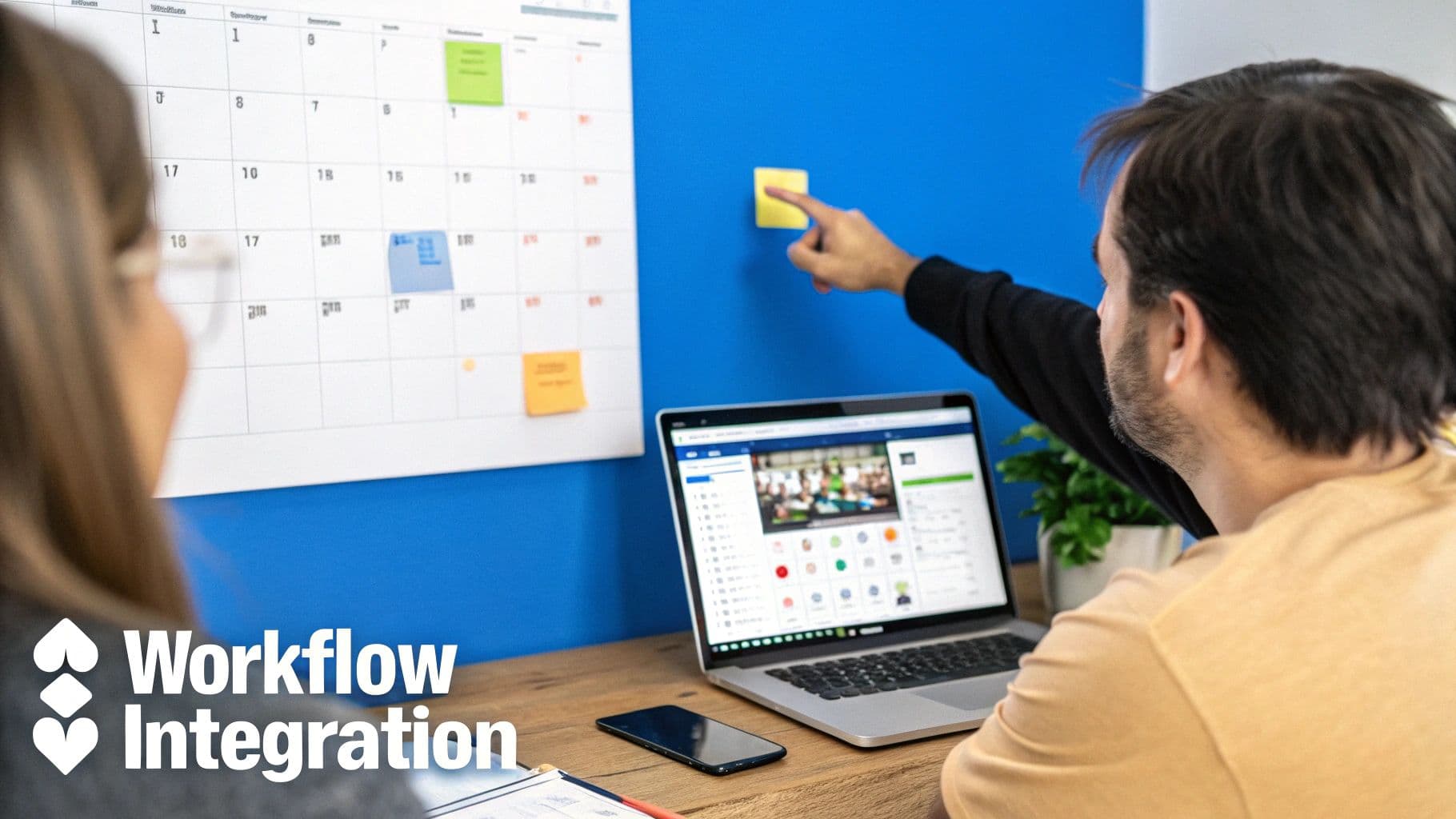
Getting this right is about more than just loading up a queue of posts. It’s about building a smooth, repeatable system for everything from brainstorming ideas to analyzing the results.
Laying the Groundwork for Success
Before you even think about scheduling your first post, there are a couple of crucial setup steps. It’s the boring-but-necessary prep work, like taping a room before you paint. Skipping it leads to a mess later on.
First up, securely connect your social media accounts. Any decent platform will use something called OAuth. This is a secure handshake that grants the tool access without you ever handing over your passwords. It’s a non-negotiable security feature.
Next, if you're not a one-person show, you absolutely need to establish user roles and permissions. This is mission-critical for agencies and businesses. It lets you decide who can write drafts, who can give the final sign-off, and who can actually hit the "publish" button.
Properly configured user permissions are the guardrails of your content strategy. They prevent accidental posts, ensure brand consistency, and create a clear, accountable workflow from the very beginning.
With your accounts linked and your team roles defined, you're ready to build the engine that will run your content strategy.
Building a Well-Oiled Content Machine
A solid workflow takes content management from a frantic, last-minute scramble to a calm, predictable process. It should cover the entire journey of a post, from a spark of an idea to a detailed performance report. Taking the time to build a strong social media management workflow is what separates the pros from the amateurs.
Here’s a simple, four-stage workflow you can steal and adapt:
- Content Creation & Curation: This is the creative part. Your team is drafting copy, designing graphics, and finding interesting articles to share. A shared asset library inside your scheduling tool is a lifesaver here, giving everyone a single place to grab approved logos, images, and videos.
- Internal Review & Approval: Once a draft is ready, it needs a second set of eyes. This is where managers, clients, or even a legal team can give feedback and sign off. Platforms with built-in approval queues are fantastic because they kill messy email chains and keep all the conversation right there with the content.
- Strategic Scheduling: The post is approved—now what? Don't just throw it on the calendar at a random time. Use your platform's analytics to find the best times to post. These are the golden hours when your specific audience is scrolling and most likely to engage with your content.
- Performance Analysis & Optimization: Your job isn't over when the post goes live. You need to circle back and check the analytics. Keep an eye on key metrics like engagement rate, reach, and clicks. This data tells you what’s hitting the mark and what’s not, so you can stop guessing and start making smarter decisions.
This structured loop ensures every single piece of content is created with purpose, vetted for quality, and published for maximum impact.
Making the Switch from Manual Posting
Moving away from posting on the fly can feel like a big shift, but it doesn't have to be painful. The whole point is to make your life easier, not to add another complicated process.
A great place to start is by filling your content library with evergreen posts. Think of timeless content like how-to guides, answers to frequently asked questions, or your most popular blog posts. Having a bank of this stuff ready to go is perfect for filling gaps in your schedule and keeping your feeds active, especially when things get hectic.
Next, work out a clear scheduling cadence. Decide how often you'll post on each network and do your best to stick to it. Consistency is a huge signal to social media algorithms, and a scheduling tool makes maintaining that rhythm almost effortless.
Finally, make sure your team understands why you’re making this change. This isn't just about automation. It's about freeing them from tedious tasks so they can spend more time on things that really matter—like talking to your community, planning bigger campaigns, and coming up with brilliant new ideas. When your team sees it as a tool that helps them, they'll embrace it.
Your Top Questions About Scheduling Platforms, Answered
Jumping into the world of social media scheduling platforms can feel like a big step. You've probably got a few questions floating around—concerns about engagement, account security, and what all these different terms even mean. It's smart to get these sorted out before you dive in.
Let’s clear the air and tackle some of the most common questions head-on. My goal is to give you the confidence you need to pick the right tool and use it well.
Will Using a Scheduler Hurt My Engagement?
This is easily the biggest myth out there, and it’s time to put it to bed for good. The short answer is no, a scheduler won't hurt your engagement.
Reputable platforms use official, network-approved APIs (Application Programming Interfaces). In plain English, this means social networks like X and Instagram see a post from a trusted scheduler the same way they see a post you make directly in their app. There’s no penalty.
The real threat to your engagement isn't the tool—it's developing a robotic "set it and forget it" mindset. When you use these platforms strategically, they can actually boost your engagement. How? By helping you post consistently when your audience is most active and ready to interact.
Think of a scheduler as a tool that frees you up for what really matters: authentic engagement. It handles the manual task of posting, so you can spend your time replying to comments, answering DMs, and actually building a community.
The winning formula has always been a balance between smart automation and real human interaction.
How Secure Is Connecting My Social Accounts?
Handing over access to your social media accounts is a big deal, and security should absolutely be a top concern. The good news is that high-quality scheduling platforms take this extremely seriously.
They never ask for your passwords. Instead, they use a secure authorization standard called OAuth.
If you’ve ever used a "Sign in with Google" or "Log in with Facebook" button, you’ve used OAuth. Think of it like giving a valet a key that only starts the car—it doesn’t open the trunk or the glove box. You're giving the platform permission to do one specific thing (like post for you) without ever handing over the master keys to your entire account.
To keep things as secure as possible, always follow these best practices:
- Stick to Reputable Platforms: Choose well-known tools that have clear privacy policies and use OAuth for authentication.
- Turn on Two-Factor Authentication (2FA): Enable 2FA on both your social media accounts and your scheduling tool. It’s one of the single best things you can do for your online security.
- Review Permissions Regularly: Once in a while, check which apps have access to your social accounts and remove any you don’t use anymore.
What's the Difference Between Crossposting and Scheduling?
This is a great question. While they sound similar, scheduling and crossposting solve two very different problems in your content workflow. Nailing down the difference will help you find a tool that actually fits what you’re trying to accomplish.
Scheduling is all about timing. You create a post and tell the tool to publish it on a single, specific platform at a future date. It's about planning ahead and building out a content calendar.
Crossposting, on the other hand, is all about distribution. It’s the act of taking one piece of content and publishing it across several different platforms.
This is where a tool like PostOnce introduces a new concept: automated crossposting. The workflow is completely different. You post on a supported source such as X, and the tool shares that post with eligible connected destinations. Availability varies by source/destination pair and post type. No planning, no scheduling—just instant distribution.
Here’s a simple way to think about it:
| Action | Core Function | Best For |
|---|---|---|
| Scheduling | Timing a post for a future release on one platform. | Planning content calendars, timing campaigns, and ensuring consistent activity over time. |
| Crossposting | Distributing a single piece of content across multiple platforms. | Achieving maximum reach quickly, maintaining a consistent brand message everywhere. |
| Automated Crossposting | Instantly distributing a post from a source platform to all others, no planning required. | Creators and businesses focused on speed, efficiency, and eliminating repetitive tasks. |
Simply put, scheduling is about when. Automated crossposting is about where and how fast.
Ready to stop the endless copy-pasting and start automating your content distribution? PostOnce was built to solve this exact problem, letting you publish everywhere just by posting once. Explore how automatic crossposting can transform your workflow and give you back hours every week.