


















Integrated marketing communications is really just a fancy way of saying that all your marketing should be telling the same story. It's the strategic glue that holds your brand’s messaging together across every single channel, ensuring you deliver a consistent, seamless, and customer-focused experience.
Instead of your social media team doing one thing and your advertising team doing another, every piece works in concert.
Understanding Integrated Marketing Communications

Think of your brand as a band. Your advertising is the lead guitar, your PR is the steady bass line, and your social media is the drumbeat that gets everyone moving. If they all play a different song, you just get noise. Integrated marketing communications (IMC) is the bandleader, making sure everyone is playing from the same sheet music to create a hit song.
This unified approach isn't just a "nice to have" anymore; it's essential. Customers bounce between websites, emails, TikTok, in-store displays, and traditional ads without a second thought. A disjointed message in this environment is jarring and kills trust. Imagine a luxury brand known for exclusivity suddenly running a 50% off fire sale on social media—it completely undermines the premium image they built in Vogue. The two messages are at war with each other.
An integrated strategy means that no matter where or how a customer runs into your brand, they get the same core message and the same distinct personality. This consistency is what builds real, lasting relationships.
So, what is integrated marketing communications at its core? It's a philosophy built on synergy. Each marketing channel is picked not just for what it can do on its own, but for how it can amplify the others. The combined impact is far greater than the sum of its parts.
To get a clearer picture, let's break down the fundamental concepts. This table gives you a quick snapshot of the key components of IMC before we dive deeper into each one.
Core Principles of Integrated Marketing at a Glance
| Principle | Description | Example |
|---|---|---|
| Consistency | All messaging, visuals, and tone of voice are uniform across every channel. | Nike's "Just Do It" slogan appears consistently in TV ads, on social media, and on their product packaging. |
| Coherence | While consistent, messages are also logically connected and make sense together. | A company promotes a new eco-friendly product on Instagram, and their blog features articles on sustainability. |
| Continuity | The marketing message evolves over time but remains connected to a central theme. | Dove's "Campaign for Real Beauty" has evolved over the years but always focuses on celebrating diverse body types. |
| Complementarity | Each channel plays a unique role that strengthens the others. | A TV ad creates broad awareness, while a targeted email campaign drives direct sales for the advertised product. |
As you can see, these principles aren't just abstract ideas—they're the practical building blocks for creating a powerful and unified brand presence.
Here are a few of the biggest wins you get from this approach:
- Enhanced Brand Trust: When you say the same thing everywhere, people start to believe you. Consistency builds credibility and makes your brand feel dependable.
- Improved Efficiency: Coordinating your marketing stops you from reinventing the wheel. It cuts down on wasted effort and stretches your budget for a much better return on investment.
- A Seamless Customer Journey: Customers move smoothly from one touchpoint to the next, like following a clear path, because the experience is logical and connected.
From Marketing Silos to True Synergy
To really get why integrated marketing communications is so important, you first have to picture the mess it was created to clean up. For a long time, marketing departments were a collection of separate islands. Think of them as silos.
The advertising team did their thing, the public relations crew had their own agenda, and the sales promotion folks were off in their own world. Nobody was really talking to each other.
Each team chased its own goals with its own budget, leading to a brand message that was all over the place. A customer might see a serious, high-end magazine ad one day, then hear a silly, discount-focused radio spot the next. This kind of disjointed communication just creates confusion and, worse, it chips away at customer trust.
As the number of media channels grew and people got smarter about marketing, the cracks in this old model started to show. It became obvious that brands were just making a lot of noise instead of telling a clear, consistent story.
The Rise of a Unified Voice
Integrated Marketing Communications, or IMC, came about as the direct solution to this chaos. It was born from the need to manage the growing complexity of media and the shift in how consumers engaged with brands in the late 20th century.
The term itself was really put on the map in the early 1990s, thanks to thinkers like Don Schultz at Northwestern University. In 1993, he and his colleagues literally wrote the book on it—the first textbook dedicated to the IMC framework. They gave structure to a new, more strategic way of thinking about how brands should talk to people. You can read more about its academic roots from the people who helped shape it at the Medill School of Journalism, Media, Integrated Marketing Communications.
At its core, this new philosophy was simple but powerful: all marketing activities should be planned and executed with one voice, one strategy, and one common goal.
This was a major shift. It moved marketing away from just launching a bunch of separate, one-off campaigns and toward building a seamless, ongoing conversation with the customer. The focus wasn't just on the next sale; it was on building a real, long-term relationship. This evolution completely changed the game, defining the integrated approach we see as essential today.
The Building Blocks of an IMC Strategy
A truly effective Integrated Marketing Communications (IMC) strategy isn't just one big campaign. It's more like a finely tuned orchestra where every instrument plays its part to create a single, powerful piece of music. Each marketing component has a specific job, but when they work in harmony, the result is far more impactful than any one of them could achieve alone.
Think of it this way: you wouldn't build a house with just a hammer. You need a blueprint, a foundation, walls, and a roof, all working together. In marketing, these core components are the tools you use to build your brand’s story and presence.
The Core Marketing Mix
Let's break down the primary tools in your marketing toolkit. These aren't solo acts; they're collaborative players on the same team, all driving toward the same goal.
- Advertising: This is often the most visible part of the mix. Think paid channels like TV, radio, digital ads, and print. Advertising is all about casting a wide net to get your core message in front of a large audience and build broad awareness.
- Public Relations (PR): PR is the art of building trust and credibility through earned media. A positive feature in a well-respected magazine or a collaboration with an industry influencer gives your brand an authentic stamp of approval that money can't always buy.
- Sales Promotions: These are your short-term incentives—things like discounts, contests, or loyalty rewards. Their job is to create a sense of urgency and give customers a direct nudge to convert interest into a sale.
- Direct Marketing: This is where you get personal. Communicating directly with individual customers through channels like email, text messages, or even personalized mail allows you to build stronger relationships and foster long-term loyalty.
This visual helps illustrate how all these integrated efforts come together to hit major business goals like brand consistency, customer engagement, and ultimately, a better ROI.
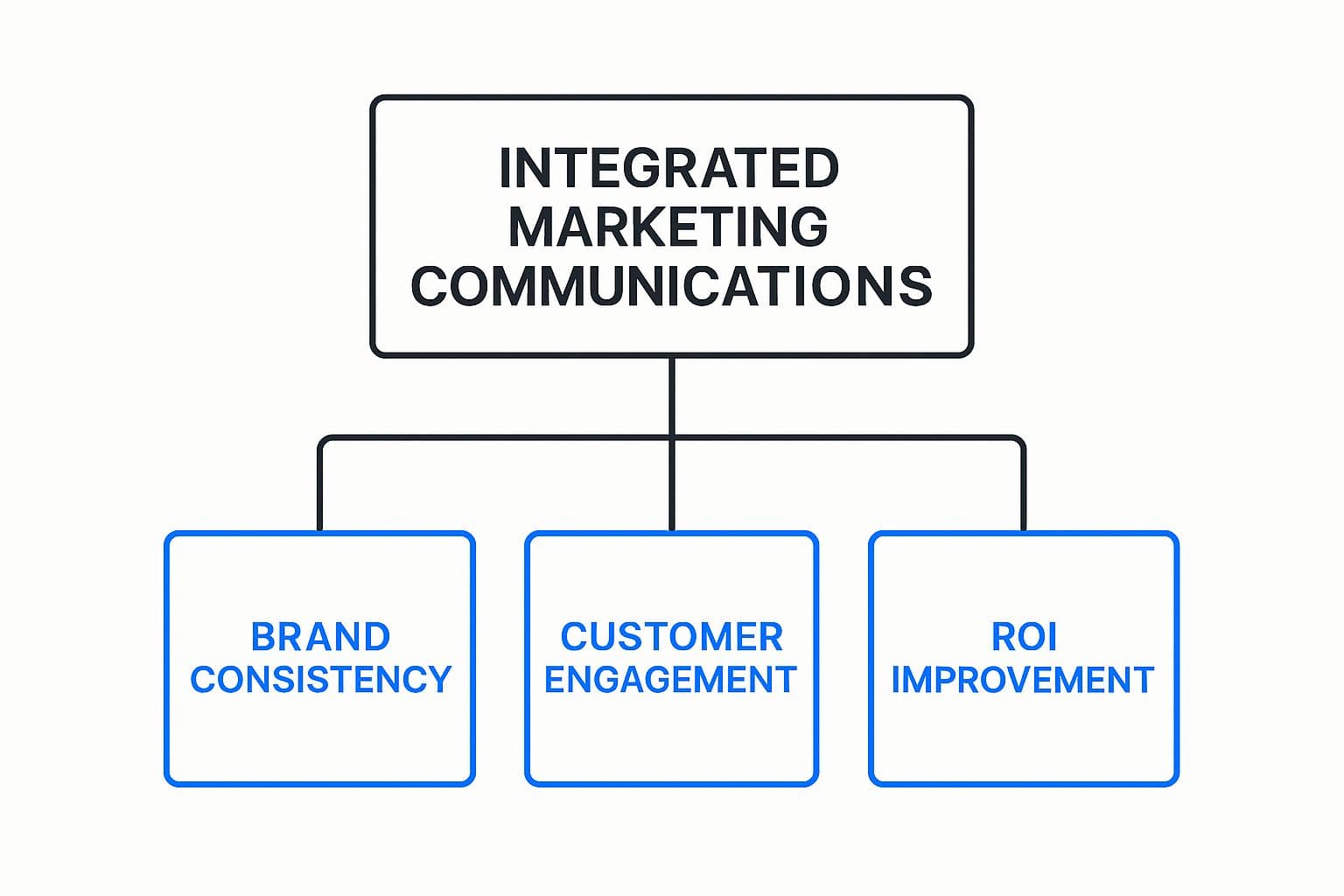
As you can see, a well-planned IMC strategy isn't just about marketing activities; it’s about directly supporting the outcomes that lead to real, sustainable growth.
Unifying with Digital Marketing
In today’s world, digital marketing is the glue that holds everything together. It’s the common thread weaving through your website, SEO, social media, and content creation, making sure every channel reinforces the others.
For instance, a new blog post (content marketing) can be announced in an email newsletter (direct marketing) and promoted across your social media channels, all while being optimized for search engines (SEO) to pull in organic traffic. It’s a flywheel effect. Just like an IMC strategy needs its foundational elements, understanding the essential pillars for a robust podcast marketing strategy shows how crucial focused, multi-channel planning is for success.
Comparing Siloed vs. Integrated Marketing
The difference between a disjointed marketing approach and a truly integrated one is night and day. A siloed strategy often leads to mixed messages and wasted effort, while an IMC plan creates a seamless and powerful brand experience for the customer.
This table breaks down the key differences.
| Aspect | Siloed Marketing | Integrated Marketing (IMC) |
|---|---|---|
| Messaging | Inconsistent; different departments send different messages. | Unified and consistent across all channels. |
| Customer Experience | Fragmented and confusing; customers get mixed signals. | Seamless and cohesive; a single brand story everywhere. |
| Teamwork | Departments work in isolation, often competing. | Collaborative; teams share goals and data. |
| Efficiency | Redundant work and wasted resources are common. | Efficient use of budget and resources; efforts are amplified. |
| Measurement | Difficult to see the big picture or attribute results accurately. | Holistic view of performance; clear attribution. |
Ultimately, moving from a siloed approach to an integrated one is about creating synergy. It's about making 2 + 2 = 5.
The real magic happens when a big PR win is amplified with paid social media ads, or when a new sales promotion is kicked off with a coordinated email blast and influencer campaign. This is what integrated marketing communications is all about—making every single piece work harder, together.
Why Integrated Marketing Drives Real Business Growth
So, what's the real payoff for weaving all your marketing together? It's about more than just having a consistent brand voice—it’s about turning your marketing from a budget item into a true growth engine. When all your channels are singing from the same hymn sheet, the result is far more powerful than if they were all performing solo.
This synchronized approach brings some serious operational perks. Think about it: instead of siloed teams accidentally creating the same graphics or running campaigns that compete with each other, everyone's resources get pooled and focused. This cuts out the waste and makes everything run smoother, often leading to major cost savings. In fact, some analyses show that businesses using an integrated strategy can trim their marketing spend by up to 20%. You can learn more about the financial upside of IMC in this comprehensive guide.
That newfound efficiency is great, but its biggest impact is on the customer experience—and that’s where the magic really happens.
Build Trust, Boost Conversions
Trust is everything, and a seamless brand experience is how you earn it. When a customer sees the same core message on your website, in their email inbox, and on their social feed, it builds a powerful sense of reliability. It tells them you’re consistent and dependable. This clarity removes friction, making their journey with your brand feel natural and effortless.
At its core, integrated marketing aims to make every customer interaction feel like part of one single, ongoing conversation. This strengthens the relationship at every single touchpoint.
This foundation of trust directly fuels your conversion rates and return on investment (ROI). A cohesive strategy creates a domino effect that leads to better results:
- Reinforced Messaging: Imagine a customer sees a social media ad, clicks through to a blog post, and later gets a follow-up email. Each piece reinforces the others, making the final call-to-action feel like the next logical step, not a random sales pitch.
- Improved Brand Recall: Consistent visuals, colors, and tone make your brand instantly recognizable. When it comes time to buy, you’ll be the first one they think of.
- Greater Customer Loyalty: People stick with brands they trust. A positive and predictable experience turns one-time buyers into loyal fans who come back again and again.
By aligning every marketing activity, you create a powerful flywheel where each part strengthens the others. This leads to better campaign outcomes and a much healthier bottom line. For some hands-on advice on unifying your voice, check out our social media management tips to help keep your presence consistent.
How to Build Your Integrated Marketing Plan
Okay, let's move from theory to action. This is where the rubber meets the road and your integrated marketing communications strategy actually starts taking shape. Building a solid IMC plan isn't about throwing everything at the wall to see what sticks. It's about a step-by-step process that aligns your brand’s big-picture goals with coordinated, on-the-ground actions. Think of it as drawing up a detailed blueprint before you even think about pouring the foundation.
First things first, you need an honest look at where you are right now. A SWOT analysis (Strengths, Weaknesses, Opportunities, Threats) is perfect for this. This isn't just some dusty business school exercise; it’s a genuinely useful snapshot of your position in the market. It tells you what you’re great at, where you’re dropping the ball, and what outside forces could either help you or hurt you.
Define Your Objectives and Audience
With a clear view of the landscape, you have to decide what "winning" actually looks like. Fluffy goals like "increase brand awareness" won't cut it. You need to get specific and set measurable objectives. Think more along the lines of, "achieve a 15% increase in website traffic from social media within Q3," or "generate 50 qualified leads per month from our content marketing."
Once your goals are locked in, you need to know exactly who you're talking to. This is where creating detailed buyer personas becomes so important. These aren't just basic demographic lists; they're rich, semi-fictional profiles of your ideal customers, complete with their goals, biggest headaches, and where they hang out online.
A deep understanding of your audience informs every single decision you make—from the channels you pick to the tone of voice you use.
When you truly know your customer, you can craft a powerful core message. This is the single, compelling idea that acts as the heartbeat for your entire campaign, ensuring everything you put out there feels consistent and connected.
Select Channels and Measure Performance
Now for the fun part: choosing your channels. Looking at your buyer personas, where does your audience actually spend their time? A B2B tech company might double down on LinkedIn and niche industry blogs. A B2C fashion brand, on the other hand, will probably live on Instagram and TikTok.
The real trick is to pick channels that play well together. For example, you can take a piece of owned media, like a great blog post, and use a content syndication platform to automatically push it out across dozens of other networks, massively extending its reach.
After you've launched your coordinated campaign, the last—and arguably most important—step is to measure everything. Use those initial objectives and KPIs as your North Star to track what’s working and what isn’t. Keep a close eye on metrics like:
- Website Traffic: Are certain channels sending way more visitors than others?
- Conversion Rates: How many actual leads or sales did this campaign bring in?
- Engagement Metrics: What posts, videos, or emails are people reacting to the most?
This data is pure gold. It’s your feedback loop, giving you the hard evidence you need to tweak, refine, and continuously improve your integrated marketing plan for the biggest possible impact.
Answering Your Top IMC Questions
Even after mapping out the basics, a few questions about integrated marketing communications always seem to come up. Let’s clear the air and tackle the most common ones head-on.
How Is IMC Different From Just Running a Bunch of Campaigns?
This is a great question, and the answer comes down to one word: synergy.
Running multiple campaigns is like having a band where every musician is playing a different song. Sure, they’re all making noise, but it's just chaos. Your social media team is doing one thing, your email marketers are doing another, and your ad people are off in their own world.
Integrated marketing communications, on the other hand, is like a well-rehearsed orchestra. Every instrument—or in this case, every marketing channel—is playing from the same sheet music. The social media campaign echoes the PR announcement, which is then reinforced by your digital ads. It’s all one seamless, powerful story.
What Are the Biggest Hurdles to Making IMC Work?
Honestly, the biggest challenge is almost always internal. Getting different teams like sales, PR, and marketing to break out of their comfortable silos and actually talk to each other can feel like a monumental task. It often requires a real shift in company culture.
The toughest part isn't crafting the perfect message. It's getting every single team to deliver that message with one voice. That takes shared goals, real communication, and leadership that’s committed to the vision.
Another common struggle is measurement. When you have so many channels working together, how do you prove what’s working? You need the right analytics tools to connect the dots and see the combined impact, not just how one email or one ad performed in isolation.
Can Small Businesses Actually Pull This Off?
Absolutely. In fact, IMC can be a small business's secret weapon. It’s all about maximizing the impact of every dollar you spend.
Instead of stretching a small budget across a dozen disconnected efforts, you can create a single, powerful message that cuts through the noise. This helps you build brand recognition much faster. For example, keeping your voice and visuals consistent across just a few key social platforms can make a huge difference. You can learn more about this by checking out these social media cross-posting strategies.
By hammering home one core message in every blog post, email, and social media update, a small business can build the kind of strong, trustworthy brand that competes with the big guys.