


















A content syndication platform is a powerful tool that automatically pushes your content—like blog posts, whitepapers, and videos—out to a whole network of third-party websites. Think of it as a digital news wire for your brand. It takes the great stuff you're already creating and gets it in front of a much bigger, more targeted audience than you could ever reach on your own.
What Exactly Is a Content Syndication Platform?

Let's say you just published a fantastic, in-depth article. On your own blog, it'll reach your loyal followers, which is great, but its true potential is so much bigger. A content syndication platform acts like a megaphone for that article, broadcasting it across dozens, sometimes even hundreds, of other relevant and authoritative sites.
This isn't just about sharing a link on social media. It’s about republishing your entire article (or a big chunk of it) on another publisher’s website, always with full credit pointing back to you as the original source.
The Big Idea: The whole point of a content syndication platform is to put your content in front of fresh, relevant audiences on websites they already know and trust. This is how you build brand awareness, drive traffic, and generate leads without the soul-crushing work of pitching every single publisher by hand.
This approach has become a go-to strategy in modern marketing, especially for B2B companies. In fact, its use is widespread; nearly four out of five B2B marketing leaders now rely on content syndication vendors. This boom has been fueled by a 55% increase in the demand for B2B content since 2019.
How Does It Actually Work?
At its core, a content syndication platform automates a process that would otherwise be a massive headache. Instead of your team spending weeks hunting for the right websites, negotiating deals, and reformatting every piece of content, the platform does the heavy lifting through its pre-existing network. It’s one of the best business process automation examples out there for marketers.
It's important not to mix this up with simpler forms of content sharing. While you might be familiar with crossposting on social media, syndication is a completely different beast, operating on a larger scale with more ambitious goals. You can see the key differences here: https://postonce.to/blog/what-is-crossposting.
Ultimately, these platforms close the gap between creating great content and getting people to actually discover it. They ensure your best work doesn't just gather dust on your own site but travels across the web to find the exact people who need it.
To give you a clearer picture, here’s a quick summary of what these platforms really do for you.
Content Syndication At a Glance
| Key Function | Primary Goal | Typical Outcome |
|---|---|---|
| Automated Content Distribution | Reach new, targeted audiences | Your content appears on established industry websites. |
| Building Authority | Establish your brand as an expert | Readers see your name on sites they already trust. |
| Integrated Lead Capture | Generate qualified marketing leads | New prospects are added directly to your sales funnel. |
| SEO-Friendly Republishing | Boost your site's search rankings | Canonical tags send authority back to your original article. |
In short, a good platform delivers a powerful mix of benefits that can seriously move the needle for your marketing efforts. The result is a powerful combination of benefits:
- Expanded Reach: Your content instantly gets in front of an established publication's built-in readership.
- Enhanced Authority: Being featured on reputable sites builds your credibility and positions you as a thought leader.
- Lead Generation: Many platforms come with built-in lead capture, turning readers into qualified prospects.
- SEO Benefits: Proper syndication includes a canonical link back to your original post, telling search engines you're the true source and passing valuable authority to your site.
How These Platforms Get Your Content Out There
So, you’ve poured your expertise into a brilliant piece of content. What now? A content syndication platform is essentially your distribution powerhouse, taking that article and putting it in front of fresh eyes—audiences that might never have found your website on their own. It’s a smart blend of technology and publisher partnerships, all designed to get you maximum exposure without hurting your SEO.
The process kicks off when you hand your original content over to the platform. From there, it's largely hands-off for you. The system automatically pushes your work out to its network of third-party publishers. This isn't just a random assortment of sites; it's a curated collection of news outlets, specialized industry blogs, and professional publications that have opted-in to receive and republish quality content. This automation alone saves you from the soul-crushing task of manual outreach.
Think of it as one key piece of a much larger puzzle. Understanding a broader content distribution strategy helps you see where syndication fits in and how it complements your other marketing efforts.
The Two Core Distribution Models
When you dive into content syndication, you'll find it generally falls into two buckets: free or paid. Each has its place, but they offer very different levels of control and potential return.
- Free Syndication: This is when you republish your work on open platforms like Medium or as a LinkedIn Article. It’s a solid way to cast a wide net for brand awareness and a great place to start. The catch? You have little say in who sees your content, and you don’t typically get any direct lead generation features.
- Paid Syndication: This is where things get serious. With a paid platform, you’re buying access to a premium network of publishers. This model guarantees placement, lets you target specific audiences (think industry, job title, or company size), and often includes built-in lead capture forms that turn readers into actual prospects.
While free options are a good way to test the waters, paid platforms are built for business growth. They justify the investment by delivering measurable results, like qualified leads and new sales opportunities.
The Tech Working Behind the Scenes
How does your article just show up on all those other websites? It’s not magic, just some really smart technology, mainly RSS feeds and APIs.
An RSS (Really Simple Syndication) feed is basically a simple file that keeps a running summary of your latest content. The platform keeps an eye on this feed, and whenever you publish something new, it automatically grabs it for distribution. APIs (Application Programming Interfaces) create an even more direct link, allowing the platform to push content straight into a publisher’s own content management system. It's seamless.
This infographic breaks down how content flows from creation all the way through to analysis.
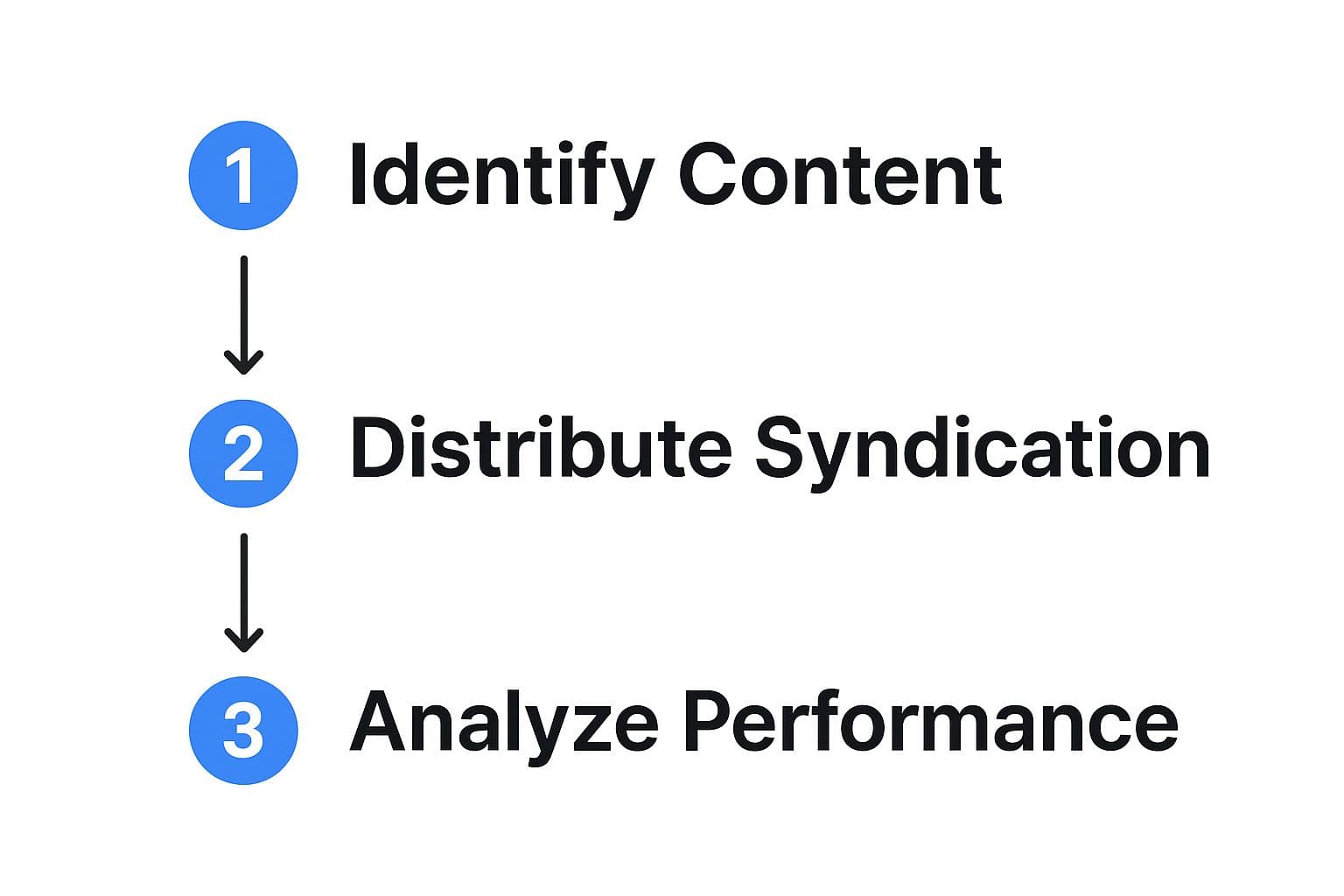
This workflow ensures that once your content is approved, it gets distributed quickly and efficiently, with all the performance data tracked to show you what’s working. While we're talking about republishing articles here, the same automated principle applies to social media. For a similar strategy, check out our guide on https://postonce.to/blog/how-to-crosspost-on-social-media.
Keeping Your SEO Safe with Canonical Tags
Let’s address the elephant in the room: duplicate content. It’s a legitimate concern. Won’t Google penalize you for having the same article plastered all over the internet? Not if it’s done right. Reputable syndication platforms have a simple, elegant solution: the canonical tag.
A canonical tag (
rel="canonical") is a small piece of HTML code that acts like a signpost for search engines. It tells them, "Hey, this is a copy, but the original master version is over here." When a publisher runs your syndicated article, this tag points directly back to the original post on your website.
This little tag is a game-changer. It channels all the SEO juice—the authority, the backlinks, the credibility—back to your original article. So, instead of being penalized, Google sees the syndicated copies as legitimate reprints that actually reinforce the authority of your site. This is how a content syndication platform manages to expand your reach and boost your SEO at the same time.
How Content Syndication Drives Real Business Growth

Let's be honest: any new marketing investment has to justify its cost with a clear return. When it comes to content syndication platforms, the benefits aren't just abstract ideas—they translate directly into measurable business growth. This is about far more than just getting your articles republished. It's a strategic way to scale your influence, fill your sales pipeline, and fortify your brand's digital presence.
By pushing your best work out through a network of established websites, you’re not just reaching more people; you’re tapping into their pre-built, trusting audiences. This isn't a one-off tactic. It's a strategic play that delivers compounding returns in three key areas: massive brand awareness, a steady flow of quality leads, and a stronger SEO foundation.
Explode Your Brand Awareness and Credibility
Imagine your company's latest analysis appearing on a major industry publication—the one your ideal customer starts their day with. That single placement can do more for your credibility than a dozen blog posts on your own site. This is the real magic of syndication for building a brand.
It all boils down to a simple truth: visibility builds familiarity, and familiarity builds trust. When potential buyers see your name and insights on websites they already respect, they start to associate that credibility with your brand.
You're no longer just another voice shouting into the digital void. Instead, you become a recognized authority whose perspective is valued by reputable publishers. This "borrowed credibility" is one of the fastest ways to elevate your brand from an unknown entity to a noteworthy leader.
This isn’t about vanity metrics, either. That spike in awareness creates a halo effect that lifts all your other marketing efforts. Your social profiles gain more followers, your email open rates creep up, and your sales team has an easier time booking meetings because they aren't starting from scratch.
To get the most out of this, you need a solid content foundation. An effective evergreen content strategy is crucial, as platforms are brilliant at distributing timeless content that delivers sustained impact.
Generate a Stream of High-Quality Leads
While brand awareness is great, most of us need to see a direct impact on the sales pipeline. This is where a top-tier content syndication platform truly proves its worth, shifting from a simple publisher to a powerful lead generation engine. The best platforms don’t just share your articles; they embed them with smart lead-capture tools.
Here’s a typical rundown of how it works:
- Gated Content: Your most valuable assets, like in-depth research reports or comprehensive whitepapers, are offered on partner sites.
- Simple Forms: To download the content, a reader provides their professional details—name, company, email, and job title.
- Direct Integration: These fresh leads are piped directly into your CRM or marketing automation platform, teeing them up for your sales team.
This process is incredibly powerful because it targets professionals who are actively looking for solutions. They aren't just casually browsing; they’re seeking expert information to solve a real business problem, which makes them highly qualified prospects. The results speak for themselves: companies using content syndication report about 45% higher sales achievement than those that don't. You can dig deeper into these findings over at Revnew.com.
Enhance Your SEO Authority with Powerful Backlinks
Perhaps the most significant long-term benefit of content syndication is the muscle it adds to your website's SEO. Every time your content is republished on a high-authority site, it should include a canonical tag pointing back to your original article. This detail is non-negotiable.
This tag is a signal to search engines like Google, telling them, "Hey, this site is the original source." As a result, you earn valuable backlinks from these reputable domains. Search engines see backlinks as votes of confidence; when authoritative sites link to you, it tells them your content is credible and important.
This has a direct and potent effect on your own site's ability to rank for your target keywords. Over time, a consistent syndication strategy builds a powerful backlink profile that makes your entire website more visible in search results. It’s a classic virtuous cycle: your syndicated content drives immediate traffic and leads while simultaneously building the SEO foundation that brings you organic traffic for years to come.
Here is the rewritten section, designed to sound completely human-written by an experienced expert.
What Separates a Great Syndication Platform from an Average One?
When you’re looking for a content syndication platform, you're not just buying a distribution service—you're investing in a growth partner. On the surface, many platforms look the same, all promising to get more eyes on your content. But the difference between a mediocre platform and a truly great one lies in the details.
A great platform doesn't just spray your content across the web hoping something sticks. It acts like a skilled matchmaker, connecting your best work with the exact people who need to see it. To find that partner, you have to look past the marketing buzz and really understand what's going on under the hood.
H3: The Quality of the Publisher Network
The heart of any syndication platform is its network of publishers. It’s tempting to be wowed by massive numbers, but let me be blunt: quality and relevance always beat sheer quantity. A top-tier platform won’t hide where your content is going; it will be transparent about its partners.
You should be looking for a network filled with respected industry blogs, established news sites, and niche publications that your target audience already trusts. Getting your whitepaper featured on a handful of authoritative sites in your industry is infinitely more valuable than having it scattered across a hundred irrelevant blogs. It’s about building credibility, not just collecting empty impressions.
Expert Tip: Don't take a platform's word for it. Always ask for a list of their top publishers. If their network doesn't align with where your ideal customers hang out, it's not the right fit, no matter how big it is.
When your content shows up next to other trusted resources, that credibility rubs off on your brand. That’s how you make a real impact.
H3: Advanced Targeting: From Shotgun to Sniper Rifle
This is where the magic really happens. The best platforms have moved far beyond just pushing content out. They offer incredibly detailed targeting that lets you pinpoint your ideal audience with surgical precision. It’s the difference between shouting into a crowded room and having a quiet, direct conversation with the right person.
A platform worth its salt will let you build an audience based on a whole range of criteria:
- Job Title: Go straight to the decision-makers, whether that's a "VP of Marketing" or an "IT Director."
- Industry: Focus your budget on the verticals that actually matter to you, like SaaS, healthcare, or manufacturing.
- Company Size: Filter by employee count or revenue to find businesses that match your ideal customer profile.
- Location: Zero in on specific countries or regions to support your local sales teams.
This kind of control means your marketing dollars are spent wisely, placing your best assets in front of the people who have the authority and the need to buy. It turns your syndication from a simple brand awareness play into a powerful lead-generation engine.
H3: Analytics That Actually Mean Something
If you can't measure it, you can't improve it. Vague metrics and vanity stats are useless. A top-tier content syndication platform must give you a clear, easy-to-understand analytics dashboard that shows you exactly what your investment is achieving.
You need data you can actually act on. Look for these essential reporting features:
- Lead-Level Detail: You should be able to see exactly who is engaging with your content—their name, title, company, and contact info.
- Core Engagement Metrics: Track the basics like impressions and clicks, but more importantly, conversion rates that show how well your content is performing.
- Publisher Performance: Instantly see which sites in the network are delivering the best leads, so you know what's working and what's not.
This kind of reporting closes the loop. You can see that a specific whitepaper is killing it with CFOs in the finance sector, and you can immediately double down on that strategy. It’s about connecting your spend directly to tangible business outcomes, like qualified leads and new sales opportunities.
When evaluating platforms, it's helpful to see a clear breakdown of what features are non-negotiable versus what are nice-to-haves. This table provides a quick checklist to guide your decision-making process.
Key Feature Comparison for Syndication Platforms
| Feature | Description | Importance Level (Essential/Advanced) |
|---|---|---|
| Publisher Transparency | Provides a clear list of where your content will be syndicated. | Essential |
| Firmographic Targeting | Allows targeting by company size, industry, and revenue. | Essential |
| Demographic Targeting | Allows targeting by job title, function, and seniority. | Essential |
| Lead-Level Reporting | Delivers detailed contact information for every lead generated. | Essential |
| Performance Dashboard | Offers real-time analytics on clicks, conversions, and CPL. | Essential |
| Intent Data Integration | Uses 3rd-party data to target accounts actively researching solutions. | Advanced |
| AI-Powered Optimization | Uses AI to automatically match content to the best-fit audience/publisher. | Advanced |
| CRM/MAP Integration | Natively syncs leads and data with platforms like Salesforce or HubSpot. | Advanced |
| Content Personalization | Dynamically adjusts content or calls-to-action for different audiences. | Advanced |
Ultimately, the right platform will have all the essential features as a baseline, while the advanced features provide an extra layer of power and efficiency to take your campaigns to the next level.
H3: The Quiet Rise of AI and Automation
Artificial intelligence isn't just a buzzword anymore; it's a real force in marketing tech. The market for content distribution technology is growing fast, largely because AI is making these tools smarter and more efficient. The leading syndication platforms are now using AI to handle tasks that used to require a ton of manual effort.
Think of it like an intelligent assistant that's constantly working behind the scenes. AI can analyze your article, understand its core topics, and then automatically find the perfect publisher and audience segment for it. This ensures your content gets delivered at just the right moment for maximum impact, without you having to micromanage every single detail.
Choosing the Right Syndication Partner

Picking a content syndication platform is one of those make-or-break decisions. Get it right, and you can supercharge your growth. Get it wrong, and you’ll burn through your marketing budget with almost nothing to show for it. This isn't just about buying a tool; it's about finding a true strategic partner.
Think of it like hiring a specialized sales team for your content. You wouldn't bring them on without scrutinizing their network, their process, and how they define success, right? The same logic applies here. You need a partner that doesn't just blast your content out but delivers real, predictable results that line up with your actual business goals.
Evaluate the Publisher Network
The first and most critical question for any potential partner is simple: "Who's in your publisher network?" A giant list of no-name blogs is worthless compared to a carefully curated group of respected, industry-specific sites where your ideal customers already hang out. Quality trumps quantity every single time.
Don't be afraid to dig for details. A transparent partner will be happy to show you their top-tier publishers. If the sites in their network don't feel like places where your customers would be, that's a huge red flag. A great fit means your content shows up on sites that give your brand instant credibility by association—a far smarter strategy than just spraying your content everywhere. You can read more about the differences in our guide on social media cross-posting.
Scrutinize Targeting and Reporting
Once you're sold on the network's quality, it's time to get into the nitty-gritty of their targeting options. Can you really pinpoint prospects by job title, industry, company size, and location? The more granular you can get, the more efficiently your campaign will run. You want your money spent reaching decision-makers, not just anyone.
Just as important is how they report back on performance. Vague metrics are a waste of time. You need a platform that gives you clear, actionable data.
Ask them point-blank: "How do you report on campaign success, and what specific metrics can I expect to see?" A solid partner will provide a dashboard showing leads generated, cost-per-lead (CPL), and exactly which publishers are pulling their weight.
Align Pricing with Your Goals
Pricing models for syndication platforms are all over the map, so you have to pick one that makes sense for your goals and budget. The most common structures you'll see are:
- Cost-Per-Lead (CPL): You pay a set price for every qualified lead. This is the best choice for performance-based campaigns where ROI is everything.
- Flat Fee: You pay a recurring fee (usually monthly or annually) for access to the platform, no matter how many leads you get.
- Cost-Per-Click (CPC): You pay whenever someone clicks on your content. This model works well if your main goal is driving traffic and building brand awareness.
Match the model to your main objective. If generating high-quality leads is your number one priority, a CPL model gives you the most predictable return on your spend.
Finally, always ask for recent case studies and client testimonials. This is where the rubber meets the road. Seeing how a vendor has helped businesses like yours get real results is the best way to cut through the sales pitch and feel confident that you’re picking a partner who will actually deliver.
Got Questions? We've Got Answers
Dipping your toes into content syndication often brings up a few important questions. It's smart to wonder how it affects your SEO and which content will actually get results. Let's clear up some of the most common concerns marketers have.
Will Syndication Hurt My Site's SEO?
This is probably the biggest myth out there, but the short answer is no—not when you do it right. In fact, it can be a huge boost for your SEO.
Reputable syndication platforms have a simple, elegant solution: the canonical tag. This small bit of code (rel="canonical") is added to the syndicated version of your article, and it acts like a signpost for Google, essentially saying, "Hey, this is a copy. The original, authoritative version is over here!"
This single tag tells search engines to pass all the SEO juice—the authority, the credit, the backlinks—directly to your website. So instead of duplicate content penalties, you end up with high-quality links from established publisher sites, which is exactly what Google loves to see.
What Kind of Content Should I Syndicate?
The golden rule is to share content that's genuinely helpful and educational. Think about it from the perspective of someone who's never heard of your brand. What would make them stop and read?
The content that consistently performs best includes:
- Deep-dive articles that really unpack a complex topic.
- Original research reports packed with fresh data and unique insights.
- Problem-solving whitepapers that offer a clear path to a solution.
- Detailed case studies that prove your value with real-world results.
The key is value. Content that feels like a thinly veiled sales pitch won't get picked up by good publishers, and it definitely won't resonate with their audience.
What's the Real Difference Between Free and Paid Syndication?
It all boils down to your goals and how much control you need.
Free syndication, like posting your articles on sites like Medium or LinkedIn, is a great way to get your name out there. It’s perfect for general brand awareness, but you don't get much say in who sees your content, and it’s not really built for generating leads.
Paid platforms, on the other hand, are designed for performance. They offer guaranteed placement on relevant, high-traffic websites. You get powerful targeting options to zero in on your ideal audience—by job title, industry, or even company size—and they come with tools specifically for capturing leads. This gives you far more control and, most importantly, a measurable return on your investment.
Ready to stop manually posting and start growing your brand on autopilot? PostOnce lets you create content once and automatically distribute it everywhere. See how it works at PostOnce.