


















If you're managing multiple online communities, you know the grind of keeping them all active. The solution is smart automation with a tool like PostOnce, which handles the heavy lifting of distribution. But the real secret lies in your strategy. It all boils down to one crucial distinction: crossposting is about smart adaptation, while multiposting is just blind broadcasting.
Crossposting vs Multiposting The Core Differences

Understanding the difference between these two approaches is non-negotiable for building a real audience. People often use the terms interchangeably, but their effect on your engagement, reputation, and sanity couldn't be more different.
Multiposting is the brute-force method. You write one post, then copy and paste it everywhere—from a formal LinkedIn update to a niche Reddit community—without a single change. Sure, it's fast. But it’s a tactic that usually backfires because it completely ignores the unique culture, rules, and expectations of each space. The most common outcomes are dismal engagement, annoyed followers, or worse, getting flagged as spam.
Crossposting is the thoughtful alternative. You still start with a core idea or piece of content, but you reshape it to fit each platform's native language.
The goal of crossposting isn't just to be present everywhere; it's to be relevant everywhere. It shows you understand and respect the community you're posting in.
This could mean spinning a deep-dive blog post into a punchy Twitter thread, turning key stats into a sharp-looking Instagram carousel, or reframing a question to spark debate in a specific subreddit. If you want to dig deeper into the mechanics, we've covered the essentials in our guide on what is crossposting and how to do it right.
To make the contrast crystal clear, here’s a quick breakdown of how these two strategies stack up against each other.
Crossposting vs Multiposting Quick Comparison
This table highlights the core differences in strategy, platform response, and how your audience will likely perceive your efforts.
| Attribute | Crossposting (The Smart Way) | Multiposting (The Risky Way) |
|---|---|---|
| Strategy | Tailor content to each platform's audience, tone, and format. | Post identical content across all platforms without changes. |
| Effort | Higher initial effort, focused on quality and adaptation. | Minimal effort, focused on speed and quantity. |
| Audience Perception | Seen as authentic, respectful, and value-driven. | Often perceived as lazy, impersonal, or spammy. |
| Engagement | Typically drives higher engagement, discussion, and reach. | Usually results in low engagement and audience fatigue. |
| Community Fit | Respects and integrates with community rules and etiquette. | Ignores platform-specific norms, risking moderation issues. |
Ultimately, the choice comes down to what you're trying to achieve. One path builds genuine connection and authority, while the other just adds to the noise.
Understanding Technical and Algorithmic Impacts
The real distinction between crossposting and multiposting isn't just about good manners online; it’s about how platforms technically see and rank your content. Their algorithms are built to spot and reward fresh, native posts while often penalizing anything that looks like a lazy, repetitive broadcast.
When you multipost, you're essentially blasting the same exact message everywhere at once. Modern algorithms are incredibly good at spotting this. If they see the identical text, image, and data pop up across several channels, they'll often suppress it to keep users' feeds from feeling redundant. This can kill your visibility before your post even has a chance.
The Algorithm's View on Duplicates
Social media algorithms are always being tweaked to make the user experience better. A huge part of that is weeding out content that feels spammy or unoriginal. Multiposting basically tells the algorithm that your content isn't crafted for the specific audience you're claiming to talk to.
We saw this shift happen in a big way between 2015 and 2018. Platforms like Facebook started cracking down hard on duplicate content. In fact, after Facebook's major 2018 algorithm update, accounts that relied on simple multiposting saw their organic reach plummet by as much as 40%. The message was clear: unique content wins.
The core problem with multiposting is that it ignores a fundamental truth: every social platform is its own country with a unique language and culture. The algorithm is the border guard.
Crossposting Signals Value and Freshness
Crossposting, on the other hand, is about playing with the algorithms, not against them. When you create unique variations of a post, you’re sending a powerful signal that you’re offering something fresh and valuable, adapted specifically for that community. It’s a small effort that makes a massive difference.
Here’s a look at how seemingly minor tweaks change how an algorithm sees your post:
- Unique Metadata: Every time you rewrite a caption, resize an image, or switch up the tags, you create new metadata. To an algorithm, this isn't a copy; it's a completely distinct piece of content.
- Platform-Native Features: Using a LinkedIn poll, an Instagram Reel, or a Twitter thread shows you're engaging with the platform’s own tools. Platforms almost always reward this "native" behavior with a visibility boost.
- Link Handling and Threading: Each network handles links and conversations differently. A smart crosspost formats a link for a clean preview on Facebook, while turning the same core idea into a threaded discussion on Reddit. It's all about optimizing the user experience.
This tailored approach not only keeps your content from getting flagged as spam but actively helps it perform better. If you’re looking to get a better handle on these systems, you might want to read our guide that explains how the social media algorithm really works. Once you learn to speak each platform’s technical language, you can make sure your message is actually heard.
Navigating Community Etiquette and Moderation

Algorithms might get your content seen, but people decide if it succeeds. At the end of the day, success in any online community comes down to respecting its culture and unwritten rules. This is where the real difference between crossposting and multiposting becomes crystal clear—it’s less about the tech and more about human connection.
Multiposting often lands with a thud. To community members and moderators, it can look lazy at best and, at worst, like pure spam. Seeing a generic, one-size-fits-all message pop up signals that the poster doesn't actually care about that specific community, which is a fast track to getting downvoted, deleted, or even banned.
The Perception of Effort and Intent
Crossposting, when done right, shows you've made an effort to add real value in a way that fits each community's vibe. It’s all about speaking the right language in the right room.
This means you naturally shift your style depending on the platform:
- LinkedIn: You’d adopt a professional, data-backed tone to share industry insights.
- Reddit: Your approach would be more conversational and tailored to the subreddit's specific rules (and inside jokes).
- Instagram: You’d lead with a visual story, using strong imagery and the right hashtags to connect with that audience.
Respecting community etiquette isn’t just about dodging penalties; it’s about building the social capital that makes people actually want to listen to you.
When you tailor your content, you’re sending a powerful signal: "I took the time to understand what matters here." That small act of adaptation can be the difference between being ignored and being welcomed.
Real-World Scenarios in Moderation
Let's picture a software company trying to promote a new tool. If they just drop a generic multipost into the r/programming subreddit, packed with corporate buzzwords and a salesy link, it’ll probably be flagged and removed within minutes for breaking self-promotion rules.
A smart crosspost, however, reframes the entire message. The creator might instead share a genuine technical hurdle they overcame while building the tool, opening the door for an authentic discussion with other developers. This approach adds value first, respects why the community exists, and builds genuine trust. The core idea is a lot like good email etiquette—it's about clear, respectful communication tailored to your audience.
Ultimately, getting this part right is non-negotiable. If you're wondering whether your approach is hitting the mark, our guide on how to avoid spamming when crossposting offers practical tips for sharing content that helps, not harms. This human-first mindset is what separates a flash in the pan from lasting influence.
Engagement and Reach: Where the Two Strategies Really Diverge

Sure, multiposting is fast. But that speed often comes at the cost of what really matters: engagement and reach. Crossposting, on the other hand, almost always drives better results because it plays by the rules of each community. This isn't just a hunch; the data clearly shows that adapting your content is what sparks real interaction.
Think about it. When you take the time to turn a long-form article into a punchy LinkedIn poll or a visually striking Instagram carousel, you're meeting people where they are. You're speaking their language. This simple act of tailoring your content to fit the platform boosts both visibility and engagement, because you're aligning with what users and the algorithms expect to see.
The Downward Spiral of Engagement Decay
Multiposting often leads to what’s known as engagement decay. It’s a simple concept: when people see the exact same post from you on three different feeds within an hour, they start to tune you out. Instead of tripling your impact, you just look like a robot. It’s the fastest way to get your audience to scroll right past.
The numbers don't lie. A study analyzing 1.3 million posts revealed that identical multiposts on Facebook and Instagram suffered 52% lower interaction rates. As platform algorithms sniffed out the duplicate content, the average engagement per post plummeted from 3.2% to a dismal 1.5%.
On the flip side, smart crossposting—like repurposing an Instagram Reel into a Twitter thread with commentary—has been shown to lift click-through rates (CTR) by an average of 28%. One agency even reported an extra 15,000 site visits a month just from making that small change. You can dig into the full findings on these social media posting strategies.
By treating each platform as a unique conversation, crossposting builds a stronger, more engaged audience. Multiposting simply broadcasts a monologue that few people stick around to hear.
How to Maximize Your Reach—Intelligently
Beyond likes and comments, the two approaches have a profoundly different impact on your overall reach. Multiposting keeps you stuck talking to the same slice of your audience over and over again. Crossposting, however, unlocks new pockets of users on each platform.
A message carefully crafted for a professional audience on LinkedIn will be seen by a completely different set of eyes than the fun, visual version you share on Instagram. This is how you expand your total footprint without burning out your followers. Grasping this difference is fundamental to growth, a topic we dive into in our guide on what social media reach truly means. At the end of the day, you want to grow your influence, not just amplify your own echo.
How PostOnce Solves the Crossposting vs. Multiposting Dilemma
This entire article answers the question, "How does crossposting differ from multiposting in online communities?" The clear takeaway is that crossposting is the superior strategy for building engagement and respecting community norms, but it demands more time and effort. This is the exact problem PostOnce was built to solve. It automates the adaptation process, allowing you to get the benefits of crossposting with the efficiency of multiposting.
From Manual Effort to Smart Automation
The biggest headache with crossposting is keeping your quality high when you're trying to post everywhere. Manually adapting one piece of content for five different platforms can easily eat up an hour, making it tough to stay consistent. PostOnce gets rid of that roadblock completely.
Think of it as your central command center where you map out your distribution plan. For instance, you could set a rule to automatically turn a longer Facebook post into a punchy, 280-character tweet or to tack on professional hashtags before it goes out to LinkedIn.
Here’s a peek at what that automated crossposting looks like right inside the PostOnce dashboard.
The interface lets you build your content once, then apply custom rules to distribute it perfectly across all your chosen platforms.
A Practical Solution for Every Creator
Whether you’re a solo creator, a small business owner, or managing accounts for a marketing agency, the objective is universal: get your content seen by more people without sacrificing quality or living on social media. PostOnce is designed to help you strike that balance.
By automating the most tedious tasks, the platform frees you up to focus on what really matters—creating great original content. You can check out all the features and see how to automate crossposting across multiple platforms to maintain a strong, high-quality online presence.
PostOnce transforms crossposting from a time-intensive chore into a scalable, set-and-forget strategy. It bridges the gap between efficiency and authenticity, ensuring your content always feels native to the platform where it appears.
This automated approach makes sure you never accidentally fall into the multiposting trap of just shouting the same generic message everywhere. Instead, every single post is perfectly tuned to its platform, respecting the local etiquette and what the algorithms favor. The result? Better engagement, wider reach, and more genuine connections with your audience, no matter where they find you.
Choosing the Right Strategy for Your Goals
Deciding between crossposting and multiposting goes way beyond just being efficient. It's about making sure your distribution strategy actually lines up with what you're trying to achieve. A one-size-fits-all approach is a recipe for wasted effort; you need a solid framework to make the right call based on your content, audience, and the time you have.
Context is everything here. If you're just pushing out a minor, time-sensitive announcement, a quick multipost might be perfectly fine. But for a major campaign meant to establish your authority or drive sales, you absolutely need the nuanced approach of crossposting to connect with different communities on platforms like LinkedIn versus Instagram.
When to Crosspost and When to Multipost
To build a smarter content plan, run through a quick mental checklist before hitting "publish." This simple evaluation will help you figure out how much customization each post really needs, ensuring your work pays off.
- Content Type: Is this an urgent update or a deep, value-packed piece? Quick alerts can be multiposted, but thought leadership articles demand the careful adaptation of crossposting.
- Audience Demographics: Are you talking to the same crowd on every platform? If your LinkedIn followers are industry peers and your Facebook audience is local customers, blasting the same message will fall flat with at least one group.
- Campaign Goals: Is the goal broad awareness or deep engagement? Awareness campaigns can sometimes get away with multiposting, but if you want meaningful interaction, crossposting is non-negotiable.
The decision tree below maps out the choice between grinding it out manually or using a tool like PostOnce to get your time back and streamline the whole process.
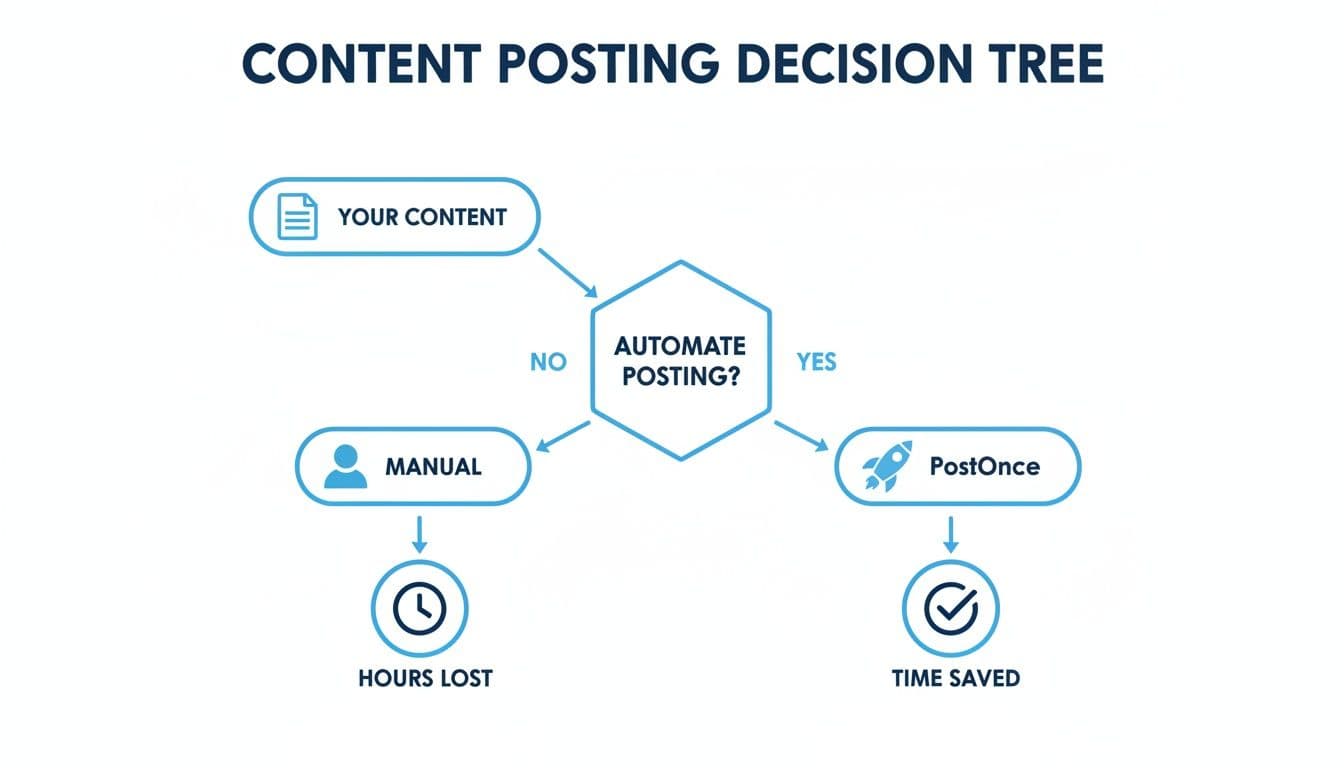
This visual really drives home the central trade-off: handling content distribution by hand eats up hours you'll never get back, while smart automation saves a ton of that time.
Data-Driven Decision Making
The numbers don't lie—a tailored strategy wins. A 2023 study of 500 brands was a real eye-opener. It found that multiposting identical content across Twitter, Facebook, and LinkedIn resulted in 37% audience overlap fatigue, which tanked impressions by an average of 29%.
On the other hand, smart crossposting—even with simple tweaks like optimizing hashtags or shortening the text—grew unique reach by a massive 42%. It successfully tapped into audiences that didn't overlap. You can dive into the complete results to see how these crossposting strategies boosted reach.
By thinking strategically about each post, you move from just broadcasting content to building genuine connections. The goal isn't just to be seen, but to be valued in every community you participate in.
Ultimately, having a clear framework makes you more intentional. It helps you put your energy where it will have the biggest impact, giving every single piece of content the best possible shot at success.
Frequently Asked Questions
People often get stuck on the finer points of crossposting versus multiposting. Let's clear up some of the most common questions so you can build a smarter, more effective content strategy.
Is It Ever Okay to Multipost the Exact Same Content?
Honestly, it’s rare. While the general rule is to avoid it for community building, there are a couple of exceptions. Multiposting can work for urgent, time-sensitive announcements—think flash sale reminders, breaking news, or critical updates where speed is everything.
But for anything meant to build your brand, spark genuine conversation, or establish yourself as an expert, crossposting is always the way to go. It’s a simple sign of respect for each community’s norms, and that small effort pays off big time in the long run.
How Can I Crosspost Efficiently Without Spending All Day on It?
This is where having the right tool in your corner makes all the difference. The key is to find an automation platform built for this exact purpose. For example, a tool like PostOnce lets you write your main post once, then set up smart rules that automatically tweak it for each network.
This is the sweet spot: you get the speed of a single action combined with the nuance and effectiveness of platform-native content.
You could set a rule to automatically chop your text down for X (formerly Twitter), add a more professional tone for LinkedIn, and even select the right image dimensions for Instagram—all without you having to lift a finger for each one.
Will Crossposting Negatively Affect My SEO?
Not at all—as long as you do it right. This is a common myth, but search engines don't penalize you for sharing content on social media the way they would for duplicating content across your own website. They see social platforms as separate ecosystems.
In fact, when you tailor your content for each platform and include a link back to the original source on your site, you’re creating valuable social signals. This tells search engines that your content is being shared and discussed across different communities, which can actually give your SEO a nice little boost.
Ready to stop wasting time and start crossposting the smart way? With PostOnce, you can automate your entire workflow, ensuring every post is perfectly optimized for every platform, every time. Learn more and start your free trial today.