


















PostOnce is the fastest way to stop copy-pasting the same real estate post into five apps and turn social media into a repeatable system. If you're managing listings, showing homes, answering clients, and still trying to stay visible on multiple platforms, real estate social media automation stops being a nice add-on and starts becoming basic operational infrastructure.
Most agents don't have a content problem. They have a distribution problem. The caption gets written once, then has to be resized, trimmed, reformatted, and reposted everywhere else. That friction is what breaks consistency, and inconsistent social media rarely helps a busy agent generate steady opportunities.
Stop Manually Posting and Start Closing More Deals
A lot of agents are still running social media like it's an end-of-day admin task. They finish appointments, remember they haven't posted, grab a listing photo, write something quick, put it on Instagram, then tell themselves they'll “share it everywhere else later.” Later usually doesn't happen.
That gap matters because your audience doesn't live on one platform anymore. The National Association of Realtors reports that 87% of REALTORS® use Facebook, 62% use Instagram, and 48% use LinkedIn. The same NAR resource also says social media produces the highest number of quality leads among the tech tools agents use for lead generation, which helps explain why 57% of agents use social media daily to market their business (NAR social media data).

Manual posting is the real bottleneck
The issue isn't whether social media works. The issue is whether you can execute it consistently while still doing the job you get paid for. Manual posting creates three problems at once:
- It steals attention: Every post becomes a mini production cycle of rewriting, uploading, tagging, and checking formatting.
- It breaks consistency: A busy week means your content cadence disappears.
- It weakens follow-through: Good content gets published once instead of being distributed properly.
That last point gets missed. One strong post about a neighborhood, a buyer mistake, or a fresh listing should become a multi-platform asset, not a one-platform throwaway.
Practical rule: If posting requires you to open multiple apps every time, your process won't hold up during listing season.
Agents working in niche models feel this pressure even more. If you're exploring wholesaling real estate through social media, for example, the need for fast, repeated visibility gets even sharper because timing and reach matter.
Real estate social media automation is a system
The right way to think about real estate social media automation is not “software that schedules posts.” It's a publishing system that keeps your brand visible while you handle showings, negotiations, and lead follow-up.
A strong local-business content workflow depends on repeatability, not constant reinvention. That's why this broader guide to social media marketing for local business is so relevant to real estate. The mechanics are the same. You need a dependable way to publish useful content without rebuilding the process every day.
When agents stop treating social posting as a manual chore, they usually get two immediate wins. Their content becomes more regular, and their best ideas get distributed instead of dying inside drafts or camera rolls.
Set Your Automation Strategy Before You Automate Anything
Automation makes bad strategy louder. If you don't know who you're trying to reach, what action you want, and what content belongs on each platform, automation just helps you publish irrelevant posts on a reliable schedule.
A better starting point is simple. Decide what business outcome each content stream supports.
Pick one primary goal at a time
Most real estate content falls into one of these buckets:
- Brand authority: You want local homeowners to recognize you as the person who knows the market.
- Lead capture: You want buyers, sellers, investors, or landlords to submit a form, send a message, or book a call.
- Relationship maintenance: You want your past clients and warm audience to keep seeing you so you stay top of mind.
- Listing exposure: You want a property to get attention quickly and professionally.
Those goals can overlap, but they shouldn't be mixed carelessly in the same post queue. A listing campaign behaves differently from a neighborhood credibility campaign. A first-time buyer series also needs a different voice than an investor update.
Match audience segments to content themes
Most agents serve more than one audience, and that's where feeds get messy. The fix is to define a few clear personas and assign content categories to each.
A practical setup might look like this:
| Audience segment | What they care about | Good post types |
|---|---|---|
| First-time buyers | Process clarity, financing basics, confidence | checklists, FAQs, step-by-step carousels |
| Move-up sellers | timing, prep, pricing, local demand | seller tips, staging advice, market commentary |
| Investors | deal logic, rental trends, area fundamentals | concise analysis, location breakdowns, professional updates |
| Downsizers | simplicity, timing, life transition | planning tips, neighborhood lifestyle content, practical guides |
Channel fit plays a critical role here. LinkedIn excels at handling educational or investor-facing content. Instagram tends to carry property visuals and local lifestyle stories better. Facebook frequently supports community visibility and broad local reach.
Before you automate a single thing, write that map down. If you need a framework, this guide to building a social media strategy plan is a useful starting point.
Protect the parts that must stay human
One of the biggest mistakes in real estate social media automation is trying to automate trust. Realtor.com's guidance is clear on the core principle: AI and automation should be a starting point, not a substitute for your voice, your story, or your neighborhood nuance (Realtor.com guidance on social media trends in real estate marketing).
Automate distribution. Don't automate judgment.
That means some tasks are safe to automate, and some should stay manual.
- Good candidates for automation: evergreen educational posts, listing repurposing, recurring community content, scheduling, and cross-platform distribution
- Keep these manual: direct messages, comment replies, market-sensitive commentary, client-specific situations, crisis updates, and anything that depends on local nuance or compliance review
Build your rules before your calendar
A good automation strategy usually starts with rules like these:
- Educational content can repeat in refreshed form.
- Listings get distributed fast, but captions should still be reviewed.
- Community and local-trust posts need a human pass before publishing.
- Replies are never handled as a fully automated substitute for conversation.
Once those rules exist, the tool serves the strategy. Without them, the tool drives the behavior, and that's when feeds start sounding generic.
PostOnce Your Hub for Smart Cross-Platform Automation
An agent finishes a new listing post at 8:15 a.m. By 8:45, that same asset needs to fit Instagram, Facebook, LinkedIn, and Google Business Profile. Different crops, different caption lengths, different hashtag rules, different links. That is where manual posting starts wasting selling time.
The core problem isn't scheduling
A calendar is easy. Distribution is the hard part.
Generic schedulers let agents choose a time slot, but the work usually continues after that. Teams still rewrite captions for each network, swap image sizes, clean up formatting, remove hashtags on one platform, add them back on another, and check whether the post still reads correctly after each edit.
For real estate, that extra work shows up every day. One listing becomes four versions. One market update becomes three caption formats. One neighborhood post needs a different treatment depending on where it appears. If the tool cannot handle those changes, the process stays manual even when the posting date is automated.
That is why a dedicated cross-posting platform for real estate social media workflows matters more than another scheduler.
What a smart automation hub should do
The tool should reduce production work, not just hide it behind a calendar. In practice, that means five capabilities matter most:
- One source post for multiple channels: Create the asset once, then distribute from a single starting point.
- Platform-specific formatting: Adjust captions, hashtags, media handling, and structure for the destination network.
- Rules by content type: Route listings, educational posts, testimonials, and local content through different publishing paths.
- Multi-account visibility: Keep agent, team, and brokerage accounts organized without losing brand control.
- Repeatable posting systems: Reuse evergreen content without rebuilding the post every time.
Operational takeaway: If your team still edits every post by hand after it is scheduled, the tool is managing dates, not distribution.
Why PostOnce fits real estate operations
Real estate marketing starts with repeatable assets. Listing photos. Open house announcements. Market updates. Buyer tips. Seller FAQs. Testimonial clips.
PostOnce works well because it treats each asset as the source for a distribution workflow. That changes the job from manual posting to rule-based publishing. The question becomes which channels should receive the content, in what format, and under what account structure.
That is a better fit for how agents work. A solo agent can prep one post and keep visibility across channels without burning an hour on copy-paste tasks. A small team can assign content prep to a coordinator, set publishing rules once, and keep execution consistent across agent profiles.
Here's a walkthrough that shows how that kind of process works in practice.
For agents, we put the full setup on one page: social media for realtors, from listing walkthroughs on Instagram to your Facebook Page, TikTok and YouTube Shorts.
What this solves in daily brokerage work
The payoff is better execution with fewer avoidable mistakes.
Manual cross-posting creates small errors that hurt performance over time. Crops break. Line spacing looks off. The wrong link gets pasted. A caption reads naturally on Instagram but feels awkward on LinkedIn. An agent means to repost a listing update and misses the window. None of those mistakes are dramatic on their own. Together, they make the brand look inconsistent and make the system harder to maintain.
A smart cross-platform hub fixes that operational gap. It gives agents and teams one publishing center, one repeatable process, and fewer chances for manual errors to slow down lead generation.
Build Your Automated Real Estate Content Machine
The most reliable content workflow in real estate uses two lanes. One lane runs on automation. The other stays flexible and human-led. If you mix everything together, your feed becomes either chaotic or robotic.
The better setup is an evergreen library plus a real-time lane.
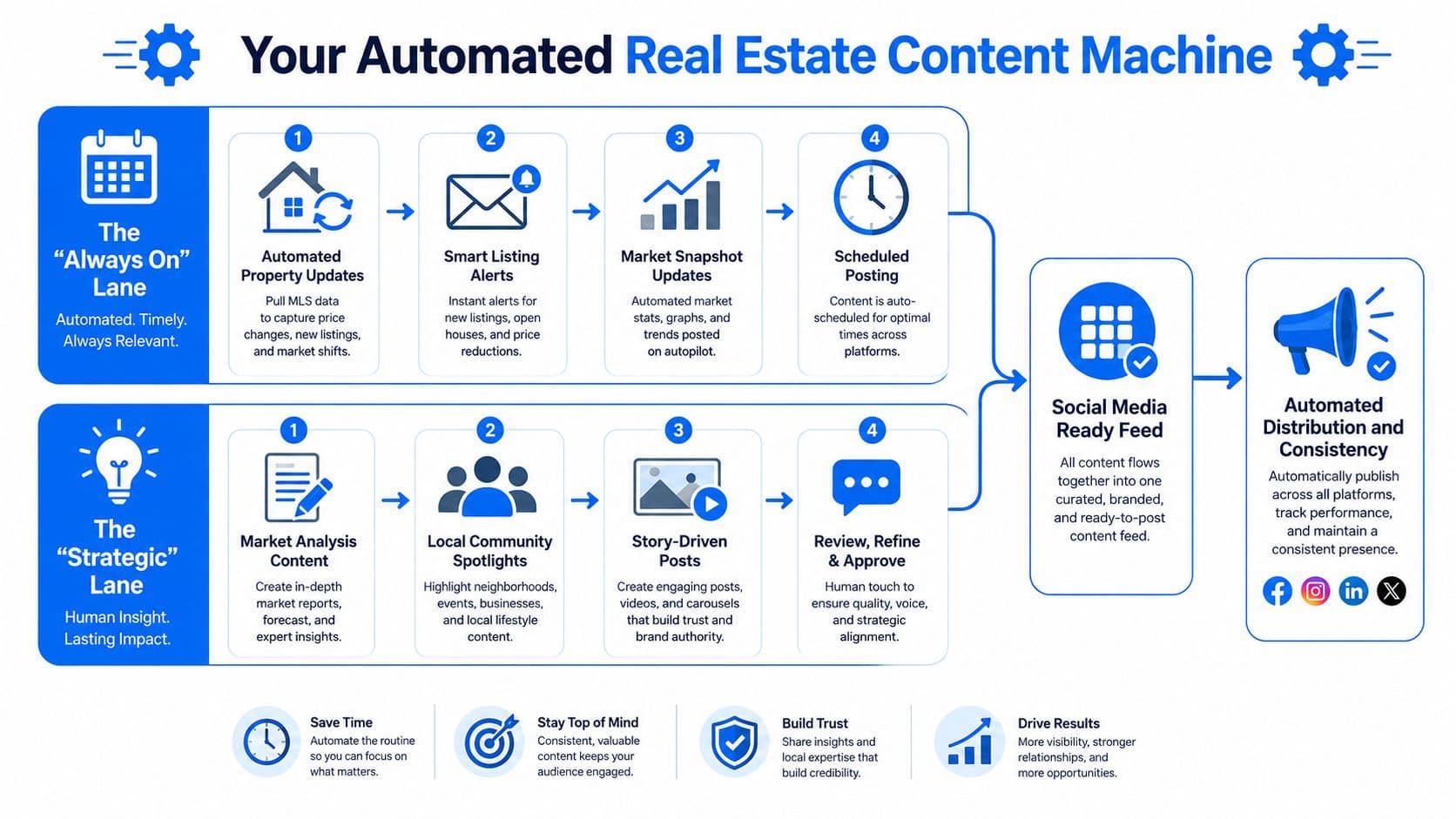
Lane one is your evergreen library
MoxiWorks recommends a workflow that separates reusable educational and listing-related content from urgent updates. Automation handles the evergreen bucket, while manual review stays reserved for high-context content. It also recommends using randomized or rule-based scheduling so repeated topics don't appear in a rigid pattern (MoxiWorks real estate automation workflow).
Evergreen content is the material that stays useful over time. For most agents, that includes:
- Buyer education: financing basics, closing steps, mistakes to avoid, offer prep
- Seller education: pricing principles, staging tips, showing prep, timeline expectations
- Neighborhood authority: school-area overviews, commute notes, local business highlights, community guides
- Process clarity: what happens after a contract is signed, how inspections work, who pays for what
This content should live in a reusable library, not in random folders with names like “Post ideas final final.”
Lane two is your real-time lane
Real-time content needs context and judgment. You can't safely automate everything in this category because timing, compliance review, and local nuance matter.
Typical real-time posts include:
-
New listings and coming soon updates
These move fast and often need specific brokerage-approved language. -
Open house changes or event reminders
Timing is critical, and details can shift. -
Immediate market commentary
A local rate reaction, neighborhood news item, or inventory shift needs human framing. -
Client moments and community interaction
These should feel personal, not prepackaged.
The best automated feeds don't automate everything. They automate the repeatable parts and protect the posts that need judgment.
Turn one asset into a content sequence
A lot of agents think they need more ideas. Usually they need better repurposing.
Take a single “Neighborhood Guide” as an example. One source asset can become:
- an Instagram carousel about local highlights
- a Facebook post focused on community identity
- a LinkedIn update with a market or lifestyle angle
- a short caption on buyer fit
- a recurring evergreen post refreshed later with a new photo set
That kind of reuse is what makes automation valuable. If you want to sharpen that process, a dedicated guide to content repurposing strategy is worth studying.
Build templates that reduce daily decisions
Your content machine works better when the team isn't deciding everything from scratch each morning. Create templates for your main recurring formats.
A simple working library might include:
| Template type | Core purpose | Manual or automated |
|---|---|---|
| Buyer tip post | build trust with early-stage leads | automated |
| Seller checklist | nurture appraisal prospects | automated |
| Neighborhood spotlight | support local authority | automated with review |
| New listing launch | create immediate exposure | manual review first |
| Open house reminder | drive short-term action | manual review first |
| Client testimonial | social proof and credibility | automated after approval |
The strongest version of real estate social media automation feels steady, not noisy. Your evergreen lane keeps the feed alive. Your real-time lane keeps it believable.
Turn Automated Posts into Leads and Stay Compliant
Posting alone doesn't create business. The post has to point somewhere. If your automated content doesn't lead to a next step, you're building visibility without capture.
For most agents, that next step should be simple and specific. Download a guide. Request a home valuation. Register for an open house. Ask for a market update. Book a buyer consult.

Add a call to action that matches the post
A seller-prep post shouldn't end with “Contact me for all your real estate needs.” That's too vague. Match the CTA to the content someone just consumed.
Examples:
- A post about pricing mistakes can link to a home valuation page.
- A first-time buyer checklist can link to a downloadable buyer guide.
- A neighborhood spotlight can link to a local homes page or consultation form.
- A listing post can route to the property page, registration page, or inquiry form.
The key is continuity. The CTA should feel like the next step, not a hard turn.
Route leads into a CRM immediately
Many agent workflows break at this specific point. The post performs. A person clicks. The form gets filled out. Then the follow-up is delayed because the lead lands in email and sits there.
A cleaner system connects each lead capture point to your CRM so the handoff happens automatically. Then you can tag the lead by source, assign a follow-up sequence, and keep the response process consistent.
Use practical labels. “Seller guide download.” “Valuation request.” “Open house registration.” Those tags help you understand intent later, even when attribution is imperfect.
Compliance note: Every automated campaign should be reviewed as a marketing workflow, not just as a social post. The destination page, form language, and follow-up message all need the same level of care.
Compliance has to sit inside the workflow
Real estate marketing has guardrails that generic social media guides often ignore. Every brokerage has its own review expectations, and local advertising rules can be strict. On top of that, agents need to stay aligned with fair housing obligations, brokerage identification requirements, and any MLS or IDX display rules that affect listing promotion.
That doesn't mean automation is risky by default. It means your system needs checkpoints.
A practical review checklist looks like this:
- Brokerage identification: confirm required brand or license disclosures are present where needed
- Listing permissions: verify that listing details and media are approved for promotion
- Fair housing alignment: avoid language that suggests preference, limitation, or exclusion
- Landing page consistency: make sure the claim in the social post matches the form and follow-up
- Human review for sensitive posts: market commentary, local issues, and client-specific content should never publish unchecked
The safest automation system isn't the one that publishes the most. It's the one that standardizes repetitive distribution while forcing review where compliance and trust matter.
Measure What Matters and Optimize for ROI
The strongest benefit of automation isn't just saved time. It's better reporting. Once your publishing becomes structured, you can clearly see which topics, formats, and calls to action are helping the pipeline.
A practical ROI model used in real estate automation is ROI = (Leads Generated × Avg. Deal Value) / (Tool Cost + Time Saved), and the value of that formula is that it gives agents a usable way to monitor month-over-month performance instead of guessing (how real estate teams can track automation ROI).
Stop judging performance by likes alone
Likes are easy to see and easy to overvalue. They don't always tell you whether a post helped create real business movement.
A better scorecard includes:
- Link clicks: Did people take the next step?
- Landing page visits: Did the content create intent?
- Form submissions: Did the post generate identifiable leads?
- Saves and shares: Did the content feel useful enough to keep or pass along?
- Lead quality notes in the CRM: Did the inquiries match the audience you wanted?
If you want a stronger framework for this, review a practical guide to how to measure social media ROI.
Review trends, not isolated wins
One viral-feeling post doesn't build a business. A repeatable pattern does.
Look at your results monthly and ask:
- Which content themes produced the most clicks?
- Which lead magnets generated the best conversations?
- Which platforms are worth continued effort for your market?
- Which automated posts are getting ignored and need to be retired or rewritten?
That habit turns automation into an operating system instead of a content treadmill.
Good reporting doesn't just tell you what got attention. It tells you what deserves to stay in the machine.
Ready-to-Use Real Estate Automation Recipes
| Recipe | Goal | Content Needed | Automation Rule Example |
|---|---|---|---|
| New listing distribution | get immediate property visibility | approved listing photos, short caption, property link | publish to primary platforms when listing asset folder is marked ready |
| Buyer education series | build trust with early-stage buyers | checklist posts, FAQs, short educational captions | rotate evergreen buyer tips on a recurring schedule with non-repeating order |
| Seller lead magnet campaign | capture appraisal and seller-guide leads | seller prep posts, landing page, form, follow-up email | distribute seller education posts and attach the same valuation or guide CTA |
| Neighborhood authority campaign | strengthen local brand presence | area photos, local notes, community highlights | queue location-based posts monthly and vary captions by platform |
| Open house reminder workflow | drive attendance and inquiries | event graphic, date and time, registration link | send reminder posts before the event with manual approval required |
| Testimonial promotion | reinforce social proof | approved client quote, image, short story | repost approved testimonials into an evergreen queue at spaced intervals |
The point isn't to build the biggest content calendar. It's to build a smaller system that keeps producing useful posts, capturing leads, and showing you what works.
If you're tired of scheduling tools that still leave you doing manual platform cleanup, PostOnce gives you a cleaner way to run real estate social media automation. Create content once, apply smart cross-posting rules, and keep your marketing active across channels without turning every post into another admin task.