


















Having an effective online presence for a small business isn't just a 'nice-to-have' anymore. It's the engine that drives modern customer acquisition. It’s the powerful combination of your website, social media activity, and search engine visibility that signals to potential customers that you're credible, professional, and ready to solve their problems.
Why Your Business Cannot Afford to Be Invisible Online
Let's be direct: if customers can't find you online, you barely exist in their world. The days of relying only on foot traffic or word-of-mouth are long gone. Today, the path to purchase almost always starts with a Google search or a quick scroll through social media.
This isn't a fleeting trend; it’s a permanent shift in how people shop and connect with businesses. Think of a strong online presence as your 24/7 salesperson, your digital brochure, and your best tool for building trust before a potential customer even speaks to you.
How Today’s Customers Discover and Vet Businesses
Forget the old idea that some industries don't need to be online. It doesn't matter if you're a local plumber, a boutique consulting firm, or an artisan bakery—your next customer is looking for you on their phone or computer right now.
The data is impossible to ignore. A staggering 99% of consumers now use the internet to find local businesses, and 81% do some online research before they even consider making a purchase. This vetting process often involves checking out reviews (something 55% of people do) or, crucially, visiting the business's website (47%).
Considering that 27% of small businesses still don't have a website, they're essentially invisible to a huge chunk of their potential market.
A powerful online presence isn't just a marketing tactic—it's a core pillar for survival and growth. It's the difference between being discovered and being overlooked.
You Need More Than Just a Facebook Page
One of the biggest mistakes I see small business owners make is thinking a Facebook page is enough. While social media is a vital part of the equation, it's just one piece of a much larger puzzle. Your website is the only digital asset you truly own and control.
Here’s a simple breakdown of the core components every modern business needs:
| Component | Primary Role | Key Action for Small Businesses |
|---|---|---|
| Website | Central Hub & Conversion Tool | Create a professional, mobile-friendly site that showcases your services and captures leads. |
| Social Media | Community & Traffic Driver | Engage with your audience where they hang out and drive them back to your website. |
| Search Engines | Discovery & New Customer Funnel | Implement basic SEO so people find you when they search for what you offer. |
These pillars work together to create a cohesive and effective presence. A great social media post can drive traffic to a blog on your website, which in turn helps you rank higher on Google, attracting even more new customers.
To truly see how all the pieces fit together, you might start by understanding what is PPC for small business, as paid ads are a key way to amplify your visibility quickly.
The time and effort you put into building this presence isn't just another business expense; it's a direct investment in your future growth and relevance. In the sections ahead, we’ll walk through exactly how to build each of these pillars, starting with your most important digital asset.
Your Digital Foundation: A Professional Website
Think of your social media profiles as your business's outposts, generating buzz and engaging with the community. Your website, however, is the headquarters. It's the one piece of your online presence you truly own and control—a digital storefront that never closes and works for you 24/7.
A polished, easy-to-use website is more than just an online brochure; it’s a powerful signal of credibility. When potential customers find you, this is where they go to validate your business, understand what you offer, and decide whether you’re the right fit for them. All your other marketing efforts, from social posts to email newsletters, should ultimately lead them right here.
Choosing Your Platform and Domain
Before you can build anything, you need a plot of land and an address. Your domain name (like yourbusiness.com) is your address on the internet. My best advice? Keep it simple. Go for something that’s easy to say, spell, and remember. Try to stick close to your brand name and avoid hyphens or numbers if you can—they just make it harder for people to find you.
With your domain secured, it’s time to choose a platform. You essentially have two paths:
- Website Builders: Tools like Wix, Squarespace, or Shopify are fantastic for business owners who aren't coders. They use intuitive drag-and-drop editors, so you can build a professional-looking site without touching a line of code.
- Content Management Systems (CMS): WordPress is the undisputed king here. It offers incredible flexibility but comes with a steeper learning curve. It’s a great option if you need deep customization and are willing to learn or hire some help.
For most small businesses just starting out, a website builder is the quickest and most efficient way to get online. They typically bundle hosting, security, and support into one package, which takes a lot of technical headaches off your plate. If you want to dive deeper, exploring website design strategies specifically for small businesses can give you a real edge in attracting customers.
Designing for a Seamless User Experience
A beautiful website that’s confusing to use is like a stunning storefront with a locked door. This is where user experience (UX) comes in. It’s all about making your site logical and intuitive so visitors can effortlessly find what they need and take the next step.
Today, that means designing for mobile-first. The majority of your visitors will likely come from a smartphone, so your site absolutely must look and work perfectly on a small screen. This isn't just a nice-to-have; search engines like Google actively prioritize mobile-friendly sites in their rankings.
So, what do your visitors need to see right away?
- Your Services or Products: A clear, concise explanation of what you do.
- Contact Info: Your phone number, email, and address should be impossible to miss.
- Business Hours: Don't make people hunt for this information.
- A Clear Call-to-Action (CTA): Tell them what to do next. "Book Now," "Shop Our Collection," "Get a Free Quote"—be direct.
Your website isn’t just there to look pretty. It's a powerful tool for converting curious visitors into loyal customers. Every single design choice should make that journey as smooth as possible.
Your Website as a Growth Engine
You don't need a massive, complex website to see real results. Even a simple, well-maintained site can become a serious engine for growth. Recent data shows that nearly half (46%) of small business websites in the U.S. pull in between 1,001 and 15,000 monthly visitors. That's a meaningful audience.
In fact, almost two-thirds (65.3%) of these sites attract fewer than 50,000 visits per month, proving you don't need huge traffic numbers to make an impact. A focused presence is what matters.
Ultimately, your website is the anchor of your entire digital strategy. It’s where you tell your story, build trust, and turn leads into lasting relationships. Whether you build it yourself or hire a pro, investing in a quality website is one of the smartest moves you can make.
Mastering the Essentials of Digital Marketing

So, your professional website is live. Think of it as your digital home base. The next step? Actually getting people to visit. This is where digital marketing comes into play—it's the engine that drives traffic to your site, turning it from a static online brochure into a machine for generating leads and sales.
Building a powerful online presence for a small business isn’t about trying to do everything all at once. That’s a recipe for burnout. Instead, it’s about creating a focused, integrated strategy where every piece works together to attract, engage, and ultimately convert your ideal customers.
Dominate Local Search with SEO
When you hear "Search Engine Optimization" (SEO), don't let the jargon intimidate you. For most small businesses, it really boils down to one simple thing: showing up when local customers search for what you offer. It's your ticket to winning those critical "near me" searches.
Your most powerful weapon in this fight is your Google Business Profile (GBP). It's completely free, and it's what powers your appearance in Google Maps and the coveted "Local Pack" at the top of search results. If you do nothing else, optimize this.
- Fill It Out Completely: Don't skip a single field. Make sure your business hours, services, address, and phone number are 100% accurate.
- Add High-Quality Photos: Show off your storefront, your team in action, and your products. Photos build trust long before a customer ever steps through your door.
- Get and Respond to Reviews: Positive reviews are a massive signal to Google that you're a legitimate, quality business. Actively ask happy customers for reviews and make it a habit to respond to all of them—the good and the bad.
Beyond your GBP, you’ll want to tackle some basic on-page SEO for your website. This just means strategically including your most important keywords in your page titles, headings, and body copy. For example, a bakery in Denver should weave phrases like "Denver custom cakes" or "best sourdough in Denver" naturally into its service pages and blog posts.
The core of a successful digital marketing approach for small businesses hinges on four key areas: data analysis, SEO, social media, and content marketing. Building a foundation with a mobile-friendly website, a polished Google Business Profile, and consistent social media activity is paramount for growth.
Choose the Right Social Media Channels
The biggest mistake I see small businesses make on social media is trying to be everywhere. It spreads your resources too thin and you end up doing a poor job on all platforms instead of a great job on one or two.
The smart move is to figure out where your ideal customers actually hang out online and meet them there. A B2B consultant, for example, is going to find qualified leads on LinkedIn, not TikTok. On the flip side, a boutique selling trendy apparel will find its audience on highly visual platforms like Instagram and Pinterest. Don't just chase trends; follow your customers.
Once you’ve picked your platforms, consistency is everything. You don't need to post multiple times a day. Modern digital marketing landscape shows that even posting just once a week can make a huge difference in brand recognition. For more great ideas, our guide on social media management tips can help you build a workflow that doesn’t feel overwhelming.
Create Content That Solves Problems
Content marketing isn't just about writing blog posts for the sake of it. It's about answering your customers' most pressing questions and solving their real-world problems. The questions you get asked every single day are a goldmine for content ideas.
Let’s look at a real-world example. A local landscaping company is constantly asked, "When is the best time to prune roses in our area?"
- Weak Content: A generic post about general rose care.
- Strong Content: A detailed blog post titled, "The Ultimate Guide to Pruning Roses in [Your City] for a Stunning Spring Bloom."
This hyper-specific approach doesn't just provide incredible value; it immediately establishes you as the local expert. That one topic can then be repurposed into a quick video for social media, a tip in your email newsletter, or even a downloadable checklist.
To get ahead, you can use some of the best small business SEO tools to uncover exactly what your customers are searching for online. When you create genuinely helpful content, you build authority and attract qualified leads who are already looking for your expertise.
Engaging Customers with Strategic Social Media
For a small business owner, social media can easily feel like a black hole for your time—a constant, nagging need for new content with no clear payoff. Let's flip that script. With the right approach, social media becomes your engine for building a community, driving traffic to your website, and converting followers into loyal customers.
The secret isn't shouting into the digital void. It's about starting real conversations where your ideal customers already hang out. A smart social media plan isn’t about being everywhere at once; it's about making a genuine impact on the one or two platforms that truly count for your business.
Pinpoint Where Your Customers Spend Their Time
Before you even think about what to post, you need to figure out where to post. Spreading your efforts too thin is a classic mistake that only leads to burnout and lackluster results. It’s time to get strategic.
Not every platform is right for every business. The key is to match the platform's purpose with your business goals and audience.
Choosing the Right Social Media Platform
This table breaks down the most popular platforms to help you decide where to focus your energy.
| Platform | Best For (Business Type) | Content Focus | Audience Demographic |
|---|---|---|---|
| B2B, Consultants, Professional Services | Industry insights, company news, case studies | Professionals, decision-makers, job seekers | |
| Cafés, Boutiques, Artists, Visual Brands | High-quality photos, videos, Reels, Stories | Primarily 18-34, visually-driven users | |
| Home Decor, Fashion, DIY, Wedding Planners | Inspirational images, how-to guides, infographics | Predominantly female, high purchase intent | |
| Local Services, Community Groups, Events | Community updates, customer testimonials, events | Broad demographic, strong for local targeting | |
| TikTok | Consumer Brands, Entertainment, Fashion | Short-form, entertaining, trend-based videos | Heavily skewed towards Gen Z and Millennials |
Thinking this through saves you from wasting hours on a platform where your customers simply aren't active. Don't chase trends; follow your audience.
Create a Simple Content Calendar
A "content calendar" might sound a bit corporate, but it's really just a simple plan to keep your posts consistent and save you from that daily "what on earth do I post?" panic. The best calendars balance promotion with real value.
A great rule to live by is the 80/20 principle: 80% of your content should entertain, educate, or solve a problem for your audience. Only 20% should be a direct sales pitch for your products or services.
Here’s how a local bakery could put this into action:
- Entertain: A quick, satisfying video of a baker frosting a cake.
- Educate: A post sharing three easy tips for keeping bread fresh at home.
- Engage: An Instagram Story poll asking followers to vote on next month's cupcake flavor.
- Promote: A beautiful photo of the "Cookie of the Week" with a special offer for followers.
This simple mix keeps people coming back because you're giving them more than just ads. You're building a relationship.
The most powerful social media strategies are built on authentic conversation, not just broadcasting. It's about building a loyal community that trusts your brand and feels connected to your story.
When you're planning your content, it's worth remembering that not all formats are created equal.
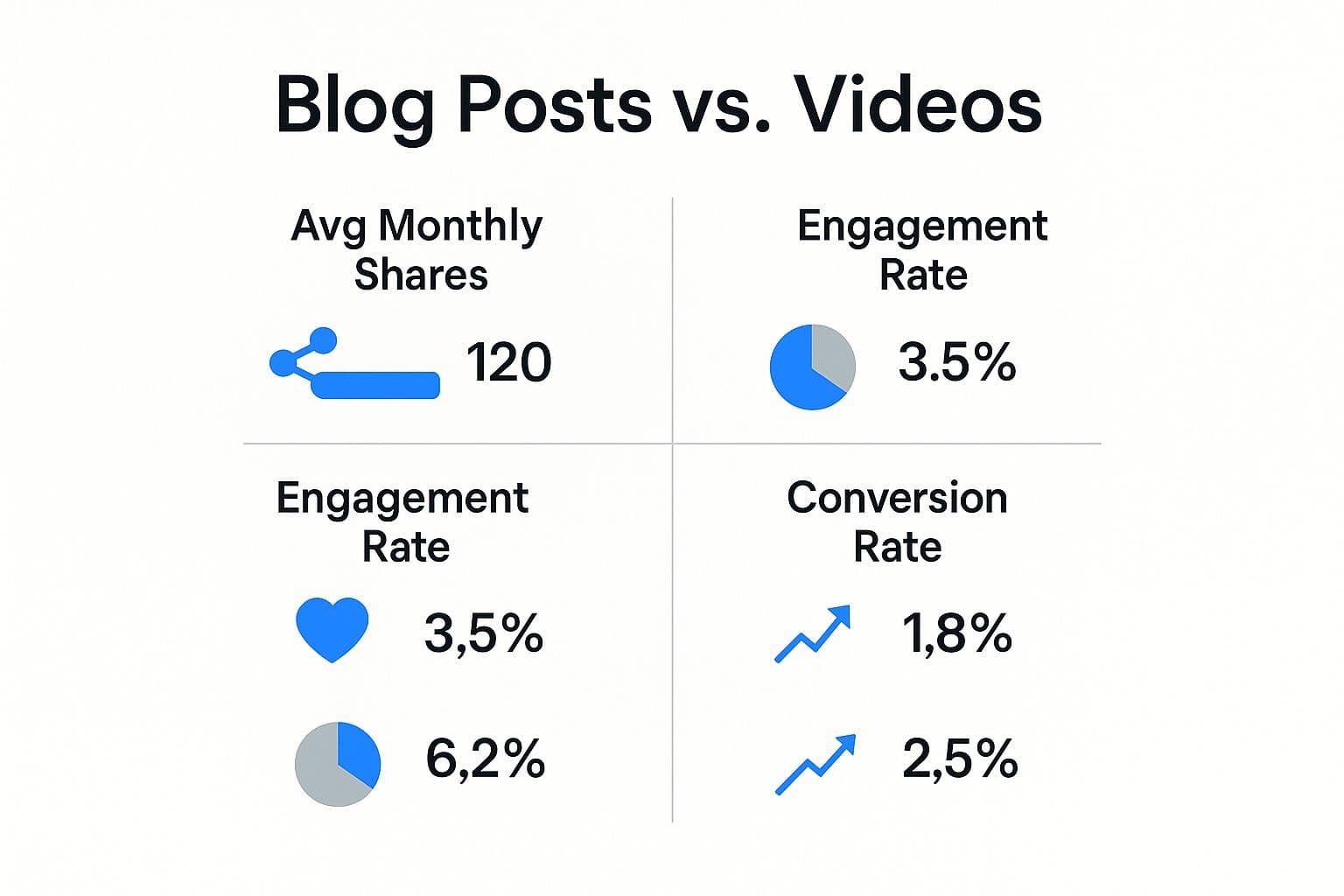
As you can see, video often drives significantly more shares and engagement than a standard blog post. That doesn't mean you should abandon writing, but it does mean that incorporating video could give your engagement a serious boost.
Foster Authentic Conversations
Finally, always remember that social media is a two-way street. Building a strong online presence for a small business means you have to actually be social.
When someone leaves a thoughtful comment, reply. When they ask a question, give them a helpful answer. It's that simple.
Use the interactive features platforms give you—polls, Q&As, and live videos are perfect for inviting your audience into your world. A B2B consultant could use a LinkedIn poll to see which new service offering resonates most, while a clothing boutique can use an Instagram Story to get instant feedback on new arrivals.
To keep this manageable, look into effective social media cross-posting strategies. This helps you stay active across your chosen channels without being glued to your phone all day. This approach is what turns your social media from a broadcast monologue into a lively community hub.
Developing a Sustainable Content Plan That Works
Let's be honest, creating content can feel like a full-time job you didn't sign up for. When you're already spinning a dozen plates, the pressure to constantly publish is overwhelming. But a great plan isn't about churning out endless content; it’s about consistently creating the right content.
The best way to do this? Stop guessing what people want and start listening.
Your customers' questions are your content cheat sheet. If you run a landscaping business and everyone asks when to fertilize their lawns, there's your next blog post. If you own a bakery and get DMs about keeping sourdough fresh, that’s your next Instagram Reel. These topics are guaranteed winners because they come straight from the people you want to help.
Brainstorming Content That Actually Connects
Grab a notebook and jot down the top 10 questions you field every single week. Pull them from emails, phone calls, in-person chats—wherever they happen. This simple exercise cuts through the noise and ensures your content is genuinely useful, which is the whole point of building a strong online presence for a small business.
Once you have your list, you can get a little more strategic with some quick keyword research. You don’t need fancy, expensive tools for this. Just head over to Google and type in one of those customer questions. Look at the "People also ask" box and the "Related searches" at the very bottom of the page. These are real phrases from real people, giving you a perfect outline of what to cover.
Create Once, Publish Everywhere
Here’s the secret weapon for sustainable content: the "create once, publish everywhere" (COPE) model. This isn’t about just blasting the same link across all your profiles. It's about smartly breaking down one big piece of content into many smaller, bite-sized pieces tailored for each platform. It’s the ultimate way to respect your time and get the most mileage out of your hard work.
Let's say you write one fantastic, detailed blog post: "The Ultimate Guide to Pruning Roses in Denver." Here’s how you can slice it up:
- Five Instagram Posts: Pull out a single tip for each post, paired with a beautiful photo of a rose.
- A Short Video for Reels/TikTok: Film a quick time-lapse of you demonstrating the proper pruning technique on a bush.
- A LinkedIn Article: Frame the topic for a professional audience—how proper landscaping boosts curb appeal and property value—and link back to your full guide.
- An Email Newsletter: Send your subscribers a summary of your best tips with a clear call-to-action to read the full guide on your website.
- Three Facebook Posts: Spread these out. Start with a poll ("When do you prune your roses?"), later share the link to the guide, and finish with a customer photo or testimonial.
A single great piece of content can fuel your marketing for an entire month. The goal is to work smarter, not harder, by making every piece you create do the heavy lifting across multiple channels.
A Practical Workflow That Keeps You Consistent
Forget the myth that you need to post every single day. Value and consistency will always win against sheer volume. For most small business owners, a realistic workflow is the key to staying in the game without burning out. Our guide to content marketing for small business digs even deeper into these strategies.
Here’s a simple, manageable workflow to try:
- First Week of the Month - The Pillar: Dedicate time to writing one high-value, problem-solving blog post. This is your "pillar" content.
- Throughout the Month - The Offshoots: Use the COPE method to break that pillar post down into 8-10 social media updates. Schedule them out.
- Mid-Month - The Nurture: Craft an email newsletter that shares the highlights from your blog post and drives traffic back to your site.
This cycle is powerful because it's sustainable. You’re consistently adding valuable, long-form content to your website (which Google loves) while keeping your social media feeds fresh and engaging. This is how you build an online presence that serves your business, not the other way around.
Frequently Asked Questions
Even with the best plan in hand, you're bound to run into questions as you start building out your online presence. It happens to everyone. This section answers some of the most common ones I hear from entrepreneurs who are right where you are now. My goal is to give you straightforward, practical answers so you can get unstuck and move forward.
How Much Should a Small Business Budget for Digital Marketing?
This is the million-dollar question, isn't it? The truth is, there’s no magic number. It’s all about finding a strategic starting point that works for you.
A solid rule of thumb for most small businesses is to earmark 5-10% of your annual revenue for all your marketing efforts. If you're in a really competitive industry or you're pushing hard for growth, you might want to bump that up closer to 15%.
The key is to see this as an investment, not just a cost. You don't have to spend a fortune right away. Start small and put your initial budget where it’s likely to have the biggest impact. For a local service business, for example, those first few dollars are almost always best spent on sprucing up your Google Business Profile and maybe running a small, tightly-targeted local ad campaign.
As the data starts rolling in, you can get smarter with your spending. Let's say you notice your audience goes wild for your behind-the-scenes videos. That’s your cue to shift a bit more of the budget toward video production. A flexible budget that adapts to what's actually working is always going to outperform a rigid plan you set once and forget.
How Do I Measure My Return on Investment?
Tracking your return on investment (ROI) is what separates just "doing marketing" from building a real business strategy. If you aren't measuring, you're essentially just guessing with your money. The good news? You don't need a PhD in data science to figure out what's working.
First, you have to define what a "win" actually looks like for your business, and it's not always a direct sale. Your key performance indicators (KPIs) might include things like:
- Website Traffic: Are more people finding your digital storefront? A free tool like Google Analytics is perfect for this.
- Lead Generation: How many people filled out your contact form, called your number, or downloaded your guide?
- Conversion Rate: Of all the people who visited your site, what percentage actually did the thing you wanted them to do?
- Social Media Engagement: Are people just liking your posts, or are they commenting and sharing? The latter shows a much deeper connection.
For instance, a local plumber might simply track how many phone calls came directly from their Google listing. A consultant, on the other hand, could measure how many qualified leads came from a specific article they published on LinkedIn. When you track these specific outcomes, you can draw a straight line from your marketing efforts to real-world results.
You don't need to track dozens of metrics. Focus on the 2-3 that are most directly tied to your business's bottom line—like new leads, appointment bookings, or online sales. This clarity makes it easy to see what's truly working.
Should I Outsource Marketing or Do It In-House?
This decision really boils down to a classic trade-off: time versus money. When you handle marketing yourself, you save money but you spend your time—valuable time you could be using to serve clients or improve your products. Outsourcing frees up that time but, of course, it has a price tag.
Here’s a practical way I've seen business owners approach this:
- Play to Your Strengths: Are you a natural writer who actually enjoys crafting blog posts? Great, maybe you handle the content and social media yourself. But if the technical side of SEO makes your head spin, that’s a perfect task to hand off to a pro.
- Calculate Your Time's Value: Get real about what an hour of your time is worth to the business. If you spend five hours a week wrestling with a task a specialist could knock out in one, you're probably losing money on the deal.
- Try a Hybrid Model: You don't have to choose one or the other. Many small businesses find a sweet spot by handling daily tasks they enjoy (like posting on Instagram) while outsourcing the bigger, more specialized projects like a website redesign or a complex paid ad campaign.
As your business grows, what works for you today might not work tomorrow. The important thing is to be honest about your skills, your available time, and where your focus delivers the most value. Finding that balance is how you build a great online presence without burning yourself out.
Ready to build a powerful and consistent online presence without the daily grind? With PostOnce, you can create content once and have it automatically shared across all your social networks, perfectly formatted for each one. Stop copy-pasting and start growing. Try PostOnce today and put your social media on autopilot.