


















A single letter can derail a whole conversation. If you're trying to figure out what L means in a text message, you're also dealing with a bigger modern problem. Short messages shift meaning fast, and the same slang can land differently across apps, audiences, and communities. That broader communication gap is exactly the kind of problem PostOnce was built to solve by helping people publish consistent messages across platforms without manually reworking every post.
You might be here because someone texted you just “L,” or because you saw “take the L” in a comment thread and weren't sure whether it was teasing, criticism, or something else. For creators, small business owners, and casual texters, the confusion is the same. One tiny abbreviation can carry a lot of meaning.
Decoding Your Texts and Social Feeds
If you received a text that only says “L”, the first reaction is usually confusion. Was it rude? Was it a typo? Was the sender joking? Those are reasonable questions, because text slang rarely works like a dictionary word. It depends on speed, tone, and where the message showed up.
That's why this topic matters beyond casual chatting. The same kind of ambiguity shows up everywhere online, from iMessage to Instagram comments to group chats. A creator might post something playful on one platform and have it read as awkward or out of touch on another. A small business owner might borrow slang without realizing their audience reads it differently.
A useful way to think about it is this. Short-form communication saves time, but it also removes clues. There's no voice, no facial expression, and often very little context. Even a simple post can become hard to interpret if it's too compressed. If you want a broader look at how short-form online content works, this guide on what a post is across platforms helps clarify how messages change depending on where they appear.
Practical rule: When a message is only one character long, the surrounding conversation matters more than the character itself.
Searching what does L mean in a text message often reveals a more practical question. “How do I know what this person meant right now?” The answer starts with the most common meaning, then branches out into context.
The Five Common Meanings of L in a Message
In most texting and online slang, L most commonly means “loss.” It's especially common in sports, gaming, and internet banter, where “take the L” means accepting a defeat or a bad outcome. That shorthand grew out of older SMS habits. Short Message Service messages traditionally had a 160-character limit, which helped abbreviations spread, and short forms still stick because texting remains a fast, high-volume channel. One widely cited figure says 98% of text messages are opened in modern messaging environments, which helps explain why compressed language survives so well in texting culture, as summarized in this explanation of what L means when texting.
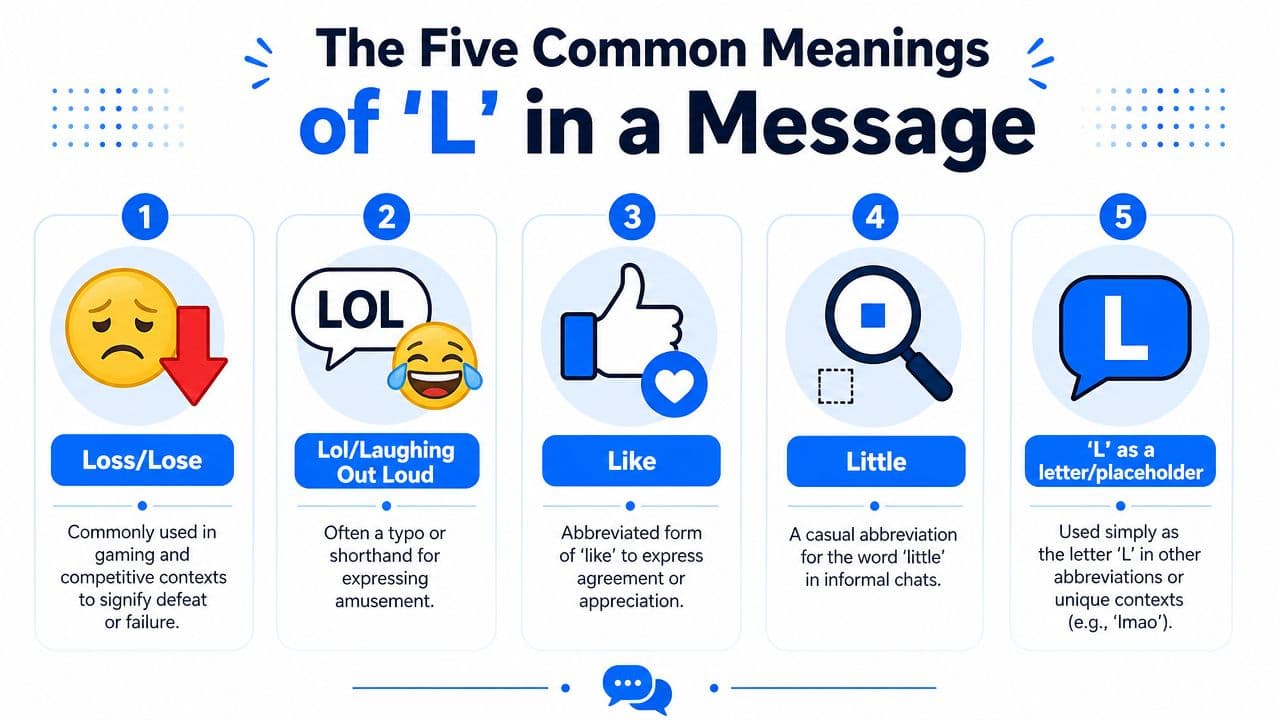
Loss is the default meaning
If someone says “that's an L” or “you took the L,” they usually mean failure, embarrassment, or defeat. This is the interpretation you should assume first in competitive or teasing conversations.
Examples:
- “We lost the final. Huge L.”
- “You forgot the tickets? Bro took the L.”
- “Just admit the L and move on.”
Sometimes it means laughing or LOL by accident
A lowercase l can show up when someone meant to type lol but sent too quickly. On some keyboards, people also send stray letters without noticing.
This meaning is more likely when the conversation is light:
- “That story was wild l”
- “l my bad”
- “l wait what”
It can stand in for like
Some people shorten words aggressively in casual chat. In that style, l may be a clipped form of like, especially when the rest of the message is already heavily abbreviated.
For example:
- “I l that song”
- “that's l so weird”
This isn't universal, so it's one of the less reliable interpretations.
It may mean little
In very informal texting, l can also point to little when the sender is reducing almost everything.
For example:
- “give me a l more time”
- “just a l tired”
This is rare enough that context matters a lot.
Sometimes it just means the letter L
Not every “L” is slang. It may be:
- an initial
- part of another abbreviation
- a placeholder
- a typo sent on its own
If you work with captions, comments, or short social posts often, you've probably seen how tiny wording changes affect tone. These examples of cool Instagram comments and short reactions show how compressed language can shift meaning quickly.
Meanings of L at a glance
| Meaning | Common Context | Example Usage |
|---|---|---|
| Loss | Gaming, sports, online banter | “Take the L” |
| Laughing or LOL typo | Fast casual chats | “l that was funny” |
| Like | Informal shorthand | “I l this” |
| Little | Heavily abbreviated texting | “a l late” |
| Letter or placeholder | Initials, abbreviations, typos | “L” |
How Context Changes Everything
The same letter can mean defeat, approval, a typo, or nothing at all. That's why context does the work. If you're trying to answer what does L mean in a text message, don't isolate the letter. Read the message before it, think about who sent it, and notice where the exchange happened.
Start with the sender and setting
A close friend in a fast-moving group chat might send “l” as a typo and never think twice. A gamer in a match chat probably means loss. A professional contact almost certainly doesn't mean slang at all.
Three clues usually solve it fastest:
- Relationship: Friends use playful shorthand more than clients or coworkers.
- Platform: Slang-heavy spaces encourage compressed language more than formal inboxes.
- Conversation topic: Competition, mistakes, and teasing often point toward “loss.”
If you want a broader look at why tone shifts between channels, this overview of what crossposting means for multi-platform content helps frame the problem well.
Read one message backward and one message forward. Most slang becomes clear when you stop treating it like a standalone word.
Slang changes by region and moment
Slang isn't fixed. It moves by community, age group, and platform. A useful underserved point here is recency. Some abbreviations stay familiar for years, while others get replaced by newer ones. A 2023 search-trends report highlighted that Californians were often searching for “PMO” and “ICL”, not just older slang terms, which shows how quickly people chase newer abbreviations and meanings, as discussed in this search-trends breakdown on emerging slang.
That matters because “L” may be well known, but it doesn't always dominate the way older explainers assume. In some spaces, it's obvious. In others, it may feel dated, ambiguous, or overshadowed by newer shorthand.
Tiny details can change tone
Punctuation and capitalization can also shift meaning.
- “L” can look more deliberate than “l”
- “L.” may read colder or more final
- “lol” and “l” are easy to confuse in a hurry
- A one-letter reply after bad news often feels harsher than the sender intended
Real World Examples of L in Action
Examples make this much easier. Once you see L inside a full exchange, the meaning usually clicks.
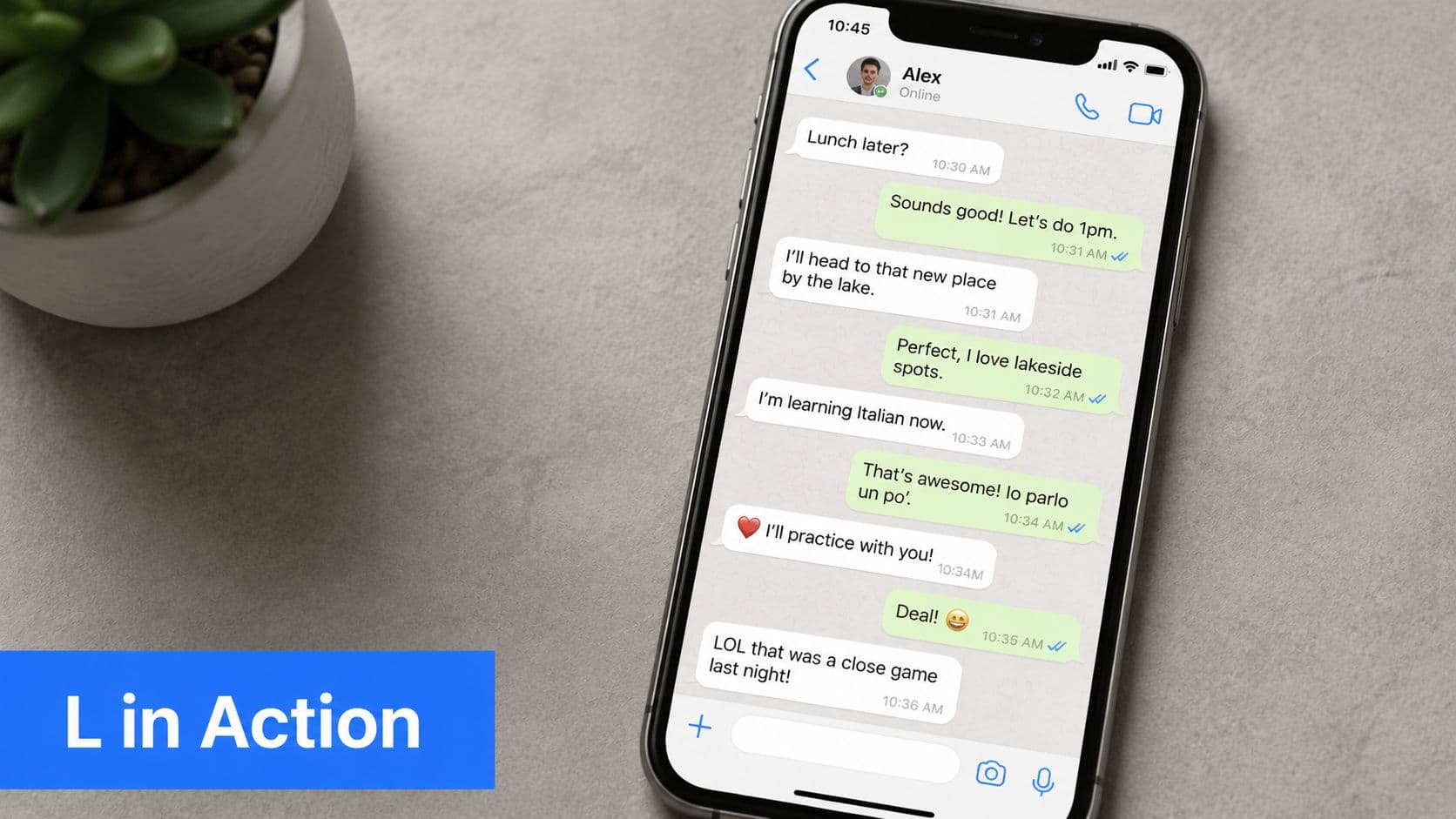
Example one
A: We were up by two and still lost.
B: That's an L.
Meaning: Loss.
Why it's clear: The conversation is about a game and a bad result.
Example two
A: I just slipped in front of everyone at the coffee shop
B: l nooo
A: stop laughing
Meaning: probably laughing or a partial lol.
Why it's clear: The tone is playful, and the rest of the exchange confirms amusement.
Example three
A: did you hear the new track
B: yeah I l it
Meaning: likely like.
Why it's clear: The sentence structure points toward opinion, not defeat.
Example four
A: can you send me a l more info
B: sure, give me a minute
Meaning: little.
Why it's clear: The phrase reads naturally as “a little more info.”
A one-letter message isn't decoded by the letter alone. The nearby words do most of the work.
Example five
A: meet at 7?
B: l
A: k cool
Meaning: probably a typo.
Why it's clear: The reply doesn't fit as slang, and the next message treats it like a harmless mistype.
Example six
A: I forgot to submit the form
B: take the L
A: fair enough
Meaning: accept the mistake.
Why it's clear: “Take the L” is a fixed phrase used for owning a bad outcome.
These are the situations where people get tripped up. They search what does L mean in a text message expecting one clean definition, but texting doesn't work that way. The best reading comes from pattern recognition, not from memorizing a single answer.
How to Respond When You Receive an L
If you still aren't sure what the sender meant, don't overcomplicate your reply. A short clarification usually works better than pretending you understood.
Safe responses when it's unclear
Try one of these:
- “What do you mean?”
- “L as in loss?”
- “lol or L?”
- “You mean that jokingly?”
- “I'm not following, say more.”
These responses are casual enough for friends and clear enough to avoid awkward guessing.
When the meaning is obvious
If someone says “take the L,” the smoothest response is usually light and self-aware.
Examples:
- “Yeah, that one's on me.”
- “I deserved that.”
- “Massive L.”
If it was clearly a typo, you usually don't need to mention it. Just continue the conversation. Correcting every tiny shorthand mistake can make an easy exchange feel stiff.
For business owners and creators, this matters in public too. Misreading slang in comments can create weird replies, off-brand jokes, or unnecessary tension. A good reputation often comes down to reading tone accurately before reacting. This guide to social media reputation management is useful if you handle messages where tone can quickly affect how people see your brand.
Master Your Cross-Platform Messaging with PostOnce
A confusing little message like “L” points to a much bigger online reality. Every platform has its own habits, speed, and slang tolerance. What sounds funny on Threads might look sloppy on LinkedIn. What feels normal in a private group chat may confuse a broader public audience.
That creates a real workflow problem for creators, solo operators, and small teams. If you post everywhere manually, you end up rewriting the same idea over and over just to fit the tone of each platform. If you don't adapt, you risk sending the wrong signal.
Why this search intent connects to messaging strategy
Someone searching for what does L mean in a text message usually wants clarity. Not theory. Not a giant slang list. They want to avoid misunderstanding. The exact same need shows up when you publish online as a brand or creator. You want your message to mean what you intended, no matter where it appears.
That's why a cross-platform system matters. With PostOnce crossposting tools, you can create once and distribute across multiple networks without copy-pasting everything by hand. That makes it easier to keep the core message consistent while still respecting platform differences.
Clear communication isn't only about knowing slang. It's also about publishing in a way that reduces misreading.
If your audience lives across Instagram, Reddit, LinkedIn, X, Threads, or BlueSky, you're not just managing content. You're managing interpretation.
Frequently Asked Questions About Text Slang
Does L always mean loss
No. Loss is the most common meaning in online slang, but not the only one. It can also be a typo, shorthand, or just the letter itself.
What does W mean in texting
W usually means a win, success, or something good. It often shows up as the opposite of L.
Does uppercase or lowercase matter
Sometimes. L can feel more intentional, while l can look like a typo or rushed message.
Is L always negative
Not always. It often carries a negative meaning when it refers to a loss, but in other cases it may be neutral, accidental, or context-dependent.
If you want fewer misunderstandings when posting across different platforms, PostOnce helps you publish once and crosspost cleanly across your channels, so your message stays consistent even when each platform speaks a slightly different internet language.