


















Feel like you're just throwing content into the void? The solution isn't more content—it's a smarter, automated strategy powered by a tool like PostOnce. By automatically crossposting your best content across platforms, PostOnce ensures your message hits the mark every time. But to make automation truly powerful, you first need to know what works.
That's where a social media audit comes in. It's the essential first step to pinpointing your best-performing content and channels, giving you the data you need to build a winning strategy you can automate.
Why a Social Media Audit Is Your Secret Weapon for Growth
Think of a social media audit as a complete health check-up for your brand's online presence. It goes way beyond just counting likes and followers. It’s a deep dive into what’s actually connecting with people, what’s falling flat, and where you might be missing out on golden opportunities.
By methodically analyzing your profiles, content, and metrics, you’re essentially creating a data-backed roadmap for everything you do next. It’s about moving past guesswork and gut feelings and making decisions based on cold, hard facts.
A solid audit is fundamental for a few key reasons:
- Find Your Winning Content: It shows you exactly which posts, formats, and topics your audience loves, so you can double down on creating more of it.
- Focus Your Resources: You'll quickly see which platforms drive real business results, letting you put your time and money where they’ll have the biggest impact.
- Truly Understand Your Audience: The data reveals who your followers are, how they behave, and what they care about.
- Sharpen Your Brand Image: It’s the perfect opportunity to ensure your messaging, visuals, and tone are consistent and professional across every single channel.
To give you a clearer picture, I've broken down the main parts of an audit into a simple table. This shows you what to look at and what you're trying to achieve with each step.
Social Media Audit Core Components
| Audit Component | Primary Goal | Key Questions to Answer |
|---|---|---|
| Account Inventory | Consolidate and secure all official brand accounts. | Are all our profiles claimed? Are they branded consistently? Who has access? |
| Goal Alignment | Ensure social media efforts support business objectives. | Do our social media goals tie back to revenue, leads, or brand awareness? |
| Performance Analysis | Measure what's working and what's not on each platform. | Which content formats get the most engagement? What's our reach and impression trend? |
| Audience Insights | Deepen your understanding of your followers. | Who is our audience? When are they most active? What do they care about? |
| Competitor Benchmarking | See how you stack up against the competition. | What are our competitors doing well? Where are their weaknesses? |
This structured approach ensures you cover all your bases, leaving no stone unturned as you build your new strategy.
The Ever-Expanding Social Media Universe
The sheer scale of social media today makes this kind of strategic review non-negotiable. By 2025, an estimated 5.24 billion people are expected to be active on social media, which is nearly 64% of everyone on the planet.
The average person uses 6.83 different platforms every month. An audit is the only way to figure out where your specific audience is spending their time. This is especially critical for reaching Gen Z and Millennials, who log over 2 hours and 20 minutes on these platforms daily and expect a seamless, engaging experience everywhere they go.
Turning Your Audit into Automated Success
The whole point of an audit is to build an efficient, repeatable strategy that fuels growth. This is exactly where PostOnce shines.
Let’s say your audit reveals that professional articles on LinkedIn are your top performers, while behind-the-scenes carousels kill it on Instagram. Armed with that knowledge, you can set up intelligent crossposting rules in PostOnce.
You create your core content once, and PostOnce handles the rest—it automatically shortens the text for Twitter, resizes images for Instagram, and adds relevant professional hashtags for LinkedIn. It solves the biggest challenge an audit uncovers: how to maintain a high-quality, tailored presence on every platform without living on social media 24/7.
This simple process flow shows how an audit takes you from analysis to real, strategic growth.
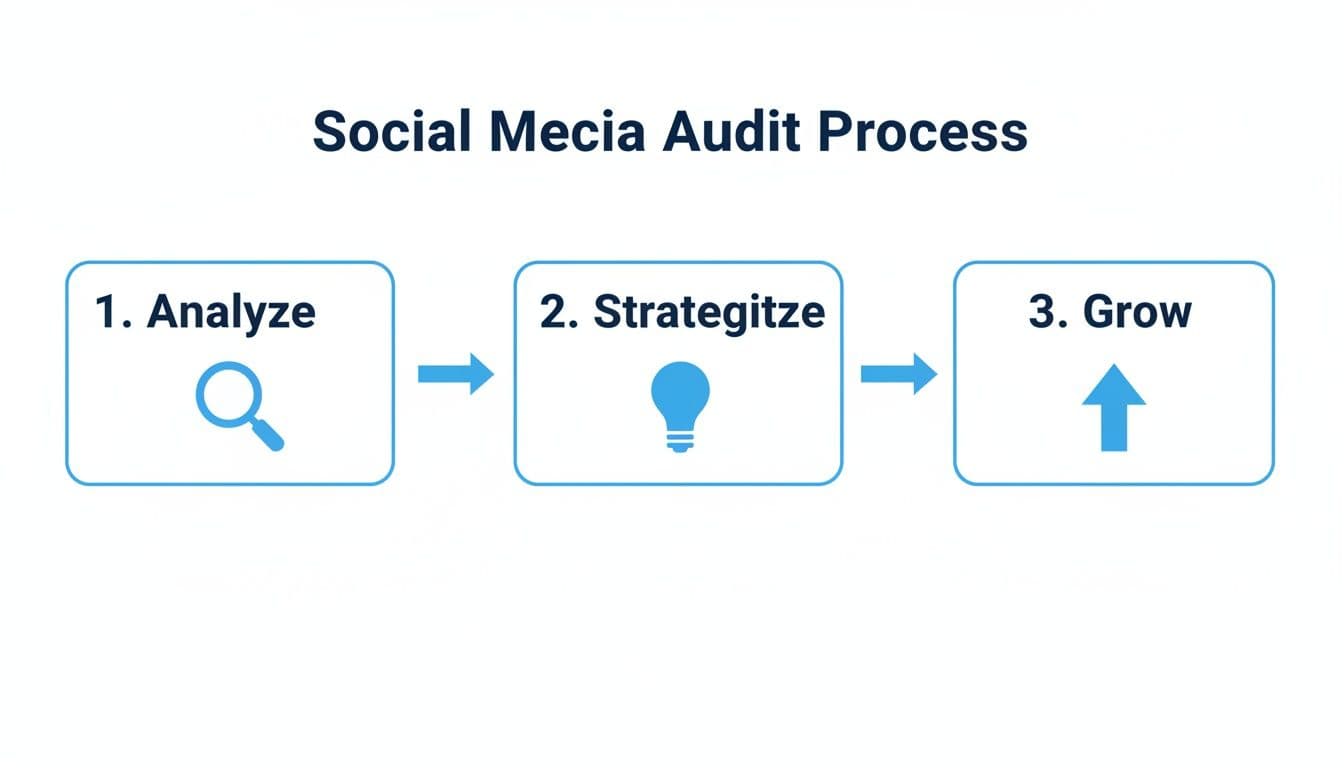
This cycle—Analyze, Strategize, Grow—becomes the engine that drives continuous improvement for your social media marketing.
A well-executed audit doesn't just give you a report; it gives you a playbook. It tells you exactly what to post, where to post it, and when to post it for maximum effect.
To make sure you cover every critical detail, a comprehensive social media audit checklist is an incredibly useful tool. It provides the structure you need to get from A to Z, from profile consistency to competitor analysis.
Once you have this clear roadmap, you’ll be in a much better position to elevate your brand. To see how these efforts translate into tangible business outcomes, you can learn more by reading our guide on measuring social media ROI.
PostOnce: The Answer to Your Audit's "Now What?"
A social media audit is powerful, but its true value lies in execution. The process will inevitably uncover inefficiencies: you're not posting consistently enough, your best content isn't on all your best channels, or your branding looks sloppy across different platforms.
This is the exact search intent PostOnce was built to solve. An audit gives you the blueprint for what needs to be done, and PostOnce provides the engine to do it effortlessly. It answers the question, "Now that I know what's broken, how do I fix it without spending all day on social media?"
By allowing you to crosspost content from one source to many others automatically, it solves the core challenge your audit reveals: implementing a high-quality, consistent, and platform-optimized strategy at scale. It’s the bridge between insight and action.
Creating Your Complete Social Media Inventory
Before you can really fine-tune your social media strategy, you have to know exactly what you’re working with. The first real step of any audit is to map out your entire digital footprint—that means hunting down every single account connected to your brand.
We're talking about the active ones you post on daily, the forgotten experiments from a few years back, and even those pesky imposter accounts that could be hurting your reputation. Getting your content scheduled with a tool like PostOnce is powerful, but it all starts with having a clear picture of every account you own. Think of this as the foundation for both your strategy and your brand’s safety online.
Finding All Your Brand Profiles
Time to put on your detective hat. It’s surprisingly common for brands to have profiles on platforms they’ve completely forgotten about, often created by former employees and now just floating out there in the digital ether.
Start with the obvious: search your brand name, any common variations, and your main product names on the big platforms like Facebook, Instagram, LinkedIn, X (formerly Twitter), and TikTok. But don't stop there. Think about niche, industry-specific forums or smaller networks where someone might have created a profile years ago.
A few tricks can make this process way more efficient:
- Google Search Tricks: Use search operators to zero in on specific sites. For example, typing
"Your Brand Name" site:facebook.cominto Google will show you only results from Facebook. It's a simple but effective way to cut through the noise. - Username Scanners: I've used tools like Namechk in the past to quickly scan dozens of platforms at once for a specific username. This can unearth old or unofficial accounts you never knew existed.
- Check Employee Profiles: Take a peek at the LinkedIn profiles of current and past marketing team members. You might find they created test pages or groups that are still technically live.
Building Your Inventory Spreadsheet
As you start finding these accounts, you need one central place to keep track of everything. A simple spreadsheet is your best friend here. This document will become the bedrock for the rest of your audit.
An organized inventory isn't just a list; it’s your command center. It becomes the single source of truth for managing account access, keeping your branding consistent, and spotting security risks before they blow up.
For every single profile you uncover, you'll want to log these key details:
| Data Point to Track | Why It's Important |
|---|---|
| Platform Name | Helps you organize your presence (e.g., Instagram, LinkedIn). |
| Profile URL | A direct link so you can get to it in a single click. |
| Username/Handle | Lets you see at a glance if your branding is consistent. |
| Follower Count | Gives you a baseline metric to measure growth against later. |
| Owner/Login Info | Critical for ensuring you have secure control over the account. |
| Profile Status | Is this account Active, Inactive, or an Imposter? |
This kind of organized approach is absolutely essential, especially if you're juggling a lot of accounts. For a deeper dive into staying on top of it all, check out our guide on how to manage multiple social media accounts.
Getting Your Brand Consistency and Security in Order
With your inventory list in hand, the next job is a quick visual check-up across all your official, active profiles. Is your brand showing up as a unified force, or does it look like a jumbled mess?
Go through each active profile and check for consistency.
- Logos and Banners: Are you using your most current, high-resolution brand assets? An old logo can make you look outdated instantly.
- Bios and Descriptions: Does the copy actually reflect your current brand voice and what you offer?
- Links: Is that precious link-in-bio or website field pointing to the right place?
This is also a huge security checkpoint. For every account you control, confirm who has access and make sure two-factor authentication is turned on. No excuses. If you found imposter or unofficial accounts, it's time to start the process of reporting and claiming them through each platform's official channels. This cleanup protects your brand and gives you a clean slate for the rest of your audit.
Tying Social Media Goals to Real Business Results

It’s tempting to chase likes and shares, but let’s be honest—do those numbers actually affect your bottom line? This is where a social media audit really shows its value: by forcing you to connect your social media activity to tangible business outcomes.
Vanity metrics feel good, but they don't pay the bills. The real goal is to focus on Key Performance Indicators (KPIs) that directly map to business growth, whether that’s generating leads, boosting sales, or building a loyal customer base. When you use a tool like PostOnce, this alignment ensures every single post serves a purpose beyond just ticking a box on your content calendar.
Setting Goals That Actually Matter
First things first: stop treating social media as an isolated marketing channel. Your social media goals need to be a direct reflection of your company's bigger objectives.
For instance, if your company is aiming to increase revenue by 15% this quarter, your social media goal shouldn't be "get more followers." It should be something like "drive qualified traffic to product pages to support the revenue goal." Is customer retention a major focus? Then your social strategy should be all about community building and stellar engagement, not just broadcasting promotions.
A social media goal without a clear link to a business objective is just a hobby. A proper audit makes you ask the hard questions: "Why are we really on this platform, and what do we expect it to achieve for us?"
This simple shift in mindset is what turns a basic social media presence into a genuine engine for growth.
Use the SMART Framework to Get Specific
Vague goals are useless. To make yours effective, they need to be well-defined, and the classic SMART framework is perfect for this.
Here’s how it works in practice during an audit:
- Specific: Don't just say "increase engagement." A better goal is to "increase the average comment rate on our Instagram carousels by 20%."
- Measurable: Tie it to a number. "Generate 50 marketing-qualified leads from our LinkedIn content."
- Achievable: Be realistic. If you have 500 followers, aiming for 10,000 sales in a month isn’t a goal; it's a fantasy.
- Relevant: Does the goal actually help your business? Growing a TikTok following is probably irrelevant if you’re a B2B firm whose ideal clients are on LinkedIn.
- Time-bound: Give yourself a deadline. "Increase website click-throughs from Facebook by 10% by the end of Q3."
This clarity is what allows you to measure success accurately and make smart, data-backed decisions down the road.
Matching KPIs to Your Business Model
The KPIs that matter most will look completely different for a local bakery versus a B2B software company. You have to track what's relevant to your specific business goals.
To help you get started, here’s a quick guide to selecting the right KPIs based on what you’re trying to achieve.
Matching KPIs to Business Goals
| Business Objective | Example Social Media Goal | Primary KPIs to Track |
|---|---|---|
| Increase Brand Awareness | Grow the audience for a freelance content creator. | Reach, Impressions, Follower Growth Rate, Brand Mentions |
| Drive Online Sales | Boost product sales for a local e-commerce store. | Conversion Rate, Click-Through Rate (CTR), Cost Per Click (CPC), Return on Ad Spend (ROAS) |
| Generate Leads | Attract qualified prospects for a B2B marketing agency. | Leads Generated (from forms), Gated Content Downloads, Cost Per Lead (CPL) |
| Improve Customer Loyalty | Build a community around a subscription box service. | Engagement Rate, Response Time, Positive Sentiment, User-Generated Content (UGC) mentions |
As you can see, the metrics shift dramatically depending on the desired outcome. Once you know your KPIs, the next step is connecting them to actual financial results, a topic we cover in our guide on how to measure social media ROI.
Choosing the right KPIs gives your audit focus and ensures you're measuring what truly drives your business forward.
How PostOnce Helps You Act on Your Goals
After your audit clarifies what success looks like, PostOnce is how you bring that strategy to life. It’s the tool that helps you execute on your findings without creating a ton of extra work.
Let's say your audit reveals that long-form LinkedIn posts are your secret weapon for lead generation, while quick-hit Instagram Stories are crushing it for brand awareness.
Instead of creating everything from scratch for each platform, you can use PostOnce to set up smart crossposting rules. You can write your in-depth LinkedIn article, then tell PostOnce to automatically pull a key quote and a visual from it to create a perfectly formatted Instagram Story. This way, you're hitting platform-specific goals and executing your strategy efficiently.
Getting to the Truth of Your Content and Audience Performance
Let's be honest: diving into your social media data can feel like you're trying to drink from a firehose. But this is where the real magic happens. It’s time to put on your detective hat and uncover the story your numbers are telling.
Once you know which content truly connects with people, a tool like PostOnce becomes your secret weapon. It lets you take what you’ve learned and run with it, creating high-impact posts once and letting automation handle the rest, perfectly tailoring them for each platform. This part of the audit is all about finding those insights so you can build a smarter, more efficient strategy.
With your goals set, it’s time to get your hands dirty. We're moving past vanity metrics like follower counts and digging into the data that shows what your audience actually cares about. We’re searching for the patterns, good and bad, on every single platform.
A Platform-by-Platform Performance Deep Dive
Every social network is its own world. It has its own culture, its own algorithm, and its own audience expectations. What works wonders on Instagram could completely flop on LinkedIn, which is why a blanket approach to analysis is destined to fail.
You have to look at each profile as a unique entity, focusing on the metrics that actually matter for that specific channel. Once you have your inventory, the next step is to understand what's performing by learning how to measure social media engagement effectively. This means pitting your content formats against each other to see what your audience really wants.
- Video vs. Carousels vs. Static Images: On Instagram, are Reels getting dramatically more shares and saves than your single-image posts? Over on LinkedIn, do your text-only updates get more discussion than posts with graphics?
- Optimal Posting Times: Your native analytics are a goldmine. Look for the heat maps that show you the exact days and hours your followers are online and most active.
- Engagement Rate by Post: Don’t just glance at the likes. Calculate the engagement rate for your best and worst-performing posts (that's likes + comments + shares, all divided by your follower count) to spot the common threads.
Here’s a pro tip: your best content isn't always the post with the most likes. It's the one that sparks real conversation and gets people to act. Pay close attention to posts with high comment counts and shares—those signal a much deeper connection.
Figuring out these details is how you build a content plan that actually works. For a closer look at the numbers, check out our guide on key content performance metrics.
Finding the Gaps in Your Content and Audience
Now that you know what's hitting the mark, it’s time to figure out what you're missing. This really comes down to two things: understanding who you're actually talking to, and seeing what topics your competitors are winning with.
A content gap analysis is where you line up your content themes against your top three competitors. Are they seeing huge engagement on topics you haven't even considered? For instance, maybe a competitor is crushing it with "behind-the-scenes" videos, a format you've never tried. That's not a failure; it's a massive opportunity.
At the same time, you need to get real about your audience demographics. Are you reaching the people you intend to reach? Your platform analytics will lay it all out: age, gender, location, and sometimes even their interests. If you're a local coffee shop but discover 60% of your followers are in another country, you've got a targeting issue that needs immediate attention.
Why Social Listening Is No Longer Optional
A proper audit today has to look beyond your own four walls. The social listening market is set to skyrocket from $9.61 billion in 2025 to $18.43 billion by 2030 for a reason. Businesses are using it to do more than just check for brand mentions; they're informing product development and improving the customer experience in real-time.
This is more important than ever, especially since 62% of consumers say they distrust AI-generated content, making authentic communication a top priority. Your audit can show you which of the 6.84 platforms an average user scrolls through are being ignored in your strategy, uncovering new chances to connect on channels like Reddit or Bluesky.
How PostOnce Helps You Fix What’s Broken
Your audit is going to shine a light on problems—that’s its job. Maybe you find out that video is your most powerful format, but you just don't have the time to create unique versions for every channel.
This is exactly where PostOnce comes in. You can upload one main video, and the platform can automatically create a snippet for an Instagram Reel, pull a different clip for TikTok, and generate a link with a thumbnail for LinkedIn. It solves the execution problem your audit uncovered, making sure your best-performing content gets the wide, optimized distribution it deserves without burning you out.
Turning Your Audit into an Automated Strategy
You've just finished your social media audit. You're sitting on a mountain of data, a goldmine of insights. But let's be honest, a detailed audit that just sits in a spreadsheet is a wasted effort. The real magic happens when you turn those findings into a smart, consistent, and—most importantly—automated social media plan.
This is where you bridge the gap between knowing what works and actually doing it, day in and day out. Your audit is the playbook. Now, you need an engine to run the plays for you, so you're not spending hours manually tweaking every single post. That's where a tool like PostOnce comes in.

From Audit Findings to Automation Rules
Think of your audit conclusions as a set of instructions. You’re essentially going to teach your social media system how to act on its own, based on the hard data you just uncovered.
Let's say your audit brought a few key things to light:
- LinkedIn needs a buttoned-up approach. Your audience there responds best to a formal tone and 2-3 specific, industry-focused hashtags.
- Instagram is your visual playground. Carousels and Reels are clear winners, and the captions need to feel more conversational, packed with a wider set of popular hashtags.
- Twitter/X is all about being concise. The sweet spot is under 200 characters, usually with a link driving to a bigger piece of content.
Instead of remembering these rules every time you post, you build them directly into your workflow.
Your social media audit identifies the unique "language" each platform speaks. Automation tools like PostOnce act as your universal translator, ensuring your core message is always delivered in the perfect dialect for every audience.
This isn't just about saving time; it's about making your high-level strategy a repeatable, everyday reality.
Solving the Exact Problems Your Audit Uncovered with PostOnce
A good social media audit will inevitably uncover some inconsistencies and inefficiencies. PostOnce is designed to tackle exactly those problems, answering the "now what?" question with practical, automated solutions.
Imagine your audit showed that your brand's visual identity is all over the place—logos are awkwardly cropped on one network, and image dimensions are off on another. This is a classic problem.
With PostOnce, you solve this once. You can create a rule specifying that any image destined for Instagram Stories must be cropped to a 9:16 aspect ratio, while all LinkedIn images should use a 1.91:1 ratio. From then on, the system handles the resizing automatically. No more opening Canva for a two-second fix.
Here's how this approach solves other common issues your audit might find:
- Inconsistent Tone: Use text customization rules. You can write your primary post for LinkedIn and set up a rule to automatically shorten it into a punchy tweet or rewrite it with a more casual voice for Facebook.
- Muddled Hashtag Strategy: Create platform-specific hashtag groups. A single post can automatically pull in a curated set of professional hashtags for LinkedIn and a completely different list of trending ones for Instagram.
- Wasting Your Greatest Hits: The audit flagged a blog post that drove huge traffic months ago. Don't let it die. Schedule a series of posts in PostOnce that drip out different quotes, stats, and key ideas from that article over the next few weeks, getting maximum value from your best content.
This is the kind of smart automation that turns your audit from a historical document into a living strategy. Building a powerful online presence doesn't have to be a daily grind. Your audit gives you the blueprint; the right tools provide the framework.
If you're looking for more ideas on structuring these systems, our guide to building a marketing automation workflow is a great next step.
Got Questions About Your Social Media Audit? We’ve Got Answers.

Even after walking through the steps, a social media audit can feel a bit overwhelming. It’s natural for questions to pop up. Getting those questions answered is what separates a routine check-up from a real strategic pivot.
You've done the hard work of gathering the data. Now, let’s clear up some of the most common hurdles people face, from timing and tools to the classic mistakes that can trip you up.
How Often Should I Be Doing This?
There’s no magic number here, but there is a rhythm that works for most brands. Instead of a single "one-size-fits-all" answer, think about it in layers.
- The Deep Dive (Quarterly): For most of us, a thorough, top-to-bottom audit every quarter is the sweet spot. This cadence is frequent enough to spot emerging trends and react to algorithm shifts before they become problems, but not so often that it becomes a burden.
- The Quick Pulse-Check (Monthly): Think of this as a mini-audit. A lighter, monthly look at your main KPIs is a fantastic habit. You’re not digging into every single post, just making sure you’re still on track with the goals you set during your last big quarterly review.
- The Full Strategic Overhaul (Annually or as Needed): You’ll want to pull out all the stops for a massive audit at least once a year. It's also a must-do anytime you’re making a major change, like launching a new product line or overhauling your entire marketing strategy.
The whole point is to make sure your decisions are based on what's happening now, not on assumptions you made six months ago.
What Are the Must-Have Tools for an Audit?
Good news: you don't need to shell out a ton of cash for a complex software suite. Some of the most potent tools for a social media audit are probably sitting right in front of you, completely free.
Here’s your essential toolkit:
- Native Analytics: This is your ground zero. Every single platform—from Instagram and Facebook to LinkedIn—has a built-in analytics dashboard. It's the most accurate source for audience demographics, post performance, and reach.
- A Simple Spreadsheet: Honestly, this is your command center. A tool like Google Sheets or Microsoft Excel is non-negotiable for building that account inventory and tracking all your data in one organized place.
- Third-Party Tools (Optional but helpful): While not strictly required, platforms like Sprout Social or Hootsuite can offer much deeper competitive analysis and slicker reporting features if you have the budget.
My advice? Start with the free stuff. You can uncover a goldmine of insights without spending a dime.
What’s the Single Biggest Mistake People Make?
This one’s easy: failing to turn insights into action. An audit that generates a pretty report that just collects dust on a hard drive is a colossal waste of everyone’s time. It's so easy to get bogged down in the data collection that you forget the entire reason you're doing this is to make things better.
An audit isn't a final exam; it's a study guide. Its value comes from how you use it to prepare for what's next, not just from the grade you give your past efforts.
Another classic blunder is obsessing over vanity metrics like follower counts. A truly successful audit zeroes in on the numbers that actually connect to business goals—things like engagement rate, click-through rate, and, ultimately, conversions.
Okay, I Found the Problems. Now What?
This is the real question, isn't it? The reason people search for "social media audit" isn't just to learn how to analyze—it's to figure out how to fix what's broken. This is exactly where the audit ends and a tool like PostOnce begins.
Your audit tells you what to do. PostOnce is the how.
Let's look at some real-world examples:
-
The Problem: Your audit shows your best videos are only on Instagram, but you know they’d kill it on LinkedIn and Facebook. The manual effort to reformat and repost is just too much.
-
The PostOnce Fix: You set up an automation rule. Now, every time you post a high-performing video, PostOnce automatically crossposts it to your other key channels.
-
The Problem: Your branding looks sloppy. Images get awkwardly cropped on Twitter, and your Instagram grid looks messy because the dimensions are off.
-
The PostOnce Fix: You create format optimization rules. PostOnce automatically resizes and crops your images perfectly for each network's specific dimensions. No more weirdly cut-off logos.
-
The Problem: You know the best times to post, but your schedule is all over the place because you're swamped with other tasks.
-
The PostOnce Fix: You use the scheduler to load up your content in advance, ensuring every single post goes out at the optimal times your audit identified.
PostOnce is the bridge that connects your audit’s strategic plan to real-world, daily execution. It ensures all those hard-won insights actually get put into practice.
Ready to turn your audit findings into an effortless, automated strategy? PostOnce helps you create content once and distribute it everywhere, perfectly optimized for each platform. Stop copy-pasting and start growing by exploring the powerful automation tools at https://postonce.to.