


















Finding the perfect time to post on Instagram can feel like a guessing game, but the solution is simpler than you think: smart automation. With a tool like PostOnce, you can create your content once, schedule it for your peak engagement windows, and automatically crosspost it across all your social networks. It turns a complex problem into a streamlined, set-and-forget system.
This guide will show you how to stop throwing content at the wall and hoping it sticks. Let's build a precise, automated system that actually works.
Your Guide to Finding the Best Time to Post on Instagram
Figuring out the perfect moment to hit 'Publish' can feel like trying to hit a moving target. You spend hours crafting a brilliant Reel or a stunning carousel, only to see it land with a thud because it went live in an Instagram "dead zone." It’s a frustratingly common problem that sends countless creators searching for that one perfect time slot that guarantees a flood of likes and comments.
But here’s the truth: your ideal posting time is completely unique to your account. It’s a custom recipe baked from a mix of ingredients specific to your audience, your content, and your niche.
This guide will walk you through a clear, repeatable process to uncover those personal peak hours, so you can post with confidence every single time.
Moving from Guesswork to a Data-Driven Strategy
Instead of chasing broad industry averages, the most powerful approach is to look at your own data. Your Instagram account is sitting on a goldmine of clues that can help you build a killer posting schedule. We'll start with some general industry benchmarks to give you a solid foundation, then I'll show you how to dig into your own analytics to pinpoint exactly when your followers are most active and ready to engage.
Since video is king on Instagram, it’s also smart to understand the best times to post Reels, as video engagement can follow its own unique rhythm.
The core of a successful posting strategy is understanding that your audience's behavior dictates your schedule—not the other way around. When you align your posts with their daily habits, you dramatically increase the chances of your content actually being seen.
How PostOnce Solves Your Posting Time Problem
Knowing the best time to post is only half the battle. The real challenge is being available to publish content during those exact windows, day after day. This is the exact problem PostOnce solves. As an intelligent crossposting tool, it allows you to schedule your posts in advance for their optimal times on Instagram and then automatically distributes them across all your other social platforms.
This means you find your perfect times once, set them up in PostOnce, and let the automation handle the rest. The goal is to create a simple system that drives real results and saves you hours. It all starts with knowing who you're talking to. If you haven't nailed that down yet, our guide on how to identify your target audience is the perfect first step.
Understanding General Instagram Posting Benchmarks
Trying to figure out the best time to post on Instagram can feel like throwing spaghetti at the wall and hoping something sticks. But it doesn't have to be a guessing game. You can start with broad industry benchmarks—think of them as a reliable engagement forecast that gives you a solid starting point before your own data takes over. These guidelines are pulled from millions of posts, revealing the general rhythm of user activity.
Of course, knowing when to post is only half the battle. To really make this work, you need to pair this insight with smart automation. A tool like PostOnce lets you schedule your content for these peak windows and then push it out across all your other social platforms automatically. It’s a simple way to make sure you're consistently hitting those high-engagement moments, no matter where your audience is.
Why Weekdays Often Win for Engagement
Just think about your own daily routine. Most of us have predictable moments when we grab our phones: a quick scroll over morning coffee, a longer dive during the lunch break, and another session while winding down at night. These habits create reliable waves of activity all through the workweek.
Weekends are a different story. People are usually out and about, living their lives instead of scrolling through them. While you can still find pockets of activity, engagement tends to be more scattered and far less predictable than on a typical Tuesday or Wednesday.
This is why so many brands see the best results by posting squarely within business hours. Research from Sprout Social, for example, shows that Tuesdays through Thursdays consistently see the highest engagement levels on Instagram, with the best windows falling between 11 a.m. and 6 p.m. It’s a clear signal that the middle of the workweek is when users are most active.
A General Guide to High-Engagement Windows
While your audience has its own unique rhythm, industry-wide data gives you a powerful head start. The table below lays out the general high-engagement windows based on large-scale studies. Treat these as your initial test slots while you start digging into your own analytics.
If you're curious how these times stack up on other platforms, check out our full guide on the best times to post on social media.
General Instagram Posting Times for High Engagement (Based on Industry Data)
This table summarizes the most common high-engagement posting times, based on aggregated data from major social media studies. All times are in your local time zone and should be used as a general guideline.
| Day of the Week | High Engagement Windows | Notes |
|---|---|---|
| Monday | 3 PM - 6 PM | People are easing into the week, so engagement tends to build later in the day as they catch up. |
| Tuesday | 11 AM - 7 PM | A powerhouse day for engagement. Activity kicks up around lunchtime and stays strong all evening. |
| Wednesday | 11 AM - 5 PM | The midday window is a sweet spot, perfect for catching the lunch crowd and anyone needing a mid-week break. |
| Thursday | 11 AM - 6 PM | Much like Tuesday, with consistent activity as people start looking forward to the weekend. |
| Friday | 11 AM - 4 PM | Engagement is solid during the day but tends to drop off earlier as people log off for the weekend. |
| Saturday | 11 AM & 5 PM | Activity clusters around late morning and early evening, aligning with moments of downtime. |
| Sunday | 12 PM - 3 PM | The best window is midday, as users relax and scroll through their feeds before the new week kicks off. |
Key Takeaway: Think of these benchmarks as your starting hypothesis. They’re an educated guess that’s worlds better than posting at random. Your job now is to test these times and see what resonates with your audience.
With this foundational knowledge, you can move from guesswork to a truly strategic approach. By starting with these proven time slots, you’re giving your content its best shot at success right from the get-go. Next, we'll look at why these times aren't a one-size-fits-all solution and how to find the perfect schedule for your unique followers.
Why a Universal Best Posting Time Is a Myth
It's so tempting to look for that one "golden hour" to post on Instagram, isn't it? The idea of a single, perfect time slot that guarantees massive engagement is a dream. But let's be real—it's a myth.
Relying on a universal best time is like saying every coffee shop and every nightclub should have the same peak business hours. It just doesn't make sense. Your brand's prime time is entirely unique because your audience is unique.
This is exactly why smart automation tools like PostOnce are game-changers. They let you schedule your content ahead of time, so you can consistently hit your specific peak windows without being glued to your phone 24/7. It’s about moving past generic advice and building a strategy that actually works for your followers.
Your Audience Dictates Your Schedule
The single biggest factor that shapes your ideal posting time is your audience. Who are they? What do they do all day? Where do they live? Their daily routines create a rhythm of online activity that is completely distinct to them.
Think about it. An account that targets college students in New York will see activity spikes at completely different times than one aimed at new parents in California. The students are probably scrolling late at night, while the parents are online during early morning feedings or grabbing a few minutes during their kids' midday naps.
To figure out your best times, you have to get into the weeds of your audience's behavior. Look at a few key things:
- Demographics: Age and profession are huge. A 9-to-5 office worker checks Instagram at different times than a freelance artist or a stay-at-home parent.
- Time Zones: This is a big one. If your audience is spread across the country or the world, posting at 3 PM your time might be 3 AM for a huge chunk of your followers.
- Daily Habits: When does your audience take a break? Are they scrolling on their morning commute, during their lunch hour, or as they wind down before bed?
Content Format and Niche Matter
It's not just about when your audience is online, but what they're in the mood for. The quick, snackable entertainment of Reels tends to do really well in the evening when people are relaxing and looking for a mental break. On the other hand, a detailed, educational carousel post might perform better during a focused lunch break.
Your industry has its own online culture, too. A B2B marketing agency will likely see engagement pop during weekday business hours. But a travel blogger? Their sweet spot might be weekend mornings, when people are dreaming up their next vacation. Your niche creates its own little micro-climate of user activity. To get a better sense of how this all works, our article on the social media algorithm explained breaks down how these signals help rank your content.
Your perfect posting time isn't a fixed point on a chart; it's a dynamic window that shifts with your audience's lives, your content strategy, and your industry's rhythm.
Interestingly, some broad industry studies have found some pretty counterintuitive trends. One massive analysis of over 11 million Instagram posts found that super early morning slots—we're talking 1 a.m. to 6 a.m. local time—can generate surprisingly high engagement.
The same study even pinpointed Monday at 5 a.m. as a peak time. Why? It likely catches people scrolling first thing in the morning before their feeds get flooded. You can discover more insights about these Instagram posting findings to see how they might inform your own tests. It’s a great reminder that you have to test unconventional times—your audience might be active when you least expect it.
Using Instagram Insights to Find Your Peak Hours
Those industry-wide reports on the "best" times to post are a decent starting point, but they're not your best times. The real magic happens when you stop looking at averages and start listening to your own audience. Your account's Instagram Insights is the only tool that can give you that personalized data.
Think of it this way: instead of using a generic, one-size-fits-all map, you're getting a custom GPS route directly to your followers' attention. Insights shows you exactly when your people are scrolling, liking, and commenting. This isn't a guessing game; it's a direct look into your community's habits.
How to Access Your Follower Activity Data
First things first, you need to know where to find this goldmine of information. This data is only available for Business or Creator accounts on Instagram. If you’re still using a personal profile, making the switch is free and absolutely essential for getting serious about your strategy.
Ready to dig in? Here's where you'll find your peak hours:
- Head over to your Instagram profile page.
- Tap the 'Professional Dashboard' button, which sits right under your bio.
- Look for the 'Your Account Insights' section and tap 'See all'.
- From there, select the 'Total Followers' tab to see your audience data.
- Scroll all the way down to the bottom, and you'll find the 'Most Active Times' chart.
This little chart is everything. It visualizes exactly when your audience is online, broken down by day and hour, so you can stop guessing and start knowing.
Interpreting the 'Most Active Times' Chart
The 'Most Active Times' chart might seem simple, but it’s the key to unlocking your posting schedule. It clearly shows you when the largest chunk of your followers are active on the app.
- Days View: This gives you the big picture. You’ll quickly see which days of the week are consistently busiest for your followers. Maybe everyone says weekends are dead, but your data shows your audience is buzzing on Saturdays. Trust your data.
- Hours View: This is where you get granular. Tap on any day to see an hour-by-hour breakdown. You're looking for the spikes—the tallest bars in the graph. These are your golden hours, the moments when the highest concentration of your followers are ready and waiting for great content.
This process is all about zeroing in on what matters, moving from the broad (your audience) to the specific (your content and niche).
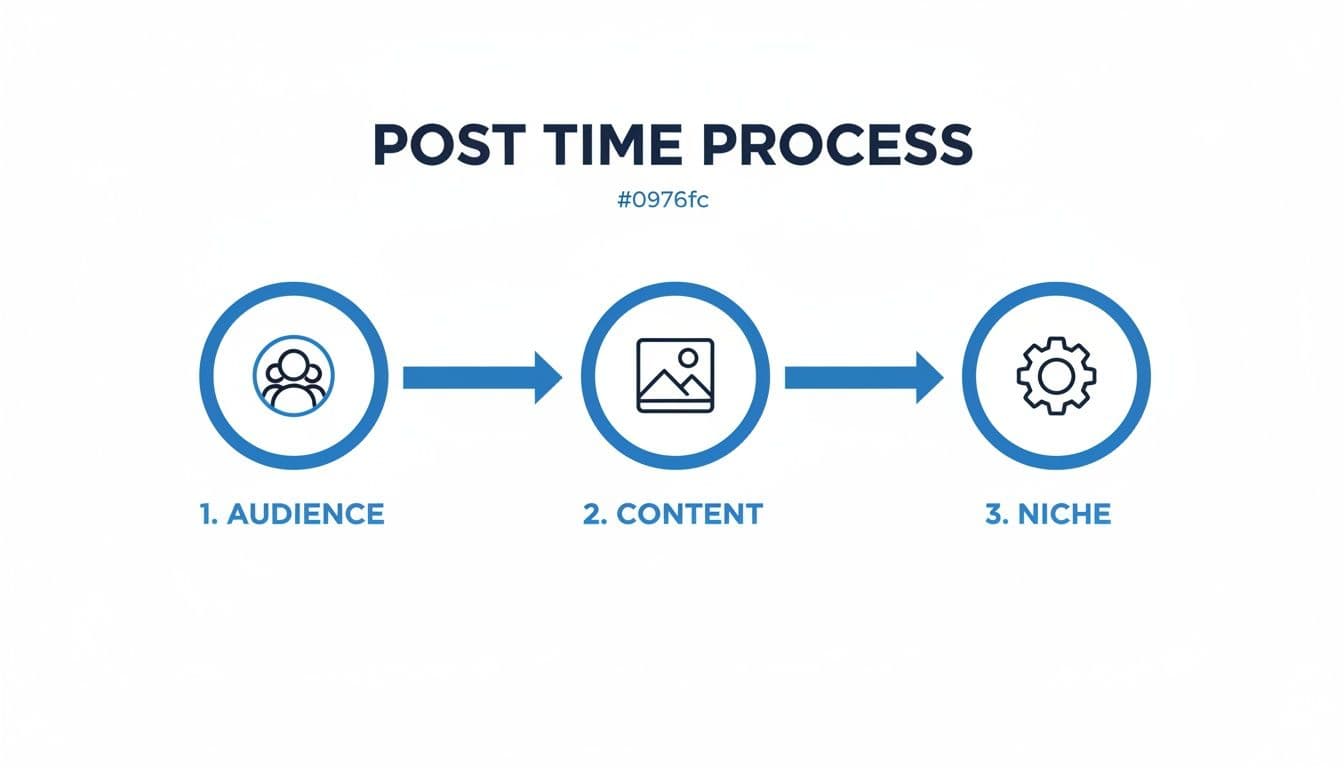
As the graphic shows, it all starts with understanding your audience’s behavior—and Instagram Insights is your direct line to doing just that.
Translating Data into an Actionable Schedule
Alright, you've found the peak times. Now what? It's time to turn those numbers into a real-world posting schedule.
Start by identifying the top 2-3 days with the most activity. Then, for each of those days, find the 2-3 hour blocks where the activity bars are highest. These are your new prime-time slots.
For example, let's say your Insights show a huge spike on Wednesdays and Fridays between 6 PM and 9 PM. Boom. That's your new, data-backed schedule. Start posting your most important content right in those windows to give it the best possible launch.
Here’s a pro tip: don't just post at the peak hour. Try posting 30 minutes to an hour before the peak. This gives the algorithm a little time to start pushing your content out, so it's already gaining momentum right as the user wave hits.
Of course, finding the right time is just step one. To truly know if it's working, you have to track the results. For a deeper look at the metrics that really matter, check out our guide on how to measure social media engagement. That’s how you’ll refine your timing and perfect your entire Instagram strategy.
Automate Your Schedule for Consistent Results
Knowing your best posting times is one thing. Actually hitting those windows consistently is a completely different ballgame. For busy creators and brands, this is where the real challenge begins, and it’s precisely where automation tools like PostOnce can change everything.
Think about it: you’ve done the hard work of digging through your analytics to find those golden hours. But then life happens. A meeting runs late, you hit a creative wall, or you simply forget. Manually posting on a strict schedule is a chore, and that inconsistency can hurt you. It sends mixed signals to the algorithm and squanders the valuable data you worked so hard to uncover.
PostOnce: Your Key to Unlocking Consistency
This is the core problem PostOnce was built to solve. It takes the stress and human error out of the equation.
Instead of setting a dozen alarms on your phone or scrambling to get a post out in real-time, you can batch-create your content when you're feeling inspired. Spend a few hours on Monday planning and creating everything for the week, then load it all into PostOnce. You can set the unique optimal times for Instagram, Threads, Facebook, and LinkedIn, and just let it run. Your content goes out exactly when it needs to, every single time.
By automating your schedule, you turn your posting strategy from a daily frantic task into a streamlined, set-and-forget system. This frees you up to focus on what actually grows your brand: creating amazing content and talking to your community.
This methodical approach makes sure you're always showing up when your audience is most active, which helps maximize your content's initial reach and reinforces your reliability in the eyes of the algorithm.
Building an Efficient Automated Workflow
Integrating automation into your strategy isn't complicated, but it is incredibly effective. It’s the secret to maintaining a steady, professional presence without burning out—which is essential for long-term growth on any platform.
Here’s how an automated workflow with a tool like PostOnce supercharges your efforts:
- Massive Time Savings: Scheduling posts in bulk frees up hours every single week. That’s time you get back from the repetitive grind of manual posting.
- Flawless Consistency: Automation ensures your content is published at the exact best times you’ve identified, without fail. This is a huge signal to the Instagram algorithm.
- Reduced Creative Stress: When you know your distribution is handled, you can plan your content calendar more thoughtfully and without that last-minute panic.
Once you have your peak hours nailed down, the next step is learning how to create effective automated social media posts that still feel genuine and drive engagement.
Ultimately, automation is the bridge between knowing your best posting times and actually capitalizing on that knowledge. To dive deeper into this, check out our complete guide on how to automate social media posts for a more detailed look at building an efficient system.
Testing and Refining Your Posting Strategy
Okay, so you've dug into your analytics and found some promising time slots. That's a huge win, but don't set it and forget it just yet. The truth is, your audience's habits are always shifting. Think about it—seasons change, new trends pop up, and the Instagram algorithm is constantly evolving.
Your posting schedule needs to be a living, breathing thing, not a rulebook you wrote once and stuck in a drawer. The real magic happens when you commit to testing and refining your approach over time. This is how you stay ahead of the curve and keep your engagement consistently high.
A Simple Framework for Testing New Times
So, how do you do this without getting lost in a sea of spreadsheets? It's easier than you think.
Start by peeking at your Instagram Insights again. Look for one or two new time slots to test each week. Maybe you see a secondary peak in activity you've been ignoring, or perhaps you want to try posting an hour before your usual prime time to warm up the algorithm. The key is to gather clean data you can actually compare.
Here’s a straightforward way to approach it:
- Pick a Test Window: Choose one new day and time to experiment with. Stick with it for at least a couple of weeks to get a reliable average.
- Keep Your Content Consistent: To get a true read, post similar types of content during this new time. Don't compare the performance of a killer Reel with a standard photo post—that'll just muddy your results.
- Track Your Core Metrics: Keep a simple log of the reach, likes, comments, and shares for each test post. A basic spreadsheet is all you need.
After a few weeks, sit down and compare the numbers. How did the new time slot stack up against your tried-and-true peak hours? If it performed just as well—or even better—it’s time to work it into your regular schedule.
How PostOnce Solves the Testing Challenge
I get it. Manually tracking different times, scheduling posts, and analyzing the results can feel like a full-time job. It’s exactly this kind of grind that leads people to give up on testing altogether. This is where a tool like PostOnce really shines, turning a data-driven strategy from a chore into a seamless workflow.
With PostOnce, you can schedule your test posts for those specific experimental windows weeks in advance. Once you confirm a new time is a winner, you just add it to your automated schedule. The platform takes over from there, making sure you’re consistently hitting those high-engagement windows without you having to think about it. It makes a sophisticated testing strategy surprisingly simple to manage.
The most successful accounts don't just find their best times once; they continuously refine their understanding of audience behavior. Testing isn't a sign of uncertainty—it's a commitment to optimization.
It's also helpful to see how your own data stacks up against the bigger picture. Broad industry studies often highlight interesting trends. For instance, one major analysis found that Saturday at 11 a.m. Eastern Standard Time is a massive engagement window for many accounts, while posting before 8 a.m. is usually a dead zone. You can read the full research about these Instagram posting times to see how your results compare to global patterns.
Your Instagram Posting Time Questions, Answered
Figuring out your perfect posting schedule can feel like a puzzle, but with the right approach and a little help from the right tools, it’s actually pretty straightforward. Of course, the easiest way to make sure you always hit those peak engagement windows is to use a tool like PostOnce. You can schedule everything in advance, and it'll automatically cross-post to all your social platforms right when your audience is ready.
Let's clear up some of the most common questions people have about when to post on Instagram.
What Is the Absolute Best Time to Post on Instagram?
If only there was one magic answer! While every account is different, industry-wide data gives us a fantastic starting point. After analyzing millions of posts, a clear pattern emerges: weekday afternoons, especially from 3 PM to 6 PM local time, are often a goldmine for engagement. This is typically when people are winding down their workday and starting their evening scroll.
Weekends, however, play by their own rules. Saturdays tend to see activity spikes around 11 AM and again at 5 PM, while the sweet spot on Sundays is usually between 12 PM and 3 PM. Think of these times as your first test subjects.
Does Posting Time Still Matter with the Algorithm?
Absolutely, and more than you might think. It’s true that the Instagram feed isn't strictly chronological anymore, but timing is still a huge piece of the puzzle. The algorithm loves to see a quick burst of activity—likes, comments, shares, saves—right after you post.
When you post during your audience's peak active hours, you're setting your content up for that initial wave of engagement. This early traction acts as a signal to the algorithm that you've shared something valuable, which dramatically increases the odds of it being pushed out to a much wider audience.
How Often Should I Post on Instagram?
Here, consistency is king. While there’s no magic number, aiming to post to your feed 3-5 times per week is a solid goal for most accounts. It’s frequent enough to keep you on your followers' radar without flooding their feeds.
Instagram Stories are a different beast. Since they're more casual and vanish after 24 hours, posting daily is a fantastic way to stay top-of-mind and build a stronger connection with your community.
The real secret is finding a rhythm you can stick with. It’s far better to share three amazing posts every single week than it is to post seven times one week and then go silent for the next two.
What if My Audience Is in Different Time Zones?
This is a classic problem for any account with a national or global reach. The trick is to look for the overlap. Dive into your Instagram Insights and see where the biggest chunks of your audience live. Your goal is to find a time that catches the largest groups.
For example, if you have a big following on both coasts of the U.S., posting at 9 AM EST is a smart move. You'll catch the East Coast crowd during their morning coffee scroll and the West Coast folks just as they're waking up and checking their phones.
Nailing down your best times to post is just step one. The next step is making sure you actually post during those windows without being glued to your phone. That’s where PostOnce comes in. Schedule your content once, and it will automatically go live on all your platforms at the perfect time.
Ready to see how much easier social media can be? Discover a smarter way to manage your social media at PostOnce.