

















PostOnce solves the hardest part of Friday Instagram timing before you even open the app. Instead of scrambling to publish at the exact right minute, you can schedule once, cross-post everywhere, and stop babysitting your content calendar across Instagram, Threads, LinkedIn, and the rest of your stack.
That matters on Fridays more than most days. Audience behavior shifts fast, your own schedule gets messy, and generic “post at noon” advice falls apart if your followers sit in different time zones. The best time to post on instagram on friday is not one magic slot. It is a system: start with proven timing windows, validate them with your own audience data, then automate execution so you hit the window consistently.
Stop Guessing Your Friday Posts and Start Automating
Friday posting breaks down in the same place. The content is ready. The caption is done. The visual is approved. Then someone asks, “Should this go out now or later?” and the whole process stalls.
That hesitation costs more than time. It creates inconsistent publishing, weakens your testing, and turns posting into a weekly debate instead of an operating rhythm. For solo creators, small businesses, and agencies, the better move is to remove the decision from Friday entirely.
Why Friday is harder than it looks
Friday audiences do not behave like Tuesday audiences. Some people are still in work mode early in the day. Others start checking out by lunch. If you serve multiple audience types, one post time can work for one segment and miss another.
A few common mistakes appear repeatedly:
- Posting when you are free: Convenience is not strategy. Teams frequently publish after meetings, not when followers are active.
- Using one universal time: A time that works for New York can land awkwardly in London and miss Asia completely.
- Treating every format the same: A Reel, a product post, and a professional update do not all fit the same Friday slot.
- Making timing decisions by gut feel: If you cannot repeat the process next week, you do not have a strategy.
Build the process once
The strongest Friday workflows are boring in the best way. You decide your testing windows, prepare the asset, schedule it in advance, and let the system run. If you need a clean walkthrough of that process, this guide on automating Instagram posts is a good next step.
Practical takeaway: If your Friday publishing depends on being online at the right moment, you do not have a reliable system yet.
The goal is not to find a perfect posting minute and obsess over it. The goal is to make sure your content goes live at the right time, every Friday, without stealing attention from everything else you need to finish before the weekend.
The Best Times to Post on Instagram on Friday According to Data
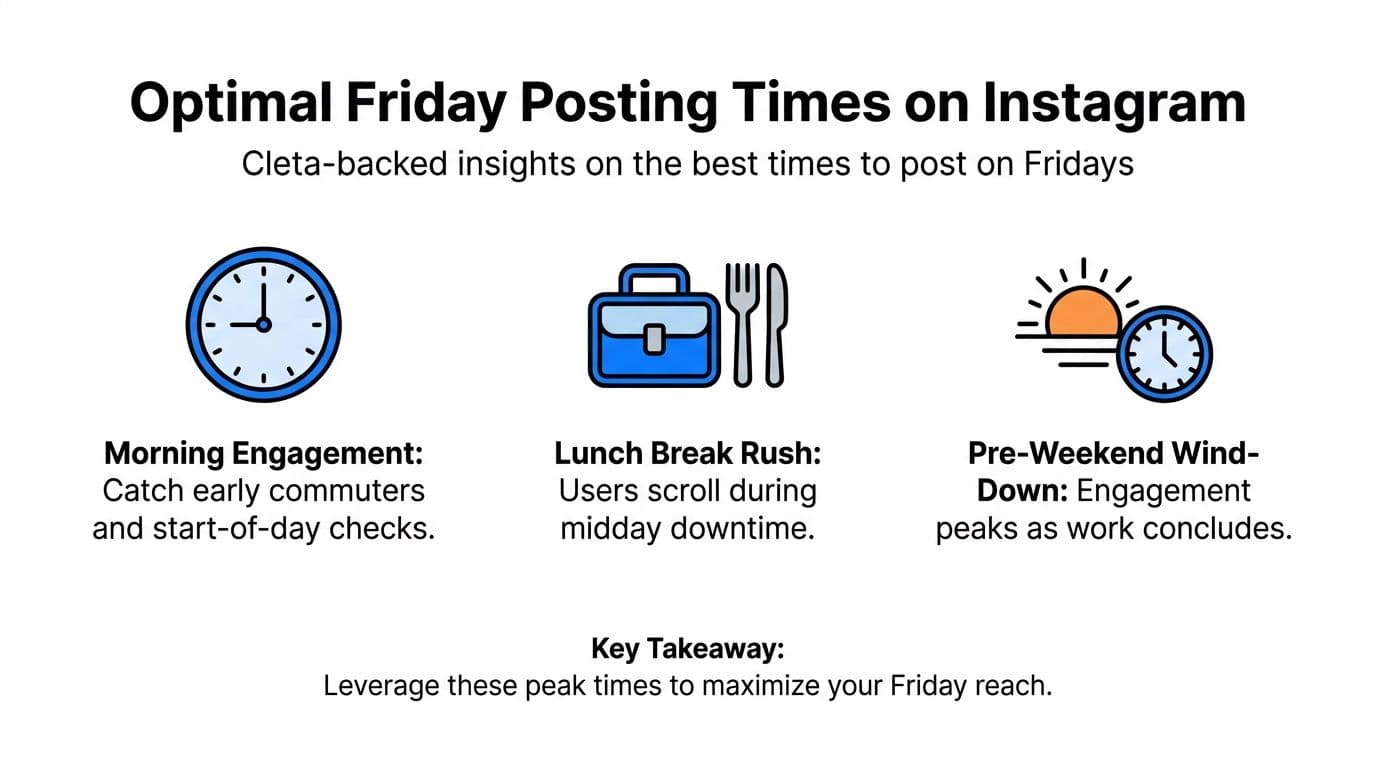
Friday commonly provides two practical posting windows. The first is early enough to catch people before their day breaks apart. The second picks up the lunch scroll, when attention shifts from work tasks to lighter browsing.
Friday morning works best for focused audiences
The clearest pattern is Friday morning from 8 to 11 AM, with a reported 23 to 35% engagement surge compared to average times, particularly for B2B and professional audiences, according to Evergreen Feed’s Friday Instagram timing analysis.
That window holds up in account management. Morning users are still in decision mode. They will read a carousel, skim a thoughtful caption, or click through to something useful if the post solves a problem quickly.
This is commonly the best Friday slot for content that asks for a little effort:
- Professional updates: Blog announcements, thought leadership, product education
- Carousel explainers: Posts that need a few swipes and a bit of concentration
- Traffic-oriented posts: Content that asks users to read, save, or click through
For teams that need one default test time, 9 to 11 AM is a sensible place to start. It avoids the earliest low-intent scroll and still reaches people before Friday attention starts to drift.
Lunch favors lighter, faster content
The second useful window is 11 AM to 1 PM. This period tends to reward content that is easy to consume and easy to share.
In practice, I use this slot for posts that do not need much context. Reels, visual promos, creator-style content, and saveable lifestyle posts frequently fit better here than dense educational assets. The user is still active, but patience is lower.
| Time window | Best fit | Typical use case |
|---|---|---|
| 8 to 11 AM | Focused, informative content | B2B posts, launches, education |
| 11 AM to 1 PM | Visual, saveable, shareable content | Reels, lifestyle content, promos |
If you want a broader weekday benchmark before you set Friday tests, this guide to the best time to post on Instagram across the week is a useful comparison point.
Why published averages only get you halfway
Different datasets highlight different peaks, which frequently reflects the specific audiences they analyzed. A North America heavy B2B account can see strong Friday morning results. A brand with a younger global audience may get better traction closer to lunch, or in a second wave tied to another region’s workday.
That trade-off matters if your followers are spread across time zones. One Friday post scheduled for 10 AM Eastern can perform well in the US, arrive late in Western Europe, and miss Asia entirely. That is why a single published “best time” becomes less useful as your audience becomes more international.
Use these windows as starting points, not fixed rules.
A practical setup is simple. Test 9 to 11 AM for informative posts and 11 AM to 1 PM for lighter visual content. If you serve multiple regions, schedule by audience segment and automate the release times instead of forcing one Friday slot to do every job.
Understanding the Psychology of the Pre-Weekend Mindset
Good Friday timing is audience psychology wearing a scheduling label. Users are not only “online.” They are in different mental states across the day, and those states change what they notice, what they ignore, and what they act on.

Morning is for closure and usefulness
Early Friday feels like the last clean work block of the week. People are tying off loose ends, catching up, and trying to finish important tasks before their attention drops.
That is why practical content tends to land better in the morning. Useful posts feel relevant. Complex posts feel manageable. Professional audiences still have enough cognitive bandwidth to read a carousel, scan a how-to caption, or click out to a resource.
If your content says “learn this,” “read this,” or “save this for later,” morning behavior supports it.
Midday shifts from work to personal interest
Lunch is different. People are still holding a phone, but their motivation changes. The scroll becomes less about staying informed and more about taking a break, planning something enjoyable, or finding a distraction that feels rewarding.
That shift matters for creative direction:
- Lifestyle content feels more natural.
- Reels and lighter videos ask for less effort.
- Weekend-adjacent messaging feels timely.
- Product discovery can work well when the post aligns with mood, not solely promotion.
A post can fail at 9 AM and work at 12 PM without the content being bad. The audience wanted something different.
Practical rule: Match the post to the mood. Do not force educational content into a casual scroll, and do not waste a strong visual Reel in a slot built for attention-heavy reading.
Message and timing should move together
A lot of weak Friday performance comes from mismatched intent. Teams choose a posting time but never adjust the angle of the content.
Try these pairings:
- Morning: direct advice, launch announcements, professional relevance
- Midday: aspiration, entertainment, shopping intent, weekend planning
- Later in the day: lighter touch, community prompts, lower-friction engagement
If you need a stronger engagement framework before testing Friday timing, this article on how to get more engagement on Instagram is a useful companion.
How to Find Your Personalized Best Time to Post on Friday
A Friday post can look like a winner in your dashboard and still miss a large share of your audience. That happens all the time with global accounts. A noon post that works in New York reaches London late and hits Singapore the next day.

Industry benchmarks help narrow the field. Your account history should decide the final schedule.
Start with Instagram Insights
Open your professional account insights and review follower activity by hour for Friday. The goal is to find repeated audience concentration, not to chase one post that happened to spike.
Focus on three inputs:
- Your busiest Friday hours
- Your top follower locations
- The formats that perform best in each time window
That third point matters more on Friday than many teams expect. As noted earlier, midday behavior frequently shifts toward lighter, faster-consumption content, particularly Reels. If your account already gets stronger reach or shares from short-form video around lunch, build your test around that behavior instead of treating every format as interchangeable.
Run a controlled timing test
Keep the creative variable as steady as possible. Change the publish time, not the whole post strategy.
A practical four-week test looks like this:
- Week 1: Publish a Friday post in your first target window
- Week 2: Publish a similar post in your second target window
- Week 3: Repeat the first window with the same format and intent
- Week 4: Repeat the second window with the same format and intent
For example, if you are testing educational carousels, keep testing educational carousels. If week one is a polished Reel and week two is a static product graphic, you are comparing format differences more than timing.
Measure the outcome that matches Friday's job
Friday does not always need the same KPI as Tuesday. Some brands want discovery before the weekend. Others want traffic, bookings, or product saves.
Track metrics that match the goal:
- Reach for awareness
- Saves and shares for content value
- Profile actions for interest in the brand
- Clicks or conversions for traffic and revenue
- Comment quality for audience fit
Pick one primary success metric before the test starts. That saves time and keeps the result clear.
Segment by location before you call a time "best"
It is common for creators and brand teams to misread their own data if they do not segment by follower location. A strong Friday result may reflect U.S. activity while Europe was already tapering off, or it may come from one region carrying the post while another barely saw it.
If your audience spans multiple markets, review performance by local time instead of account time alone. That commonly leads to one of two decisions. Either you choose the Friday slot that serves your highest-value region, or you automate separate publish times for different markets. For a broader framework, this guide on what time you should post on Instagram is a useful reference.
The best Friday schedule is commonly a short list, not a single universal hour. For global brands, the optimal outcome comes from identifying the right local windows, then using automation to hit them consistently without manual work every week.
The PostOnce Solution Stop Guessing and Start Automating
Knowing the right Friday window is useful. Hitting it consistently across accounts and markets, many teams fail. Manual posting breaks the moment your day gets busy, your client needs revisions, or your audience spans more than one region.
Execution is the problem
The search intent behind “best time to post on instagram on friday” sounds simple, but the operational problem is not. You are not just picking a time. You are deciding:
- Which audience segment matters most
- Which local time to publish for each market
- Whether Instagram timing should match your other channels
- How to keep the process repeatable every week
Most guides stop at “post at 3 PM ET” or another single time recommendation. That falls apart quickly for global brands and creators.
According to Buffer’s best-time guidance, many guides ignore time zone conversion even though a 3 p.m. ET post becomes 8 p.m. GMT or 3 a.m. SGT the next day, potentially missing key audiences. That same guidance notes that using automation to schedule for different zones can boost engagement by 20 to 30% when posts align with local peaks.
Why automation fits this exact search intent
If someone searches for the best time to post on Friday, they commonly want one of two outcomes:
- Better performance without trial-and-error every week
- A way to publish at the right time without being online
That is where automation matters. The winning move is not memorizing a chart. It is creating a schedule that publishes at the right local time and distributes the same campaign across the channels where your audience also pays attention.
A practical workflow looks like this:
| Problem | Manual approach | Better approach |
|---|---|---|
| One Friday post, multiple platforms | Copy and paste after posting | Cross-post automatically from one source |
| Audience in different regions | Guess one compromise time | Schedule for local market timing |
| Repeating weekly campaigns | Rebuild the schedule each time | Reuse publishing rules |
| Last-minute Friday chaos | Post when available | Publish on schedule regardless of your calendar |
When this matters most
Automation becomes especially useful if you are in one of these situations:
- You manage client accounts: Friday timing cannot depend on your personal availability.
- You run a small business: You need your post live while you handle sales, service, or operations.
- You publish globally: One time zone cannot represent your whole audience.
- You cross-post strategically: Instagram should not be managed in isolation from Threads, LinkedIn, Reddit, or Facebook.
If Instagram is one piece of a broader content distribution plan, PostOnce’s Instagram cross-posting workflow is the practical answer. It lets you treat Friday timing as part of a system, not a last-minute task.
Bottom line: The best time only helps if you can hit it. Automation turns timing advice into repeatable execution.
Your Friday Instagram Strategy Simplified
The strongest Friday strategy is simple.
Start with the two most useful windows. Morning works best when your content needs attention and context. Lunch works best when your content benefits from lighter scrolling behavior and stronger save or share intent. Then verify which one matches your audience, not someone else’s benchmark.
After that, remove friction. Schedule ahead. Keep your tests clean. Review results by format, audience location, and business goal. If your audience is global, stop pretending one Friday timestamp is enough.
The best time to post on instagram on friday is not a trivia answer. It is a repeatable workflow. Use published timing data to narrow the field, use Instagram Insights to confirm what your followers do, and rely on automation so execution stays consistent every week.
Frequently Asked Questions
Is Friday night a good time to post on Instagram
It can be, but it is less dependable than morning or lunch for most accounts. Friday night tends to be more audience-specific. Entertainment, lifestyle, and younger audiences may still respond well. Professional and business audiences commonly become less reliable as the weekend starts.
Should I post Reels or static posts on Friday
Use the format that matches the time slot and your audience behavior. Reels frequently fit lunch better because people are in a lighter, more passive scroll. Static posts and carousels can work well in the morning when users are more willing to slow down and read.
Does the best Friday posting time change by industry
Yes. B2B, local services, ecommerce, creators, and media accounts do not share the same audience rhythm. A consultant targeting professionals may do better in the morning. A food, fashion, or entertainment brand may see stronger results closer to lunch or later.
Should I post at the same time every Friday
Use consistency during testing, then stay consistent with the winning slot long enough to gather stable results. Constantly changing your Friday timing makes pattern recognition harder.
What if my audience is split across countries
Use localized scheduling instead of forcing one compromise time. A global audience changes the answer to “best time” because local peak hours do not line up. In that case, market-based scheduling usually beats one universal Friday post.
How long should I test a Friday posting window
Test long enough to compare multiple Fridays using similar content formats. One strong post or one weak post is not enough to choose a permanent schedule. Look for repeatability, not one-off wins.
If you want to stop guessing and start publishing at the right time every Friday, use PostOnce. It helps you schedule once, cross-post across your channels, and keep your Instagram timing consistent without manual work.