


















Think of content marketing automation as your always-on expert assistant. It’s the behind-the-scenes powerhouse that plans, schedules, and distributes your content, then diligently analyzes its performance around the clock. By using specialized tools to take care of repetitive tasks, it frees you up to focus on what you do best: high-impact creative work and big-picture strategy.
What Is Content Marketing Automation Anyway?

Let's imagine a master chef's kitchen for a moment. The chef’s real genius isn't in endlessly chopping vegetables; it’s in inventing incredible recipes and perfecting flavors. Content marketing automation is like having all the state-of-the-art appliances in that kitchen. It doesn't replace your strategic vision (the chef), but it flawlessly handles the mundane, time-sucking tasks like dicing, mixing, and timing everything to perfection.
This changes your role entirely. You get to graduate from being an overworked content producer to a strategic content architect. Instead of manually posting to five different social media platforms or painstakingly segmenting email lists by hand, you simply set the rules once. From there, the technology executes your plan with precision, day in and day out.
The goal isn't to create robotic, soulless content. It's to build a reliable system that gives you back your most valuable resource: time.
And this isn't some niche trend; it's rapidly becoming the standard. A staggering 80% of marketers worldwide are now integrating AI tools into their digital strategies. This marks a massive shift away from older, manual methods. The efficiency gains are undeniable, with studies showing that 86% of marketers save over one hour daily on creative tasks alone.
Shifting From Manual Labor To Strategic Impact
The real difference between traditional and automated content marketing comes down to where you focus your energy. Without automation, your day is often a blur of manual tasks that slowly drain your creative reserves. With it, you get to concentrate on what truly moves the needle—strategy, creativity, and building a genuine connection with your audience.
To see this in action, let's compare the two approaches side-by-side.
Manual Effort vs Automated Workflow
| Task | Manual Approach (The Hard Way) | Automated Approach (The Smart Way) |
|---|---|---|
| Social Media Posting | Logging into each platform, formatting, and posting one by one. | Schedule once, and the tool posts to all channels at the optimal time. |
| Email Nurturing | Manually sending follow-up emails to new subscribers. | A pre-built sequence automatically sends relevant content based on user actions. |
| Content Repurposing | Manually editing a blog post into a video script, then social snippets. | AI tools suggest or create social snippets and video scripts from a blog post. |
| Performance Reporting | Pulling data from multiple analytics dashboards and compiling reports. | A unified dashboard provides a real-time, consolidated view of performance. |
As you can see, automation isn't about cutting corners; it's about working smarter, not harder.
The real power of content marketing automation is not just doing things faster; it's about gaining the capacity to do things smarter. It unlocks the ability to personalize experiences, test ideas rapidly, and prove your content's value with hard data.
For example, you can automatically share a new blog post across LinkedIn, X (formerly Twitter), and Facebook, with each post perfectly formatted for that network's audience. You can also set up sophisticated email sequences that nurture new subscribers with relevant articles based on their behavior, turning a cold lead into a warm one without you lifting a finger.
This proactive, systematic approach can completely reshape your entire workflow. For a deeper dive into the broader landscape, exploring various content creation automation strategies can help you reimagine your operations from the ground up. It’s all about building an engine that works for you, so you can focus on driving the business forward.
The Real-World Benefits for Your Business
Let's move past the theory and talk about what really matters: the tangible, bottom-line impact of smart content marketing automation. This isn't just about saving a few minutes here and there. It's about fundamentally changing how your business operates for the better. The advantages really boil down to three key areas: gaining serious efficiency, delivering personalization at scale, and making decisions with data, not guesswork.
When these three pillars work together, the results can be massive. For starters, marketing automation has been shown to deliver an incredible return on investment (ROI) of up to 544%, with many businesses getting that money back in less than a year. This kind of return comes from freeing your team from mind-numbing tasks and using data to create better customer experiences—which directly translates into more leads and sales.
Achieve Radical Efficiency and Reclaim Your Time
Just think about all the time your team spends on manual, repetitive work. Scheduling social media posts, sending out welcome emails, sorting contact lists—each of these tasks, while important, eats away at the clock, leaving less time for big-picture strategy and creative thinking. This is where content marketing automation acts as a force multiplier for your team.
It takes over the tedious but necessary jobs, freeing up your people to focus on the high-impact activities that truly require a human touch.
The true measure of efficiency isn’t just doing more work; it’s about freeing up your best people to do their best work. Automation creates the space for creativity and strategy to flourish.
A perfect example of this in action is automated social media posting. It’s a game-changer for maintaining a consistent online presence without the daily grind. With a tool like PostOnce, you can write your content once and have it sent everywhere, perfectly formatted for each platform. That simple shift can give you back countless hours every single month.
Deliver Personalization at Scale
Not too long ago, true one-to-one personalization was a luxury only massive corporations could afford. Manually tracking every user's behavior to craft a unique journey was practically impossible for most businesses. Automation completely flips that script.
By gathering and making sense of user data—like which articles they read, emails they open, or links they click—automation tools can build rich, detailed profiles for you. This means you can finally send the right message, to the right person, at exactly the right moment, all on autopilot.
Here’s what that looks like in the real world:
- Behavioral Triggers: A user downloads your ebook on SEO. The system instantly enrolls them in an email sequence that drips out more advanced SEO tips over the next few weeks.
- Dynamic Content: A visitor from the healthcare industry lands on your website and sees case studies relevant to them, while someone from the finance world sees entirely different examples.
- Lead Nurturing: A potential customer checks out your pricing page but leaves. A little while later, they get a friendly follow-up email with a special offer or an invitation to a live demo.
This kind of tailored communication was once a logistical nightmare, but now it’s well within reach for businesses of all sizes. It builds deeper connections with your audience and dramatically boosts your chances of making a sale.
Make Confident, Data-Driven Decisions
Guesswork is the enemy of great content marketing. When you don't have clear data, you're essentially flying blind. You don't know which campaigns are hitting the mark, what content is actually resonating, or where to invest your budget. Automation cuts through the fog by bringing all your analytics together in one place.
Instead of trying to stitch together reports from Google Analytics, your email provider, and a half-dozen social media platforms, you get a single source of truth. This unified view lets you trace a customer's entire journey, from their very first blog post visit all the way to their final purchase. With that kind of insight, you can finally prove your content's ROI and fine-tune your strategy with complete confidence.
Where to Focus Your Automation Efforts First

Jumping into content marketing automation can feel a bit overwhelming. With so many possibilities, the biggest question is usually, "Where do I even start?" The secret isn't to automate everything at once, but to begin with the tasks that give you the biggest wins for the least amount of effort.
Think about the low-hanging fruit—those repetitive, mind-numbing jobs that eat up your time and drain your creative spark. By tackling these first, you'll see real benefits almost immediately. This builds momentum and gives you the confidence to move on to more complex automation down the road.
Let's break down the four key areas where you can make the most impact right away.
1. Content Ideation and Creation
Let's be clear: creativity is still very much a human superpower. But automation can be an incredible partner in the creative process. Think of it as a super-smart research assistant. AI-powered tools can instantly analyze what's already performing well in your niche, flagging trending topics, suggesting keywords, and even drafting outlines for your next blog post or video script.
This doesn't replace your expertise; it supercharges it. You get to spend less time digging for ideas and more time doing what you do best—crafting compelling stories that connect with your audience.
2. Seamless Multi-Channel Distribution
This is, without a doubt, the easiest and most impactful place to start. If you’ve ever spent an afternoon manually posting the same piece of content across five different social media accounts, you know how soul-crushing it can be. It’s tedious, and it’s easy to make mistakes.
Automation completely erases this chore. With a platform like PostOnce, you create the content just one time. Then, you tell the system how and when to share it across all your channels. It handles the rest, automatically adjusting everything from character counts for X to image sizes for Instagram.
Suddenly, you have a consistent presence everywhere your audience hangs out, and you didn't have to copy and paste a single thing. It’s the very definition of working smarter, not harder. To get more out of every piece you create, explore our guide on how content repurposing can amplify your message.
3. Intelligent Lead Nurturing
Getting a new lead is just the start of the conversation. Automated email workflows are your secret weapon for guiding people from initial curiosity to becoming a loyal customer. Instead of trying to remember to send follow-up emails, you can build smart sequences that deliver the right message at the right time, all based on what a person does.
Here are a few classic examples:
- The Welcome Series: Someone subscribes to your newsletter and instantly gets a series of emails introducing your brand, sharing your greatest hits, and showing them what you're all about.
- Behavioral Triggers: A prospect checks out your pricing page but doesn't sign up. A few hours later, an automated email can land in their inbox, answering common questions or offering a quick demo.
- Educational Drips: A user downloads your beginner's guide to a topic. Your system can then send them more advanced content over the next few weeks, building their knowledge and your credibility at the same time.
Automated nurturing turns your content library into an active sales tool, working 24/7 to educate prospects and move them closer to a decision.
This systematic approach ensures no one gets forgotten, and every touchpoint feels relevant and helpful.
4. Insightful Performance Analytics
The final piece of the puzzle is knowing what's actually working—and what isn't. Manually pulling reports from Google Analytics, your email provider, and all your social media accounts is another huge time-drain that automation was born to solve.
A good automation platform pulls all that data into a single, clean dashboard. At a glance, you can see which articles are driving traffic, which channels are bringing in the best leads, and what your overall return on investment looks like.
The data shows this is where marketers are focusing. In fact, 76% of marketers use automation more than any other department, and 79% have already automated some part of their customer journey. When looking to expand, the top targets for new automation are email marketing, social media management, and paid ads, with nearly 30% of marketers focusing on each. You can review the latest automation statistics to see how teams are putting these tools to work.
By automating your analytics, you can finally stop guessing and start making smart, data-driven decisions to grow your business.
How to Build Your Content Automation Stack
https://www.youtube.com/embed/4lPYU-dpR4Y
Your content automation strategy is only as powerful as the tools behind it. Building your "automation stack"—the group of software that works together—is a lot like assembling a specialized crew for a project. You don't need one person who can do everything; you need a team of experts, each one handling their specific job perfectly.
The idea isn't to chase the most expensive or feature-packed tools on the market. It's about hand-picking a set of applications that solve your team's specific problems and, most importantly, connect seamlessly to create a fluid, powerful workflow. This way, you build a system that genuinely supports your team, rather than adding another layer of complexity to their day.
The Core Components of an Automation Stack
Most solid automation stacks are built around four key types of tools. You might start with just one or two and then expand as your needs evolve. The real trick is understanding how each piece fits into the puzzle.
-
All-in-One Platforms: Think of these as the command centers for your entire marketing operation. Tools like HubSpot or Marketo bundle a CRM with email marketing, social media scheduling, and deep analytics. They’re incredibly powerful, but they can also be complex and expensive, which often makes them a better fit for larger teams with well-defined processes.
-
Content and SEO Tools: This category is all about creating better, more visible content. Software like SurferSEO or Ahrefs helps you dial in your keyword research and on-page optimization, while AI writers can help you get past the blank page and draft initial ideas. These tools provide the high-quality "fuel" for your automation engine.
-
Social Media Schedulers: These tools are laser-focused on one thing: distribution. A platform like PostOnce is a perfect example, built specifically to take your finished content and push it out across all your social networks automatically. For many, this is the best entry point into content marketing automation because the time-saving benefit is immediate and obvious.
-
Email Marketing Services: Tools like ConvertKit or Mailchimp specialize in building and nurturing your audience through email. They can handle everything from automated welcome sequences for new subscribers to segmenting your list based on user behavior, making sure your message lands in the right inbox at just the right moment.
Your tech stack should be a reflection of your strategy, not the other way around. Start by identifying your biggest bottleneck—is it distribution, lead nurturing, or analytics?—and choose a tool that solves that specific problem first.
How to Choose the Right Tools
Picking the right software can feel overwhelming, but you can cut through the noise by asking a few pointed questions. Your answers will give you a clear framework for making smart, cost-effective decisions.
- What is my budget? Always start with what you can comfortably afford. Many fantastic tools offer free or low-cost starter plans. You can always upgrade later once you've proven the return on investment.
- How big is my team? A solo creator needs something simple and intuitive, like PostOnce. A bigger team, on the other hand, might need an all-in-one platform that includes features for collaboration and assigning different user permissions.
- What are my primary goals? If your top priority is boosting brand awareness, a social media scheduler is a no-brainer. If you're focused on converting more leads, a solid email marketing service is critical. Get specific about what you need to achieve.
For anyone who wants to get their hands dirty and really understand how these systems work under the hood, a detailed course on N8n for AI automations can be a game-changer. Learning the mechanics behind these workflows gives you the power to build a truly custom stack.
Ultimately, the best content marketing automation stack is the one your team will actually use. Start small, focus on solving one problem at a time, and build a system that brings your strategy to life.
Your Step-by-Step Implementation Plan
Alright, let's get down to business. Moving from a great idea to a working system is where the magic of content marketing automation really happens. But let's be clear: this isn't about flipping a switch and hoping for the best. It's a thoughtful process.
Think of it like building a custom piece of furniture. You wouldn't just dump all the parts on the floor and start hammering away. You'd follow the plans, step-by-step, to make sure you end up with something solid and dependable. Taking this measured approach helps you sidestep common pitfalls and rack up some early wins—which is crucial for building confidence and getting your team on board.
Here’s a straightforward, five-step plan to get your first automated workflow up and running.
1. Audit Your Current Workflow
Before you automate a single thing, you need to know exactly what you're doing right now. Where are the real hang-ups in your process? What repetitive tasks are draining your team's creative energy day after day?
Map out every single step of your content lifecycle, from the first spark of an idea to the final performance report. This simple act of documentation will shine a light on the low-hanging fruit—the tasks practically begging to be automated. It might be the 30 minutes you lose every morning manually pushing updates to social media, or the hours spent pulling numbers for a monthly report. Finding these pain points gives you a clear target for your first automation project.
2. Set Clear and Measurable Goals
Once you've spotted the bottlenecks, it’s time to define what a "win" actually looks like. Fuzzy goals like "save more time" or "improve lead generation" just won't cut it. You need specific, measurable objectives that prove your automation efforts are paying off.
Your goals are the "why" behind your automation. They turn a tech investment into a business strategy, giving you a clear benchmark to measure your return on investment.
Here are a few examples of strong, measurable goals:
- Cut down time spent on social media scheduling by 5 hours per week.
- Boost the open rate of our welcome email series by 15% within the next three months.
- Generate 20% more marketing-qualified leads from our blog content in the next quarter.
These concrete targets will not only guide your setup but also make it easy to show real results to your team and stakeholders.
3. Start With a Small Pilot Project
I know it's tempting, but resist the urge to automate everything all at once. The smartest approach is to start small with a single, manageable pilot project. This gives you a safe space to learn your new tools, iron out any wrinkles, and score a quick victory without throwing your entire marketing operation into chaos.
A classic first project is a welcome email series for new subscribers. It’s a self-contained workflow with a clear purpose (nurturing new leads), and its performance is simple to track. Another fantastic starting point is automating your social media posts. Setting up a system to automatically share new blog content can free up your time almost immediately. Our guide on automated social media posting is a great resource for getting this done right.
The image below gives a high-level view of how content flows through an automated system, from creation all the way to analysis.
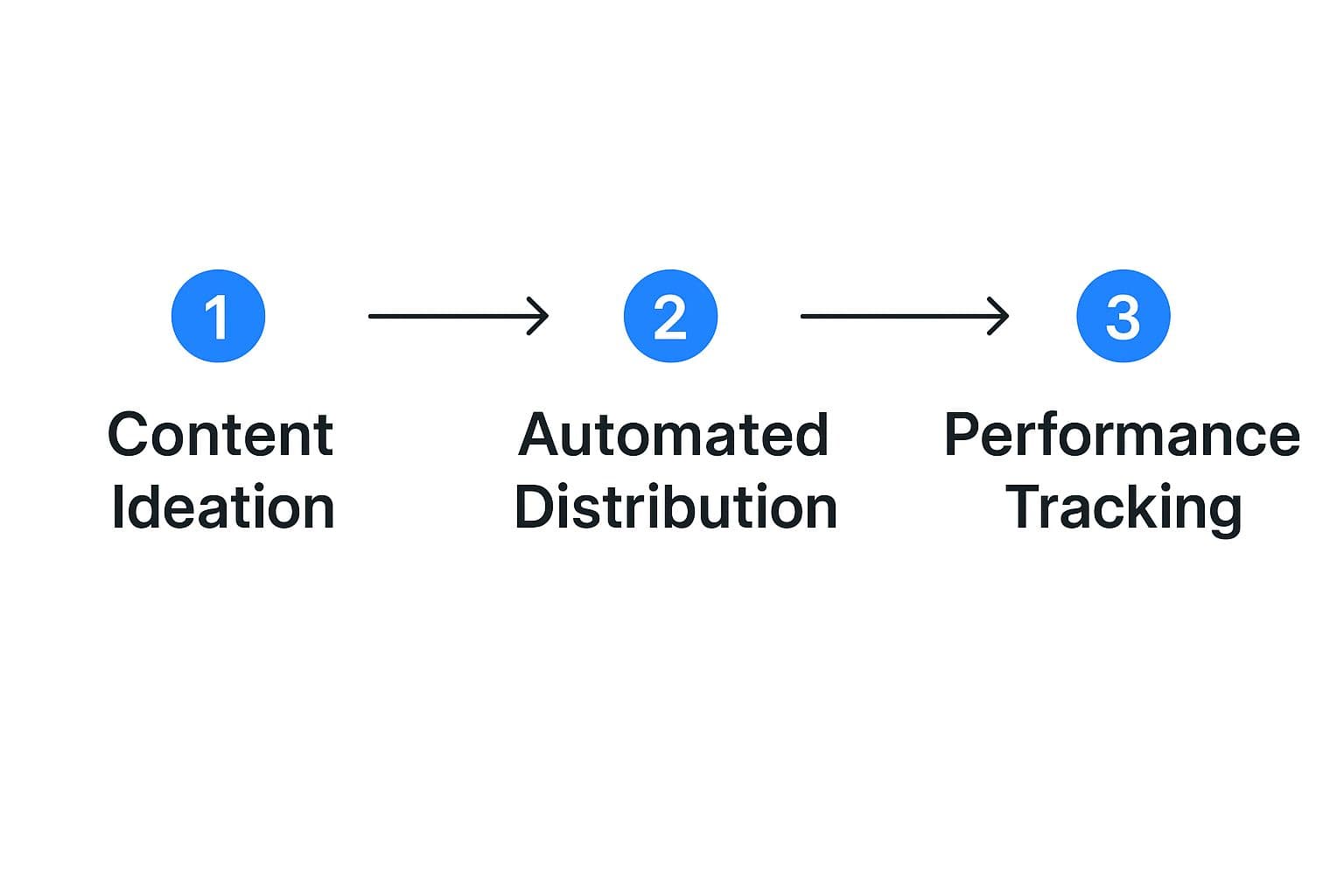
This visual helps reinforce a key idea: successful automation is an interconnected system, not just a bunch of one-off tasks.
To help you stay organized, here's a simple checklist you can use for your first project.
Your First Automation Project Checklist
| Phase | Action Item | Status (To-Do / In-Progress / Complete) |
|---|---|---|
| Phase 1: Planning | Audit current content workflow and identify a bottleneck. | |
| Phase 1: Planning | Set a specific, measurable goal for the pilot project. | |
| Phase 2: Setup | Select the right automation tool for the job. | |
| Phase 2: Setup | Map out the entire workflow, including triggers and actions. | |
| Phase 3: Building | Write and create all necessary content (emails, posts, etc.). | |
| Phase 3: Building | Build the automation sequence inside your chosen tool. | |
| Phase 4: Testing | Run internal tests to check for errors, typos, and broken links. | |
| Phase 4: Testing | Have a colleague test the user experience from start to finish. | |
| Phase 5: Launch | Activate the workflow for a small segment of your audience, if possible. | |
| Phase 5: Launch | Deploy the workflow to your full, intended audience. | |
| Phase 6: Analysis | Monitor performance metrics against your initial goal. | |
| Phase 6: Analysis | Identify areas for improvement and plan your first optimization. |
This checklist ensures you don't miss a beat as you bring your first automation to life.
4. Build, Test, and Launch
Now for the fun part: building your first automated workflow. Inside your chosen tool, you'll map out each step logically. If you're creating that welcome email series, this means writing the emails, deciding on the time delays between them, and setting up the trigger that kicks off the whole sequence (like someone filling out a form).
Let me say this clearly: testing is non-negotiable. Seriously. Run through the entire flow yourself. Sign up with a test email to see the welcome series as a user would. Click every link. Read every line of copy. Make sure the timing feels right. Once you're confident it's all working flawlessly, you're ready to go live. Activate the workflow and let it start working for you.
5. Analyze, Refine, and Scale
Just because your workflow is live doesn't mean your job is done. The final—and ongoing—step is to keep an eye on its performance. How is it stacking up against the goals you set back in step two? Are you actually saving the time you wanted to? Are your open rates climbing?
Use the data to make smart adjustments. If an email's click-through rate is low, try A/B testing a different subject line or call-to-action. If you notice that video posts get way more engagement, tweak your social distribution rules to prioritize them.
Once your pilot project is running smoothly and hitting its targets, you can start to scale. Take the lessons you've learned and apply them to another part of your marketing. Little by little, you'll build out a powerful, interconnected automation engine that works for you 24/7.
Common Pitfalls and How to Avoid Them

Automation tools are incredibly powerful, but they aren't a magic button you press for instant success. The real power of content marketing automation is unlocked by the human strategy guiding the software. Too many businesses get excited by the tech, dive in headfirst, and wonder why their efforts are falling flat.
The difference between a successful automation setup and a costly, frustrating one usually boils down to avoiding a few common mistakes. Knowing what these are from the get-go will help you build a system that strengthens customer relationships and drives real growth, instead of just creating new problems.
Mistake 1: The "Set It and Forget It" Mindset
One of the biggest traps you can fall into is the "set it and forget it" mentality. Yes, the point is to automate tasks, but your strategy always needs a human hand on the wheel. Markets change, your audience's tastes evolve, and what worked six months ago might be completely irrelevant today.
Just turning on a workflow and walking away is a surefire way to become obsolete. Your automation needs regular check-ups to make sure it's still hitting the mark and serving your audience.
Automation is your vehicle, but you are still the driver. Without a human guiding the strategy, even the most powerful engine will eventually drift off course.
This means regularly digging into your performance data, A/B testing your messaging, and tweaking your automated sequences based on what you see. The goal is to create a living, breathing system, not a dusty, static one.
Mistake 2: Automating Bad Content
Think of automation as a megaphone. If you give it high-quality, genuinely helpful content, it will broadcast your success to the world. But if you feed it lazy, generic, or poorly written content, it will just as loudly broadcast your failures—damaging your brand's reputation at scale.
Never, ever use automation as an excuse to skimp on quality. Before you plug any blog post, email, or social update into an automated workflow, ask yourself a simple question: "Would I be proud to share this with our audience myself?" If the answer is no, it doesn't belong in your automation queue.
For example, blasting the exact same generic update across all social platforms can do more harm than good. To get this right, it’s worth learning the best practices for social media cross-posting to ensure quality across networks before you automate it.
Mistake 3: Ignoring Your Data
Those analytics dashboards in your automation tools aren't just for decoration; they're your direct feedback loop from your audience. Ignoring this data is like trying to fly a plane with your eyes closed. You have no idea if you're on course, gaining altitude, or heading for a nosedive.
The best marketers practically live in their analytics. They’re constantly checking key metrics to see what’s resonating and what’s bombing.
- Email Performance: Are your open rates and click-through rates where they should be? Why or why not?
- Social Engagement: Which posts are sparking conversation and driving people to your site?
- Lead Quality: Are your automated funnels bringing in qualified leads, or just filling your CRM with noise?
Without this insight, you’re just guessing. Regularly analyzing your data is the only way to evolve your automation from a simple task-doer into a smart system that gets better over time and delivers real results.
A Few Common Questions About Automation
Diving into automation can feel like a big step. It’s totally normal to have a few questions swirling around before you jump in. Let's walk through some of the most common ones we hear from marketers, so you can feel confident about how this all works.
Will Automation Make My Content Sound Like a Robot Wrote It?
Not a chance—as long as you're using it the right way. The whole point of automation isn't to take over your creative spark. It's designed to handle the tedious, manual parts of the job, like scheduling posts, pulling analytics, or sending follow-up emails.
Think of it this way: automation is your behind-the-scenes stagehand. You, the expert, write the amazing script. The automation tool just makes sure the curtains go up on time and the spotlights hit their marks. Your unique voice and creativity should always be front and center.
What's the Price Tag on Content Marketing Automation?
The cost really runs the gamut, and it all depends on what you need it to do.
You can find simple, focused tools for things like social media scheduling that start under $50 per month. On the other hand, you have the big, all-in-one platforms like HubSpot or Marketo, which can range from a few hundred to several thousand dollars a month.
My advice? Don't try to boil the ocean. Start by pinpointing your single biggest headache—the one task that eats up most of your time. Find an affordable tool that solves just that one problem. It’s the fastest way to see a clear return on your investment.
Aren't "Marketing Automation" and "Content Marketing Automation" the Same Thing?
That's a fantastic question, and it's easy to see why people get them mixed up. The terms are often thrown around together, but there’s a key distinction.
Marketing automation is the big picture. It’s a massive umbrella covering the automation of just about any marketing task you can think of—from managing ad campaigns to scoring leads for the sales team.
Content marketing automation is a specialized discipline that lives under that umbrella. It’s laser-focused on the journey of your content. This includes:
- Ideation: Tools that help you brainstorm topics and keywords.
- Distribution: Systems for pushing your content out to all your channels.
- Personalization: Tech that serves the right article or video to the right person at the right time.
- Analysis: Dashboards that pull all your content performance data into one place.
So while they're related, content marketing automation is built specifically for the day-to-day realities of a content creator.
Ready to stop copy-pasting and start automating your content distribution? With PostOnce, you can create content once and share it everywhere automatically. Sign up for PostOnce today and reclaim your time.